News

Glass Tube Precision Slicing with Diamond Wire Loop: 3 mm Section Test Data

Abstract: This report documents a precision straight-slicing trial on glass tube supplied by a European customer. The workpiece was a tube of 12 mm outside diameter and 104 mm length, sliced into sections 3 mm long on an ESO-GM diamond wire loop cutting machine, with cutting oil as the cooling medium and a fully coated diamond wire. Across five sections the measured results came out at total thickness variation (TTV) 0.004-0.028 mm, thickness tolerance ±0.026 mm against a 3.000 mm nominal, surface roughness Ra...


Optical Glass Precision Slicing with Diamond Wire Loop: 30.5 mm Rod Test Data

Abstract: This application report covers a high-precision straight-slicing test on optical glass supplied by a European customer. The workpiece was a rod of 30.5 mm diameter, cut into sections 15 mm long on an ESO-GM gantry diamond wire loop cutting machine, with cutting oil as the cooling medium and a fully coated diamond wire. Measured results across three sections: total thickness variation (TTV) 0.003-0.008 mm, thickness tolerance ±0.141 mm against a 15.000 mm nominal, surface roughness Ra 0.58-1.06 μm, and maximum edge chipping 4.9-6.2 μm....

BG38 Glass Sheet Slicing with Diamond Wire Loop: 5 mm Test Data

Abstract: This application report documents a high-precision straight-slicing test on BG38 glass sheet supplied by a European customer. The workpiece measured 86 mm x 60 mm x 1 mm and was cut into strips of 5 mm x 60 mm x 1 mm on an ESO-GM gantry diamond wire loop cutting machine, using cutting oil as the cooling medium and a fully coated diamond wire. Measured results: total thickness variation (TTV) 0.003-0.020 mm (average 0.014 mm), thickness tolerance ±0.027 mm, surface roughness Ra 0.63-0.76...

How to Measure TTV on Thin Slices: The Nine-Point Method

Abstract: Total thickness variation (TTV) is the single number most often quoted for a precision slicing process, and the easiest one to measure badly. This guide documents the nine-point grid dual-probe method used in Ensoll's slicing tests for PEEK and PMI foam cut with a diamond wire loop: how the sample is prepared, how it is held, where the nine points sit, how TTV is calculated from them, and which errors produce a plausible but wrong number. Key TakeawaysTTV = Tmax - Tmin...

PEEK vs PMI Foam: Diamond Wire Cutting Comparison

Abstract: PEEK and PMI foam sit at opposite ends of the material spectrum that a diamond wire loop has to handle - one is a dense, tough thermoplastic, the other a low-density cellular structural foam. This comparison sets Ensoll's two published slicing tests side by side: a 200 mm x 60 mm x 60 mm PEEK block cut into 6.5 mm slices with cutting fluid, and four 400 mm x 400 mm PMI foam slices cut to 0.8 mm dry. It compares the...

PMI Foam Cutting Parameters: Diamond Wire Loop Setting Reference

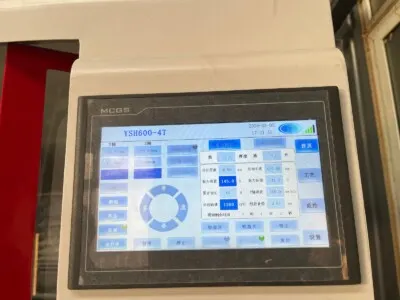
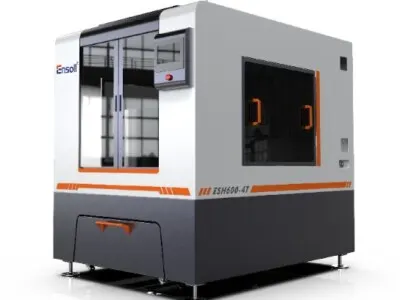
Abstract: This reference sheet lists the process window validated in Ensoll's PMI (polymethacrylimide) structural foam slicing test on an ESH600-4T horizontal diamond wire saw machine: a 0.60 x 3460 mm fully coated diamond wire loop, 100 mm/min wire travel speed, 145 N wire tension, 25 m/s wire speed, 60 s wire-bow tensioning time, 17 N·m cutting load and 400 mm cutting width, with dry cutting. It explains what each parameter does on a cellular foam, which way to move it when a defect...

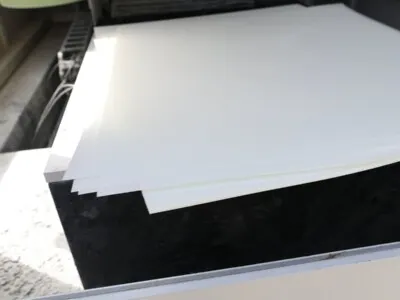
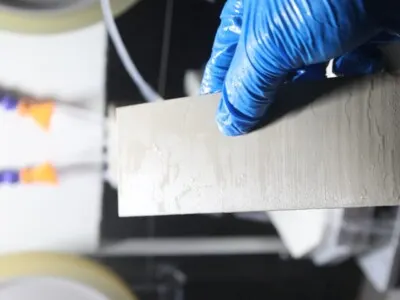
Cutting PMI Foam with Diamond Wire Loop: 0.8 mm Precision Slicing Test

Abstract: This application report documents a precision straight-slicing test on PMI (polymethacrylimide) structural foam supplied by a European customer. Four slices measuring 400 mm x 400 mm x 0.8 mm were produced on an ESH600-4T horizontal diamond wire loop cutting machine using dry cutting and a fully coated diamond wire. Measured results: total thickness variation (TTV) 0.013-0.050 mm (average 0.036 mm), thickness tolerance +/-0.043 mm, surface roughness Ra 0.68-0.82 um, and maximum edge chipping 5.5-7.1 um. Matching machine structure, cutting method and process parameters...

Cutting PEEK with Diamond Wire Loop: Precision Slicing Test

Abstract: This article presents a precision slicing test on PEEK (polyether ether ketone) using a diamond wire loop. The workpiece was a 200 mm × 60 mm × 60 mm PEEK block provided by European customer H, sliced into 6.5 mm-thick pieces on an Ensoll ESO-GM gantry-type diamond wire loop cutting machine. We report the equipment and wire selection, cutting parameters, cooling strategy, and quantitative quality metrics including Total Thickness Variation (TTV), thickness tolerance, surface roughness (Ra), and edge...