
Diamond wire loops and spool wire by diameter, abrasive grit and core specification — the consumable side of wire cutting, and the variable that most often decides whether a process works.

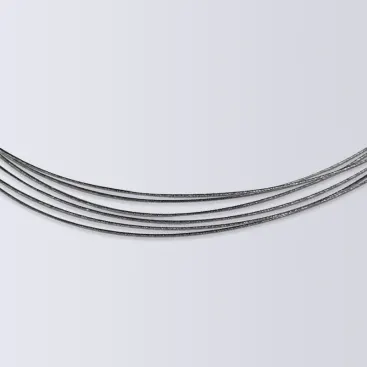
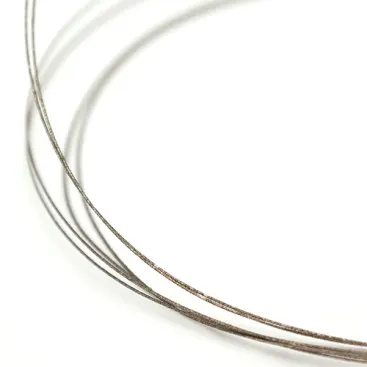
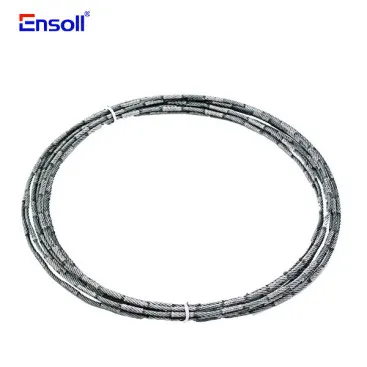
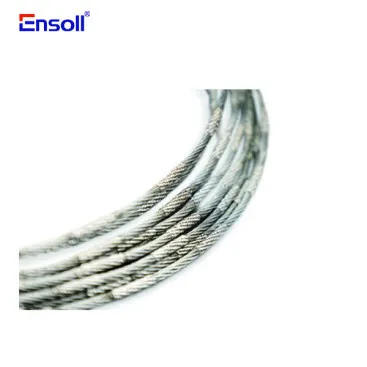
The wire is the process
Machine parameters can be tuned. Wire specification cannot be fixed by tuning. Diameter sets kerf and stiffness, grit size sets surface finish and damage depth, bond type sets wire life, and core material sets how the wire behaves under tension. Four decisions, and they constrain everything downstream.
Durchmesser: the first decision
| Durchmesser | Schnittbreite | Typical use | Kompromiss |
|---|---|---|---|
| 0.10–0.20 mm | 0.13–0.23 mm | Waffeln, precious material | Fragile; low tension; short life |
| 0.25–0.35 mm | 0.28–0.39 mm | Keramik, Glas, Magnete | General-purpose sweet spot |
| 0.40–0.60 mm | 0.44–0.65 mm | Metals, Graphit, profiling | Stiffer cut; more material lost |
| 0.70–1.20 mm | 0.75–1.30 mm | Cable, thick sections, demolition | High load; needs a rigid machine |
Grit size: the second decision
Grit size sets the surface finish and, more importantly, the subsurface damage depth. A rough rule that holds across materials: damage depth scales with grit size in micrometres, roughly one to one. D126 leaves around 100–130 µm of damage; D64 leaves 50–70 µm; D30 leaves 25–35 µm.
Choose the coarsest grit whose damage depth the next process can remove. Going finer than necessary costs cutting speed and wire life for a benefit the next step was going to deliver anyway.
Loop versus spool
A loop is a closed ring, joined by a weld or a mechanical splice, and is reused until the abrasive dulls. A spool is open-end wire, used once. The decision is economic, not technical: loops win on short cuts and one-offs, spools win wherever consistent finish across thousands of cuts matters more than wire cost.
On loops, the joint is the weak point. A weld that is 10% weaker than the core will fail first, every time, and usually at the worst moment. Ask for the joint strength as a percentage of core strength, not just the wire's rated load.
Core material
Steel core is standard: hohe Zugfestigkeit, good fatigue life, and it tolerates the tension needed for straight cuts. Composite and specialty cores exist for corrosion resistance and for very small diameters, at a significant cost premium. If your process does not need them, do not pay for them.
Häufig gestellte Fragen
How do I know when a loop is worn out?
Three signals, in order: feed rate needed to maintain cut time starts climbing, surface finish degrades on the same parameters, and wire diameter drops below about 90% of nominal. The third is the objective one — measure it.
Does a thinner wire always save money?
Only if the material being saved is worth more than the extra wire cost and the narrower process window. On ceramic stock it usually is. On mild steel it usually is not.
Can I use one wire for several materials?
You can, and it will be a compromise on all of them. The grit that suits glass will dull on graphite; the diameter that suits cable will waste material on gemstone.
What shortens wire life most?
Coolant starvation and guide misalignment, in that order — not the material being cut. Both produce the same symptom (a dull wire early in its life), which is why they are usually misdiagnosed as a wire quality problem.