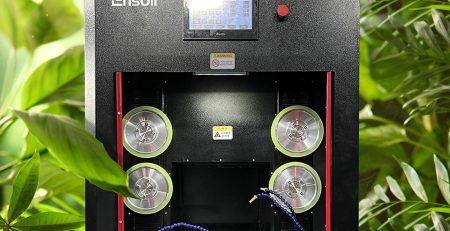
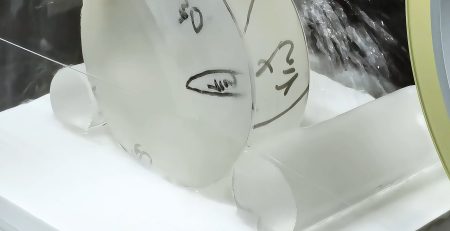
Test de découpe du quartz: 80 mm/min, Fil diamanté sans fin
Test conclusion: In this customer sample test, Ensoll cut a 415 mm diameter quartz workpiece at a stable feed rate of 80 mm/min using a customized ESC600-4T endless diamond wire saw, a fully coated 0.80 mm diamond wire loop, and cutting oil. Three 30 mm-thick samples recorded TTV values of 0.410-0.630 mm, average Ra values of 1.52-1.87 µm, et éclats maximum sur les bords de 16.1-18.2 µm.
- Un 415 mm diameter, 500 mm long quartz workpiece was sliced into 30 mm samples at a stable 80 mm/min feed using a customized ESC600-4T machine, a fully coated 0.80 mm diamond wire loop at 38 m/s, and cutting oil.
- Three samples recorded TTV of 0.410-0.630 mm, average surface roughness of Ra 1.52-1.87 micromètres, et éclats maximum sur les bords de 16.1-18.2 micromètres.
- Cutting oil was the decisive process change: water-based coolants limited feed to roughly 1-3 mm/min, while oil lubrication stabilized the diamond-quartz interface for high-feed cutting.
- High-speed quartz cutting is a system-level result — machine rigidity, 230 N tension control, wire specification, lubrication and a segmented feed strategy must all match; raising feed rate alone does not reproduce it.
This report documents the equipment configuration, paramètres de coupe, measurement method, and results of a quartz cutting trial for a UK customer, anonymized as Company B. The values below describe this test setup and sample condition; they should not be interpreted as guaranteed results for every quartz grade or geometry.
Key test results
- Workpiece: quartz, Ø415 mm × 500 mm
- Cut sample: Ø415 mm × 30 mm
- Stable cutting feed: 80 mm/min
- Diamond wire speed: 38 m/s
- TTV: 0.410-0.630 mm across three samples
- Average surface roughness: Ra 1.52-1.87 µm
- Maximum measured edge chipping: 16.1-18.2 µm
Feed stock matters as much as machine settings here — quartz de haute pureté behaves differently from fused silica under the wire.
Why high-speed quartz cutting is difficult
Quartz is primarily silicon dioxide (SiO2). Its strong covalent-bonded network gives it high hardness and chemical stability, but also makes it brittle and sensitive to crack initiation. As the cutting feed increases, friction, wire bow, vibration, localized heating, and unstable abrasive engagement can reduce accuracy or produce chipping and subsurface damage.
The engineering objective was therefore not simply to make the wire travel faster. The process had to raise material-removal efficiency while keeping the wire trajectory, cutting load, un refroidissement, lubrication, la constance de l'épaisseur, surface condition, and edge integrity under control.
Test object and equipment configuration
| Article | Test condition |
|---|---|
| Material | Quartz |
| Dureté | Mohs hardness approximately 7 |
| Taille de la pièce | Ø415 mm × 500 mm long |
| Target sample size | Ø415 mm × 30 mm d'épaisseur |
| Machine | Customized ESC600-4T endless diamond wire saw |
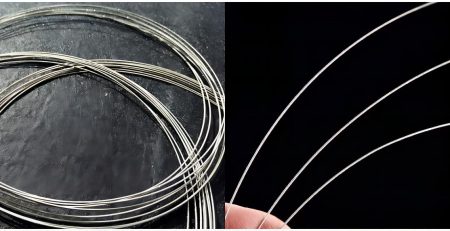
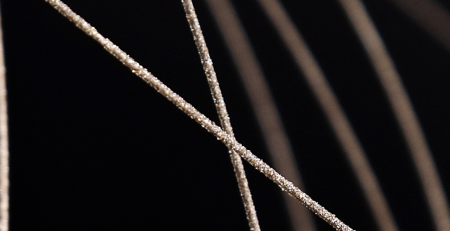
| Cutting tool | Fully coated diamond wire loop, Ø0.80 mm × 3,780 mm |
| Cooling/lubrication | Huile de coupe |

The machine was configured around a rigid cutting structure, stable workpiece clamping, controlled vertical feed, and automatic wire tension management. For related configurations, see Ensoll’s la machine de découpe à fil diamant ESC600 and the wider range of diamond wire saw machines.
Cutting parameters and process strategy
| Paramètre | Recorded setting |
|---|---|
| Boucle de fil diamanté | Ø0.80 mm × 3,780 mm, entièrement revêtue |
| Feed-rate trials | 55, 60, et 80 mm/min |
| Stable production-test feed | 80 mm/min |
| Largeur de coupe | 415 mm |
| Recorded wire tension | 230 N |
| Vitesse du fil | 38 m/s |
| Wire-bow tensioning time | 200 s |

Why cutting oil mattered
Early trials with water or conventional water-based coolant were limited to approximately 1-3 mm/min and did not maintain a stable cutting state. Switching to a dedicated cutting oil improved lubrication at the diamond abrasive-quartz interface, réduction de la résistance de frottement et du stress localisé, et a aidé les grains abrasifs à enlever le matériau de manière plus cohérente.
Dans des conditions optimisées, le processus a atteint une alimentation stable de 80 mm/min. Une stratégie segmentée a également été évaluée: une alimentation d'entrée plus élevée a été utilisée lors de l'engagement initial, puis l'alimentation a été réduite à mesure que la surface de contact et la charge de coupe augmentaient. Cette approche a raccourci le temps de coupe non stable tout en préservant la qualité des arêtes pendant la partie la plus profonde de la coupe.
Le complètement revêtu boucle de fil de diamant sans fin a permis un engagement abrasif continu et a évité les points de retournement associés au mouvement alternatif du fil.

Résultats de coupe mesurés
Trois échantillons coupés ont été évalués pour la variation d'épaisseur, écart dimensionnel, Rugosité, et éclats sur les bords. Les mesures fournissent une image plus utile que la seule vitesse de coupe car elles montrent si le processus plus rapide a maintenu une géométrie répétable et l'intégrité de la surface.
1. Total thickness variation (TTV)
Le TTV a été mesuré avec un plateau à vide, grille en neuf points, méthode d'épaisseur à double sonde. L'équipement a été stabilisé thermiquement et calibré, et chaque échantillon a été nettoyé et centré avant la mesure.
| Échantillon | Tmax (mm) | Tmin (mm) | TTV (mm) |
|---|---|---|---|
| S01 | 29.780 | 29.200 | 0.580 |
| S02 | 30.040 | 29.410 | 0.630 |
| S03 | 29.830 | 29.420 | 0.410 |
Le 0.410-0.630 La plage de TTV en mm indique que la charge de coupe et le parcours du fil sont restés contrôlés sur les trois échantillons pendant ce test.
2. Précision de l'épaisseur
| Échantillon | Épaisseur moyenne (mm) | Écart par rapport à 30.000 mm |
|---|---|---|
| S01 | 29.479 | -0.521 mm |
| S02 | 29.720 | -0.280 mm |
| S03 | 29.660 | -0.340 mm |
L'écart moyen maximum absolu de l'épaisseur était 0.521 mm. Le choix de la tolérance devrait encore prendre en compte le processus de meulage ou de polissage en aval du client.
3. Rugosité de surface
La rugosité de surface a été mesurée par profilométrie au stylet suivant la norme ISO 4287 cadre d'évaluation. Trois positions représentatives ont été mesurées sur chaque échantillon.
| Échantillon | Ra-1 (µm) | Ra-2 (µm) | Ra-3 (µm) | Ra moyen (µm) |
|---|---|---|---|---|
| S01 | 1.83 | 1.40 | 1.33 | 1.52 |
| S02 | 1.70 | 1.73 | 1.65 | 1.69 |
| S03 | 1.91 | 1.83 | 1.86 | 1.87 |
4. Ébréchure des bords
Les quatre bords de chaque échantillon ont été nettoyés et inspectés avec un microscope d'outil calibré. L'ébréchure maximale mesurée est restée inférieure à 20 µm pour les trois échantillons.
| Échantillon | Position 1 | Position 2 | Position 3 | Position 4 | Maximum (µm) |
|---|---|---|---|---|---|
| S01 | 12.5 | 15.2 | 14.6 | 16.8 | 16.8 |
| S02 | 14.3 | 17.5 | 18.2 | 16.9 | 18.2 |
| S03 | 11.8 | 14.6 | 15.2 | 16.1 | 16.1 |

Ce qui a permis le 80 résultat mm/min?
- Lubrification adaptée au quartz: L'huile de coupe a réduit le frottement à l'interface et stabilisé l'engagement abrasif mieux que le milieu à base d'eau utilisé lors des premiers essais.
- Structure de machine rigide: La fixation stable et l'avance contrôlée ont réduit les vibrations et les fluctuations de position sur le 415 largeur de coupe de mm.
- Paramètres de coupe dynamiques: le taux d'avance a été ajusté aux conditions de contact changeantes plutôt que maintenu à une valeur agressive unique tout au long de la coupe.
- Découpe en boucle continue: the endless wire maintained one-direction, high-speed abrasive motion without reciprocating reversal.
- Tension control: stable wire tension limited bow variation and helped preserve thickness consistency and edge quality.
Engineering interpretation and limitations
The result shows that high-speed quartz cutting is a system-level problem. Machine rigidity, maintien de la pièce, spécifications du fil diamant, coolant/lubricant, tension, la vitesse du fil, and feed strategy must be matched to one another. Increasing feed alone is unlikely to reproduce the same result.
Quartz grade, internal stress, inclusions, geometry, required allowance, surface specification, and downstream processing can all change the practical cutting window. Before production, Ensoll recommends a sample test using the customer’s actual material and acceptance criteria. Notre custom diamond wire cutting solution workflow combines material testing, machine configuration, wire selection, and process development.
Frequently asked questions
Can an endless diamond wire saw cut large-diameter quartz?
Oui. This test cut a 415 mm diameter quartz workpiece. The required machine travel, rigidity, maintien de la pièce, wire length, tension, and coolant delivery must be sized for the workpiece.
Is 80 mm/min guaranteed for every quartz workpiece?
Non. Le 80 mm/min value is the stable feed reached under the documented sample, equipment, un fil, and cutting-oil conditions. Different quartz grades, sizes, tolérances, and surface requirements require process validation.
Why was cutting oil used instead of water?
Dans ce test, cutting oil provided better lubrication at the diamond-quartz interface and supported a more stable, higher-feed cutting state. Fluid selection must also account for cleaning, environmental, sécurité, and downstream-process requirements.
What data should a customer provide for a quartz cutting test?
Useful inputs include quartz grade, workpiece drawing, dimensions, cutting direction, target thickness, tolerance, TTV, Rugosité, chipping limit, production volume, coolant restrictions, and downstream grinding or polishing allowance.
Conclusion
Under the documented conditions, the customized endless diamond wire cutting process combined an 80 mm/min stable feed with controlled TTV, Rugosité, and edge chipping on 415 mm quartz samples. The test demonstrates the value of matching equipment structure, fully coated diamond wire, cutting oil, tension control, and segmented feed strategy for hard and brittle quartz.
Need to validate your own quartz material? Send Ensoll your drawing, material information, and acceptance criteria to discuss a sample cutting test and machine configuration.
Examiné par l'équipe d'ingénierie Ensoll.