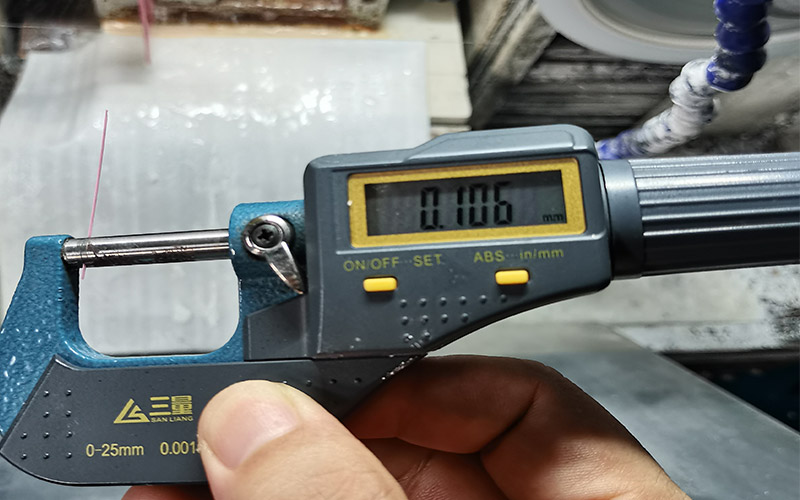
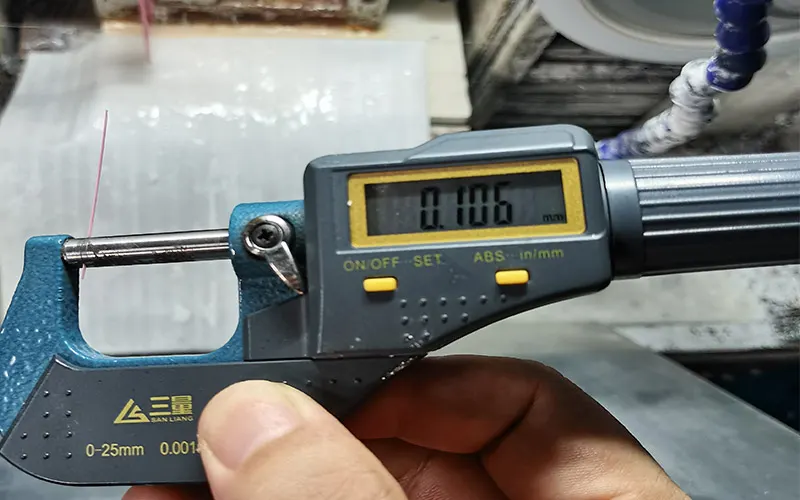
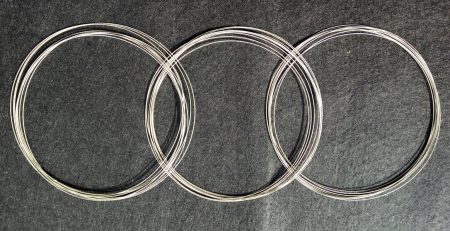
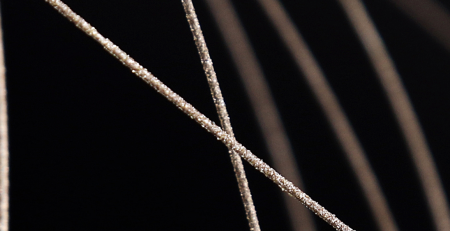
Diamond wire cutting has demonstrated precision down to 1mm in real cutting cases, making it a go-to method for meticulous work.
Five factors drive its precision: diamond’s hardness, the stability of the continuous loop motion, the thin wire profile, minimal cutting force, and broad material versatility.
Wire diameters from a few tenths of a millimeter to a few millimeters allow intricate detailing and tight corners that thicker tools cannot follow.
The gentle, controlled cutting force keeps delicate and brittle materials intact – no deformation, no structural damage.
Diamond wire cutting will not fully replace diamond grinding wheel cutting: wheels win on removal rate, wire wins on precision, finish and brittle materials – they complement each other.
Introduction:
In the realm of cutting technology, the latest innovation that has taken the industry by storm is the diamond wire cutting method. This groundbreaking technique has revolutionized precision cutting processes, providing unparalleled accuracy and versatility. In this blog post, we will delve into the world of diamond wire cutting, exploring its capabilities and understanding why it has become the go-to tool for achieving exceptional cutting results.
Cutting Prowess:
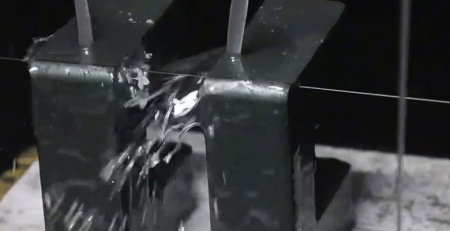
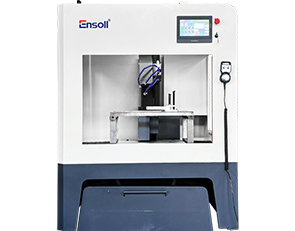
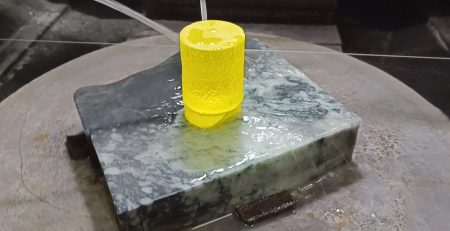
Allow us to present some remarkable cutting cases that highlight the extraordinary capabilities of our diamond wire cutting tool. With this remarkable technology, we have successfully achieved cutting precision as fine as 1mm.
Why Diamond Wire Enables Precision Cutting:
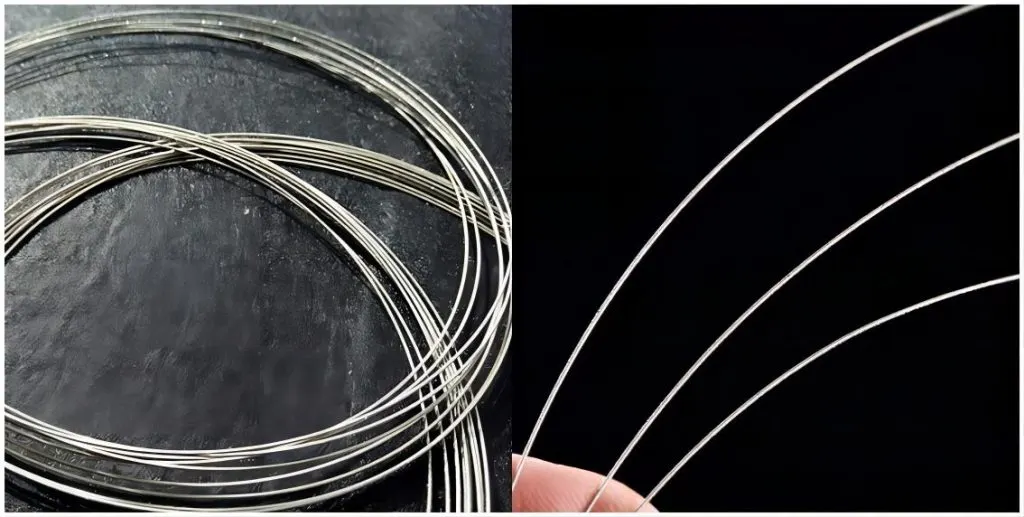
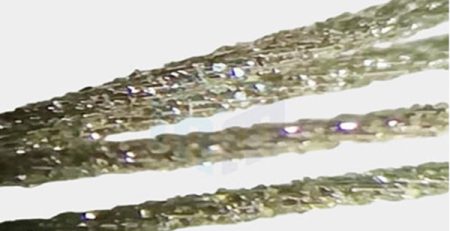
Firstly, diamond wire is composed of a wire matrix embedded with tiny diamond particles. Diamonds are renowned for their exceptional hardness, making them one of the hardest materials known to man. This inherent hardness provides the diamond wire with remarkable cutting capabilities, allowing it to effectively slice through a wide range of materials with precision.
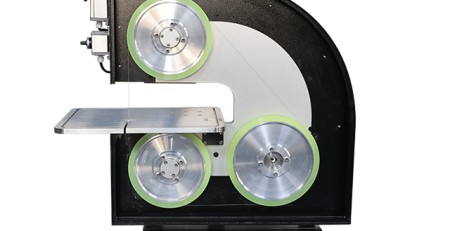
The continuous loop design of the diamond wire is another crucial element that contributes to its precision cutting ability. As the wire moves through the material being cut, it maintains a consistent and controlled cutting motion. This uniform movement ensures that the cutting process remains stable, reducing the risk of deviations or errors. The result is a clean and precise cut that adheres closely to the intended dimensions and contours.
Moreover, the thinness of the diamond wire enhances its precision cutting capabilities. With a diameter ranging from a few tenths of a millimeter to a few millimeters, the diamond wire minimizes material wastage and allows for intricate detailing. The thin profile enables the wire to navigate tight corners and intricate shapes, enabling the achievement of highly precise cuts even in complex patterns.
Another significant advantage of diamond wire cutting is its minimal cutting force. Unlike other cutting methods that exert substantial force on the material, diamond wire cutting applies a gentle and controlled force. This characteristic is particularly beneficial when working with delicate or fragile materials that are prone to damage or deformation under excessive pressure. The reduced cutting force ensures that the material remains intact and undisturbed, resulting in precise cuts without compromising the structural integrity of the workpiece.
In addition to its precision, diamond wire cutting offers excellent versatility. It can be used to cut a wide range of materials, including metals, composites, stones, and ceramics. This versatility makes it an ideal choice for various industries, such as aerospace, electronics, and automotive, where precise cutting of diverse materials is essential.
Will Diamond Wire Cutting Replace Diamond Grinding Wheel Cutting?
The emergence of diamond wire cutting has sparked a question: Will it replace the traditional method of diamond grinding wheel cutting? While diamond wire cutting offers numerous advantages, it is important to understand that both methods have their unique strengths and applications. Let’s explore this further.
Diamond wire cutting and diamond grinding wheel cutting serve different purposes and cater to specific cutting requirements. Diamond grinding wheel cutting excels in scenarios where high material removal rates are desired. It is particularly effective when dealing with harder materials or when a rougher surface finish is acceptable. The grinding action of the diamond wheel allows for efficient material removal, making it suitable for applications that prioritize productivity and speed.
On the other hand, diamond wire cutting offers unparalleled precision and control, making it the preferred choice for tasks that demand intricate detailing and minimal material loss. The diamond wire’s ability to achieve fine cuts with exceptional accuracy, reduced kerf width, and minimal heat-affected zone makes it ideal for applications in industries such as electronics, aerospace, and medical, where precision is paramount.
Another aspect to consider is the nature of the workpiece and its material properties. Diamond grinding wheel cutting may be more suitable for dense and hard materials that require substantial material removal, whereas diamond wire cutting is better suited for delicate or brittle materials that require minimal force and precision cuts.
Furthermore, the choice between diamond wire cutting and diamond grinding wheel cutting depends on the desired surface finish. Diamond grinding wheel cutting tends to leave a rougher surface compared to the smoother finish achieved by diamond wire cutting. Therefore, the intended application and the desired surface quality play a significant role in determining the appropriate cutting method.
It is important to note that advancements in technology and cutting techniques continuously improve both diamond wire cutting and diamond grinding wheel cutting. Each method undergoes refinement to enhance their capabilities and address specific cutting challenges. Rather than one method replacing the other, they coexist and complement each other in the realm of cutting technology.
In conclusion:
Diamond wire cutting method has emerged as the epitome of precision cutting tools. Its ability to achieve unparalleled accuracy, coupled with its versatility and customization options, makes it the go-to choice for industries that prioritize meticulous cutting requirements. While it may not completely replace diamond grinding wheel cutting, the diamond wire cutting method offers a new level of precision and control, pushing the boundaries of what is possible in the realm of cutting technology. Embrace this revolutionary tool, and unlock a world of limitless cutting possibilities.
Frequently Asked Questions
How precise is diamond wire cutting?
Cutting precision as fine as 1mm has been demonstrated in real production cases. The combination of a thin diamond-coated wire, a stable continuous loop motion and minimal cutting force lets the cut adhere closely to intended dimensions and contours, even in complex patterns.
Will diamond wire cutting replace diamond grinding wheel cutting?
No – the two methods coexist and complement each other. Grinding wheels excel at high material removal rates on hard, dense materials where a rougher finish is acceptable. Diamond wire wins where precision, minimal material loss, a smooth finish and gentle force on brittle materials matter.
Why does diamond wire cutting use so little force?
The wire removes material by fine abrasive grinding rather than brute force, so it applies a gentle, controlled load. This is particularly valuable for delicate or fragile materials that would deform or crack under the pressure of conventional cutting tools.
What materials can diamond wire cutting handle?
A wide range: metals, composites, stones, ceramics and more. This versatility is why it serves aerospace, electronics, medical and automotive industries, where precise cutting of diverse materials is essential.
When should you choose a grinding wheel instead of diamond wire?
Choose a grinding wheel when high material removal rate and productivity come first, when the material is dense and hard, and when a rougher surface finish is acceptable. Choose diamond wire when precision, surface quality and material integrity are the priority.
Optical glass machining requires sub-micron precision to meet the demands of industries like aerospace, photonics, and consumer electronics. With read more
In the world of advanced manufacturing, precision cutting of magnetic materials represents one of the most challenging yet crucial processes.... read more
In the demanding world of advanced semiconductors, where performance and efficiency are paramount, one material stands as a critical enabler:... read more
Key Takeaways
Four main types of diamond wire saw machines exist: continuous wire, multi-wire, fixed wire and portable machines.
Continuous wire saw... read more
The diamond looped wire saw has characteristics such as high efficiency, high precision, wide range of applications, material conservation, uniform... read more