SiC and GaN are third-generation semiconductors transforming power electronics, 5G and EVs — but they are extremely hard to cut.
Their ultra-high hardness, brittleness and thermal-stress sensitivity defeat most conventional cutting methods.
Diamond wire saw solves SiC/GaN cutting with the hardest abrasive in a cold, low-force, narrow-kerf process.
Introduction
The rise of third-generation semiconductor materials (SiC and GaN) has transformed power electronics, 5G, and electric vehicle industries. However, their extreme hardness and brittleness make precision cutting a major manufacturing hurdle. This article explores the cutting challenges of SiC/GaN wafers and whydiamond wire sawtechnology is the optimal solution.
Why SiC/GaN Cutting is Difficult?
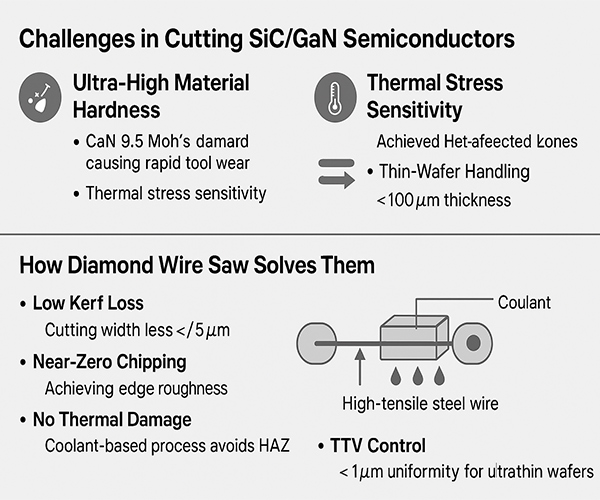
1. Ultra-High Material Hardness
SiC (Silicon Carbide): 9.5 Mohs hardness (close to diamond), causing rapid tool wear.
GaN (Gallium Nitride): High fracture toughness, prone to micro-cracks.
2. Brittleness & Edge Chipping
Traditional cutting methods (e.g., blade dicing) generate edge defects (>20μm chipping), reducing yield in power devices and RF chips.
3. Thermal Stress Sensitivity
Laser cutting induces heat-affected zones (HAZ), altering material properties critical for high-frequency applications.
4. Thin-Wafer Handling
SiC/GaN wafers for advanced packaging (e.g., Chiplet designs) require <100μm thickness with sub-1μm TTV (Total Thickness Variation).
Diamond Wire Cutting: The Optimal Solution
1. How Diamond Wire Saw Works
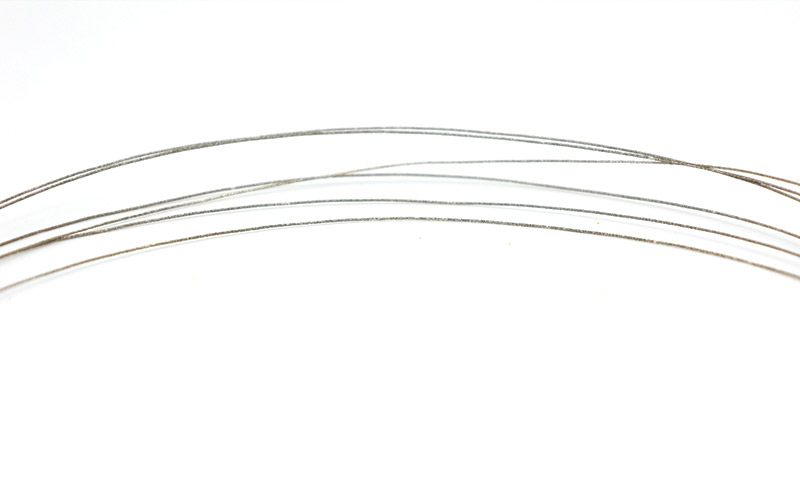
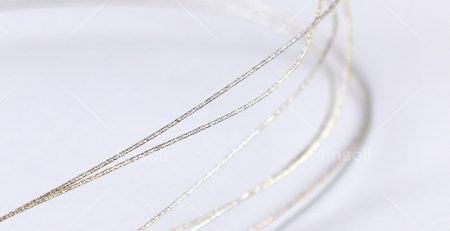
Electroplated diamond particles(5–50μm) on a high-tensile steel wire.
l Reciprocating or continuous motion with coolant minimizes thermal stress.2. Key Advantages for SiC/GaN
Low Kerf Loss: <50μm cutting width vs. 200μm in blade dicing (material savings).
Near-Zero Chipping: Achieves <5μm edge roughness (critical for HEMT devices).
No Thermal Damage: Coolant-based process avoids HAZ.
TTV Control: <1μm uniformity for ultra-thin wafers.
Case Study: SiC Power Module Production
A leading EV manufacturer switched from laser to diamond wire cutting for SiC MOSFETs:
Result 1: Yield increased from 78% to 93%(reduced crack-induced failures).
Result 2: Cut speed reached 500mm/minwith 0.3μm diamond wire
Choosing the Right Diamond Wire Saw
For SiC/GaN applications, prioritize:
Wire Diameter: 0.1–0.3mm for fine finishes.
Diamond Grit Size: 10–20μm for balance between speed and surface quality.
Machine Stability: Vibration <0.1μm to prevent micro-cracks.
Future Trends
Hybrid Cutting: Combining diamond wire with laser pre-grooving for heterogeneous integration.
AI-Based Process Control: Real-time adjustment for defect-free cutting.
Conclusion
Diamond wire saw technology addresses the hardness, brittleness, and thermal challenges of SiC/GaN cutting, enabling higher yields and thinner wafers. For semiconductor manufacturers, investing in precision diamond wire equipment is critical to scaling next-gen devices.
Looking for SiC/GaN cutting solutions?Contact usfor a free consultation on diamond wire saw systems tailored to your needs. For a full process walkthrough, see how to process silicon carbide from slicing through to finish.
Frequently Asked Questions
Why are SiC and GaN so difficult to cut?
Both materials combine Mohs 9-class hardness with brittleness and sensitivity to thermal stress, so blades wear fast and lasers risk heat-induced cracks.
How does diamond wire saw solve SiC and GaN cutting?
Diamond abrasive handles the hardness, while the cold, low-force wire process avoids thermal damage and minimizes edge chipping and sub-surface cracks.
What is third-generation semiconductor material?
Wide-bandgap semiconductors such as SiC and GaN that operate at higher voltage, frequency and temperature than silicon, driving power electronics, 5G and EV applications.
Technical content reviewed by the Ensoll engineering team — a diamond wire loop manufacturer with 10+ years of production experience.
Diamond wire loop cutting has revolutionized the cutting process for colored crystals, offering numerous advantages over traditional methods. This... read more
The rapid evolution of 5G telecommunications, electric vehicle (EV) charging infrastructure, and high-frequency power supplies has placed a massive spotlight... read more
Introduction to KDP Crystals
KDP crystals have a large nonlinear optical coefficient and a high laser damage threshold, making them important... read more