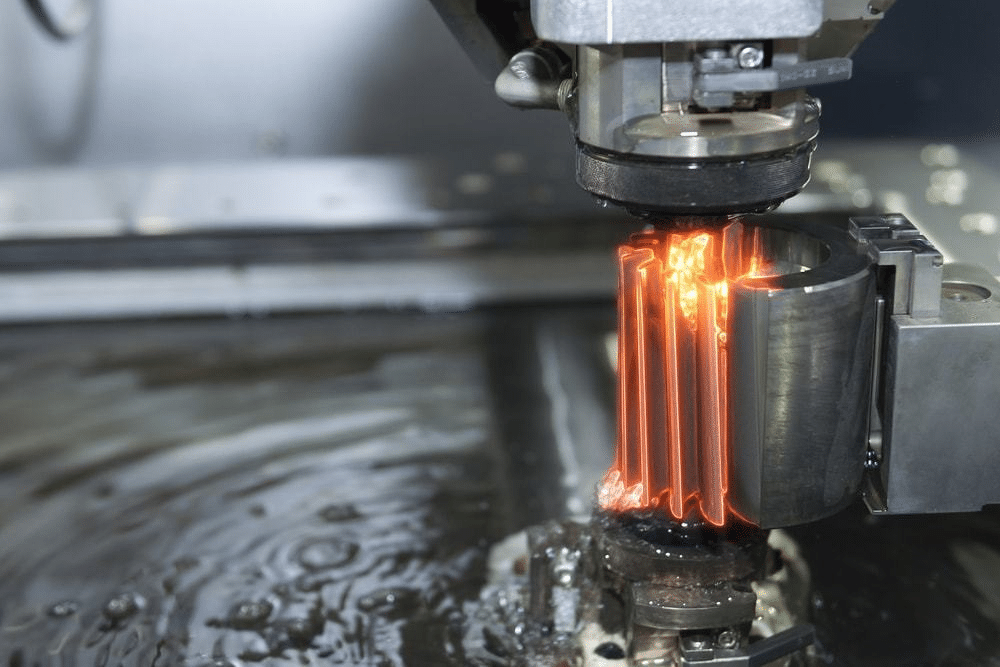
Wire EDM cuts electrically conductive materials using spark erosion, daher ist die Materialhärte unerheblich – even hardened tool steel and tungsten carbide can be cut.
The process is non-contact and produces zero mechanical stress, enabling complex geometries, sharp corners and fine details.
Wire EDM delivers excellent surface finish and tight tolerances, but is limited to conductive materials and is relatively slow.
For non-conductive hard materials such as ceramics, glass and sapphire, diamond wire loop cutting is the complementary technology of choice.
In the world of high-precision manufacturing, there are materials so hard that traditional steel drill bits and carbide cutters simply cannot touch them. When aerospace engineers need to slice through titanium or semiconductor manufacturers need to create microscopic components in hardened steel, they turn to a process that feels like science fiction: Funkenerosion (EDM).
Nämlich, the Wire EDM (WEDM) machine has become the gold standard for “impossible” cuts. In diesem Leitfaden, we will break down what an EDM wire cut machine is, how it works, and why it remains a cornerstone of industrial innovation alongside modern diamond wire technologies.
2. The Science: How Does the “Spark” Work?
The process of Wire EDM relies on the principles of erosion through electricity. Here is the step-by-step breakdown of what happens inside the machine:
The Electrode: A thin wire (usually brass, Kupfer, or coated molybdenum), acting as one electrode, is fed from a supply spool through the workpiece.
The Dielectric Fluid: The entire cutting area is submerged in or flushed with deionized water (the dielectric fluid). This fluid acts as an insulator until a specific voltage is reached, and then it acts as a conductor.
The Spark: The machine generates high-frequency electrical pulses between the wire and the workpiece. When the gap is small enough, a spark jumps across, creating a “plasma channel” that reaches temperatures of 8,000°C to 12,000°C.
The Erosion: This intense heat melts and vaporizes a microscopic amount of the metal. The dielectric fluid then immediately flushes these tiny particles away and cools the area.
The Continuous Feed: Because the wire itself is eroded by the sparks, it is constantly moving from one spool to another, ensuring a “fresh” cutting surface is always present.
3. Key Advantages of Wire EDM Cutting
Why do manufacturers choose EDM over traditional milling or waterjet cutting?
Ein. Hardness is Irrelevant
In traditional machining, the tool must be harder than the material it is cutting. In EDM, the only requirement is that the material must be electrically conductive. You can cut hardened tool steel, Wolframkarbid, and titanium as easily as you can cut aluminum.
B. Complex Geometries & Sharp Corners
Because the wire can be as thin as 0.02mm, EDM can produce internal corners with almost zero radius. It allows for the creation of intricate shapes, thin walls, and complex “keyway” slots that are physically impossible for a rotating round drill bit.
C. Zero Mechanical Stress
Since the wire never actually touches the part, there are no mechanical cutting forces. This means you can machine extremely delicate or thin-walled parts without the risk of bending, distorting, or vibrating the material.
D. Exceptional Surface Finish
Wire EDM is known for producing a mirror-like finish. Because it is a thermal erosion process rather than a mechanical tearing process, the resulting surface is incredibly smooth, often eliminating the need for secondary polishing.
4. EDM vs. Diamant-Drahtsägemethode: Which One Do You Need?
In 2026, many of our clients at Ensoll ask about the difference between Wire EDM and ourDiamant-Drahtsäge Technologie. While both use a “Draht” to cut, they serve different purposes:
Merkmal
Wire EDM Machine
Ensoll Diamond Wire Saw
Material Requirement
Must beConductive (Metals)
Can beNon-Conductive (Keramik, Glas, Silizium)
Schnittgeschwindigkeit
Relatively Slow (Precision focus)
High Velocity (Efficiency focus)
Mechanism
Electrical Erosion (Spark)
Mechanical Micro-Grinding (Diamonds)
Best Use Case
Mold making, tiny aerospace parts
Halbleiter-Wafer, Sic, Industriekeramik
If you are cutting non-conductive materials like Silicon Carbide (Sic) or Technical Ceramics, EDM will not work. In those cases, the Ensoll Diamond Wire Loop is the industry-standard solution.
5. Applications of EDM Wire Cut Machines
Wire EDM is utilized in any industry where “failure is not an option” and precision is paramount:
Luft- und Raumfahrt: Creating cooling holes in turbine blades and intricate engine components.
Medizinische Geräte: Slicing tiny, delicate surgical instruments and implants from biocompatible metals.
Tool and Die Making: Creating the hardened steel molds used to mass-produce plastic parts (like the casing of your smartphone).
Automobil: Producing high-precision gears and prototype parts for Electric Vehicle (EV) powertrains.
6. Maintenance and Operational Efficiency in 2026
To keep an EDM machine running at peak performance, operators focus on three main factors:
Drahtspannung: Just like Ensoll’s diamond wires, EDM wires must be kept at a constant tension to prevent “wire lag,” which can cause inaccuracies in the center of a thick cut.
Water Conductivity: The deionized water must be filtered and its conductivity monitored constantly. If the water is too “dirty,” the sparks will become uncontrollable.
Generator Settings: Moderne 2026 EDM machines use AI-driven power generators that adjust the spark frequency in real-time to prevent wire breakage while maximizing speed.
Schlussfolgerung: The Precision Fulfillment Era
The EDM wire cut machine remains a marvel of modern engineering. By using electricity to bypass the limitations of physical hardness, it allows us to build the complex, high-performance world we live in today.
Whether you are using Electrical Discharge Machining for conductive metal molds or Ensoll’s Diamond Wire Loops for advanced semiconductor wafers, the goal is the same: Precision Redefined.
Häufig gestellte Fragen
What is wire EDM cutting and how does it work?
Drahterodieren (Funkenerosion) Verwendet einen dünnen, electrically charged wire as an electrode. A controlled series of sparks between the wire and the workpiece erodes the material along the programmed path, without any physical contact.
What materials can be cut with wire EDM?
Any electrically conductive material, regardless of hardness: tool steel, Edelstahl, Titan, Wolframkarbid, Inconel and other superalloys. Non-conductive materials like ceramics, glass and most stones cannot be cut by EDM.
What are the main advantages of wire EDM?
Hardness is irrelevant, there is zero mechanical cutting force, it produces complex shapes with sharp internal corners, and it achieves excellent surface finish and micron-level tolerances.
Wire EDM vs diamond wire cutting: which should I choose?
Choose wire EDM for conductive metals when you need intricate contours and ultra-fine finish. Choose diamond wire loop cutting for non-conductive hard-brittle materials (Silizium, Keramik, Glas, Saphir, Magnete) or when you need faster straight slicing with low kerf loss.
Einführung in fortschrittliche Glasschneidelösungen
In der heutigen anspruchsvollen optischen Fertigungslandschaft, Schneiden von Diamantdrahtsägen ist als Goldstandard hervorgegangen... mehr lesen
Wichtige Erkenntnisse
NdFeB (Neodym-Eisen-Bor) ist der stärkste kommerzielle Seltene-Erden-Magnet, verwendet in allen Bereichen der Elektronik, selbstfahrend, medizinisch und erneuerbare Energie —... mehr lesen
Das diamantgeschlungene Drahtschneiden besitzt mehrere wesentliche Vorteile im Bereich der Bearbeitung von magnetischen Materialien, was es zu einem idealen Steckling macht.. mehr lesen
Wichtige Erkenntnisse
Diamantdraht-Schleifen schneiden ist zu einem Mainstream-Prozess für optisches Glas geworden, weil es hohe Genauigkeit kombiniert, hohe Schnittgeschwindigkeit... mehr lesen
Wichtige Erkenntnisse
Diamantdrahtsägemaschinen verbinden präzises Schneiden mit umweltbewusstem Design: kein Schlamm, kein Öldunst und viel weniger... mehr lesen
Abstrakt: This report documents a precision straight-slicing trial on glass tube supplied by a
European customer. The workpiece was a tube... mehr lesen
Wichtige Erkenntnisse
Gummiblöcke mit eingebetteten Metalldrähten (wie reifenabgeleitete Blöcke) sind mit herkömmlichen Klingen extrem schwer zu schneiden, weil... mehr lesen