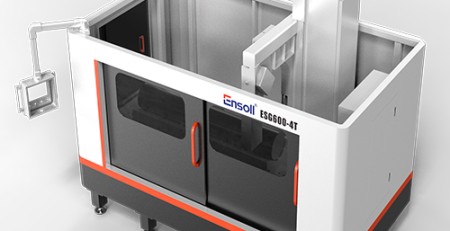
Prueba de corte de cuarzo: 80 mm/min, Alambre de diamante sin fin
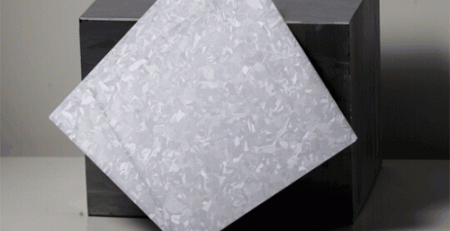
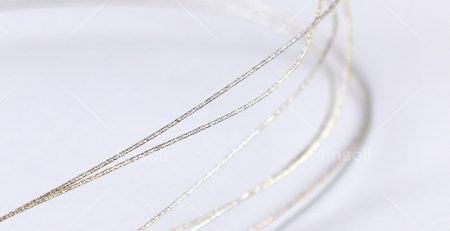
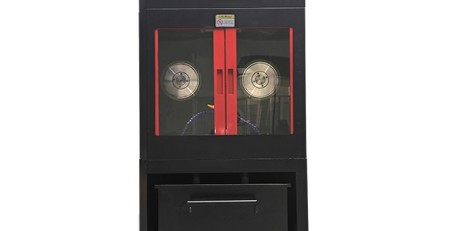
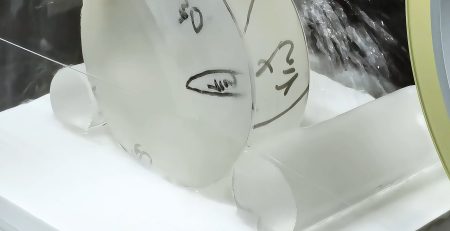
Conclusión de la prueba: En esta prueba de muestra de cliente, Ensoll cortó una 415 pieza de trabajo de cuarzo de diámetro mm a una velocidad de avance estable de 80 mm/min usando una sierra de cinta de diamante sin fin ESC600-4T personalizada, un bucle de alambre de diamante completamente recubierto de 0.80 mm, y aceite de corte. Tres 30 muestras de mm de espesor registraron valores de TTV de 0.410-0.630 milímetro, valores promedio de Ra de 1.52-1.87 µm, y máximo astillado de borde de 16.1-18.2 µm.
- Un 415 Pie de cuarzo de mm de diámetro, 500 mm de largo fue cortado en 30 muestras de mm a una alimentación estable de 80 mm/min usando una máquina personalizada ESC600-4T, un bucle de alambre de diamante completamente recubierto de 0.80 bucle de alambre de diamante de mm en 38 M/s, y aceite de corte.
- Tres muestras registraron TTV de 0.410-0.630 milímetro, rugosidad superficial promedio de Ra 1.52-1.87 micrómetros, y máximo astillado de borde de 16.1-18.2 micrómetros.
- El aceite de corte fue el cambio decisivo en el proceso: Los refrigerantes a base de agua limitaron la alimentación a aproximadamente 1-3 mm/min, mientras la lubricación con aceite estabilizó la interfaz diamante-cuarzo para corte de alta velocidad.
- El corte rápido de cuarzo es un resultado a nivel de sistema — rigidez de la máquina, 230 control de tensión N, especificación de alambre, lubrication and a segmented feed strategy must all match; raising feed rate alone does not reproduce it.
This report documents the equipment configuration, cutting parameters, measurement method, and results of a quartz cutting trial for a UK customer, anonymized as Company B. The values below describe this test setup and sample condition; they should not be interpreted as guaranteed results for every quartz grade or geometry.
Key test results
- Workpiece: cuarzo, Ø415 mm × 500 milímetro
- Cut sample: Ø415 mm × 30 milímetro
- Stable cutting feed: 80 mm/min
- Diamond wire speed: 38 M/s
- TTV: 0.410-0.630 mm across three samples
- Average surface roughness: Ra 1.52-1.87 µm
- Maximum measured edge chipping: 16.1-18.2 µm
Feed stock matters as much as machine settings here — cuarzo de alta pureza behaves differently from fused silica under the wire.
Why high-speed quartz cutting is difficult
Quartz is primarily silicon dioxide (SiO2). Su fuerte red de enlaces covalentes le da alta dureza y estabilidad química, pero también lo hace frágil y sensible a la iniciación de grietas. A medida que aumenta la alimentación de corte, fricción, curvatura del alambre, vibración, calentamiento localizado, y el compromiso abrasivo inestable pueden reducir la precisión o producir astillado y daño subsuperficial.
El objetivo de ingeniería, por lo tanto, no era simplemente hacer que el alambre se moviera más rápido. El proceso debía aumentar la eficiencia de remoción de material mientras se mantenían bajo control la trayectoria del alambre, carga de corte, enfriamiento, lubricación, la consistencia del espesor, condición de la superficie, y la integridad del filo.
Objeto de prueba y configuración del equipo
| Artículo | Condición de prueba |
|---|---|
| Material | Cuarzo |
| Dureza | Dureza Mohs aproximadamente 7 |
| Tamaño de la pieza de trabajo | Ø415 mm × 500 mm de longitud |
| Tamaño de muestra objetivo | Ø415 mm × 30 mm de grosor |
| Máquina | Sierra de alambre diamantado sin fin ESC600-4T personalizada |
| Herramienta de corte | Bucle de alambre con diamante totalmente recubierto, Ø0,80 mm × 3,780 milímetro |
| Enfriamiento/lubricación | Aceite de corte |

The machine was configured around a rigid cutting structure, stable workpiece clamping, controlled vertical feed, and automatic wire tension management. For related configurations, see Ensoll’s ESC600 diamond wire saw cutting machine and the wider range of máquinas de sierra de alambre de diamante.
Cutting parameters and process strategy
| Parámetro | Recorded setting |
|---|---|
| Bucle de alambre de diamante | Ø0,80 mm × 3,780 milímetro, fully coated |
| Feed-rate trials | 55, 60, y 80 mm/min |
| Stable production-test feed | 80 mm/min |
| Ancho de corte | 415 milímetro |
| Recorded wire tension | 230 N |
| Velocidad del alambre | 38 M/s |
| Tiempo de tensado del arco de alambre | 200 s |

Why cutting oil mattered
Early trials with water or conventional water-based coolant were limited to approximately 1-3 mm/min and did not maintain a stable cutting state. Switching to a dedicated cutting oil improved lubrication at the diamond abrasive-quartz interface, reduced frictional resistance and localized stress, and helped the abrasive grains remove material more consistently.
Under the optimized condition, the process reached a stable feed of 80 mm/min. A segmented strategy was also evaluated: a higher entry feed was used during the initial engagement, then the feed was reduced as the contact area and cutting load increased. This approach shortened non-steady cutting time while protecting edge quality during the deeper portion of the cut.
The fully coated bucle de alambre de diamante sin fin provided continuous abrasive engagement and avoided the reversal points associated with reciprocating wire motion.

Resultados de corte medidos
Se evaluaron tres muestras de corte para la variación de espesor, desviación dimensional, Rugosidad superficial, y astillado de bordes. Las mediciones proporcionan una imagen más útil que la velocidad de corte por sí sola porque muestran si el proceso más rápido mantenía la geometría repetible y la integridad de la superficie.
1. Total thickness variation (TTV)
TTV se midió con un plato de vacío, cuadrícula de nueve puntos, método de espesor de sonda dual. El equipo estaba termostáticamente estabilizado y calibrado, y cada muestra se limpió y centró antes de la medición.
| Muestra | Tmax (milímetro) | Tmin (milímetro) | TTV (milímetro) |
|---|---|---|---|
| S01 | 29.780 | 29.200 | 0.580 |
| S02 | 30.040 | 29.410 | 0.630 |
| S03 | 29.830 | 29.420 | 0.410 |
El 0.410-0.630 El rango de TTV en mm indica que la carga de corte y la trayectoria del hilo se mantuvieron controladas en las tres muestras durante esta prueba.
2. Precisión del espesor
| Muestra | Espesor promedio (milímetro) | Desviación respecto a 30.000 milímetro |
|---|---|---|
| S01 | 29.479 | -0.521 milímetro |
| S02 | 29.720 | -0.280 milímetro |
| S03 | 29.660 | -0.340 milímetro |
La desviación máxima absoluta del espesor promedio fue 0.521 milímetro. La selección de holgura todavía debe considerar el proceso posterior de rectificado o pulido del cliente.
3. Rugosidad de la superficie
Surface roughness was measured by stylus profilometry following the ISO 4287 evaluation framework. Three representative positions were measured on each sample.
| Muestra | Ra-1 (µm) | Ra-2 (µm) | Ra-3 (µm) | Average Ra (µm) |
|---|---|---|---|---|
| S01 | 1.83 | 1.40 | 1.33 | 1.52 |
| S02 | 1.70 | 1.73 | 1.65 | 1.69 |
| S03 | 1.91 | 1.83 | 1.86 | 1.87 |
4. Edge chipping
The four edges of each sample were cleaned and inspected with a calibrated tool microscope. Maximum measured chipping remained below 20 µm for all three samples.
| Muestra | Posición 1 | Posición 2 | Posición 3 | Posición 4 | Maximum (µm) |
|---|---|---|---|---|---|
| S01 | 12.5 | 15.2 | 14.6 | 16.8 | 16.8 |
| S02 | 14.3 | 17.5 | 18.2 | 16.9 | 18.2 |
| S03 | 11.8 | 14.6 | 15.2 | 16.1 | 16.1 |

What enabled the 80 mm/min result?
- Lubrication matched to quartz: cutting oil reduced interface friction and stabilized abrasive engagement better than the water-based media used in the early trials.
- Rigid machine structure: stable clamping and controlled feed reduced vibration and positional fluctuation over the 415 ancho de corte de mm.
- Dynamic cutting parameters: la velocidad de avance se ajustó a la condición cambiante de contacto en lugar de mantenerse en un valor agresivo durante todo el corte.
- Corte en bucle continuo: el alambre sin fin se mantenía en una dirección, movimiento abrasivo de alta velocidad sin inversión de ida y vuelta.
- Control de tensión: la tensión estable del alambre limitaba la variación de curvatura y ayudaba a preservar la consistencia del grosor y la calidad del borde.
Interpretación de ingeniería y limitaciones
El resultado muestra que el corte de cuarzo a alta velocidad es un problema a nivel de sistema. Rigidez de la máquina, sujeción de la pieza, especificación del alambre de diamante, refrigerante/lubricante, tensión, velocidad del hilo, y la estrategia de avance deben estar coordinados entre sí. Aumentar únicamente la velocidad de avance probablemente no reproducirá el mismo resultado.
Grado de cuarzo, estrés interno, inclusiones, geometría, margen requerido, especificación de la superficie, y el procesamiento posterior pueden cambiar toda la ventana práctica de corte. Antes de la producción, Ensoll recommends a sample test using the customer’s actual material and acceptance criteria. Nuestro custom diamond wire cutting solution workflow combines material testing, machine configuration, wire selection, and process development.
Frequently asked questions
Can an endless diamond wire saw cut large-diameter quartz?
Sí. This test cut a 415 mm diameter quartz workpiece. The required machine travel, rigidity, sujeción de la pieza, wire length, tensión, and coolant delivery must be sized for the workpiece.
Is 80 mm/min guaranteed for every quartz workpiece?
No. El 80 mm/min value is the stable feed reached under the documented sample, equipment, alambre, and cutting-oil conditions. Different quartz grades, sizes, tolerances, and surface requirements require process validation.
Why was cutting oil used instead of water?
En esta prueba, cutting oil provided better lubrication at the diamond-quartz interface and supported a more stable, higher-feed cutting state. Fluid selection must also account for cleaning, environmental, seguridad, and downstream-process requirements.
What data should a customer provide for a quartz cutting test?
Useful inputs include quartz grade, workpiece drawing, dimensiones, cutting direction, target thickness, tolerancia, TTV, Rugosidad superficial, chipping limit, volumen de producción, restricciones de refrigerante, and downstream grinding or polishing allowance.
Conclusión
Under the documented conditions, the customized endless diamond wire cutting process combined an 80 mm/min stable feed with controlled TTV, Rugosidad superficial, and edge chipping on 415 mm quartz samples. The test demonstrates the value of matching equipment structure, fully coated diamond wire, cutting oil, control de tensión, and segmented feed strategy for hard and brittle quartz.
Need to validate your own quartz material? Send Ensoll your drawing, material information, and acceptance criteria to discuss a sample cutting test and machine configuration.
Revisado por el equipo de ingeniería de Ensoll.