Diamond wire loop saw cut NdFeB magnet
Diamond wire loop saw cutting NdFeB magnet
- NdFeB magnets are tetragonal Nd2Fe14B crystals — the strongest commercial permanent magnets in use today and the most common rare-earth magnet across electronics, motors, medical equipment and aerospace.
- There are two types: bonded NdFeB, which is magnetically isotropic and corrosion-resistant, and sintered NdFeB, which is stronger but corrodes easily and must be plated (zinc, nickel, or nickel-copper-nickel coatings).
- Traditional cutting routes are reciprocating long-wire saws for large magnets and inner-diameter (ID) slicing machines for small ones; ID machines are precise but slow.
- Diamond wire loop saws cut NdFeB about 3 times faster than ID slicing machines, which is why magnet manufacturers are rapidly adopting them.
Neodymium magnets, also known as NdFeB magnets, are tetragonal crystals formed by neodymium, iron, and boron (Nd2Fe14B). This type of magnet is the second most magnetic permanent magnet after absolute zero holmium magnet today, and it is also the most commonly used rare earth magnet.

NdFeB is divided into two types: sintered NdFeB and bonded NdFeB. Bonded NdFeB has magnetism in all directions and is resistant to corrosion;
The sintered NdFeB is easy to corrode, and the surface needs to be plated. Generally, there are galvanized, nickel, environmentally friendly zinc, environmentally friendly nickel, nickel-copper-nickel, and environmentally-friendly nickel-copper-nickel. Sintered NdFeB is generally divided into axial magnetization and radial magnetization, which are determined according to the required working surface.
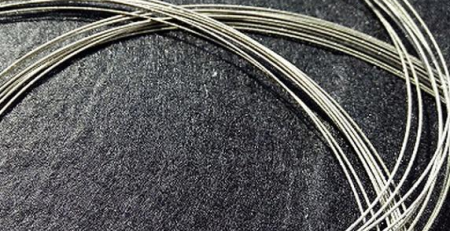
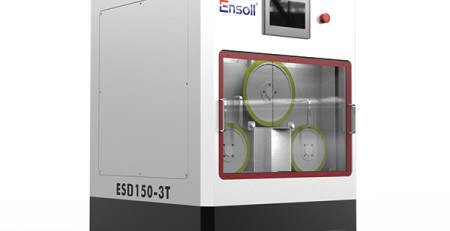
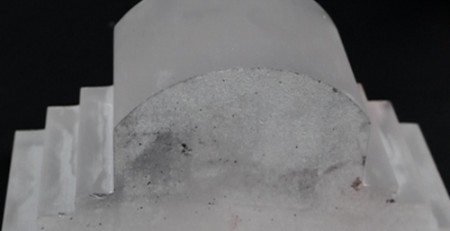
For cutting large NdFeB magnet, many manufacturers use reciprocating long-wire cutting, while small NdFeB magnet is cut with an Inner diameter cutting machine. The cutting efficiency of the Inner diameter cutting machine is low, but sometimes cutting a small amount of NdFeB magnet does not require turning on a large machine. With the rise of diamond wire loop saw, some manufacturers began to use diamond wire loop saw to cut NdFeB, the cutting efficiency is 3 times that of the Inner diameter cutting machine, which has been welcomed by many manufacturers in China.
Sintered NdFeB permanent magnet materials have excellent magnetic properties and are widely used in electronics, electrical machinery, medical equipment, toys, packaging, hardware machinery, aerospace and other fields.
The more common ones are permanent magnet motors, speakers, magnetic separators, computer disk drives, magnetic resonance imaging equipment and meters.
Below the NdFeB cutting video for reference:
If you want to know more, contact me or leave a message!
The full process for this material is documented in how to cut neodymium magnets.
Frequently Asked Questions
What is the best way to cut NdFeB magnets?
For small NdFeB magnets, a diamond wire loop saw is currently the best option: it cuts about 3 times faster than an inner-diameter slicing machine while handling the hard, brittle sintered material cleanly. Large magnets have traditionally been cut on reciprocating long-wire machines, but wire loop saws are taking over there as well.
What is the difference between sintered and bonded NdFeB magnets?
Bonded NdFeB has magnetism in all directions and resists corrosion. Sintered NdFeB delivers higher magnetic performance but corrodes easily, so its surface must be plated. Sintered grades are also divided into axial and radial magnetization depending on the required working surface.
Why do sintered NdFeB magnets need surface plating?
Because the sintered material corrodes readily when exposed. Common protective coatings include zinc, nickel, environmentally friendly zinc and nickel, and nickel-copper-nickel multilayer plating.
Where are NdFeB magnets commonly used?
Typical applications include permanent magnet motors, speakers, magnetic separators, computer disk drives, MRI equipment and meters — spanning electronics, electrical machinery, medical devices, toys, packaging, hardware and aerospace.
Reviewed by the Ensoll engineering team.