In modern manufacturing, A importância da tecnologia de usinagem de precisão está se tornando cada vez mais proeminente, especialmente no campo do processamento de materiais magnéticos. Os materiais magnéticos são amplamente utilizados em indústrias como a eletrônica, automotivo, aeroespaço, e energia, e sua precisão de usinagem afeta diretamente o desempenho dos produtos finais. laço de arame de corte diamantado tecnologia, como um método de usinagem eficiente e preciso, ganhou força significativa no processamento de materiais magnéticos nos últimos anos. Este artigo investiga os princípios, Vantagens, Aplicativos, and future trends of diamond wire loop cutting technology.
Principais Conclusões
Diamond wire loop cutting uses a high-strength steel wire coated with diamond particles (electroplated or resin-bonded) moving at high speed to micro-grind through hard, brittle materials.
Its four core advantages for magnetic materials: alta eficiência de corte, micron-level accuracy, minimal kerf waste — critical for expensive rare earths — and low energy consumption.
Proven applications span permanent magnets (NdFeB, SmCo), magnetismo suave (ferrites, Aço de silício) and even magnetic thin films for microelectronics.
The technology is moving toward AI-monitored adaptive cutting, nano-diamond and ultra-fine wires, and multi-material composite cutting — while wire life, thermal control and equipment cost remain the active engineering challenges.
1. Overview of Diamond Wire Loop Cutting Technology
1.1 O que é Corte com Fio de Diamante em Laço?
Diamond wire loop cutting is a precision machining technique that uses a metal wire coated with diamond particles as the cutting tool. Through high-speed reciprocating motion, it achieves precise cutting of hard and brittle materials. Diamante, being the hardest natural material, offers exceptional wear resistance and cutting efficiency, making it particularly suitable for cutting high-hardness materials such as magnetic materials, semicondutores, e cerâmica.1.2 Structure of Diamond Wire Loop
Metal Wire Core: Usually made of high-strength steel or stainless steel, serving as the carrier for diamond particles.
Diamond Particles: Fixed onto the metal wire surface through electroplating or resin bonding, forming the cutting edge.
Revestimento: To protect the metal wire and enhance cutting efficiency, o laço de fio de diamanteis often coated with a specialized layer.
2. Advantages of Diamond Wire Loop Cutting for Magnetic Materials
2.1 Alta eficiência de corte
Diamond wire loop cutting technology can complete the cutting of high-hardness magnetic materials in a short time, significantly improving production efficiency. Compared to traditional grinding wheel cutting or laser cutting, diamond wire loop cutting is faster while maintaining high cutting quality.
2.2 High Precision Machining
Magnetic materials require extremely high machining precision, especially in microelectronics and precision instruments. Diamond wire loop cutting technology can achieve micron-level cutting accuracy, ensuring that the dimensions and shapes of magnetic materials meet design requirements.
2.3 Low Material Waste
Traditional cutting methods often result in significant material loss, whereas diamond wire loop cutting, due to its fine wire diameter, generates minimal material waste during the process. This is particularly important for expensive magnetic materials.
2.4 Environmental Friendliness and Energy Efficiency
Diamond wire loop cutting does not require coolants or lubricants, reducing environmental pollution. Adicionalmente, its high cutting efficiency results in relatively low energy consumption, aligning with the modern manufacturing industry’s demand for green production.
3. Applications of Diamond Wire Loop Cutting in Magnetic Material Processing
3.1 Cutting of Permanent Magnetic Materials
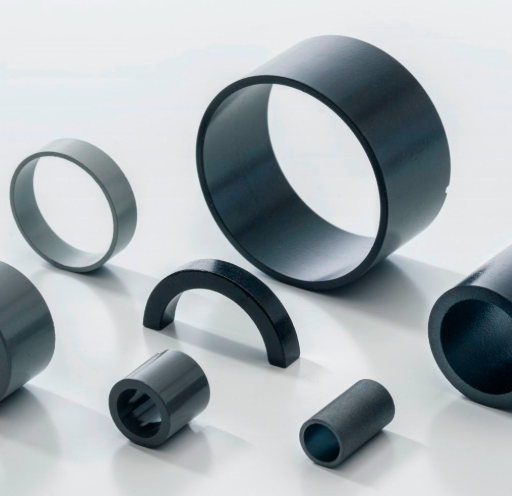
Permanent magnetic materials (such as neodymium iron boron andsamário cobalto) exhibit extremely high hardness and brittleness, making them prone to cracking or chipping with traditional cutting methods. Diamond wire loop cutting technology effectively avoids these issues, ensuring the integrity and performance of permanent magnetic materials.
3.2 Precision Machining of Soft Magnetic Materials
Soft magnetic materials (such as ferrites and silicon steel) are widely used in electronic transformers, inductors, and other devices. Diamond wire loop cutting technology enables high-precision cutting of soft magnetic materials, ensuring the electromagnetic performance of the devices.
3.3 Cutting of Magnetic Thin Films
In the field of microelectronics, the machining of magnetic thin films requires extremely high precision and surface quality. Diamond wire loop cutting technology achieves precise cutting of magnetic thin films, ensuring their uniformity and performance.
4. Future Trends in Diamond Wire Loop Cutting Technology
4.1 Automation and Intelligence
With the advancement of Industry 4.0, diamond wire loop cutting technology is moving toward automation and intelligence. By incorporating machine vision, artificial intelligence, and IoT technologies, real-time monitoring and optimization of the cutting process can be achieved, further enhancing cutting precision and efficiency.
4.2 Development of New Diamond Wire Loops
To meet the cutting needs of different materials, the development of new diamond wire loops is accelerating. Por exemplo, nano-diamond-coated wire loops and ultra-fine diamond wire loops are gradually being applied in magnetic material processing, further improving cutting performance.
4.3 Multi-Material Composite Cutting
In the future, diamond wire loop cutting technology will not be limited to single-material cutting but will also be applied to the machining of multi-material composite structures. Por exemplo, in composite structures of magnetic and non-magnetic materials, diamond wire loop cutting technology can achieve high-precision layered cutting, meeting the machining requirements of complex structures.
5. Challenges and Solutions in Diamond Wire Loop Cutting Technology
5.1 Wire Loop Lifespan Issues
Diamond wire loops experience wear over prolonged use, leading to reduced cutting efficiency. To address this, researchers are developing more wear-resistant diamond coating materials and advanced manufacturing processes to extend the lifespan of the wire loops.
5.2 Thermal Damage During Cutting
High-intensity cutting processes can generate high temperatures, causing thermal damage to the material surface. By optimizing cutting parameters and introducing cooling systems, thermal damage can be minimized, improving cutting quality.
5.3 Cost Control
The high equipment and material costs of diamond wire loop cutting technology limit its adoption in small and medium-sized enterprises. In the future, as the technology matures and scales up, the costs are expected to decrease, enabling broader applications.
6. Conclusão
Diamond wire loop cutting technology, como um método de usinagem eficiente e preciso, demonstrates immense potential in the field of magnetic material processing. Its advantages, including high cutting efficiency, high precision machining, low material waste, and environmental friendliness, make it an indispensable tool in modern manufacturing. As the technology continues to advance, diamond wire loop cutting will find applications in more fields, driving the manufacturing industry toward higher precision, eficiência, e sustentabilidade.
A metal wire — typically high-strength steel — is coated with diamond particles by electroplating or resin bonding and formed into a continuous loop. Driven at high speed, the embedded diamonds micro-grind the workpiece, slicing hard, brittle materials with a very narrow kerf and smooth surfaces.
Why is diamond wire loop cutting suited to magnetic materials?
Magnetic materials are hard, brittle and heat-sensitive. The wire loop cuts with distributed low force (no cracking), generates little heat (no demagnetization), and its fine diameter wastes very little of costly rare-earth stock — a combination grinding, laser and EDM cannot match.
Can diamond wire loops cut both permanent and soft magnetic materials?
Sim. The same process handles permanent magnets such as NdFeB and SmCo, soft magnetics such as ferrites and silicon steel, and even magnetic thin films, with only parameter and wire-grit changes between materials.
What limits diamond wire loop cutting today?
Three things: wire wear over long runs (addressed by more wear-resistant coatings), heat build-up at aggressive parameters (managed with cooling and optimized settings), and the initial equipment cost, which falls as the technology scales and matures.
Principais Conclusões
O quartzo de alta pureza é a matéria-prima para cadinhos de semicondutores, crescimento de lingotes PV e componentes ópticos.
A pureza define o limite de desempenho de.... leia mais
A rápida evolução das telecomunicações 5G, veículo elétrico (VE) infraestrutura de carregamento, e fontes de alimentação de alta frequência colocaram um enorme foco.... leia mais
Processo tradicional de produção de células solares
Principais Conclusões
A produção tradicional de células solares começa com a fabrico de pastilhas de silício e prossegue através de texturização, difusão, etching,... leia mais
Principais Conclusões
Alumina (Al₂O₃) é dura, resistente ao desgaste e quebradiça; o defeito que importa é lascamento na entrada e na saída de... leia mais
Principais conclusões
Cerâmicas avançadas (alumina, Zirconia, nitreto de silício, Sic) estão a crescer em aplicações de semicondutores, novas energias, e aplicações médicas.
A sua dureza e fragilidade... leia mais
Tipos de Vidro Óptico
Principais Conclusões
O vidro óptico apresenta-se em seis tipos principais: vidro óptico incolor, vidro óptico anti-radiação, vidro resistente à radiação,... leia mais
Application of precision ceramics in semiconductor and new energy fields
Today's world has witnessed unprecedented changes and accelerated evolution. Um novo... leia mais