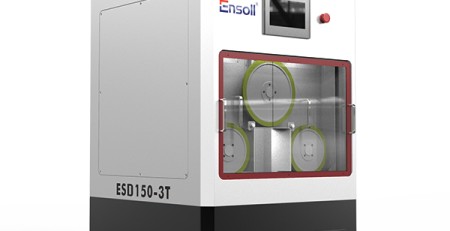
Schneiden von weichen Ferritkernen: Endlos-Diamantdraht
Die rasante Entwicklung der 5G-Telekommunikation, Elektrofahrzeuge (EV) Ladeinfrastruktur, und Hochfrequenzstromversorgungen haben einen starken Fokus auf eine bestimmte Klasse von magnetischen Materialien gelegt: Weiche Ferrite. Im Gegensatz zu harten Permanentmagneten wie NdFeB oder SmCo, weiche Ferrite (wie Mangan-Zink- und Nickel-Zink-Ferrite) sind keramische Verbindungen, die für ihre hohe magnetische Permeabilität und bemerkenswert niedrige elektrische Leitfähigkeit entwickelt wurden. These properties make them indispensable for preventing energy loss in transformers, Induktivitäten, and electromagnetic interference (EMI) suppressing cores.
- Weiche Ferrite (MnZn and NiZn) are ceramic magnetic materials essential to high-frequency transformers, inductors and EMI suppression cores — and they are extremely brittle.
- Traditional blades cause severe edge chipping, kerf loss of up to 50% on thin parts, and sub-surface micro-cracks that shorten core life.
- A diamond wire loop running continuously at 40-60 m/s cuts by low-force micro-grinding: near-zero chipping, kerf down to 0.2-0.35 Mm, and a near pre-polished surface finish.
- Key parameters are wire speed above 50 m/s for hard ferrites, tightly controlled feed to avoid wire bow, and uniform fine diamond grit.
Aber, because soft ferrites are essentially industrial ceramics, they inherit the classic vulnerabilities of the ceramic family. They are incredibly brittle, highly sensitive to thermal shock, and prone to internal stress fractures during machining. As electronic components shrink and frequencies rise, manufacturers face the daunting task of slicing these fragile ferrite blocks into ultra-thin, complex geometries with flawless accuracy.
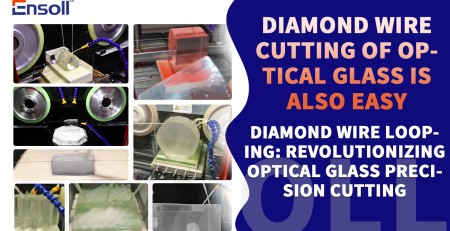
To meet these tight tolerances without compromising structural integrity, high-volume electronics manufacturers are shifting away from traditional abrasive wheel cutting and adopting Endlos Diamant-Drahtschlaufe Technologie.
Soft ferrites crack more easily than rare-earth magnets, yet the same rules that govern wie man Neodym-Magnete schneidet apply: keep cutting force low and temperature stable.
The Soft Ferrite Challenge: Ceramic Brittleness Meets High Frequency
Processing soft ferrites is a delicate balancing act. Sintered ferrite blocks are rigid but possess very low tensile strength. During traditional slicing processes, manufacturers face several distinct manufacturing bottlenecks:
1. Severe Edge Chipping and Micro-Cracking
When traditional inner-diameter (ID) saws or thick diamond blades cut through a ferrite block, they exert high localized mechanical pressure. As the blade exits the cut, this pressure causes the ceramic material to fracture, resulting in severe edge chipping (崩边). For high-frequency transformer cores, even minor edge defects can alter the magnetic flux path, increase eddy current losses, and degrade the overall efficiency of the component.
2. High Ceramic Powder Waste (Schnittbreitenverlust)
Traditional grinding wheels are relatively thick (often over $1.0\text{ Mm}$). When slicing miniature ferrite components—such as low-profile inductor cores that are only a few millimeters thick—a thick blade can easily turn up to $50\%$ of the raw material into useless ceramic sludge. Minimizing this cutting path, or kerf loss, is vital for maintaining cost-effective production.
3. Sub-Surface Damage (SSD)
The mechanical stress of a heavy, slow-moving blade doesn’t just damage the surface; it telegraphs micro-fractures deep into the interior of the ceramic matrix. Dieser Substanzschaden beeinträchtigt die mechanische Lebensdauer des Ferritkerns, was ihn anfällig für Risse unter den thermischen Zyklen von Hochleistungsbetrieb macht.
Der Durchbruch: Endloser Diamantdraht-Loop-Schnitt
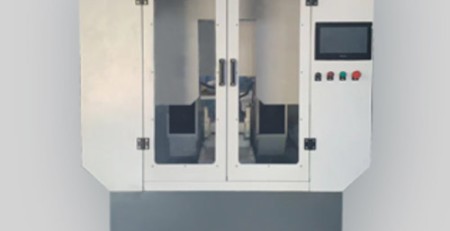
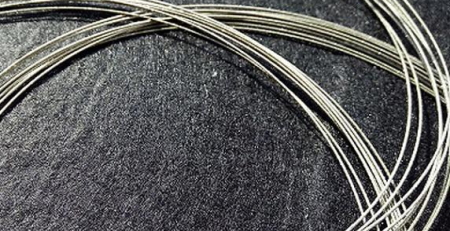
Um die Einschränkungen starrer Klingen zu überwinden, integrieren moderne Präzisionswerkstätten endlose Diamantdraht-Loops in ihre Produktionslinien. Ein Endlose Diamantdrahtschlaufe ist ein kontinuierlicher, flexibler Stahldraht, beschichtet mit präzise abgestuften Industriediamantpartikeln, der über ein Hochgeschwindigkeits-Riemenscheibensystem in einer festen, einzigen Richtungs-Loop läuft
Bei der Verarbeitung von weichem Ferrit, erzielt diese Technologie einen Quantensprung in Qualität und Effizienz aufgrund mehrerer unterschiedlicher Betriebsmechaniken:
Ultra-hohe lineare Geschwindigkeiten mit minimaler Vorschubkraft
Unlike traditional reciprocating wire saws that travel at low speeds and constantly reverse direction, an endless diamond wire loop rotates continuously in one direction at velocities between $40\text{ M/s}$ and $60\text{ M/s}$.
This immense speed changes the physics of the cut. Instead of forcing its way through the ceramic, the wire performs a lightning-fast micro-grinding action. The mechanical force exerted on the ferrite block drops to near zero, eliminating the shock factors that cause edge chipping and allowing for the safe production of ultra-thin ferrite wafers.
Drastic Reduction in Kerf Loss
Because the endless loop operates under highly optimized, steady tension without the “vibration jerk” of reciprocating systems, the core steel wire can be manufactured to be incredibly thin—frequently down to $0.20\text{ Mm}$ to $0.30\text{ Mm}$. Dieser bemerkenswert schmale Schlitz maximiert die Materialausnutzung, und ermöglicht Herstellern, deutlich mehr nutzbare Ferritkerne aus einem einzigen gesinterten Block zu gewinnen.
Außergewöhnliche Wärmeabführung und Spanabfuhr
Während weiche Ferrite hohe Betriebstemperaturen in Stromkreisen verkraften können, sind sie während der Bearbeitung sehr empfindlich gegenüber plötzlichen, lokalisierten thermischen Schocks. Wenn eine Schnittzone überhitzt, kann der Ferrit eine lokale Wärmeausdehnung erfahren, die zu sofortigen Rissen führt.
Die kontinuierliche, Hochgeschwindigkeitsbewegung von Die Diamantdrahtschleife verhindert eine Wärmeansammlung, indem sie ständig einen frischen, kühlen Drahtabschnitt in die Schnittzone einführt. In Kombination mit hochvolumigen, wasserlöslichen Kühlmitteln, wird das feine Keramikpulver (Span) sofort weggespült, der Draht bleibt scharf und der Ferritblock perfekt kühl.
Superior Surface Finish ($R_a$)
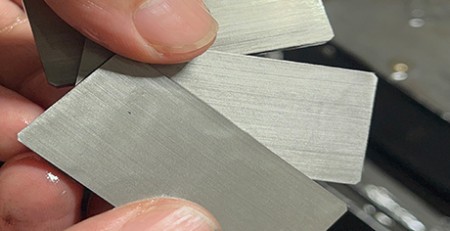
Die glatten, Die kontinuierliche Bewegung der Endlosschleife ergibt eine außergewöhnlich saubere Oberflächenbeschaffenheit mit minimaler Rauheit ($R_a$). Eine glattere Oberfläche bedeutet, dass die Kontaktflächen von geteilten Ferritkernen (wie E-Kerne oder U-Kerne) nur wenig bis gar kein zweites Läppen oder Polieren erfordern, um die perfekte Passgenauigkeit zu erreichen, die notwendig ist, um die Luftspalt-Reluktanz zu minimieren.
Technischer Vergleich: Weiches Ferrit-Schneiden
| Leistungskennwert | Traditionelle Keramik-Trennscheiben | Endlos-Diamantdrahtschleife () |
| Schneidemechanismus | Hochdruck-Mechanikscheren | Hochgeschwindigkeit, niedrig-kraft Mikroschleifen |
| Draht-/Klingenstärke | $0.8\Text{ Mm}$ to $1.5\text{ Mm}$ | $0.2\Text{ Mm}$ to $0.35\text{ Mm}$ |
| Materialausbeute | Niedrig (Hoher Schnittverlust/Schlamm) | Hoch (Minimale Materialverschwendung) |
| Kantenabplatzungen | Häufig, erfordert umfangreiches Nacharbeiten | Praktisch keine Absplitterungen oder Mikrorisse |
| Oberflächenqualität ($R_a$) | Rau, erfordert zweites Läppen | Ausgezeichnet, fast vorpolierte Oberfläche |
Optimierung der Parameter für weiche Ferrite
Achieving the perfect cut on a soft ferrite ceramic depends heavily on balancing three core machine parameters:
- Wire Speed Selection: Für harte, brittle ceramics like Mn-Zn ferrites, keeping the wire speed on the higher end ($>50\Text{ M/s}$) ensures that the material removal stays in the brittle-ductile transition zone, optimizing surface smoothness.
- Feed Rate Tuning: Die Vorschubgeschwindigkeit (the speed at which the wire pushes into the material) must be tightly controlled. Moving too fast increases bowing of the wire, which can introduce slight geometric deviations in flatness.
- Grit Size Optimization: Using a highly uniform, micro-sized diamond grit ensures that the material is eroded evenly, avoiding deep scratches that could act as stress concentrators later on.
Schlussfolgerung: Driving the Future of High-Frequency Electronics
Schlussfolgerung: Driving the Future of High-Frequency Electronics
As power electronics transition toward smaller footprints and higher power densities—driven heavily by wide-bandgap semiconductors like Silicon Carbide (Sic) and Gallium Nitride (Gan)—the demands on soft ferrite magnetic components have never been stricter.
The Endless Diamond Wire Loop provides the precise manufacturing solution that this industry requires. By overcoming the natural brittleness of industrial ceramics, eliminating edge breakage, and maximizing raw material yields, technology stands out as the premier choice for manufacturing the high-frequency magnetic components powering our automated, electrified future.
Häufig gestellte Fragen
What is the best way to cut soft ferrite cores?
Diamond wire loop slicing. The continuous single-direction wire removes the ceramic by high-speed, niedrig-kraft Mikroschleifen, which virtually eliminates the edge chipping and sub-surface cracking that traditional slitting blades cause on brittle ferrites.
Why do ferrite cores chip during cutting?
Ferrit ist eine gesinterte Keramik mit sehr niedriger Zugfestigkeit. A rigid blade concentrates mechanical pressure at the cut edge, and the material fractures as the blade exits. High localized cutting force and vibration are the root causes.
How thin can diamond wire cut ferrite?
The diamond wire core itself is typically 0.20-0.30 Mm, so the kerf is extremely narrow. That enables ultra-thin ferrite wafers and lets manufacturers extract far more usable cores from one sintered block than with 0.8-1.5 mm blades.
Does diamond wire cutting damage the magnetic properties of ferrite?
Nein. It is a cold process: the fast-moving wire constantly brings fresh, cool abrasive into the cut and water-soluble coolant flushes heat and swarf away, so there is no thermal shock or heat-affected zone to degrade the ferrite.
Technische Inhalte geprüft vom Ensoll-Engineering-Team – einem Hersteller von Diamantdraht-Schleifen 10+ Jahre der Produktionserfahrung.