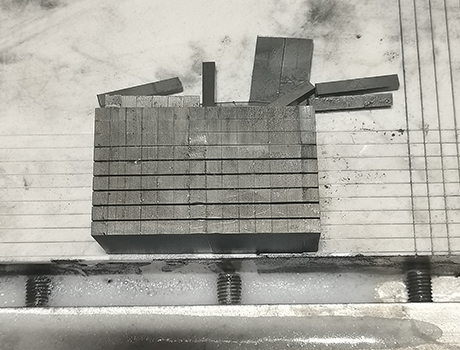
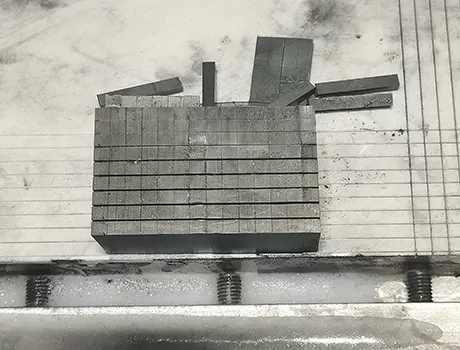
Magnetic materials like neodymium (NdFeB), Samarium-Kobalt (SmCo), Ferrit, and alnico require specialized cutting equipment to maintain their structural integrity and magnetic properties during processing. Unlike conventional metals, these materials present unique challenges that demand precision cutting solutions.
Wesentliche Erkenntnisse
Cutting magnetic materials demands equipment that handles four challenges at once: Sprödigkeit, heat sensitivity, ±0.02 mm tolerances and minimal material waste.
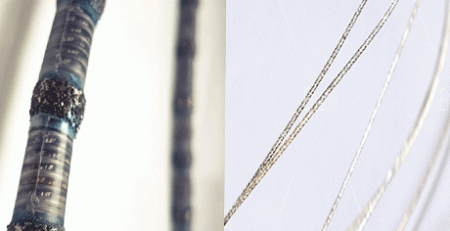
Compared with laser (heat-affected zone, <5 mm schneiden), Wasserstrahl (abrasive contamination, taper) and abrasive saws (1-2 mm-Kerf, rough finish), diamond wire saw machines are the most complete solution.
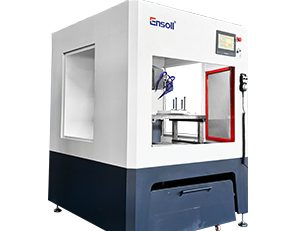
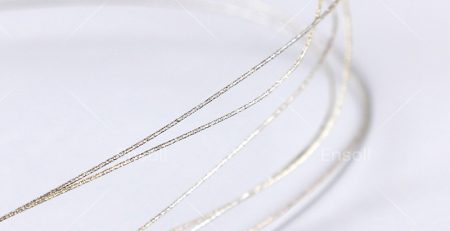
A modern machine like the ESG200-4T uses a 0.1-0.3 mm diamond wire loop at programmable 0.1-10 M/s, achieving ±0.005 mm positioning, Ra <0.2 micrometer finish and kerf loss as low as 0.15 Mm.
Typical payback is 12-18 months at medium volume, driven by 20-40% material savings and about 50% faster processing than conventional methods.
BeiEnsoll, we specialize in advanced magnetic material processing using our state-of-the-artESG200-4TDiamantdraht-Säge-Schneidemaschine. This innovative technology has revolutionized how manufacturers cut sensitive magnetic components while preserving their critical properties.
Challenges in Magnetic Material Cutting
Cutting magnetic materials presents several technical challenges that standard equipment cannot adequately address:
Sprödigkeit: Most permanent magnets are extremely brittle and prone to cracking
Heat Sensitivity: Excessive heat can demagnetize materials
Precision Requirements: Many applications demand tolerances within ±0.02mm
Materialverschwendung: Conventional methods create significant material loss
Traditional cutting methods like laser cutting, Wasserstrahlschneiden, or abrasive sawing often fail to meet these challenges effectively. This is where specialized equipment like Diamant-Drahtsägenmake the critical difference.
Challenge: Required contamination-free cutting for MRI components
Solution: ESG200-4T with medical-grade coolant system
Results: Zero contamination, 100% quality approval rate
Fallstudie 3: Aerospace Supplier
Challenge: Complex-shaped sensor magnets with tight tolerances
Solution: ESG200-4T with multi-axis capability
Results: Achieved ±0.008mm precision consistently
Future of Magnetic Material Cutting
Emerging trends that reinforce the value of diamond wire saw technology:
Thinner Magnets: Demand for <0.5mm thick components
Complex Geometries: 3D-shaped magnets for advanced applications
Material Diversity: New composite magnetic materials
Industrie 4.0 Integration: Smart, connected cutting systems
The ESG200-4T is future-proofed to address these evolving requirements through:
Software-upgradable control systems
Modular design for new capabilities
Compatibility with emerging materials
Schlussfolgerung
For manufacturers requiring precision cutting of magnetic materials, diamond wire saw technology – particularly theESG200-4Tfrom Ensoll – represents the optimal solution. It outperforms all alternatives in precision, Materialeinsparungen, and quality while eliminating thermal damage concerns.
Four main types: Diamantdrahtsägemaschinen (the most advanced option), laser cutting systems, waterjet cutters and conventional abrasive saws. For brittle magnets like NdFeB, SmCo and ferrite, diamond wire saw machines deliver the best combination of precision, surface quality and material savings.
What precision can a diamond wire saw machine achieve on magnets?
Machines such as the ESG200-4T hold ±0.01 mm dimensional accuracy with ±0.002 mm repeatability, Ra unter 0.2 micrometers and kerf loss as low as 0.15 mm — with no heat-affected zone, so magnetic properties are preserved.
Why is laser cutting risky for magnetic materials?
Laser cutting creates a heat-affected zone that can degrade or demagnetize the material near the cut, it is limited to thinner sections (typically under 5 Mm), and it carries higher equipment and operating costs than wire sawing.
How do you choose a magnetic material cutting machine?
Match the machine to the material and volume: check wire diameter range and speed programmability, tension control stability, cutting envelope, Kühlsystem, and whether the supplier offers material-specific parameter presets. Also compare kerf loss and operating cost per hour — wire saws run around $15/hour versus $30-40 for waterjet and laser.
Ferritmaterialien sind überall in moderner Technologie zu finden. Von den winzigen magnetischen Bauteilen in Ihrem Smartphone bis zu den leistungsstarken Elektromagneten in.... mehr lesen
In der anspruchsvollen Welt der Halbleiterfertigung, die Reise von einem rohen Siliziumbarren zu einer Hochleistungs- integrierten Schaltung ist... mehr lesen
Wichtige Erkenntnisse
Eine Diamantdrahtsäge ist eine offene, dünner Draht mit eingebetteten Diamantpartikeln, der für kontinuierliches geradliniges Schneiden verwendet wird... mehr lesen
Wichtige Erkenntnisse
Laserschneiden ist berührungslos und schnell, aber seine wärmebeeinflusste Zone kann Mikrorisse erzeugen, die die Effizienz der Solarzellen verringern.
Diamantdraht... mehr lesen
Zuletzt überprüft: September 2026
Wichtige Erkenntnisse
Graphit ist weich, aber spröde und abrasiv — es stumpft Klingen schnell ab und erzeugt leitfähigen Staub,... mehr lesen
Diamant-Drahtschlaufe Schneidetechnologie hat das Präzisionsschneiden in der Halbleiterfertigung und der Materialverarbeitung revolutioniert. Diese fortschrittliche Methode nutzt diamantgetränkte... mehr lesen
In der Welt des industriellen Schneidens, Präzision und Effizienz stehen an erster Stelle. Eine innovative Lösung, die in den letzten.. an Bedeutung gewonnen hat. mehr lesen
Wichtige Erkenntnisse
Draht-EDM schneidet elektrisch leitfähige Materialien unter Verwendung von Funkenerosion, daher ist die Materialhärte unerheblich - selbst gehärteter Werkzeugstahl... mehr lesen