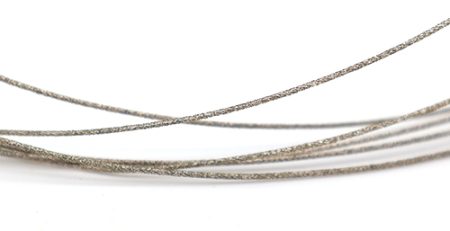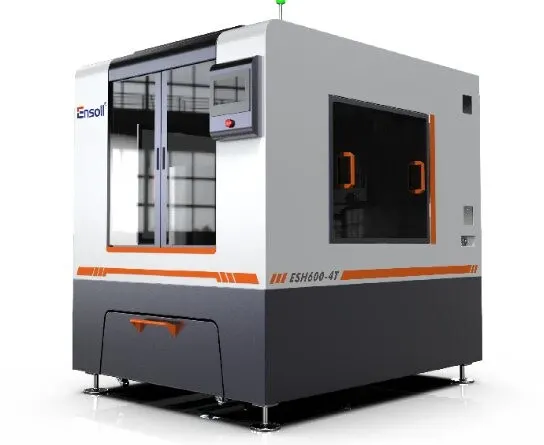
Découpe de la mousse PMI avec un fil en boucle diamantée: 0.8 Test de tranchage avec précision millimétrique
Abstrait: This application report documents a precision straight-slicing test on PMI
(polymethacrylimide) structural foam supplied by a European customer. Four slices measuring 400 mm x 400 mm x
0.8 mm were produced on an ESH600-4T horizontal boucle de fil de diamant cutting machine
using dry cutting and a fully coated diamond wire. Measured results: variation d'épaisseur totale (TTV)
0.013-0.050 mm (en moyenne 0.036 mm), tolérance d'épaisseur +/-0.043 mm, surface roughness Ra 0.68-0.82 μm, and maximum
éclats sur les bords 5.5-7.1 μm. Matching machine structure, cutting method and process parameters to the cellular
structure of PMI foam kept material removal stable and held slice dimensional accuracy and cut-surface quality
within a workable range.
Points clés à retenir
- PMI foam is a low-density structural foam with a fine cellular structure; at excessive cutting load its
skeleton is compressed or torn rather than cleanly sheared. - Dry cutting was chosen to keep coolant out of the foam cells and to remove the cleaning and drying steps
that follow a wet cut. - Across four 0.8 tranches de mm: TTV 0.013-0.050 mm (mean 0.036 mm), tolérance d'épaisseur +/-0.043 mm, Ra
0.68-0.82 μm, maximum chipping 5.5-7.1 μm. - Samples ran slightly thin overall (down to -0.043 mm), which points to a straightforward dimensional
compensation on the next run. - Machine, un fil, cutting method and parameters were matched as one set; no single parameter carried the
result.
Sample test for European customer I | Processus de coupe par boucle de fil diamanté
Overview of the PMI Foam Slicing Test
This test was carried out on PMI foam supplied by a European customer (customer I), with high-precision
straight slicing as the primary requirement. PMI (polymethacrylimide) foam is a high-performance structural foam
known for low density, a uniform cellular structure, and good specific strength and specific stiffness. Son
porous interior gives it a material-removal behaviour quite different from that of dense materials: the diamond
abrasive grains act continuously on the foam skeleton, and excessive cutting load or poorly matched parameters
readily cause local compression, tearing and an uneven cut face, all of which feed directly into slice thickness
and surface quality. This test therefore matched cutting method, configuration de la machine, wire and process
parameters to the structural characteristics of PMI foam and to the straight-slicing accuracy requirement, so
that material removal stayed stable while slice dimensions and cut-surface quality remained under control.
Because of the demands PMI foam places on cutting stability, dimensional accuracy and cross-section quality,
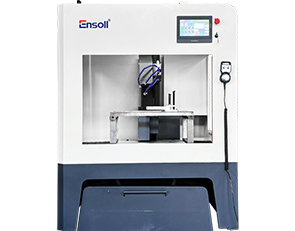
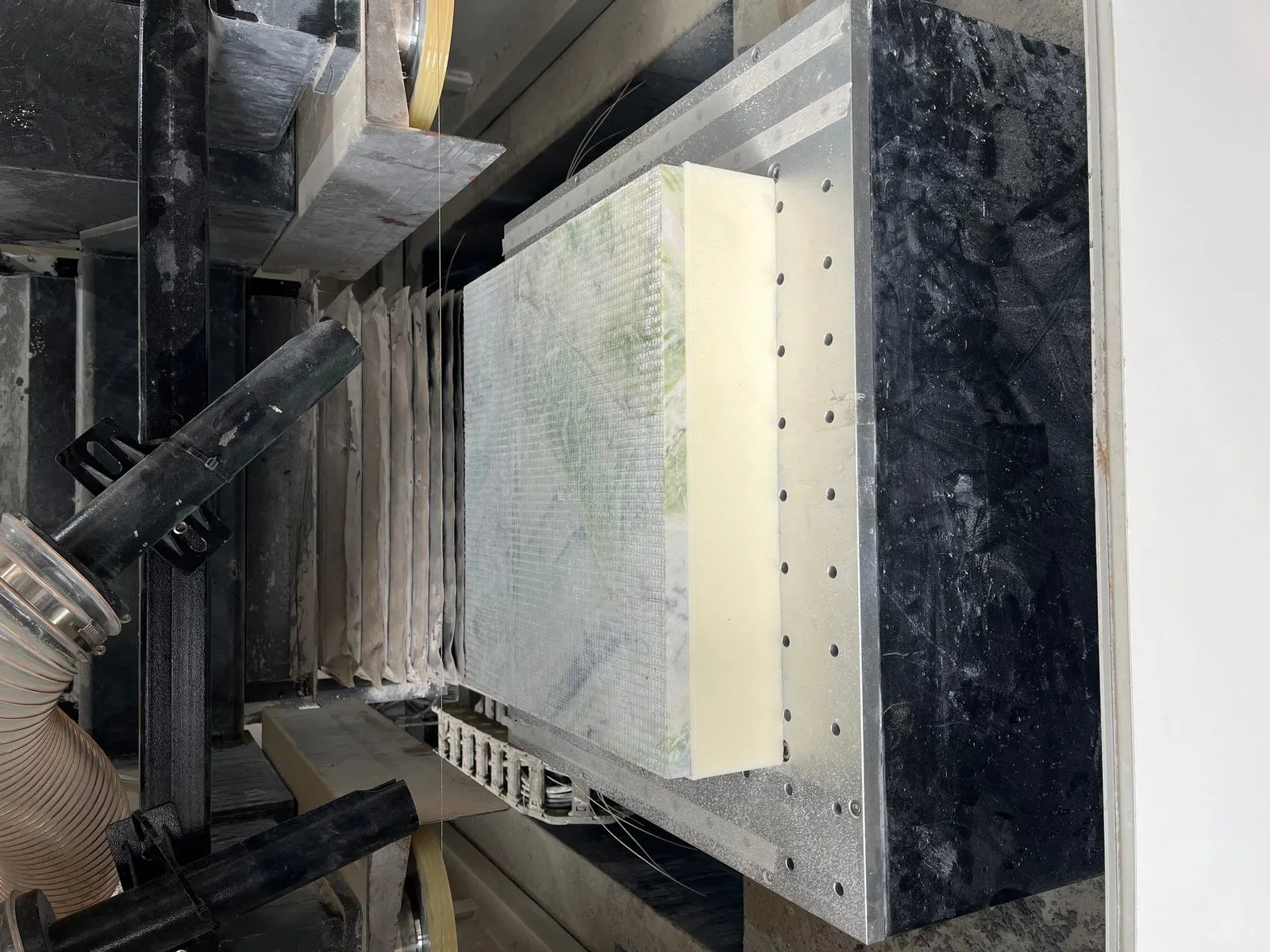
Ensoll applied a diamond wire solution tailored to foam machining. Côté machine, a dedicated horizontal
scie à fil diamantée was used so that the wire runs stably along the horizontal
plane, providing a repeatable cutting path and stable feed for straight slicing. On the consumable side, un
diamond wire suited to PMI foam keeps the abrasive grains acting on the material surface continuously and evenly,
which sustains stable removal. On the cutting-method side, dry cutting avoids coolant entering the foam cells and
lets chips escape promptly during the cut. On that basis, wire running speed and feed rate were adjusted against
the density, cellular structure and target slice thickness of the material, holding the cutting load in a
suitable band and reducing the local compression and tearing that excessive point loads cause in the foam
structure. Matching machine, un fil, cutting method and parameters as one set kept the slicing process stable and
brought slice thickness, dimensional accuracy and surface quality under control, establishing a process basis
for high-precision straight slicing of PMI foam.
1. Test Object: Basic Information
- Material: mousse PMI
- Dureté: environ MH 2
- Dimensions de la pièce: 400 mm x 400 mm x 50 mm
- Cut dimensions: 400 mm x 400 mm x 0.8 mm
2. Sélection de la machine et du fil
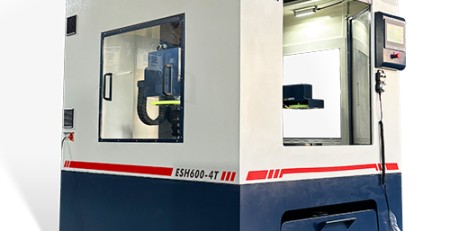
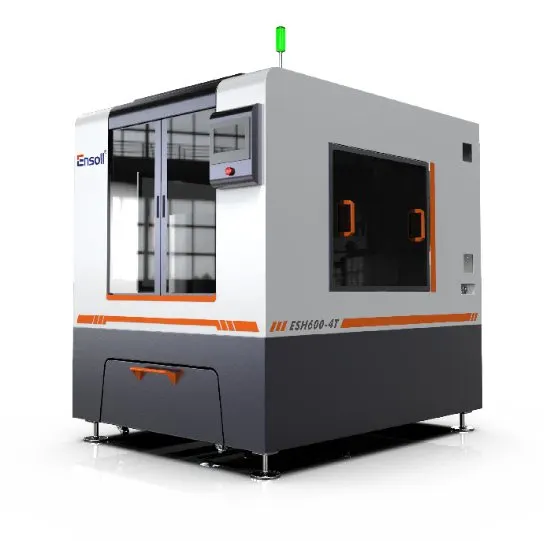
Machine type: ESH600-4T. Because PMI foam is lightweight, porous and easily deformed, et
because the requirement is high-precision straight slicing, Ensoll selected a horizontal diamond wire cutting
machine suited to PMI machining. This keeps the wire running stably and preserves cutting-path accuracy, reduces
the effect of machine vibration and cutting-load fluctuation on machining quality, and limits the local
deformation, edge defects and thickness deviation that uneven loading would otherwise produce, thereby improving
both the dimensional accuracy and the cut-surface quality of PMI slices.
- Type de liquide de refroidissement: dry cutting. Because PMI foam is porous, lightweight and prone to absorbing
liquids, dry cutting prevents coolant from entering the cells or remaining in the material and destabilising
slice dimensions. It also removes the cleaning and drying steps that follow a wet cut, which helps preserve
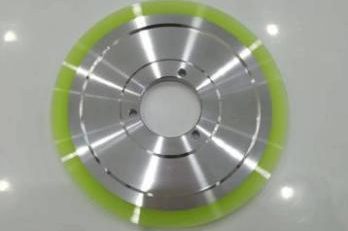
structural integrity and dimensional accuracy. - Wire type: entièrement revêtue. Un fully coated diamond wire loop
raises grain bonding strength and distribution stability, sustaining a stable and continuous cutting capability.
It reduces the cutting fluctuation caused by wire wear and grain pull-out, limits tearing and edge defects, et
improves the dimensional consistency and surface quality of PMI slices.
3. Méthode de découpe et avantages de la machine
Horizontal cutting method. La machine utilise une structure de coupe horizontale avec un
mouvement unidirectionnel et rapide boucle de fil de diamant comme outil de coupe; le
la pièce est fixée sur la table de travail et découpée par avance de précision. Cette disposition est compacte avec un trajet de mouvement clair,
ce qui aide à maintenir la trajectoire du fil stable et réduit l'influence des fluctuations de charge sur l'épaisseur de tranche et
la qualité de la surface coupée. Elle supporte également les modes de coupe fixes,, rotatifs et oscillants, de sorte que le mode de coupe peut être adapté
aux propriétés du matériau et aux exigences d'usinage, élargissant l'adaptabilité de la machine à différents matériaux et
conditions de processus.
Système de contrôle intelligent de la tension. La tension par ressort combinée avec la rétroaction du capteur de force
permet un fonctionnement à tension constante ou variable selon l'état d'usinage. Maintien de la tension du fil
stable during the cut improves wire running stability and reduces trajectory fluctuation and the risk of wire
breakage; tension is automatically reduced in standby and during wire changes, which limits wire fatigue and
pulley wear.
Multi-stage automatic cutting. Épaisseur de la tranche, number of cuts, cutting speed and cutting
depth can be preset, and the machine then completes continuous cutting automatically to those parameters,
reducing manual interference in the process. For tasks requiring many slices in succession, this raises cutting
efficiency and batch-to-batch consistency.
Breakpoint resume. If the process is interrupted by a wire break, power loss or similar
fault, the system records the current cutting position and resumes from that point once operation is restored,
with no need to reset the workpiece origin. Cela réduit l'erreur d'usinage due au repositionnement répété, diminue
la perte de matériau et améliore l'efficacité de l'usinage continu.
4. Paramètres et méthode de refroidissement
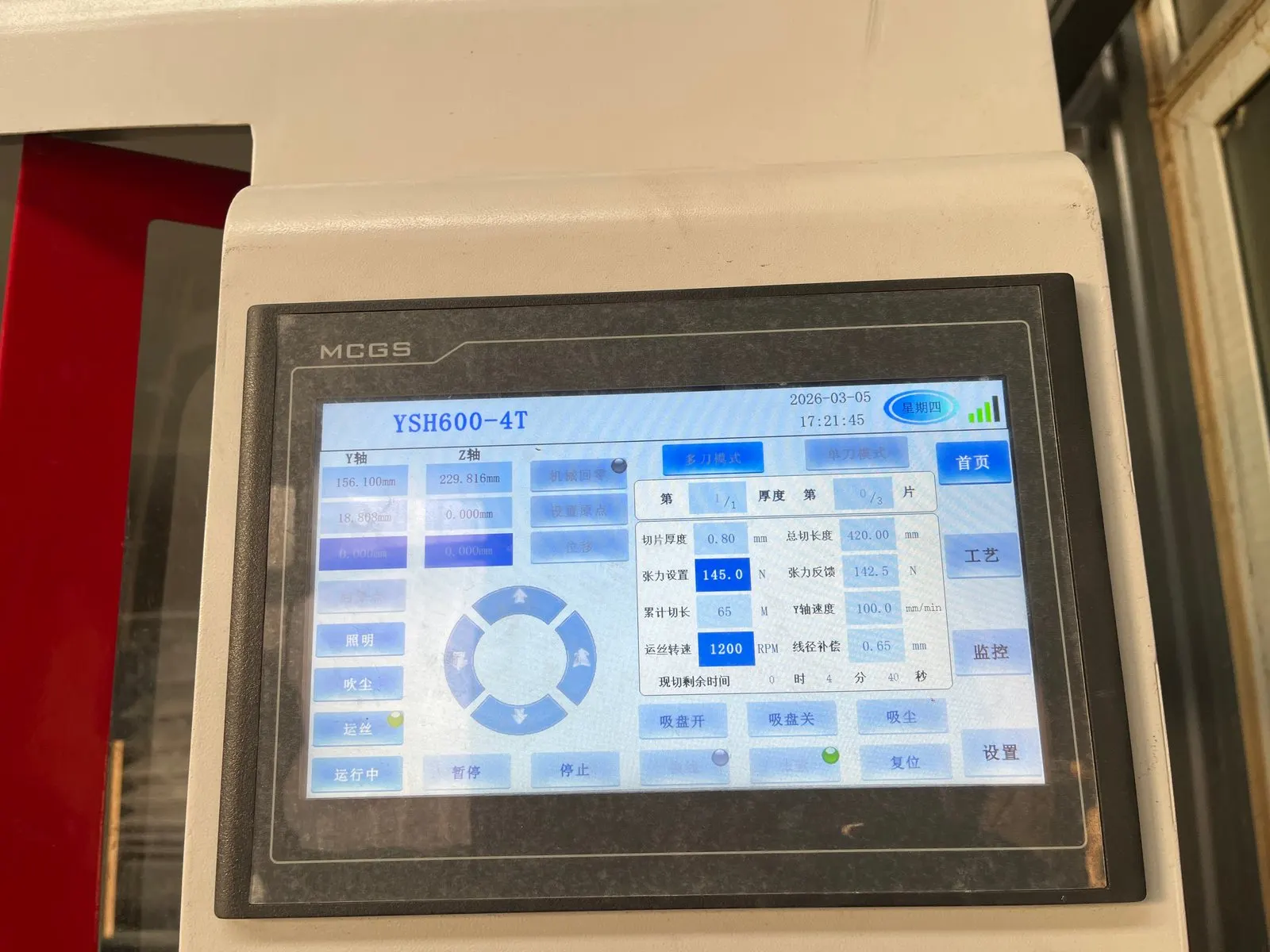
| Paramètre | Valeur |
|---|---|
| Diamètre du fil (mm) | 0.60 x 3460 |
| Vitesse de déplacement du fil (mm/min) | 100 |
| Largeur de coupe (mm) | 400 |
| Tension du fil de coupe (N) | 145 |
| Vitesse du fil (m/s) | 25 |
| Temps de flexion du fil (s) | 60 |
| Charge de coupe (N·m) | 17 |
5. Efficacité et résultats de coupe
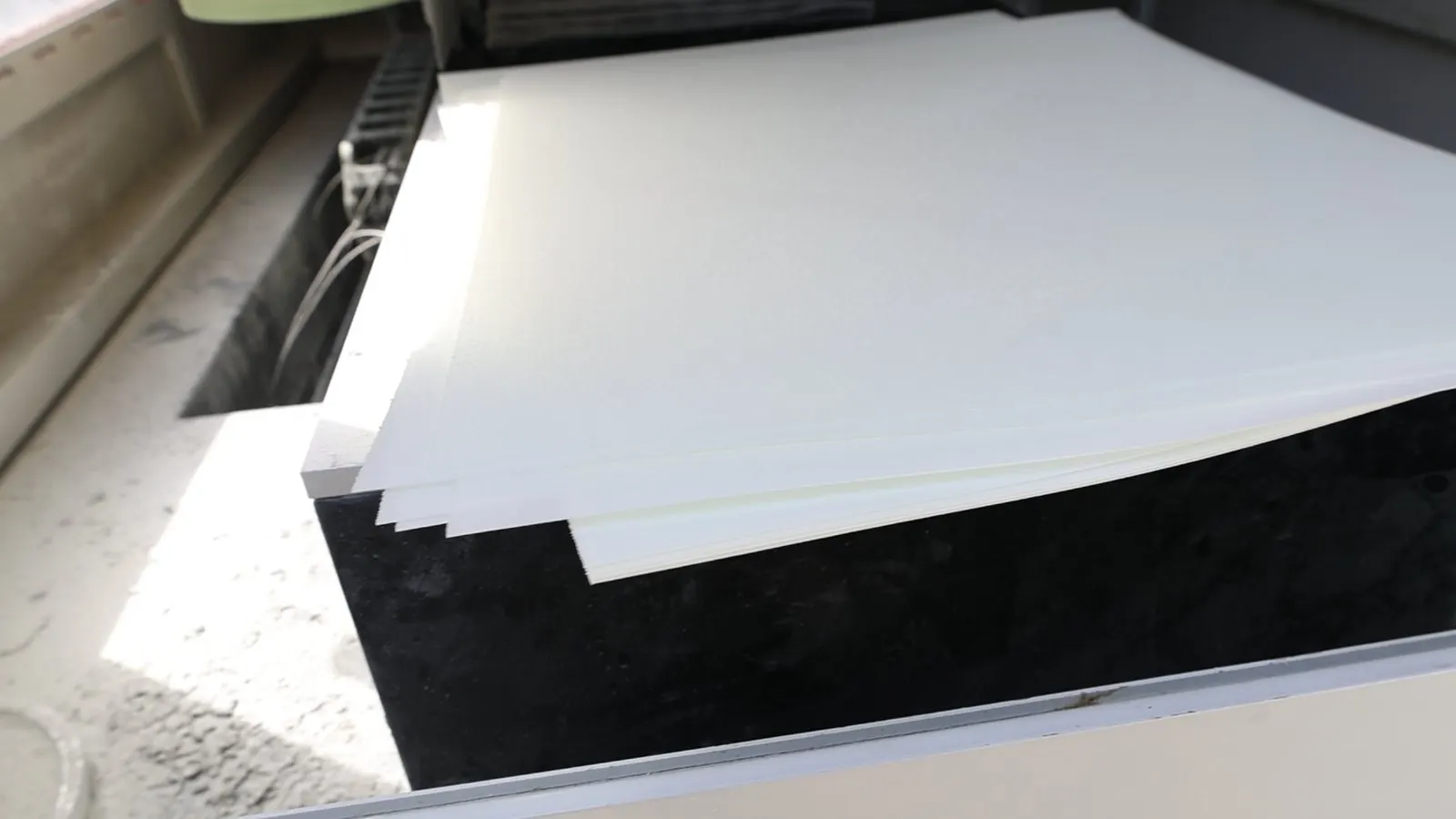
5.1 Données de test TTV (mm)
TTV (Variation totale de l’épaisseur) a été mesuré à l'aide d'une grille à neuf points, méthode d'épaisseur à double sonde sur une
table à ventouse, appliqué aux tranches de mousse PMI produites par découpe au fil diamanté. Les dimensions de l'échantillon découpé étaient
400 mm x 400 mm x 0.8 mm, avec une épaisseur nominale de 0.8 mm. Avant la mesure, l'instrument a été thermiquement
stabilisé et calibré avec un bloc d'épaisseur standard pour réduire la dérive zéro et l'erreur systématique. Après
nettoyage sans poussière, each sample was centred on the vacuum chuck and held by negative pressure so that it stayed
in a stable measuring state, limiting the effect of position shift, local warping and deformation on the
thickness readings. The procedure follows the same nine-point method used in our
PEEK slicing test. Thickness data were then collected in sequence at the preset nine
grid positions, and the difference between the largest and smallest readings across all points was taken as the
TTV of that sample, which is used to evaluate the thickness uniformity and machining consistency of PMI foam
slices.
| Échantillon | Lectures d'épaisseur en neuf points (mm) | Tmax | Tmin | TTV |
|---|---|---|---|---|
| S01 | 0.785, 0.790, 0.799 / 0.800, 0.802, 0.812 / 0.819, 0.832, 0.835 | 0.835 | 0.785 | 0.050 |
| S02 | 0.752, 0.754, 0.757 / 0.759, 0.762, 0.775 / 0.786, 0.787, 0.789 | 0.789 | 0.752 | 0.037 |
| S03 | 0.747, 0.748, 0.751 / 0.754, 0.756, 0.757 / 0.762, 0.784, 0.791 | 0.791 | 0.747 | 0.044 |
| S04 | 0.749, 0.751, 0.753 / 0.755, 0.759, 0.760 / 0.760, 0.761, 0.762 | 0.762 | 0.749 | 0.013 |
Évaluation: Four PMI foam slices were tested for thickness uniformity by the nine-point
méthode. TTV values ranged from 0.013 À 0.050 mm avec une moyenne de 0.036 mm. Sample S04 showed the smallest
variation, à 0.013 mm. Overall, the results indicate reasonable slice thickness consistency, although some
scatter remains between samples.
5.2 Données de tolérance d'épaisseur (mm)
Thickness tolerance was measured by the same nine-point grid method, avec 0.800 mm as the nominal thickness of
the sample. The deviation between the measured thickness at each point and the nominal thickness was calculated,
et le maximum d'écart positif, maximum negative deviation and thickness deviation range were collated to
evaluate the dimensional accuracy and overall machining consistency of the PMI foam slices.
| Échantillon | Épaisseur moyenne (mm) | Déviation d'épaisseur (mm) |
|---|---|---|
| S01 | 0.808 | +0.008 |
| S02 | 0.769 | -0.031 |
| S03 | 0.761 | -0.039 |
| S04 | 0.757 | -0.043 |
| Écart positif maximal | +0.008 | +0.008 |
| Écart négatif maximal | -0.043 | -0.043 |
| Tolérance d'épaisseur | +/-0.043 | +/-0.043 |
Évaluation: Avec 0.800 mm as the nominal thickness, the average thicknesses of the four PMI
foam slices were 0.808, 0.769, 0.761 et 0.757 mm, corresponding to deviations of +0.008, -0.031, -0.039 et
-0.043 mm. L'écart positif maximal était +0.008 mm, the maximum negative deviation -0.043 mm, et la
overall thickness tolerance +/-0.043 mm. The results show that sample thickness tends toward the negative side,
with the last three samples running somewhat thin; thickness control can be improved further through cutting
parameters and dimensional compensation.
5.3 Surface Roughness Ra Data (μm)
Rugosité de surface (Ra) was measured to ISO 4287 using a stylus profiler. Trois positions représentatives,
centre, milieu-gauche et milieu-droit, were profiled on the cut face of each PMI foam slice, and Ra was calculated at
each position to evaluate surface quality and machining consistency after diamond wire cutting.
| Échantillon | Ra-1 | Ra-2 | Ra-3 | Ra moyen |
|---|---|---|---|---|
| S01 | 0.82 | 0.79 | 0.85 | 0.82 |
| S02 | 0.76 | 0.72 | 0.78 | 0.75 |
| S03 | 0.80 | 0.75 | 0.82 | 0.79 |
| S04 | 0.68 | 0.65 | 0.71 | 0.68 |
Évaluation: Four PMI foam slices were tested for surface roughness by the three-point
méthode. Average Ra ranged from 0.68 À 0.82 μm, with little variation between measuring positions, indicating a
broadly uniform cut surface and a stable wire running and material-removal process.
5.4 Données sur l’ébréchure des bords (μm)
Chipping was measured by optical imaging on a toolmaker’s microscope to quantify edge defects on the PMI foam
slices. Sample edges were cleaned before measurement, and the instrument magnification and measuring scale were
calibrated. Each edge region of the slice was then examined under the microscope, recognisable chips, notches
and local edge damage were located and measured, and the defect size at each measuring point was recorded. Le
largest defect on a single slice was taken as the primary evaluation index, giving a combined view of edge
integrity and machining quality after cutting PMI foam.
| Échantillon | Position 1 | Position 2 | Position 3 | Position 4 | Ébréchure maximale |
|---|---|---|---|---|---|
| S01 | 5.2 | 6.4 | 5.8 | 7.1 | 7.1 |
| S02 | 4.6 | 5.7 | 5.1 | 6.3 | 6.3 |
| S03 | 5.0 | 6.1 | 5.5 | 6.8 | 6.8 |
| S04 | 3.8 | 4.7 | 4.3 | 5.5 | 5.5 |
Évaluation: Four PMI foam slices were inspected for edge defects by the four-point method.
Defect sizes were generally small, with maximum chipping between 5.5 et 7.1 um and little difference between
samples. The results indicate stable edge material removal during diamond wire cutting and good edge integrity on
the slices.
6. Conclusion
The high-precision slicing of PMI foam in this test produced good results, mainly because the dedicated
cutting machine, the dry cutting method and the process parameters were matched as one set. PMI foam is a
high-performance structural foam with low density, an internal cellular structure and good specific strength and
stiffness, and that cellular structure gives it a load behaviour different from dense materials during diamond
wire cutting. The diamond grains act continuously on the internal skeleton, and when the cutting load is too
high or the parameters are poorly matched, local compression, tearing and an uneven cut face appear and affect
slice thickness and dimensional accuracy. Aiming at the structural properties of PMI foam and the straight
slicing accuracy requirement, this test therefore optimised machine selection, cutting method and process
parameters in a targeted way, controlling dimensional accuracy and cut-surface quality while keeping the cutting
process stable.
Première, sélection de la machine. Given the demands PMI foam slicing places on motion stability,
cutting accuracy and machine rigidity, a dedicated horizontal diamond wire loop cutting machine for precision
PMI machining was selected. Horizontal cutting keeps the wire running stably along the horizontal plane, which
helps hold the cutting trajectory and feed motion steady and reduces the effect of machine vibration, motion
error and wire running fluctuation on cut position and dimensional accuracy. Stable feed and motion control also
narrow the variation in cutting load, keeping the relative motion between wire and PMI foam consistent. Ceci
reduces the compression and tearing that uneven local loading causes, improves slice dimensional consistency,
and provides a stable machine basis for high-precision PMI slicing.
Deuxièmement, cutting method. Given the cellular structure and properties of PMI foam, dry cutting
a été utilisé. Dry cutting introduces no liquid coolant, so liquid cannot enter the foam cells, and the cleaning and
drying steps that would otherwise affect the material state are avoided. Le
fully coated diamond wire loop grinds the material directly and continuously, so
removal takes place under relatively stable cutting conditions. Controlling wire
running state and cutting load sensibly reduces the local squeezing and tearing the material experiences during
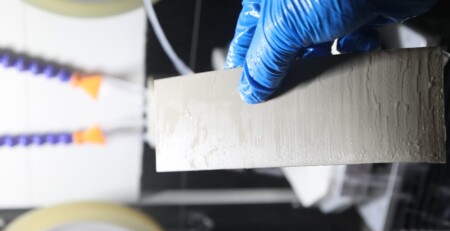
découpage, improving the uniformity of the cut cross-section and edge quality, and keeping the process
consistent.
Third, paramètres du processus. Given the low density, cellular structure and removal behaviour of
mousse PMI, wire running speed and feed rate were matched accordingly. Parameters were set to keep the wire running
stably and material removal even, avoiding a feed rate so high that the cutting load rises and the foam skeleton
takes a large local force; wire running speed was controlled so that cutting stayed continuous and stable with
less load fluctuation. Targeted adjustment of the cutting parameters kept material removal comparatively smooth
et, while meeting machining efficiency, improved slice thickness and dimensional consistency and the quality of
the cut surface.
Taken together, the results for slice dimensional accuracy, tolérance d'épaisseur, Rugosité (Ra) et
cut-edge quality show that, through coordinated optimisation of a dedicated horizontal cutting machine, sec
cutting and suitable cutting parameters, diamond wire loop cutting meets the requirements of high-precision
straight slicing for PMI foam. The machined samples performed consistently in dimensional accuracy, slice
thickness consistency and cut-surface quality, which indicates that matching machine structure, cutting method
and process parameters to the structure and cutting behaviour of PMI foam effectively improves material removal
and process stability, and provides a process reference for high-precision straight slicing of PMI foam.
Données de processus associées
The validated parameter window behind these results – what each setting does on a cellular foam and which way to move it when a defect appears – is published as a standalone reference: PMI foam cutting parameters. For a side-by-side comparison with a dense thermoplastic measured on the same basis, voir PEEK vs PMI foam, and for the thickness measurement method itself, le nine-point TTV guide.
Questions fréquemment posées
Une coupe à fil diamant peut-elle trancher la mousse PMI jusqu'à 0.8 mm d'épaisseur?
Oui. Dans ce test, quatre 400 mm x 400 Des tranches de mousse PMI de 4 mm ont été découpées à une épaisseur nominale de 0.8 mm sur un
ESH600-4T horizontal scie à fil diamantée. La variation totale mesurée de l'épaisseur
(TTV) allait de 0.013 À 0.050 mm avec une moyenne de 0.036 mm, et la tolérance globale de l'épaisseur était de
+/-0.043 mm, ce qui constitue une base de travail pour des composants en mousse de précision.
Pourquoi la coupe à sec a-t-elle été choisie pour la mousse PMI au lieu de la coupe à humide?
La mousse PMI est poreuse, lightweight and prone to absorbing liquids. La coupe à sec empêche le liquide de refroidissement de pénétrer
dans les cellules ou de rester dans le matériau et de déstabiliser les dimensions des tranches, et elle élimine les étapes de nettoyage et
de séchage qui suivent une coupe à humide. Cela aide à préserver la structure de la mousse et la précision dimensionnelle
des tranches.
Quelle qualité de surface peut-on attendre lors de la coupe de mousse PMI?
La rugosité de surface a été mesurée selon ISO 4287 avec un profilomètre à stylet à trois positions par tranche. Ra moyen
allait de 0.68 À 0.82 um with little variation between measuring positions, and the maximum edge chipping
measured by optical microscopy was 5.5 À 7.1 μm, indicating a uniform cut surface with good edge integrity.
Why did the PMI foam slices come out slightly thin?
Avec 0.800 mm as the nominal thickness, the four slices averaged 0.808, 0.769, 0.761 et 0.757 mm, so three of
them ran thin by 0.031 À 0.043 mm. This is a systematic offset rather than random scatter, and it can be
corrected directly through cutting parameters and dimensional compensation on the next run.
Which other materials has Ensoll tested with diamond wire loop cutting?
Ensoll has published comparable process data for other polymers and hard-to-cut materials, including a
PEEK precision slicing test and a guide to the
matériaux adaptés à la découpe par boucle de fil diamanté. For general process questions, voir
le FAQ sur la technologie de découpe à fil diamanté en boucle.
Technical content reviewed by the Ensoll engineering team – a diamond wire loop manufacturer with 10+ des années d'expérience en production.