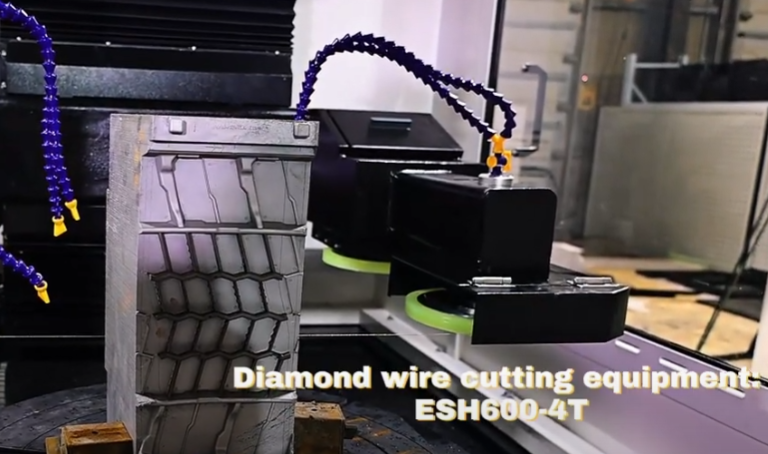
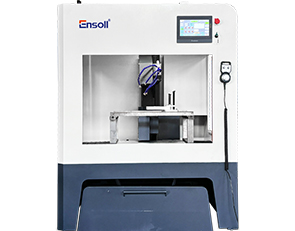
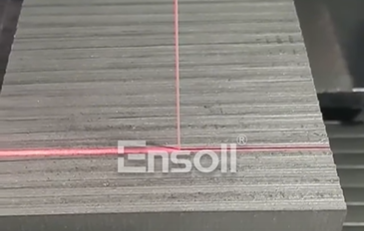
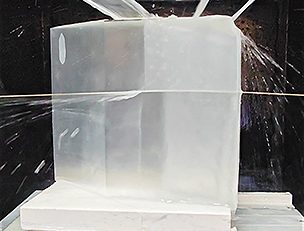
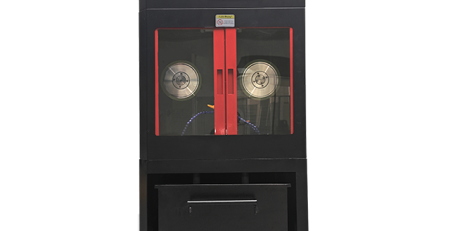
Alumina is hard, résistante à l'usure et fragile; chipping at the entry and exit of the cut is the main defect to control.
Diamond wire cutting uses distributed grinding instead of concentrated shearing, which keeps edges intact.
Vert (non fritté) bodies and fully sintered alumina need different wire grit and feed settings.
Introduction
Alumine (Al₂O₃), ou de l’oxyde d’aluminium, est l’une des céramiques avancées les plus utilisées en raison de sa dureté exceptionnelle, stabilité thermique, et les propriétés d’isolation électrique. Toutefois, Son extrême résistance mécanique et sa fragilité le rendent difficile à usiner avec les méthodes de coupe conventionnelles. Les machines de découpe à la scie à fil diamanté sont apparues comme la solution privilégiée pour la haute précision, Découpe à faible endommagement de composants en alumine dans tous les secteurs.
Cet article explore les principes, Avantages, et les applications de la découpe à la scie à fil diamanté pour l’alumine, along with key considerations for optimizing the process.
Challenges in Cutting Alumina
Before discussing diamond wire saw technology, it’s important to understand why alumina is difficult to machine:
-Extreme Hardness (9 on Mohs scale)**: Only diamond-based tools can effectively cut it without excessive wear.
– Brittleness**: Prone to chipping and micro-cracks if subjected to improper cutting forces.
– Thermal Sensitivity**: High-speed abrasive methods can induce thermal stress, leading to fractures.
Traditional machining techniques, such as grinding, laser cutting, or ultrasonic machining, often result in:
Comment fonctionne la découpe à la scie à fil diamanté
A diamond wire saw cutting machine utilizes a high-tensile steel wire embedded with synthetic diamond particles, running in a continuous loop at controlled speeds. The key components and process steps include:
1. Diamond Wire Composition
–Core Material: High-carbon steel wire for strength and flexibility.
– Granulométrie du diamant: Synthetic diamond particles (30–100 µm) bonded to the wire via electroplating or resin bonding.
– Diamètre du fil: Typically 0.1–0.5 mm, depending on the required precision.
2. Mécanisme de coupe
– The wire moves at speeds of 10–60 m/s, with controlled tension to prevent deflection.
– The diamond particles act as micro-cutting tools, gradually eroding the alumina.
– A coolant (water-based or oil-based) is applied to:
– Reduce friction & heat generation
– Flush away debris
– Extend wire life
3. Vitesse d’avance & Paramètres de coupe
– Optimized feed rate (0.1–5 mm/min) ensures efficient material removal without wire breakage.
– Lower speeds for thicker alumina blocks to minimize chipping.
– Higher speeds for thin wafers to improve productivity
Affichage de coupe:
Advantages of Diamond Wire Saw Cutting for Alumina
Compared to traditional methods, diamond wire sawing offers:
✔ Ultra-Precise Cuts – Kerf widths as narrow as **0.2 mm**, minimizing material waste.
✔ Superior Surface Finish – Ra (roughness) values below **0.5 µm**, reducing post-processing.
✔ Ability to Cut Complex Shapes – Suitable for curved, angled, or thin-section cuts.
✔ Longer Tool Life – Diamond wire lasts significantly longer than abrasive blades.
Applications in Industry
Diamond wire-cut alumina is used in:
1.Électronique & Semi-conducteurs
– Alumina substrates for IC packaging
– Insulating components in high-power electronics
2.Optique & Laser Technology
– Laser tubes & reflectors requiring high thermal stability
– Transparent alumina windows for specialized optics
3.Céramiques industrielles
– Wear-resistant liners for machinery
– High-temperature furnace components
4.Médical & Aérospatiale
– Biocompatible alumina implants
– Lightweight structural components
Considérations clés pour une coupe optimale
Pour maximiser l'efficacité et la qualité de la coupe:
Sélection du fil – Choisissez la taille de grain de diamant et la résistance de liant en fonction de la dureté de l'alumine.
Gestion du liquide de refroidissement – Une filtration appropriée empêche le colmatage et prolonge la durée de vie du fil.
Contrôle de la tension – Empêche la rupture du fil et garantit des coupes droites.
Optimisation du taux d'avance – Équilibre la vitesse de coupe et la finition de surface
Conclusion
Thediamond wire saw cutting machine is a game-changer for machining alumina, offeringunmatched precision, Perte de matière minimale, and superior surface integrity. As industries demand tighter tolerances and more complexcéramiquecomponents, this technology will remain indispensable for advanced material processing.
For manufacturers and researchers working with alumina, investing in a high-quality diamond wire saw system can significantly improve yield, réduire les déchets, and enhance product performance.
Questions fréquemment posées
Comment couper de la céramique d'alumine sans l'ébrécher?
Use a diamond wire saw with fine grit, a controlled feed rate and full coolant coverage. The distributed grinding action avoids the concentrated stress that causes chips.
Peut-on couper de l'alumine après frittage?
Oui, though it is much harder and slower. Most shops rough-shape green bodies and only finish after sintering.
Qu'est-ce qui provoque l'ébréchure des bords lors de la coupe de l'alumine?
Concentrated mechanical load at the entry and exit of the cut, made worse by vibration from unstable wire tension.
Le fil diamanté est-il meilleur qu'une lame diamantée pour l'alumine?
For precision and thin sections, oui: fente plus étroite, less chipping, and no blade wander.
Contenu technique examiné par l'équipe d'ingénierie d'Ensoll — un fabricant de boucles de fil diamanté avec 10+ des années d'expérience en production.
Key Takeaways
Four main types of diamond wire saw machines exist: fil continu, multi-fil, fil fixe et machines portables.
Scie à fil continu.... Lire la suite
Key Takeaways
Controlled tests on 5 le verre SCHOTT B270 de mm montrent qu'une scie à fil diamant atteint Ra 0.18-0.22 micromètres contre Ra... Lire la suite
Points clés
La découpe en boucle avec fil de diamant guide un fil enduit de diamant enroulé en boucle continue sur la surface de la lentille, sculpture complexe.... Lire la suite
Points clés
Les scies à fil diamanté coupent les tiges de tungstène en utilisant un fil incorporant des particules de diamant - one of the few practical... Lire la suite
Key Takeaways
Alumina ceramics are composed primarily of aluminum oxide (Al2O3) and are classified into grades by purity; they combine exceptional... Lire la suite
Points clés
Les briques sont généralement évaluées 5-8 sur l'échelle de dureté de Mohs, donc les outils de découpe et de meulage ont besoin d'abrasifs plus durs et plus.... Lire la suite
Points clés
Verre de quartz (silice fondue) est prisé pour sa clarté exceptionnelle, sa haute résistance thermique et son inertie chimique, ce qui le rend essentiel dans... Lire la suite
Points clés
Les matériaux magnétiques se répartissent en trois familles: aimants permanents (NdFeB, SmCo, AlNiCo, ferrite), magnétiques doux (Acier au silicium, ferrite douce, amorphe... Lire la suite
Depuis des siècles, le jade a été vénéré pour sa beauté, durabilité, et sa signification culturelle, particulièrement dans l'art et la joaillerie asiatiques. Toutefois,... Lire la suite
Nous sommes un fabricant leader en Chine spécialisé dans la machine de découpe à la scie à fil diamantée. Avec notre propre recherche et développement.. Lire la suite