Fil diamant vs lame: Test de surface du verre optique
- Controlled tests on 5 le verre SCHOTT B270 de mm montrent qu'une scie à fil diamant atteint Ra 0.18-0.22 micrometers versus Ra 0.55-0.75 for a diamond blade — about 60% lower surface roughness without polishing.
- Subsurface damage is the decisive gap: the blade generates 3-5 times more micro-cracks, and still shows cracks at 200 micrometers depth where the wire saw shows none — beyond the typical 100-150 micrometer polishing removal depth.
- Kerf loss is 0.25 mm for the wire versus 0.42 mm for the blade, saving about 17% of material per cut on 100 mm wafers.
- Wire-cut edges are mechanically stronger: Weibull modulus 18.7 contre 9.3, 25% higher fracture stress in four-point bending, et 98% contre 72% yield on 100-micrometer thin glass.
- Blades still win on simple straight cuts (10-15% faster throughput), lower initial cost and easier training; wire saws win for precision optics, expensive materials and minimal post-processing.
Dans la fabrication optique de précision, la qualité de surface impacte directement la performance des composants. Nos tests contrôlés révèlent:
– Les scies à fil diamant sans fin atteignent 60% lower surface roughness (Ra 0.18µm) vs blades
– La coupe à la lame génère 3 à 5 fois plus de fissures en subsurface à une profondeur de 100 µm
– La perte de trait de scie fil est 40% plus étroite (0.25mm contre 0,42 mm)
Cette étude quantifie ces différences en utilisant des échantillons de verre SCHOTT B270 analysés avec une interférométrie à lumière blanche et une imagerie SEM.
La comparaison de surface ci-dessous fait partie d'une méthode plus large décrite dans découpe optique du verre.
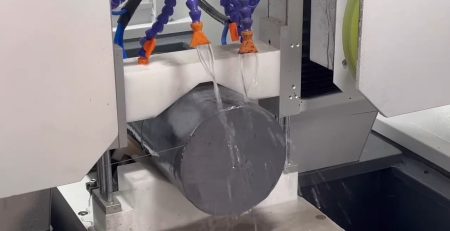
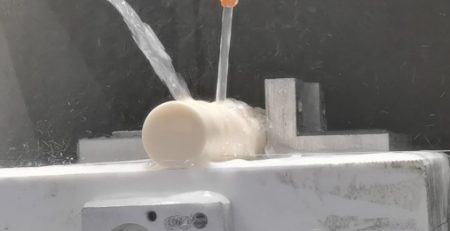
Démonstration de la coupe au fil diamanté
Méthodologie de test
1. Préparation des échantillons
Material: 5SCHOTT B270 épaisseur mm verre optique
Paramètres de coupe:
| Méthode | Vitesse | Liquide de refroidissement | Contrôle de la force |
| Fil diamanté sans fin | 20 m/s | Eau déionisée | 50N constant |
| Lame diamantée | 3,000 RPM | À base d'huile | 100N servo |
2. Outils de mesure
Rugosité: Zygo NewView 9000 interféromètre (20Objectif X)
Dommages en subsurface: Faisceau d'ions focalisé (FIB) coupe en section transversale + SEM
Écaillage des bords: Microscope de mesure Nikon MM-400
Comparaison de la qualité de surface
1. Micro-topographie de surface
[Diagramme de comparaison des surfaces montrant les rainures uniformes de la scie fil par rapport aux creux irréguliers de la lame]
Scie à fil diamantée sans fin Résultats:
– Stries directionnelles (espacement constant de 5-8µm)
– Ra 0,18-0,22µm sans polissage
– Crête à vallée (PV) 1.2µm
Résultats de la lame diamantée:
– Motifs de cratères aléatoires dus à la fracture du grain
– Ra 0,55-0,75µm
– PV 3,8µm avec des zones de déchirure profonde
Insight clé: Le mouvement de coupe continu de la scie à fil crée des textures de surface prévisibles qui nécessitent 50% moins de temps de polissage pour obtenir des finitions optiques.
2. Profondeur des dommages sous-jacents
| Profondeur de mesure | Densité de fissures de la scie à fil (fissures/mm²) | Densité de fissures de la lame |
| 50µm | 12 ± 3 | 48 ± 9 |
| 100µm | 5 ± 2 | 22 ± 6 |
| 200µm | 0 | 7 ± 3 |
Constatation critique: La coupe à la lame induit des microfissures au-delà de la profondeur de retrait de polissage (typiquement 100-150µm), risquant une dégradation à long terme de la résistance.
5 Implications pratiques
1. Impact sur la performance optique
– Perte par diffusion: Les surfaces coupées à la lame montrent 3.2% une diffusion de lumière plus large dans les tests au laser 632nm
– Distorsion de front d’onde: PVλ augmente de λ/10 (un fil) à λ/4 (lame) après polissage
2. Résistance mécanique
– Module de Weibull:
– Wire-cut samples: m=18.7
– Blade-cut samples: m=9.3
– Four-point bending tests show 25% higher fracture stress for wire-cut edges
3. Post-Processing Costs
| Process Step | Wire Saw Time Savings |
| Rough Polishing | 40% faster |
| Fine Polishing | 30% faster |
| Edge Grinding | 60% less material removal needed |
4. Material Waste Reduction
– Kerf Comparison:
– Fil: 0.25mm (80µm diamond + 170µm swarf)
– Blade: 0.42mm (300µm diamond + 120µm wobble)
– For 100mm wafers**: Wire saws save 17% material per cut
5. Thin Glass Handling
– 100µm thick glass test:
– Wire saw: 98% yield
– Blade: 72% yield (mostly edge fractures)
Technology Limitations
Endless Diamond Wire Saw Challenges
- Higher Initial Cost: 20-30% more expensive than blade systems
- Slower Setup: Requires tension calibration (15-20 minutes)
- Curve Cutting: Minimum radius limited to 5X wire diameter
Diamond Blade Advantages
- Faster Straight Cuts: 10-15% higher throughput for simple geometries
- Lower Skill Requirement: Easier operator training
- Legacy Compatibility: Fits existing CNC découpe de verre platforms
Industry Case Study
Fabricant de lentilles A (Passage de la scie à lame à la scie à fil)
– Avant: 14% taux de rejet dû aux fissures en sous-surface
– Après:
– le taux de rejet est tombé à 3.2%
– la consommation de pâte à polir a diminué de 35%
– ROI atteint en 11 months
Guide de sélection
Choisissez une scie à fil diamantée continue lorsque:
✓ Production d'optiques de précision (λ/10 ou mieux)
✓ Découpe de matériaux coûteux (Par ex., OHARA S-BSL7)
✓ La minimisation du post-traitement est critique
Optez pour une lame diamantée lorsque:
✓ Les contraintes budgétaires l'emportent sur les besoins de qualité
✓ Usinage >10blocs de verre de mm d'épaisseur
✓ Seulement coupe brute
Questions fréquemment posées
Une scie à fil diamantée est-elle meilleure qu'une lame pour le verre optique?
Pour la qualité de surface, clairement oui: dans le test SCHOTT B270 la scie à fil a produit Ra 0.18-0.22 micromètres contre 0.55-0.75 pour la lame, avec 3-5 fois moins de fissures en sous-surface et une 40% fente plus étroite. La lame reste 10-15% plus rapide pour les coupes droites simples et moins chère à acheter et à exploiter.
How deep does subsurface damage go with blade cutting?
In the test, blade-cut glass still showed 7 +/- 3 cracks per square millimeter at 200 micrometers depth, while wire-cut glass showed zero. Because typical polishing removes only 100-150 micromètres, blade-induced cracks can survive polishing and degrade long-term strength.
How much material does a diamond wire saw save per cut?
The wire kerf is 0.25 mm contre 0.42 mm for a blade. Sur 100 mm wafers that difference saves about 17% of material per cut — significant when processing expensive optical glasses such as OHARA S-BSL7.
When does a diamond blade make more sense?
Choose a blade when budget constraints outweigh quality needs, when processing glass blocks thicker than 10 mm, or when only rough cutting is required. Choose the wire saw for precision optics at lambda/10 or better, expensive materials, and whenever minimizing post-processing matters.
Examiné par l'équipe d'ingénierie Ensoll.