Classificazione dei nuovi materiali ceramici funzionali
Classificazione dei nuovi materiali ceramici funzionali
New functional ceramico materials are dielectric materials with electrical, magnetico, ottico, acustico, termico, meccanico, funzioni chimiche o biologiche. Esistono molti tipi di materiali ceramici funzionali con una vasta gamma di usi, principalmente includendo nuovi materiali ceramici con diverse funzioni come il ferroelettrico, piezoelettrico, dielettrico, Pyroelectric, semiconduttore, elettro-ottiche e magnetiche.
- New functional ceramic materials are dielectric materials with electrical, magnetico, ottico, acustico, termico, meccanico, funzioni chimiche o biologiche, inclusi ferroelettrici, piezoelettrico, dielettrico, Pyroelectric, semiconduttore, electro-optic and magnetic types.
- Insulating ceramics need high volume resistivity, low dielectric constant, low loss factor and high dielectric strength; they serve circuit substrates, imballaggio, isolatori, spark plugs and integrated circuit substrates.
- Semiconductor ceramics are polycrystalline materials rich in grain boundaries, making them ideal sensitive materials: heat-sensitive, voltage-sensitive, photosensitive, gas-sensitive and humidity-sensitive.
- Piezoelectric ceramics (typically PZT) convert mechanical and electrical energy into each other and are widely used in sensors, ultrasonic transducers, gas igniters, alarms, audio equipment, medical diagnostic equipment and communications.
- Magnetic ceramics are mainly ferrites with much higher resistivity than metal magnetic materials and small eddy-current loss, used in radar, communications, space technology and computers; other families include high-temperature superconducting, nano functional and transparent functional ceramics.

New functional ceramic materials are important basic materials in modern high-tech fields such as electronic information, circuiti integrati, comunicazioni mobili, tecnologia energetica, and national defense and military industries. Funzionale ceramica and their new electronic components have important strategic significance for the development of the information industry and the enhancement of comprehensive national strength.
Insulating Ceramics
Insulating ceramics refer to ceramic materials used in electronic equipment as installation, fixation, support, protection, insulation, isolation and connection of various radio components and devices. Insulating ceramics are required to have high volume resistivity, low dielectric coefficient, low loss factor, high dielectric strength, corrosion resistance and good mechanical properties.
Insulating ceramics are widely used in circuit substrates, imballaggio, high-frequency insulating ceramics and other industries. The main devices are insulators, Candele, resistor base materials and integrated circuit substrates.
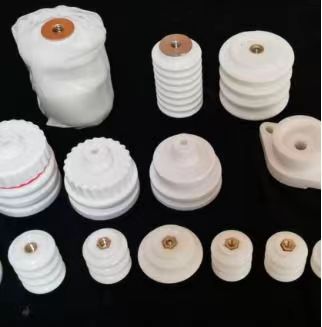

Semiconductor ceramics
Semiconductor ceramics refer to polycrystalline ceramic materials formed by ceramic technology. Different from polycrystalline semiconductors, semiconductor ceramics have a large number of grain boundaries, and the semiconducting of grains is completed during the sintering process, so they have rich material microstructure states and various process conditions, and are especially suitable for sensitive materials.
In addition to semiconductor grain boundary ceramic capacitors, the sensitive materials that have been used at present mainly include heat-sensitive materials, voltage-sensitive materials, photosensitive materials, gas-sensitive materials, and humidity-sensitive materials.
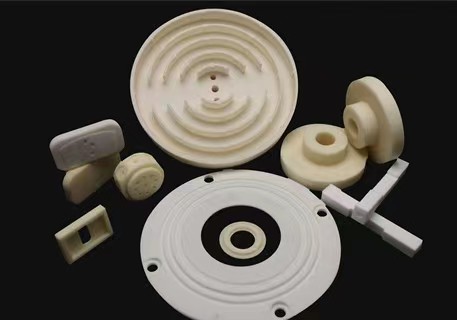

Dielectric ceramics
Dielectric ceramics, also known as dielectric ceramics, refer to functional ceramics that have the ability to polarize under the action of an electric field and can establish an electric field in the body for a long time. Dielectric ceramics have the characteristics of high insulation resistance, high withstand voltage, low dielectric constant, low dielectric loss, high mechanical strength and good chemical stability, and are mainly used in capacitors and microwave circuit components.
Dielectric ceramics include ceramic dielectric materials such as ferrodielectric ceramics, semiconductor dielectric ceramics, high-frequency dielectric ceramics, and microwave dielectric ceramics.
Piezoelectric Ceramics
Piezoelectric ceramics refers to the general term for ferroelectric ceramics which are polycrystals formed by sintering oxides(zirconia, lead oxide, in ossido di titanio, and so on.) at high temperature and solid-phase reaction, and are subjected to DC high voltage polarization treatment to make them have piezoelectric effect.

It is a functional ceramic material that can convert mechanical energy and electrical energy into each other. Due to its good mechanical properties and stable piezoelectric properties, piezoelectric ceramics are an important force, heat, electricity and light sensitive functional materials. It has been widely used in sensors, ultrasonic transducers, micro-displacers and other electronic components.
Commonly used piezoelectric components include sensors, gas igniters, alarms, audio equipment, medical diagnostic equipment and communications. The usual piezoelectric material is PZT, and the new piezoelectric ceramic materials mainly include: high-sensitivity, high-stable piezoelectric ceramic materials, electrostrictive ceramic materials, pyroelectric ceramic materials, and so on.
Piezoelectric Ceramics cutting —Ensoll—Anello di filo diamantato/Sega a filo diamantato senza fine
Magnetic ceramic material
Magnetic ceramics mainly refer to ferrite ceramics, which are composite oxides mainly composed of iron oxide and other iron or rare earth oxides. Ferrites are mostly semiconductors, the resistivity is much higher than that of general metal magnetic materials, and they have the advantage of small eddy current loss. They are widely used in high-frequency and microwave technology fields, such as radar technology, communication technology, space technology, and electronic computers.
Ferrite materials which for new energy trams cutting by sega ad anello a filo diamantato – Ensoll
High temperature superconducting ceramics
High-temperature superconducting ceramics refer to functional ceramic materials with higher superconducting temperature than metals. Since a major breakthrough was made in the research on superconducting ceramics in the 1980s, the research and application of high-temperature superconducting ceramic materials has attracted much attention. Adesso, the application of high-temperature superconducting materials is developing towards high-current applications, electronic applications, and diamagnetism.
Nano functional ceramics
Nano functional ceramics are new functional ceramics with antibacterial, activation, adsorption, filtration and other functions used in air purification and water treatment. It has far-infrared release function, negative ion release function, photocatalytic antibacterial function, deodorization, adsorption, filtration function, and mineralization function.
Transparent functional ceramics
Transparent functional ceramic materials are optically transparent functional materials, which in addition to having all the basic properties of general ferroelectric ceramics, also have excellent electro-optical effects. The electronically controlled birefringence effect, the electronically controlled light scattering effect, the electronically controlled surface distortion effect, the electrostrictive effect, the pyroelectric effect, the photovoltaic effect and the photostrictive effect can be exhibited through the control of the components.
Transparent ceramics can be made into electro-optical, electro-mechanical, military and civilian devices for various purposes: optical switches for optical communication, optical attenuators, optical isolators, optical storage, displays, real-time display pagers, optical fiber docking , optical fiber fusion splicing and optical attenuators and other applications of micro-displacement drivers, light intensity sensors, optical drivers, and so on.

With the rapid development of material science, various new properties and new applications of functional ceramic materials are constantly being recognized. Functional ceramics have been widely used in energy development, space technology, electronic technology, sensing technology, laser technology, optoelectronic technology, infrared technology , biotechnology, environmental science and other fields have been widely used. Functional ceramics are also developing towards high performance, Elevata affidabilità, multi-function, miniaturization and integration.
Of these groups, alumina is the one most often machined — the method is set out in taglio di precisione dell'allumina.
Domande Frequenti
What are new functional ceramic materials?
They are dielectric materials with electrical, magnetico, ottico, acustico, termico, meccanico, funzioni chimiche o biologiche. The family mainly includes ferroelectric, piezoelettrico, dielettrico, Pyroelectric, semiconduttore, electro-optic and magnetic ceramics, and they are important basic materials for electronic information, circuiti integrati, comunicazioni mobili, energy technology and defense industries.
What are the main categories of functional ceramics?
The main categories are insulating ceramics, semiconductor ceramics, dielectric ceramics, piezoelectric ceramics, magnetic ceramic materials (ferriti), high-temperature superconducting ceramics, nano functional ceramics and transparent functional ceramics.
What are piezoelectric ceramics and where are they used?
Piezoelectric ceramics are ferroelectric ceramics sintered from oxides such as zirconia, lead oxide and titanium oxide, then polarized under DC high voltage to gain the piezoelectric effect. They convert mechanical and electrical energy into each other and are used in sensors, ultrasonic transducers, micro-displacers, gas igniters, alarms, audio equipment, medical diagnostic equipment and communications. The usual material is PZT.
What are magnetic ceramics?
Magnetic ceramics mainly refer to ferrite ceramics, composite oxides based on iron oxide and other iron or rare earth oxides. Ferrites are mostly semiconductors with resistivity much higher than metal magnetic materials and small eddy-current loss, so they are widely used in high-frequency and microwave fields such as radar, communications, space technology and electronic computers.
Where are transparent functional ceramics used?
Transparent functional ceramics combine the basic properties of ferroelectric ceramics with excellent electro-optical effects. They are made into electro-optical, electro-mechanical, military and civilian devices: optical switches, optical attenuators, optical isolators, optical storage, displays, optical fiber docking and fusion splicing parts, micro-displacement drivers, light intensity sensors and optical drivers.
Revisionato dal team di ingegneria Ensoll.