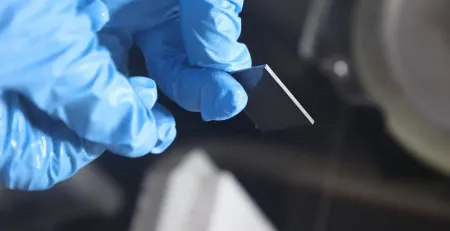
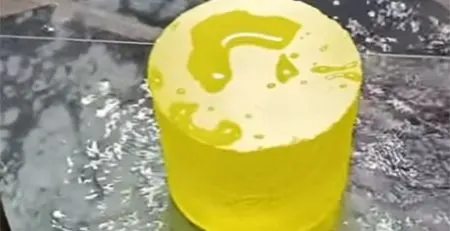
Taglio di precisione con tubo di vetro e anello di filo diamantato: 3 Dati di prova della sezione mm
Astratto: This report documents a precision straight-slicing trial on glass tube supplied by a
European customer. The workpiece was a tube of 12 mm outside diameter and 104 mm length, sliced into sections 3 millimetro
long on an ESO-GM diamond wire loop cutting machine, with cutting oil as the cooling medium and a fully coated diamond
filo. Across five sections the measured results came out at total thickness variation (TTV) 0.004-0.028 millimetro, allo spessore
tolerance ±0.026 mm against a 3.000 mm nominali, surface roughness Ra 0.65-0.90 μm, e massima scheggiatura dei bordi
3.6-8.1 μm. The tube wall is what makes this case different from flat glass work: a hollow section is far more
sensitive to clamping stiffness and to any change in cutting load, so the run was set up around machine structure,
wire choice, oil cooling and parameter matching rather than around a single speed figure.
Punti Chiave
- Un 12 millimetro (φ) x 104 mm glass tube was sliced into 3 sezioni mm su una macchina a filo diamantato a portale ESO-GM,
usando olio da taglio, completamente rivestito 0.30 x 1880 filo mm, 3 velocità di avanzamento del filo mm/min, 145 tensione N e 26 velocità del filo m/s. - TTV su cinque sezioni consecutive eseguite 0.004-0.028 mm con una media di 0.012 millimetro, e quattro delle cinque sezioni sono rimaste
a o sotto 0.010 millimetro. - Lo spessore medio si è attestato tra 2.974 e 3.001 mm contro uno 3.000 mm nominali, dando una variazione di ±0,026 mm.
Il bias è leggermente sul lato negativo, che è la direzione sicura quando la sezione ha ancora un margine per la finitura. - La rugosità media della superficie è stata di Ra 0.65-0.90 μm e il massimo scheggiamento ai bordi di 3.6-8.1 μm, con una media
massimo di circa 6.3 μm. - Una sezione (S04) si colloca chiaramente sopra le altre in tutti e tre gli indici di qualità. Questo è il segnale utile nei dati
set: indica un drift dei parametri all'interno del lotto piuttosto che un limite del processo.
Test di campionamento per un cliente europeo | Diamond wire loop cutting process
Panoramica: Cosa si proponeva di fare il Test di Taglio dei Tubetti di Vetro
The workpiece came from a European customer and the requirement was straightforward to state: high-precision
straight slicing of glass tube. Glass is a textbook hard and brittle material — elevata durezza, marked brittleness,
low fracture toughness — and under continuous grain action it tends to fail by brittle fracture rather than by
plastic flow. Cutting load and local temperature rise both push stress concentration further, ed è da lì che
scheggiature, micro-cracks and end-face damage come from. A tube adds a second problem on top. The hollow cross-section and
the wall mean the load path through the part is short and the wall stiffness is low, so clamping stability and even
small parameter changes show up directly as kerf dimension scatter or local breakage. Wire slicing is a well
established route for taglio ottico del vetro and for glass parts generally, but a tube needs
the setup matched to the wall rather than copied from a solid block trial.
Ensoll therefore ran the trial as a matched system rather than as a single parameter change. On the machine side a
dedicated diamond wire loop cutting machine was selected for glass work, which gives the tube a stable clamping base
and holds the wire on a steady path, so machine vibration and feed fluctuation do not translate straight into kerf
error. On the consumable side the wire was matched to glass so that the grains keep removing material at an even rate
instead of dropping out and leaving the cut to stall and recover. For cooling and lubrication, cutting oil was used to
improve lubrication and heat transfer at the contact zone and to keep friction heat away from the wall and the cut
face. Wire running speed and feed were then set against the wall thickness and the target 3 mm section length, keeping
cutting load inside a band the wall can carry without local overload. Macchina, filo, oil and parameters matched as one
set is what held section accuracy, end-face quality and edge integrity together. For comparison, the flat-work version
of the same logic is written up in our BG38 glass sheet slicing test.
1. Test Object: Basic Information
- Materiale: glass tube
- Durezza: circa MH 6.5
- Dimensioni del pezzo: 104 millimetro (L) x 12 millimetro (φ)
- Cut dimensions: 3 millimetro (L) x 12 millimetro (φ)
2. Selezione di macchina e filo
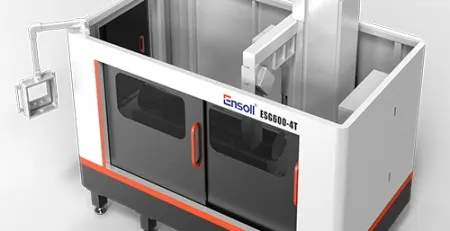
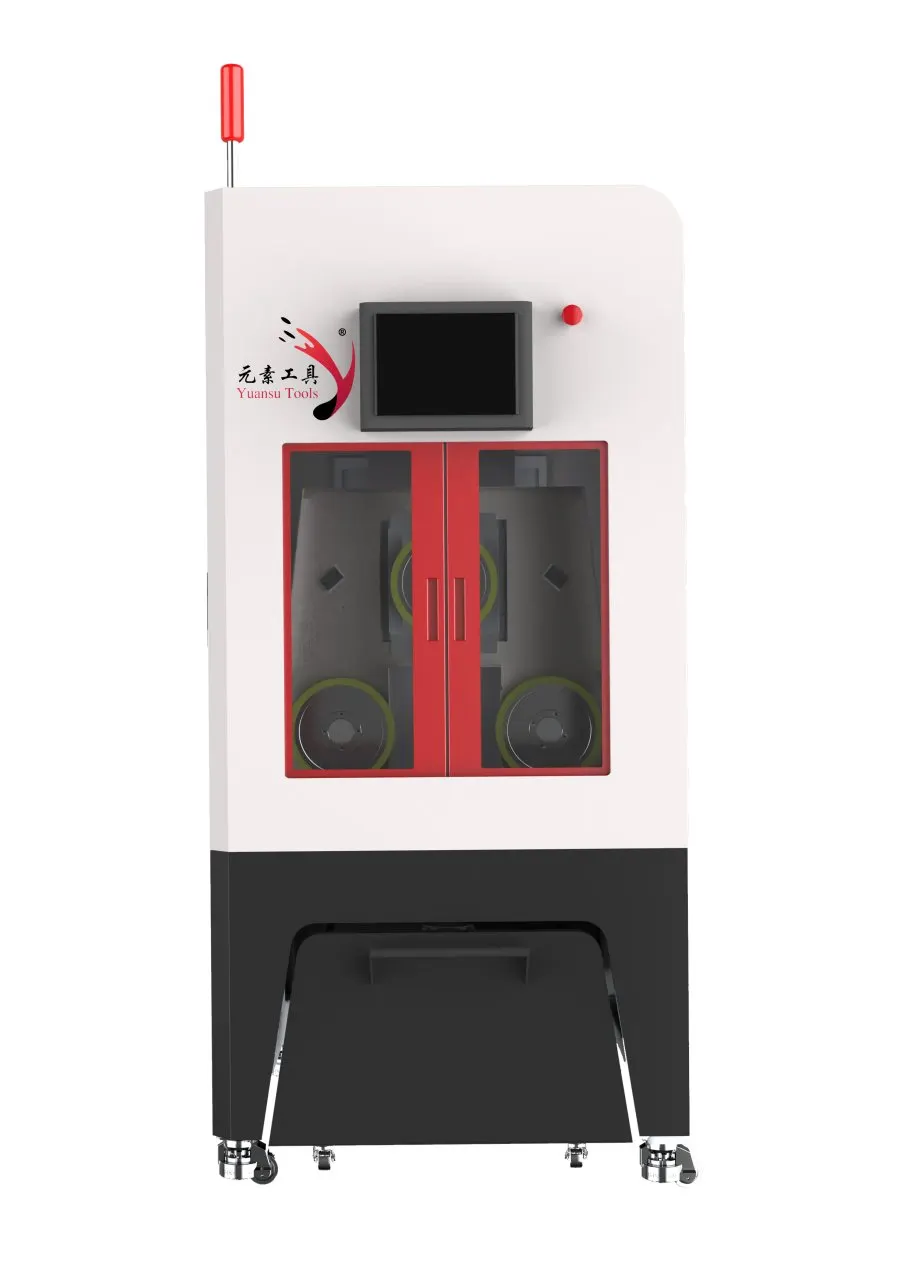
Machine type: ESO-GM. The tube wall is brittle and hollow, and the requirement was high-precision
straight slicing, so Ensoll used the ESO-GM diamond wire saw, the model set aside for glass
tube work. The point of the choice is running stability and trajectory accuracy: it holds the cut path steady, reduces
what machine vibration and load fluctuation do to the kerf, e limita lo scostamento del taglio e la rottura dei bordi su una parete sottile,
che è ciò che garantisce la precisione dimensionale della sezione e l'integrità della faccia finale nella pratica.
- l: olio da taglio. L'olio da taglio è qui il mezzo di raffreddamento e lubrificazione. Migliora
la lubrificazione e il trasferimento di calore nella zona di contatto tra filo e tubo, riduce l'attrito e l'accumulo di calore durante il
taglio, e riduce ciò che il carico termico provoca sulla parete e sulla sezione tagliata. L'effetto pratico è un minore rischio di
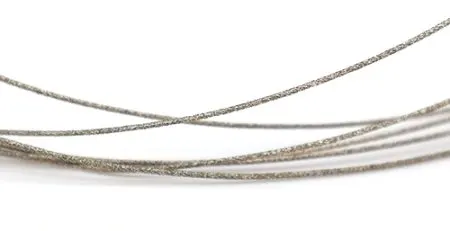
micro-crepe e scheggiature, oltre a una migliore stabilità dimensionale del taglio e una faccia finale più pulita. - Tipo di filo: completamente rivestito. Un filo diamantato completamente rivestito aumenta la resistenza del legame tra il grano e
il nucleo e limita l'estrazione dei grani e l'usura anomala del filo, così i grani continuano a tagliare a un ritmo costante durante il processo.
Il taglio costante significa che lo stato del filo smette di essere una variabile nella larghezza del taglio, which is what keeps dimensional scatter and
end-face defects down on glass tube slices, and it also extends wire life.
3. Metodo di taglio e vantaggi della macchina
Gantry cutting method. The gantry structure gives the machine high overall rigidity and running
stabilità, and the top-down vertical feed helps hold the anello di filo diamantato on a stable
path, so load variation has less effect on kerf position and dimensional accuracy in the tube slices. The machine also
carries a mist extraction system that clears the oil mist produced during cutting. On a small-diameter tube that
matters more than it sounds: keeping the work zone clear and clean is part of what makes the run repeatable.
Sistema intelligente di controllo della tensione. The system adjusts wire tension in real time from the machining
state and supports both constant-tension and variable-tension modes, so the wire runs steadily through the cut. Steady
tension cuts trajectory drift, and it lowers the local load imbalance and wire breakage risk that tension variation
brings. On a tube, a wandering wire is not a cosmetic problem — it goes straight into kerf position and section
allo spessore.
Breakpoint memory. When the wire breaks or the machine stops abnormally, the system records the
current cutting position and the associated running state. After a wire change the cut resumes from that position,
which avoids the re-positioning error and repeat cutting that would otherwise cost both material and kerf quality, e
it keeps the slicing run continuous.
Telaio in ghisa monopezzo ad alta rigidità. The one-piece cast iron frame raises overall stiffness and
resistenza alle vibrazioni, and it lowers the effect of structural vibration and the small long-term deformation of a
running machine on the wire path. For a hard brittle part such as glass tube, high rigidity means less transient
vibration and less local load fluctuation during the cut, which is what keeps chipping and micro-cracking at the kerf
under control and gives dimensional accuracy and kerf quality a stable machine basis.
4. Parameter Settings and Cooling Method
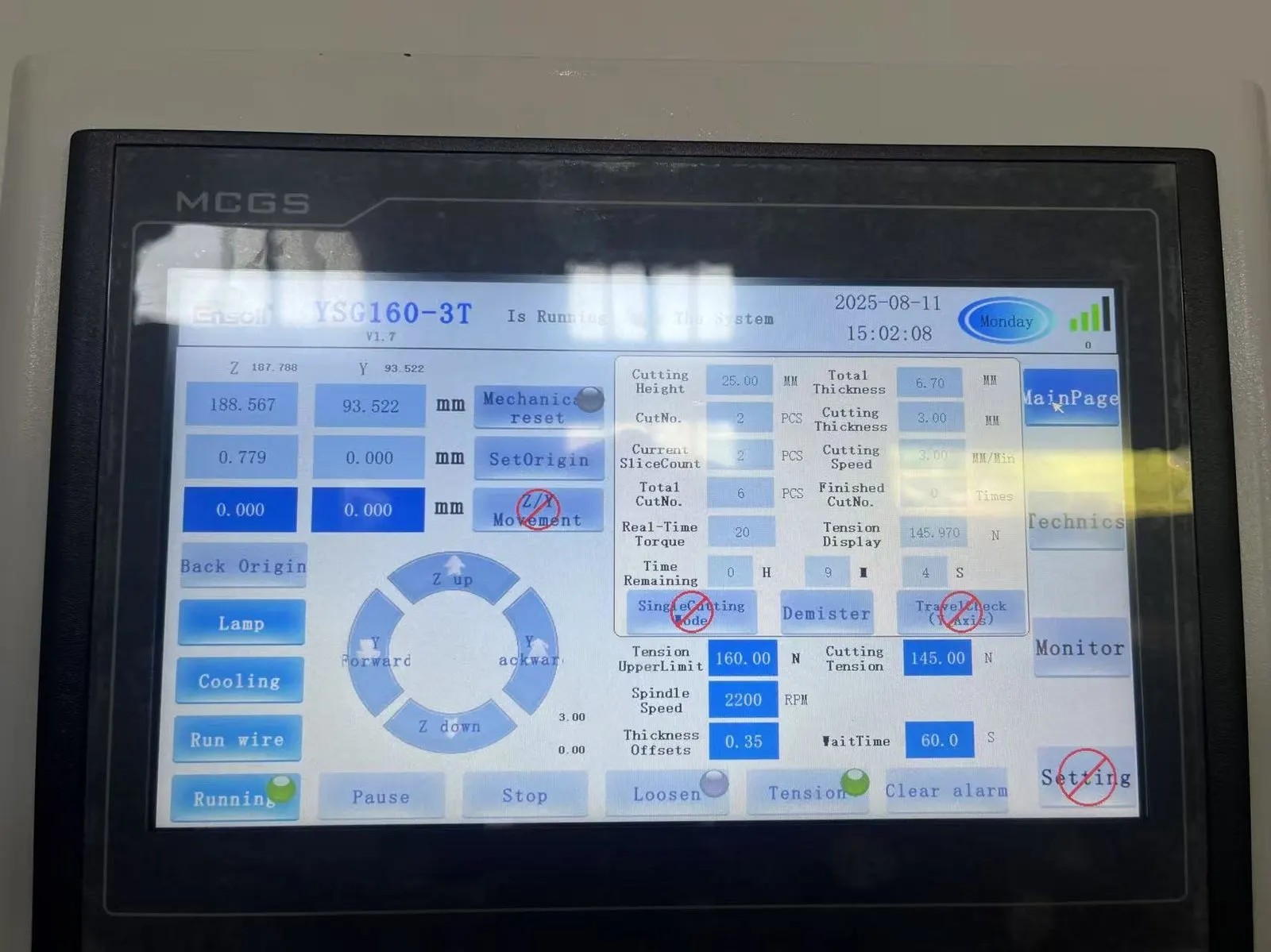
The table below is the parameter set used for the run, and the five sections reported in section 5 came off it. Filo
speed and cutting load are the two readings that carry most of the wall-load control; wire travel speed at 3 mm/min is
low in absolute terms, which is normal for a small-diameter thin-wall part where the contact length between wire and
material is short and the load per unit length climbs quickly.
| Parametro | Valore |
|---|---|
| Diametro del filo (millimetro) | 0.30 x 1880 |
| Wire travel speed (mm/min) | 3 |
| Larghezza di taglio (millimetro) | 12 |
| Cutting wire tension (N) | 145 |
| Velocità del filo (m/s) | 26 |
| Bow-forming time (s) | 60 |
| Carico di taglio (N·m) | 20 |
Cooling was cutting oil throughout, applied at the contact zone rather than flooded over the whole fixture. Oil was
chosen over water-based coolant for the same reason it wins on the other hard brittle materials Ensoll cuts: un
water-based fluid does not build a lubricating film strong enough at the grain-to-glass contact, so friction stays
high and the cut starts to depend on speed being kept low. Oil keeps the friction coefficient down, which lets the
wire hold a steady cutting state and keeps heat out of the wall.
5. Efficienza e risultati del taglio
Sono state misurate cinque sezioni consecutive dello stesso tubo. TTV e spessore sono stati rilevati su un mandrino a vuoto
calibro di spessore a doppia testa a nove punti, rugosità su un profilometro a stilo secondo ISO 4287, e scheggiature tramite microscopio per utensili.
Tutte e cinque le sezioni provenivano dal set di parametri nella sezione 4, quindi la dispersione tra di esse è dispersione di processo, non un
confronto tra impostazioni diverse.
5.1 Dati del test TTV (unità: millimetro)
TTV (Variazione dello spessore totale) è stata misurata con una griglia a nove punti su un calibro di spessore a doppia testa su mandrino a vuoto.
Il calibro è stato riscaldato fino all'equilibrio termico e calibrato rispetto a un blocco di spessore standard prima della serie di misure. Ogni
campione è stato pulito e posizionato al centro del mandrino a vuoto, e la pinzatura a pressione negativa è stata utilizzata per mantenere il disco
piatto in modo che deformazioni e inclinazioni non influenzassero la lettura dello spessore. Lo spessore è stato quindi registrato nelle nove posizioni della griglia,
and TTV is the difference between the largest and smallest reading on that sample. Nominal section thickness was
3 mm from a tube of 12 mm outside diameter and 104 mm length. The method itself is described in more detail in our
nine-point TTV measurement note.
| Campione | Letture dello spessore a nove punti (millimetro) | Tmax | Tmin | TTV |
|---|---|---|---|---|
| S01 | 2.981, 2.971, 2.979 / 2.975, 2.976, 2.977 / 2.979, 2.974, 2.972 | 2.981 | 2.971 | 0.010 |
| S02 | 2.972, 2.970, 2.979 / 2.974, 2.973, 2.975 / 2.977, 2.972, 2.976 | 2.979 | 2.970 | 0.009 |
| S03 | 2.980, 2.977, 2.987 / 2.981, 2.983, 2.979 / 2.985, 2.980, 2.982 | 2.987 | 2.977 | 0.010 |
| S04 | 2.988, 2.988, 3.010 / 2.991, 2.996, 2.987 / 3.002, 2.982, 2.994 | 3.010 | 2.982 | 0.028 |
| S05 | 2.999, 3.003, 2.999 / 3.001, 3.000, 3.002 / 3.003, 2.999, 3.001 | 3.003 | 2.999 | 0.004 |
TTV across the five sections fell in the 0.004-0.028 mm range with a mean of 0.012 millimetro, and apart from S04 every
section stayed at or below 0.010 millimetro. For a 3 mm section that is a small thickness band, and it says the wire ran
steadily and the cut stayed on its trajectory. S04 is the outlier and it is also the only section whose readings run
to the plus side of nominal, which points at a local condition during that cut rather than at a limit of the process.
Whether that came from a tension excursion, a wire condition change or a piece of debris in the kerf cannot be settled
from the thickness data alone.
5.2 Tolleranza dimensionale dello spessore (unità: millimetro)
Thickness tolerance was calculated from the same nine-point data, using the 3.000 mm nominal section thickness as
reference and taking the signed deviation at each measured position.
| Campione | Spessore medio (millimetro) | Deviazione dello spessore (millimetro) |
|---|---|---|
| S01 | 2.976 | −0.024 |
| S02 | 2.974 | −0.026 |
| S03 | 2.982 | −0.018 |
| S04 | 2.993 | −0.007 |
| S05 | 3.001 | +0.001 |
| Deviazione positiva massima | +0.001 | |
| Deviazione negativa massima | −0.026 | |
| Tolleranza dello spessore | ±0.026 |
Average thickness came out at 2.976, 2.974, 2.982, 2.993 e 3.001 millimetro, so deviations against the 3.000 mm nominali
were −0.024, −0.026, −0.018, −0.007 e +0.001 millimetro. Four of the five sit slightly under nominal
and only S05 comes in over it, which gives a maximum positive deviation of +0.001 mm against a maximum negative of
−0.026 mm and a total band of 0.026 millimetro. The distribution is close to the nominal and biased on the minus side,
which is the direction you want if the section still has a finishing allowance to spend. As a thickness control result
it is consistent: the wire loop process held the 3 mm section within ±0.026 mm over the batch.
5.3 Surface Roughness Ra (unità: μm)
La rugosità superficiale è stata misurata secondo ISO 4287 with a stylus profilometer. Three representative positions —
centro, a metà sinistra e a metà destra — were taken on the cut end face of each section.
| Campione | Ra-1 | Ra-2 | Ra-3 | Ra medio |
|---|---|---|---|---|
| S01 | 0.72 | 0.68 | 0.75 | 0.72 |
| S02 | 0.65 | 0.71 | 0.68 | 0.68 |
| S03 | 0.78 | 0.74 | 0.81 | 0.78 |
| S04 | 0.91 | 0.86 | 0.94 | 0.90 |
| S05 | 0.63 | 0.67 | 0.65 | 0.65 |
Average Ra across the five sections ran from 0.65 A 0.90 μm. S05 was the best cut face at 0.65 μm, con
S02 and S01 close behind at 0.68 e 0.72 μm. S03 rose to 0.78 μm and S04 was the highest of the set at
0.90 μm, and on S04 all three positions read high together rather than one position spiking. That pattern
matters: a single high position is usually a local defect, whereas all three rising points to a change in the cutting
state over that section. Even so, 0.90 μm is still a low roughness figure, so the honest reading is that the
process delivers a good end face most of the time and that S04 has room for parameter tuning rather than representing
a ceiling.
5.4 Sbeccature ai Bordo (unità: μm)
Chipping was quantified by tool microscope imaging on the section edges. The four edges of each 104 millimetro (L) x
12 millimetro (φ) i campioni sono stati puliti e la scala di ingrandimento e misura calibrati prima dell'osservazione, poi
ogni bordo è stato scansionato e ogni scheggiatura identificabile è stata localizzata, misurato e registrato.
| Campione | Posizione 1 | Posizione 2 | Posizione 3 | Posizione 4 | Scheggiature massime |
|---|---|---|---|---|---|
| S01 | 4.2 | 5.6 | 4.8 | 6.1 | 6.1 |
| S02 | 3.8 | 5.1 | 4.5 | 5.7 | 5.7 |
| S03 | 4.5 | 5.9 | 5.2 | 6.4 | 6.4 |
| S04 | 5.6 | 7.2 | 6.3 | 8.1 | 8.1 |
| S05 | 3.6 | 4.8 | 4.2 | 5.3 | 5.3 |
letture individuali coperte 3.6-8.1 μm e la media dei cinque valori massimi corrisponde circa 6.3 μm.
dato quanto è sottile la parete, questa è una piccola banda di difetto sul bordo, e dice che lo stato di taglio è rimasto abbastanza stabile per
sopprimere fratture fragili e propagazione di crepe al punto di fessura. vale anche la pena notare l'ordine dei campioni: S04 è
di nuovo peggiore a 8.1 μm, e la sua posizione peggiore è lo stesso angolo relativo dove passano anche spessore e rugosità
alto. Una singola sezione che trasporta tutte e tre le bandiere è un segnale coerente, non rumore.
6. Riassunto
La prova ha funzionato, e il motivo è il solito: macchina dedicata, matched wire and suitable parameters treated as
one set. Glass tube is a hard brittle material with obvious brittleness and low fracture toughness, and in cutting it
is sensitive to local load and to heat build-up, which is exactly how chipping, micro-cricche, end-face unevenness and
section thickness deviation start. Against the material behaviour, the tube wall and the straight-slicing requirement,
the work was organised along three lines — selezione della macchina, wire matching and process parameters — quindi
that the cut ran stably while section accuracy and end-face quality stayed under control.
On machine selection, the requirement was motion stability, cutting accuracy and rigidity, and the answer was a
diamond wire loop cutting machine built for glass-type hard brittle work. Structural rigidity and running stability
give the wire a reliable base for continuous running and the workpiece a stable cut, which reduces what machine
vibrazione, motion error and wire path fluctuation do to the cutting trajectory. Steady feed and motion control also
damp load fluctuation, so the wire and tube keep a consistent relative motion and the probability of kerf deviation and
local chipping drops.
On wire selection, the deciding properties were hardness and brittleness of the glass and the brittle fracture it
tends to produce. A diamond wire matched to glass cutting removes material through continuous abrasion, and matching
grain characteristics, wire diameter and wire condition keeps the load on any single grain low while still removing
material at a usable rate. Questo è ciò che riduce la scheggiatura e la micro-fratturazione dovuta alla concentrazione locale di stress e
migliora l'integrità e la consistenza della faccia terminale.
Sui parametri, la velocità di avanzamento del filo e l'alimentazione sono stati adattati al materiale, alla struttura della parete e alla sezione bersaglio
lunghezza. Il principio di impostazione era taglio costante e rimozione uniforme del materiale: un'avanzamento troppo rapido aumenta il carico di taglio, e
una cattiva corrispondenza dei parametri provoca riscaldamento localizzato, rottura fragile e rottura dei bordi. Mantenere il processo di rimozione uniforme è
ciò che garantisce la coerenza dello spessore, la qualità della faccia terminale e l'integrità dei bordi contemporaneamente a un'efficienza ragionevole.
Considerando insieme l'accuratezza della sezione misurata, thickness tolerance, Ra e qualità dei bordi, la conclusione è che un
processo a filo di diamante con una macchina abbinata, un filo abbinato e parametri adatti soddisfa i requisiti di
taglio dritto ad alta precisione di tubo di vetro. Questo è un lotto singolo di cinque sezioni da un tubo, quindi i numeri dovrebbero
essere letti come indicazioni di processo piuttosto che come una finestra di capacità garantita — ma sono abbastanza coerenti
da poter essere utilizzati nella pianificazione della produzione.
Domande Frequenti
Una lama a filo di diamante può tagliare un tubo di vetro senza creparlo?
Sì, purché il carico per unità di lunghezza rimanga basso. In questo test un 12 tubo di vetro con diametro esterno di mm è stato tagliato in 3 sezioni da mm con massima scheggiatura dei bordi di 3.6-8.1 μm e senza perdita di sezione, utilizzando una 0.30 mm di filo completamente rivestito a 3 velocità di avanzamento del filo mm/min, 145 tensione N e 26 velocità del filo m/s. Un tubo è più sensibile di una barra solida perché la parete è sottile e cede localmente prima che l'intera sezione lo faccia, quindi la rigidità del serraggio e la stabilità dell'avanzamento contano tanto quanto il filo stesso.
Quale TTV ci si può aspettare quando si taglia un tubo di vetro a parete sottile?
On this batch TTV measured by the nine-point vacuum chuck method ran 0.004-0.028 mm con una media di 0.012 millimetro, e quattro delle cinque sezioni sono rimaste a o sotto 0.010 mm on a 3 mm sezione nominale. Il TTV su un tubo è determinato principalmente dalla stabilità del percorso del filo e da quanto bene il pezzo viene mantenuto piatto durante la misurazione, quindi il piano di riferimento del mandrino a vuoto conta tanto quanto il taglio.
Perché è stato usato olio da taglio invece di un refrigerante a base d'acqua per il tubo di vetro?
L'olio forma un film lubrificante al contatto grano-vetro che i fluidi a base d'acqua non formano, e quel film è ciò che mantiene lontano attrito e calore da attrito da una parete sottile. In questo ciclo il raffreddamento a olio combinato con 145 La tensione N e una 3 mm/min velocità del filo hanno dato un taglio stabile, con Ra medio di 0.65-0.90 μm e scheggiature mantenute a 3.6-8.1 μm. La macchina dispone anche di estrazione nebbia, il che è un requisito pratico una volta che si decide di usare olio.
Is a fully coated wire better than a plain wire for glass tube slicing?
For this application it is the better default. A fully coated wire holds the grains more firmly, which limits grain pull-out and abnormal wear, so the wire keeps removing material at a steady rate instead of drifting as it wears. On a thin wall, a wire whose cutting behaviour changes mid-run turns directly into kerf width scatter and end-face variation, so wire consistency is worth paying for.
How much thickness tolerance is realistic on 3 mm glass tube sections?
This run held ±0.026 mm against a 3.000 mm nominali, with averages between 2.974 e 3.001 mm and four of five sections slightly under nominal. The bias toward the minus side is convenient because it leaves material for a finishing pass. Se la sezione ha una dimensione finita, la strada più semplice è una piccola compensazione dimensionale nella corsa successiva piuttosto che inseguirla con cambiamenti di parametro.
Perché una sezione nel lotto è venuta peggio delle altre?
S04 era l'anomalia su tutte e tre le misure di qualità contemporaneamente: TTV più alto a 0.028 millimetro, media Ra più alta a 0.90 μm e massima scheggiatura a 8.1 μm, e la sua posizione di massima scheggiatura si trova nello stesso angolo relativo dove anche spessore e rugosità risultano elevati. Una sezione che segnala su tre misure indipendenti solitamente significa che qualcosa è cambiato durante il taglio — un’escursione della tensione, una variazione nelle condizioni del filo o detriti nella scanalatura. I dati sullo spessore da soli non possono distinguere tra queste cause.
Domande più generali sulla scelta del filo, raffreddamento e abbinamento dei parametri sono raccolti nella nostra diamond wire loop cutting technology FAQ.
Contenuto tecnico revisionato dal team di ingegneria Ensoll – un produttore di anelli da taglio con filo diamantato 10+ anni di
esperienza di produzione.