소프트 페라이트 코어 절단: 무한 다이아몬드 와이어
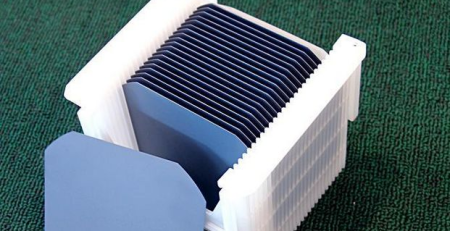
5G 통신의 급속한 발전, 전기차 (EV) 충전 인프라, and high-frequency power supplies has placed a massive spotlight on a specific class of magnetic materials: Soft Ferrites. Unlike hard permanent magnets like NdFeB or 에스엠코, soft ferrites (such as Manganese-Zinc and Nickel-Zinc ferrites) are ceramic compounds engineered for their high magnetic permeability and remarkably low electrical conductivity. These properties make them indispensable for preventing energy loss in transformers, 인덕터, and electromagnetic interference (EMI) suppressing cores.
- Soft ferrites (MnZn and NiZn) are ceramic magnetic materials essential to high-frequency transformers, inductors and EMI suppression cores — and they are extremely brittle.
- Traditional blades cause severe edge chipping, kerf loss of up to 50% on thin parts, and sub-surface micro-cracks that shorten core life.
- A diamond wire loop running continuously at 40-60 m/s cuts by low-force micro-grinding: near-zero chipping, kerf down to 0.2-0.35 밀리미터, and a near pre-polished surface finish.
- Key parameters are wire speed above 50 m/s for hard ferrites, tightly controlled feed to avoid wire bow, and uniform fine diamond grit.
그렇지만, because soft ferrites are essentially industrial ceramics, they inherit the classic vulnerabilities of the ceramic family. They are incredibly brittle, highly sensitive to thermal shock, and prone to internal stress fractures during machining. As electronic components shrink and frequencies rise, manufacturers face the daunting task of slicing these fragile ferrite blocks into ultra-thin, complex geometries with flawless accuracy.
To meet these tight tolerances without compromising structural integrity, high-volume electronics manufacturers are shifting away from traditional abrasive wheel cutting and adopting 엔들리스 다이아몬드 와이어 루프 기술.
Soft ferrites crack more easily than rare-earth magnets, yet the same rules that govern 네오디뮴 자석 절단 방법 apply: keep cutting force low and temperature stable.
The Soft Ferrite Challenge: Ceramic Brittleness Meets High Frequency
Processing soft ferrites is a delicate balancing act. Sintered ferrite blocks are rigid but possess very low tensile strength. During traditional slicing processes, manufacturers face several distinct manufacturing bottlenecks:
1. Severe Edge Chipping and Micro-Cracking
When traditional inner-diameter (ID) saws or thick diamond blades cut through a ferrite block, they exert high localized mechanical pressure. As the blade exits the cut, this pressure causes the ceramic material to fracture, resulting in severe edge chipping (崩边). For high-frequency transformer cores, even minor edge defects can alter the magnetic flux path, increase eddy current losses, and degrade the overall efficiency of the component.
2. High Ceramic Powder Waste (Kerf Loss)
Traditional grinding wheels are relatively thick (often over $1.0\text{ 밀리미터}$). When slicing miniature ferrite components—such as low-profile inductor cores that are only a few millimeters thick—a thick blade can easily turn up to $50\%$ of the raw material into useless ceramic sludge. Minimizing this cutting path, or kerf loss, is vital for maintaining cost-effective production.
3. 내부 손상 (SSD)
The mechanical stress of a heavy, slow-moving blade doesn’t just damage the surface; it telegraphs micro-fractures deep into the interior of the ceramic matrix. This sub-surface damage compromises the mechanical lifespan of the ferrite core, making it susceptible to cracking under the thermal cycles of high-power operations.
The Breakthrough: Endless Diamond Wire Loop Slicing
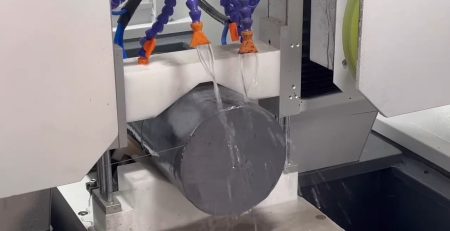
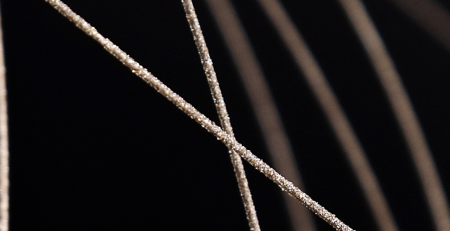
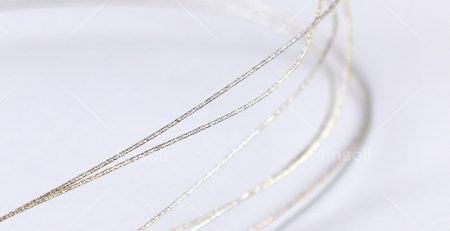
To overcome the limitations of rigid blades, modern precision machine shops are integrating endless diamond wire loops into their production lines. An 끝없는 다이아몬드 와이어 루프 is a continuous, flexible steel wire coated with precisely graded industrial diamond particles, running over a high-speed pulley system in a fixed, single-direction loop
When applied to soft ferrite processing, this technology delivers a quantum leap in quality and efficiency due to several distinct operational mechanics:
Ultra-High Linear Speeds with Minimal Feeding Force
Unlike traditional reciprocating wire saws that travel at low speeds and constantly reverse direction, an endless diamond wire loop rotates continuously in one direction at velocities between $40\text{ 엠/초}$ and $60\text{ 엠/초}$.
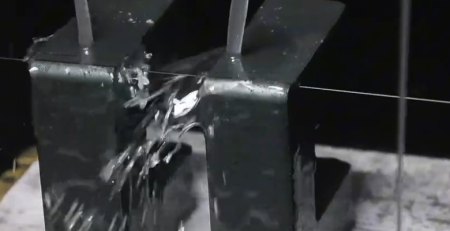
This immense speed changes the physics of the cut. Instead of forcing its way through the ceramic, the wire performs a lightning-fast micro-grinding action. The mechanical force exerted on the ferrite block drops to near zero, eliminating the shock factors that cause edge chipping and allowing for the safe production of ultra-thin ferrite wafers.
Drastic Reduction in Kerf Loss
Because the endless loop operates under highly optimized, steady tension without the “vibration jerk” of reciprocating systems, the core steel wire can be manufactured to be incredibly thin—frequently down to $0.20\text{ 밀리미터}$ to $0.30\text{ 밀리미터}$. This remarkably narrow kerf maximizes material utilization, allowing manufacturers to extract significantly more usable ferrite cores out of a single sintered block.
Exceptional Thermal Control and Swarf Flushing
While soft ferrites can handle high operational temperatures in electrical circuits, they are highly sensitive to sudden localized thermal shocks during machining. If a cutting zone overheats, the ferrite can experience localized thermal expansion, leading to immediate cracking.
The continuous, high-speed movement of the diamond wire loop prevents heat accumulation by constantly introducing a fresh, cool section of wire into the cutting zone. When paired with high-volume, water-soluble coolants, the fine ceramic powder (swarf) is instantly flushed away, keeping the wire sharp and the ferrite block perfectly cool.
우수한 표면 마감 ($R_a$)
The smooth, continuous motion of the endless loop yields an exceptionally clean surface finish with minimal roughness ($R_a$). A smoother surface means that the mating faces of split ferrite cores (such as E-cores or U-cores) require little to no secondary lapping or polishing to achieve the perfect flush fit required to minimize air gap reluctance.
Technical Comparison: Soft Ferrite Slicing
| Performance Metric | Traditional Ceramic Slitting Blades | Endless Diamond Wire Loop () |
| 절단 메커니즘 | High-pressure mechanical shearing | High-speed, low-force micro-grinding |
| Wire/Blade Thickness | $0.8\텍스트{ 밀리미터}$ to $1.5\text{ 밀리미터}$ | $0.2\텍스트{ 밀리미터}$ to $0.35\text{ 밀리미터}$ |
| Material Yield | 낮음 (High kerf loss/sludge) | 높음 (Minimal material waste) |
| 엣지 치핑 | Frequent, requires heavy reworking | Virtually zero chipping or micro-cracks |
| 표면 품질 ($R_a$) | 거칠음, requires secondary lapping | 우수, near pre-polished finish |
Optimizing Parameters for Soft Ferrites
Achieving the perfect cut on a soft ferrite ceramic depends heavily on balancing three core machine parameters:
- Wire Speed Selection: 단단한, brittle ceramics like Mn-Zn ferrites, keeping the wire speed on the higher end ($>50\텍스트{ 엠/초}$) ensures that the material removal stays in the brittle-ductile transition zone, optimizing surface smoothness.
- Feed Rate Tuning: The feed rate (the speed at which the wire pushes into the material) must be tightly controlled. Moving too fast increases bowing of the wire, which can introduce slight geometric deviations in flatness.
- Grit Size Optimization: Using a highly uniform, micro-sized diamond grit ensures that the material is eroded evenly, avoiding deep scratches that could act as stress concentrators later on.
결론: Driving the Future of High-Frequency Electronics
결론: Driving the Future of High-Frequency Electronics
� (원문대로) � (질화 갈륨)�.
�. �, �, and maximizing raw material yields, �, �.
자주 묻는 질문
�?
�. �, low-force micro-grinding, 전통적인 슬리팅 블레이드가 취성 페라이트에 일으키는 가장자리 칩과 표면 아래 균열을 사실상 없애는.
왜 페라이트 코어는 절단 중 깨지는가?
페라이트는 매우 낮은 인장 강도를 가진 소결 세라믹. 강성 블레이드는 절단면에 기계적 압력을 집중시키고, 블레이드가 빠져나올 때 재료가 파손된다. 높은 국소 절단력과 진동이 근본 원인.
다이아몬드 와이어가 페라이트를 얼마나 얇게 절단할 수 있는가?
다이아몬드 와이어 코어 자체는 보통 0.20-0.30 밀리미터, 그래서 절단면이 매우 좁다. 이로 인해 초박형 페라이트 웨이퍼가 가능하며, 제조업체들이 한 소결 블록에서 훨씬 더 많은 사용 가능한 코어를 추출할 수 있게 한다 0.8-1.5 mm 블레이드.
다이아몬드 와이어 절단이 페라이트의 자기 특성을 손상시키는가?
아니요. 냉기 공정이다: 빠르게 움직이는 와이어가 끊임없이 신선한 재료를 가져온다, 차가운 연마재가 절단 부위에 들어가고 수용성 냉각재가 열을 씻어내고 절단한다, 그래서 페라이트를 열충격이나 열 영향을 받지 않는 영역이 없기 때문.
엔솔 엔지니어링 팀이 검토한 기술 내용 — 다이아몬드 와이어 루프 제조업체 10+ 다년간의 생산 경험을 가진 회사.