Branchennachrichten

Industry news and market insights on diamond wire cutting, precision machining and advanced materials.

Dünnschicht-Solarzellen-Schneiden: Diamantdrahtschleife übertrifft

Wichtigste Erkenntnisse Dünnschicht-PV-Materialien wie CdTe, CIGS und a-Si benötigen präzises Schneiden, das sowohl thermische als auch mechanische Schäden vermeidet. Diamond wire loop outperforms lasers and blades on brittle thin-film stacks: it is a cold, narrow-kerf process with clean edges. Diamond wire loop cutting is applied in CdTe modules, CIGS and amorphous silicon panels, and is positioned as the future of advanced PV cutting. The solar energy industry continues to evolve with advanced thin-film photovoltaic (PV) technologies offering higher efficiency and lower production...
Cutting Solar Cells: Laser vs Diamond Wire Loop

Key Takeaways Laser cutting is contactless and fast, but its heat-affected zone can create micro-cracks that reduce solar cell efficiency. Diamond wire loop cutting is a cold, mechanical process: no thermal damage, cleaner edges and lower breakage on thin cells. For monocrystalline solar cells, diamond wire loop gives a narrow kerf and higher mechanical yield than thermal cutting methods. Choose laser for speed on forgiving material; choose diamond wire loop when cell efficiency and yield dominate the cost equation. The solar industry is rapidly evolving,...

Cutting Ultra-Hard Materials with Diamond Wire Loop

Ultra-hard materials like Diamond, CVD Diamond (Chemical Vapor Deposition Diamond), and Cubic Boron Nitride (cBN) are revolutionizing industries ranging from aerospace to semiconductor manufacturing. jedoch, their extreme hardness (Mohs 10 for diamond, ~9.5 for cBN) makes them incredibly difficult to machine using conventional methods. Diamond cutting wire loop technology has emerged as the most efficient solution for precision cutting of these materials. Unlike traditional saws, diamond wire loops provide minimal kerf loss, superior surface finish, and reduced thermal damage, making them ideal...

Halbleiterkristall-Schneiden mit Diamantdrahtschleife

Wichtige Erkenntnisse Halbleiterkristallschneiden wandelt Rohblöcke in Wafer um, und der Schneideschritt bestimmt sowohl Ausbeute als auch nachgelagerte Oberflächenqualität. Diamond wire loop cutting works by running a diamond-coated wire at high speed under coolant, grinding the crystal with a narrow, controlled kerf. Compared with ID blades and slurry saws, diamond wire loop cuts Si, Sic, GaN and sapphire with less material loss and lower sub-surface damage. Introduction to Semiconductor Crystal Cutting The semiconductor industry relies on precision cutting technologies to transform raw crystal...

Diamantdraht-Schleifverfahren für optische Kristalle

Einführung: Revolutionierung der Verarbeitung optischer Kristalle In der präzisionsgetriebenen Welt der optischen Fertigung, the quality of crystal cutting directly impacts the performance of end products. From laser systems to advanced imaging devices, optical crystals like sapphire, lithium niobate, and calcium fluoride form the foundation of modern photonic technologies. Traditional cutting methods often compromise material integrity, leading to reduced optical performance and increased production costs. Diamond wire loop cutting has emerged as the gold standard for optical crystal processing, offering manufacturers unprecedented control over...

Diamond Wire Loop Cutting for Corrugated Paper

In the world of industrial cutting, Präzision und Effizienz stehen an erster Stelle. One innovative solution that has gained traction in recent years is the diamond wire loop—a cutting-edge technology that delivers exceptional accuracy when slicing through materials like corrugated paper. Unlike traditional blades, diamond wire loops minimize material waste, reduce friction, and extend tool life, making them ideal for high-volume paper processing.   In diesem Artikel, we’ll explore how diamond wire loop cutting works, its advantages over conventional methods, and why it’s becoming...

Precision Glass Machining: Prototype to Production

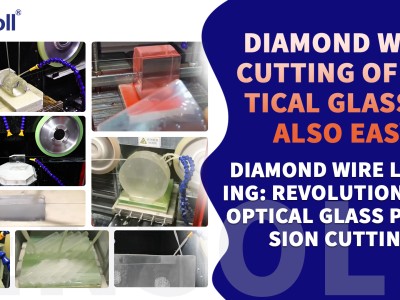
The optics industry demands extreme precision, whether for wafer-level optics production, microscope slide preparation, or custom optical glass cutting services. Manufacturers must balance speed, accuracy, and cost-effectiveness while meeting strict standards like ISO 10110 compliant cutting. Key Takeaways Wafer-level optics production fabricates many components on a single glass wafer before singulation — the cost-effective route for smartphone cameras, AR/VR lenses and medical imaging, where diamond wire saws deliver chip-free separation. Microscope slides and custom optical glass cutting depend on low-stress machining: uniform thickness,...

Präzises Glasschneiden: Null-Absplitter-Technologie

Wichtige Erkenntnisse Die Null-Absplitter-Kantentechnologie verwendet ultradünne Diamantschneiddrahtschleifen, um mechanische Belastung zu minimieren, glatte, splitterfreie Kanten zu erzeugen, higher yield rates and better structural integrity for downstream processing. Low-stress glass machining — controlled cutting force plus optimized feed rate — is the key to separating brittle fused silica and borosilicate without stress fractures, at sub-micron accuracy. Fused silica defeats conventional routes: laser cutting causes thermal stress and mechanical scribing risks micro-cracks, while diamond wire cutting is a cold process with uniform...