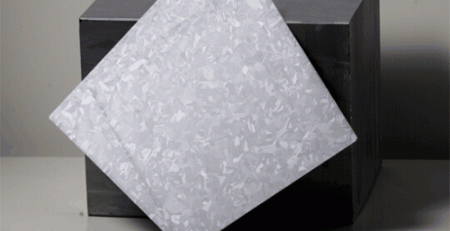
Mono Silicon Wafer Cutting with Diamond Wire Saw
El silicio monocristalino es la base de las industrias modernas de semiconductores y fotovoltaica. Para transformar lingotes de silicio en obleas funcionales, precision cutting is essential. Among various cutting technologies, sierra de alambre de diamante cutting has become the industry standard due to its efficiency, precisión, and minimal material loss.
En esta guía completa, we will explore the monocrystalline silicon cutting process, focusing on diamond wire saw cutting machines, their working principles, Ventajas, and industry applications.
- Silicon wafer cutting turns a monocrystalline ingot into wafers; the three metrics that matter are TTV, Rugosidad superficial, and sub-surface damage.
- Fixed-diamond wire sawing has largely replaced slurry sawing: kerf más estrecho, proceso más limpio, más obleas por lingote.
- Wire diameter and tension stability drive both yield and how much downstream polishing is needed.
1. Understanding Monocrystalline Silicon
Before diving into the cutting process, let’s briefly discuss monocrystalline silicon and why it requires specialized cutting techniques.
1.1 What is Monocrystalline Silicon? (You can also click the link to learn more details via Wikipedia.)
 Monocrystalline silicon is a highly pure form of silicon with a single, continuous crystal lattice structure. It is produced using the Czochralski (CZ) method or the Float Zone (FZ) método, resulting in cylindrical ingots.
1.2 Por qué el corte de precisión es crítico
– Industria de semiconductores: Los obleas de silicio deben tener superficies ultra-lisas(rugosidad a nivel nanométrico) para la fabricación de microchips.
-Industria Fotovoltaica: Las células solares requieren delgadas, uniformes(típicamente 160-180µm) para maximizar la eficiencia.
– Pérdida mínima de corte: Reducir el desperdicio de material durante el corte mejora la eficiencia de costos.
Los métodos de corte tradicionales como sierras ID (sierras de diámetro interno) y sierras de múltiples hilos con lodo han sido reemplazadas por el corte con sierra de hilo de diamante debido a su rendimiento superior.
2. Diamond Wire Saw Cutting Technology
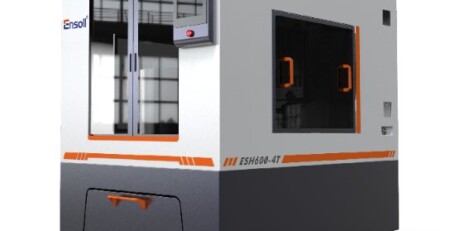
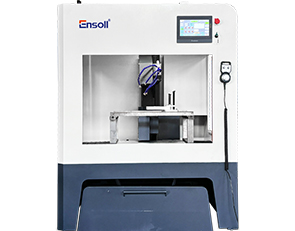
2.1 What is a Máquina cortadora de sierra de hilo de diamante?
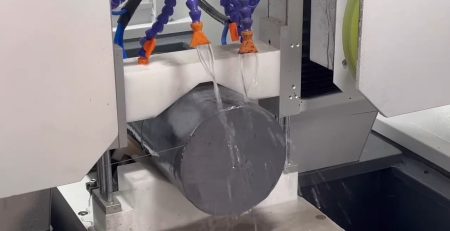
Presentación de videos:
Un Máquina cortadora de sierra de hilo de diamante uses a high-tensile steel wire embedded with diamond abrasive particles to slice through hard materials like silicon. The wire moves at high speeds (10-15 mm/min) while the workpiece is fed into it, enabling precision cutting with minimal kerf loss.
2.2Key Components of a Diamond Wire Saw Machine
- Alambre de diamante: A steel wire coated with synthetic diamond grit(30-100 µm in size) using electroplating or resin bonding.
- Wire Guidance System: Ensures consistent tension (20-60 N) and alignment.
- Sistema de refrigerante: Prevents overheating and removes silicon debris (typically using PEG-based or water-soluble coolants).
- Motion Control System: Controls wire speed, tasa de avance, and cutting angle.
2.3 Cómo funciona el corte con sierra de hilo de diamante
- Wire Movement: The diamond wire runs in a continuous loop, driven by motorized pulleys.
- Mecanismo de corte: Las partículas abrasivas de diamante muelen el silicio mediante microcorte y fractura frágil.
- Aplicación de refrigerante: Un flujo constante de refrigerante lubrica el corte, reduce el estrés térmico, y elimina la pulpa de silicio.
- Separación de obleas: El lingote de silicio se corta en obleas de grosor preciso (p ej., 180µm para obleas solares).
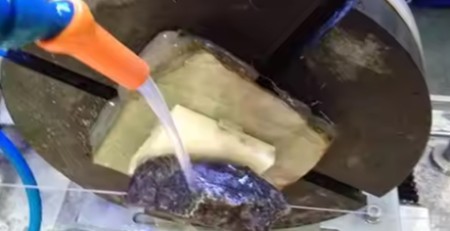
Demostración de corte de material:
3.Ventajas del corte con sierra de alambre de diamante
En comparación con métodos más antiguos como las sierras de lodo multi-hilo (MWSS), la sierra de alambre de diamante ofrece:
3.1 Mayor velocidad de corte & Eficacia
– Velocidades de corte hasta 1.5 veces más rápidas que los métodos basados en lodo.
– Las configuraciones multi-hilo permiten cortar simultáneamente cientos de obleas.
3.2 Reducción de pérdida de corte & Desperdicio de material
– Ancho de corte tan bajo como 120-150µm (vs. 180-220µm en sierras de lodo).
– Mayor rendimiento por lingote, crucial para la fabricación de paneles solares sensible a costos.
3.3 Mejor calidad de superficie
– Menor daño subsuperficial (SSD) debido a la acción abrasiva controlada.
– Marcas de alambre y ondulación reducidas, minimizando el pulido posterior al corte.
3.4 Ambiental & Beneficios de costo
– Sin problemas de eliminación de lodo (a diferencia de MWSS, que utiliza lodo abrasivo).
– Mayor vida útil del cable (hasta 1,000 cortes por alambre).
4. Desafíos & Soluciones en el corte con sierra de alambre de diamante
A pesar de sus ventajas, sierra de alambre de diamante enfrenta algunos desafíos:

4.1 Rotura del alambre & Desgaste
– Causa: Tensión excesiva, desgaste abrasivo, o falla del refrigerante.
– Solution: Monitoreo de tensión en tiempo real**, tamaño de grano de diamante optimizado, y filtración adecuada del refrigerante.
4.2 Microgrietas en la superficie
– Causa: Fractura frágil durante el corte.
– Solution: Tasa de alimentación controlada, grabado posterior al corte, o recocido.
4.3 Efecto de deformación del alambre
– Causa: Tensión desigual del alambre que genera cortes ondulados.
– Solution: Sistemas avanzados de guiado de alambre con control dinámico de tensión.
5.Aplicaciones del corte con sierra de alambre diamantado
5.1 Fotovoltaico (PV) Industria
– Producción de obleas solares (Mono PERC, TOPCon, Celdas HJT).
– Corte de obleas delgadas (menos de 150 µm para celdas de próxima generación de alta eficiencia).
5.2 Industria de semiconductores
– Corte de obleas de silicio para fabricación de circuitos integrados.
– Empaquetado avanzado** (p ej., empaquetado a nivel de oblea).
5.3 Otras aplicaciones
– Corte de sustratos de zafiro para LED.
– Mecanizado de materiales duros (Sic, cuarzo, cerámica).
6.Tendencias futuras en el corte de obleas de silicio
- Obleas más delgadas: La demanda de obleas menores de 100 µm impulsa los avances en sierras de alambre diamantado de ultra-precisión.
- IA & Automatización: Optimización de procesos basada en aprendizaje automático para mayor rendimiento.
- Métodos de corte híbridos: Combinando pre-marcado con láser + sierra de alambre diamantado para obleas ultra-delgadas.
Conclusión
El corte con sierra de alambre de diamante ha revolucionado la fabricación de obleas de silicio monocristalino, ofreciendo precisión superior, eficacia, y ahorro de costos sobre los métodos tradicionales. A medida que las industrias de semiconductores y energía solar buscan obleas más delgadas, y más grandes, infinito
la tecnología de sierra de alambre de diamante continuará evolucionando, permitiendo soluciones de electrónica de próxima generación y energías renovables.
Para los fabricantes, invertir en avanzadas máquinas de sierra de alambre de diamante es crucial para mantenerse competitivo en el mercado de materiales de alta tecnología.
Al comprender la ciencia y la ingeniería detrás del corte con sierra de hilo de diamante, los profesionales de la industria pueden optimizar sus procesos para una mayor eficiencia y menores costos de producción.
Preguntas Frecuentes
¿Cómo se cortan los obleas de silicio a partir de un lingote?
El lingote se monta y se corta con un hilo impregnado de diamante. Las líneas modernas utilizan hilo con diamante fijo y refrigerante a base de agua en lugar de lodo abrasivo suelto.
¿Qué es TTV en el corte de obleas?
Variación total de espesor a lo largo de una sola oblea. Determina cuánto pulido y abrillantado se necesita después, por lo que influye en el rendimiento y el costo.
¿Por qué el alambre de diamante reemplazó al aserrado con lodo abrasivo?
Corte más estrecho (más obleas por lingote), Menos pérdida de material, un proceso más limpio a base de agua, y una calidad de superficie más consistente.
¿Qué controla la rotura al cortar obleas más delgadas??
Hilo más fino, tensión estrictamente controlada, y una velocidad de alimentación estable. Por debajo del espesor estándar cualquier fluctuación de tensión se refleja directamente como rotura.
Contenido técnico revisado por el equipo de ingeniería de Ensoll — un fabricante de bucles de hilo de diamante con 10+ años de experiencia en producción.