Corte de espuma PMI con lazo de alambre diamante: 0.8 Prueba de corte de precisión en mm
Abstracto: Este informe de aplicación documenta una prueba de corte en rebanadas rectas de precisión en PMI
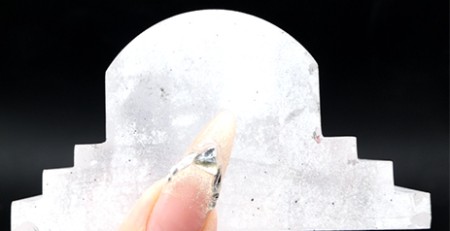
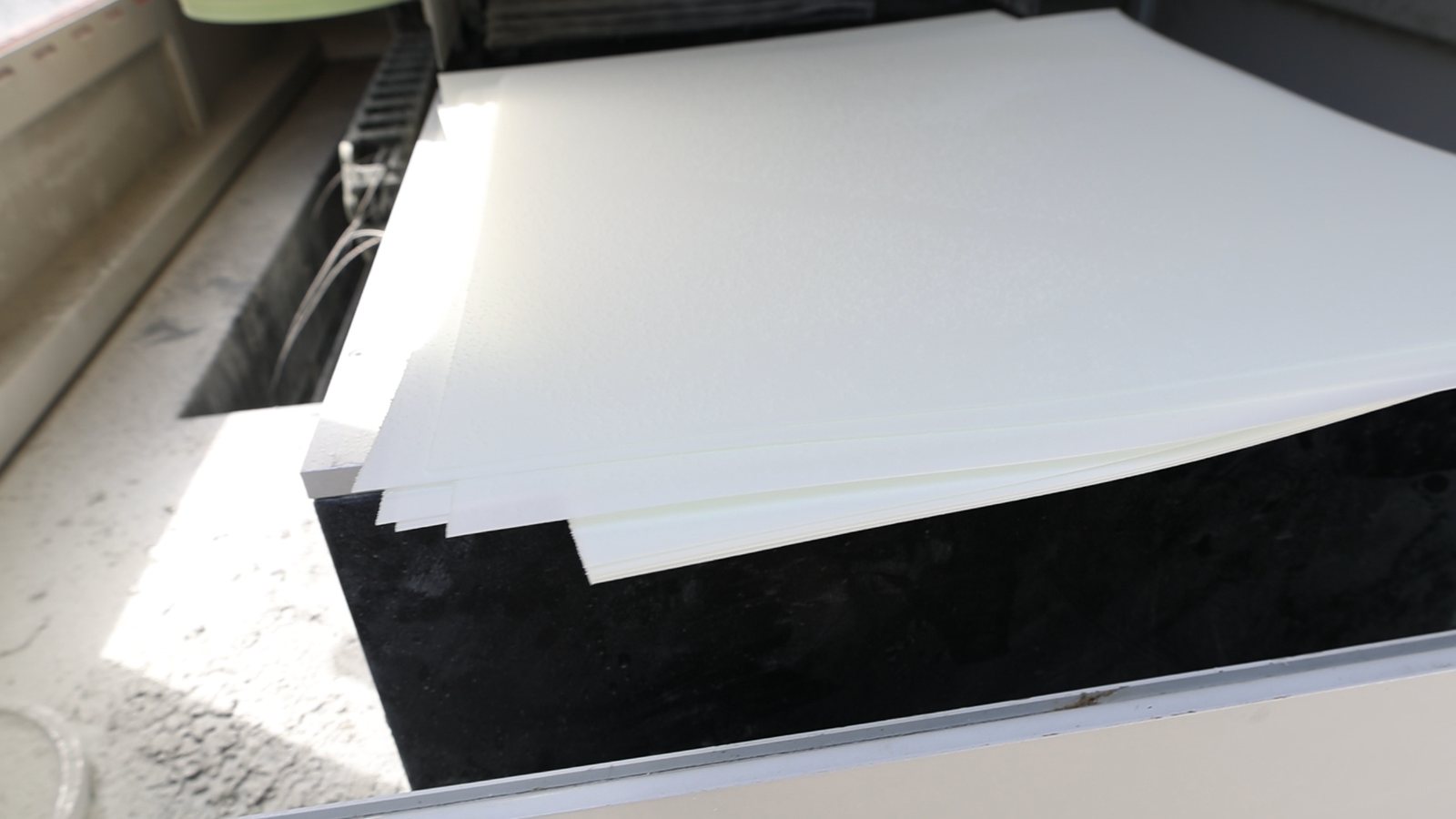
(polimetacrilimida) espuma estructural suministrada por un cliente europeo. Four slices measuring 400 mm x 400 mm x
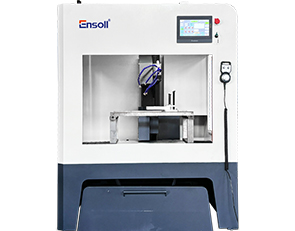
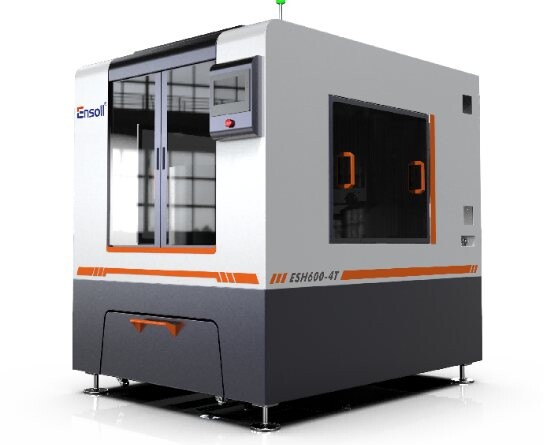
0.8 mm were produced on an ESH600-4T horizontal bucle de alambre de diamante cutting machine
using dry cutting and a fully coated diamond wire. Measured results: variación total de espesor (TTV)
0.013-0.050 milímetros (promedio 0.036 milímetros), tolerancia de grosor +/-0.043 milímetros, surface roughness Ra 0.68-0.82 µm, and maximum
astillado de bordes 5.5-7.1 µm. Matching machine structure, cutting method and process parameters to the cellular
structure of PMI foam kept material removal stable and held slice dimensional accuracy and cut-surface quality
within a workable range.
Puntos clave
- PMI foam is a low-density structural foam with a fine cellular structure; at excessive cutting load its
skeleton is compressed or torn rather than cleanly sheared. - Dry cutting was chosen to keep coolant out of the foam cells and to remove the cleaning and drying steps
that follow a wet cut. - Across four 0.8 mm slices: TTV 0.013-0.050 milímetros (mean 0.036 milímetros), tolerancia de grosor +/-0.043 milímetros, Ra
0.68-0.82 µm, maximum chipping 5.5-7.1 µm. - Samples ran slightly thin overall (down to -0.043 milímetros), which points to a straightforward dimensional
compensation on the next run. - Máquina, alambre, cutting method and parameters were matched as one set; no single parameter carried the
result.
Sample test for European customer I | Diamond wire loop cutting process
Overview of the PMI Foam Slicing Test
This test was carried out on PMI foam supplied by a European customer (customer I), with high-precision
straight slicing as the primary requirement. PMI (polimetacrilimida) foam is a high-performance structural foam
known for low density, a uniform cellular structure, and good specific strength and specific stiffness. Its
porous interior gives it a material-removal behaviour quite different from that of dense materials: the diamond
abrasive grains act continuously on the foam skeleton, and excessive cutting load or poorly matched parameters
readily cause local compression, tearing and an uneven cut face, all of which feed directly into slice thickness
and surface quality. This test therefore matched cutting method, machine configuration, wire and process
parameters to the structural characteristics of PMI foam and to the straight-slicing accuracy requirement, así que
that material removal stayed stable while slice dimensions and cut-surface quality remained under control.
Because of the demands PMI foam places on cutting stability, dimensional accuracy and cross-section quality,
Ensoll applied a diamond wire solution tailored to foam machining. On the machine side, a dedicated horizontal
diamond wire saw machine was used so that the wire runs stably along the horizontal
plane, providing a repeatable cutting path and stable feed for straight slicing. On the consumable side, un
diamond wire suited to PMI foam keeps the abrasive grains acting on the material surface continuously and evenly,
which sustains stable removal. On the cutting-method side, dry cutting avoids coolant entering the foam cells and
lets chips escape promptly during the cut. On that basis, wire running speed and feed rate were adjusted against
the density, cellular structure and target slice thickness of the material, holding the cutting load in a
suitable band and reducing the local compression and tearing that excessive point loads cause in the foam
estructura. Matching machine, alambre, cutting method and parameters as one set kept the slicing process stable and
brought slice thickness, dimensional accuracy and surface quality under control, establishing a process basis
for high-precision straight slicing of PMI foam.
1. Test Object: Basic Information
- Material: PMI foam
- Dureza: aproximadamente MH 2
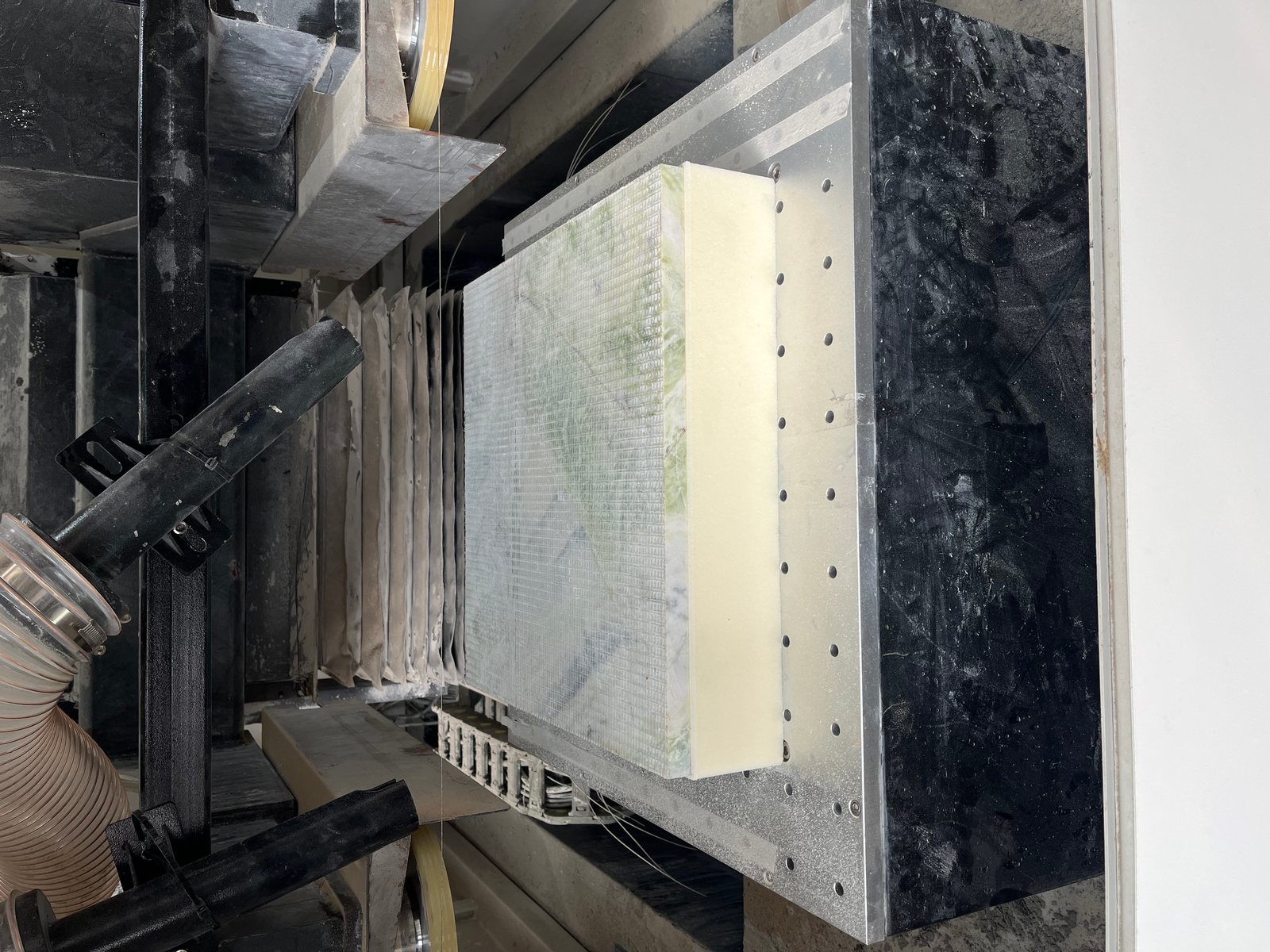
- Dimensiones de la pieza de trabajo: 400 mm x 400 mm x 50 milímetros
- Cut dimensions: 400 mm x 400 mm x 0.8 milímetros
2. Machine and Wire Selection
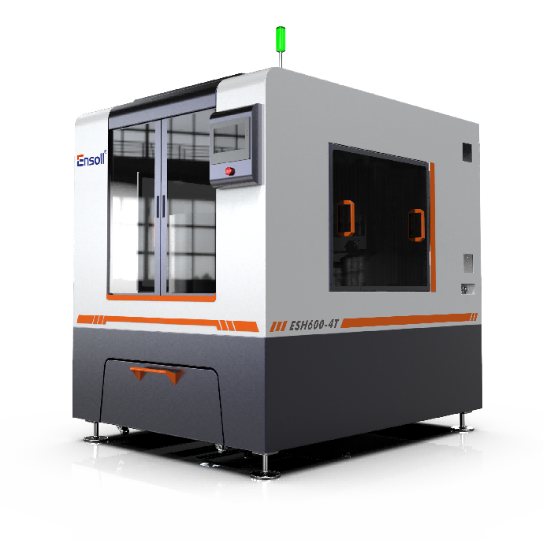
Machine type: ESH600-4T. Because PMI foam is lightweight, porous and easily deformed, y
because the requirement is high-precision straight slicing, Ensoll selected a horizontal diamond wire cutting
machine suited to PMI machining. This keeps the wire running stably and preserves cutting-path accuracy, reduces
the effect of machine vibration and cutting-load fluctuation on machining quality, and limits the local
deformation, edge defects and thickness deviation that uneven loading would otherwise produce, thereby improving
both the dimensional accuracy and the cut-surface quality of PMI slices.
- Coolant type: dry cutting. Because PMI foam is porous, lightweight and prone to absorbing
liquids, dry cutting prevents coolant from entering the cells or remaining in the material and destabilising
slice dimensions. It also removes the cleaning and drying steps that follow a wet cut, which helps preserve
structural integrity and dimensional accuracy. - Tipo de alambre: fully coated. A fully coated diamond wire loop
raises grain bonding strength and distribution stability, sustaining a stable and continuous cutting capability.
It reduces the cutting fluctuation caused by wire wear and grain pull-out, limits tearing and edge defects, y
improves the dimensional consistency and surface quality of PMI slices.
3. Método de corte y ventajas de la máquina
Horizontal cutting method. La máquina utiliza una estructura de corte horizontal con un
movimiento unidireccional y rápido bucle de alambre de diamante como la herramienta de corte; los
la pieza de trabajo está fijada en la mesa de trabajo y se corta mediante avance de precisión. Este diseño es compacto con una trayectoria de movimiento clara,
lo que ayuda a mantener estable la trayectoria del alambre y reduce la influencia de las fluctuaciones de carga en el grosor del corte y
la calidad de la superficie cortada. También soporta modos de corte fijo, rotatorio y oscilante, por lo que el modo de corte se puede ajustar
a las propiedades del material y a los requisitos de mecanizado, ampliando la adaptabilidad de la máquina a diferentes materiales y
condiciones de proceso.
Sistema inteligente de control de tensión. La tensión por resorte combinada con retroalimentación del sensor de fuerza
permite operación de tensión constante o variable según el estado de mecanizado. Manteniendo la tensión del alambre
stable during the cut improves wire running stability and reduces trajectory fluctuation and the risk of wire
breakage; tension is automatically reduced in standby and during wire changes, which limits wire fatigue and
pulley wear.
Multi-stage automatic cutting. Slice thickness, number of cuts, cutting speed and cutting
depth can be preset, and the machine then completes continuous cutting automatically to those parameters,
reducing manual interference in the process. For tasks requiring many slices in succession, this raises cutting
efficiency and batch-to-batch consistency.
Breakpoint resume. If the process is interrupted by a wire break, power loss or similar
fault, the system records the current cutting position and resumes from that point once operation is restored,
with no need to reset the workpiece origin. Esto reduce el error de mecanizado por reposicionamiento repetido, disminuye
la pérdida de material y mejora la eficiencia del mecanizado continuo.
4. Configuración de parámetros y método de enfriamiento
| Parámetro | Valor |
|---|---|
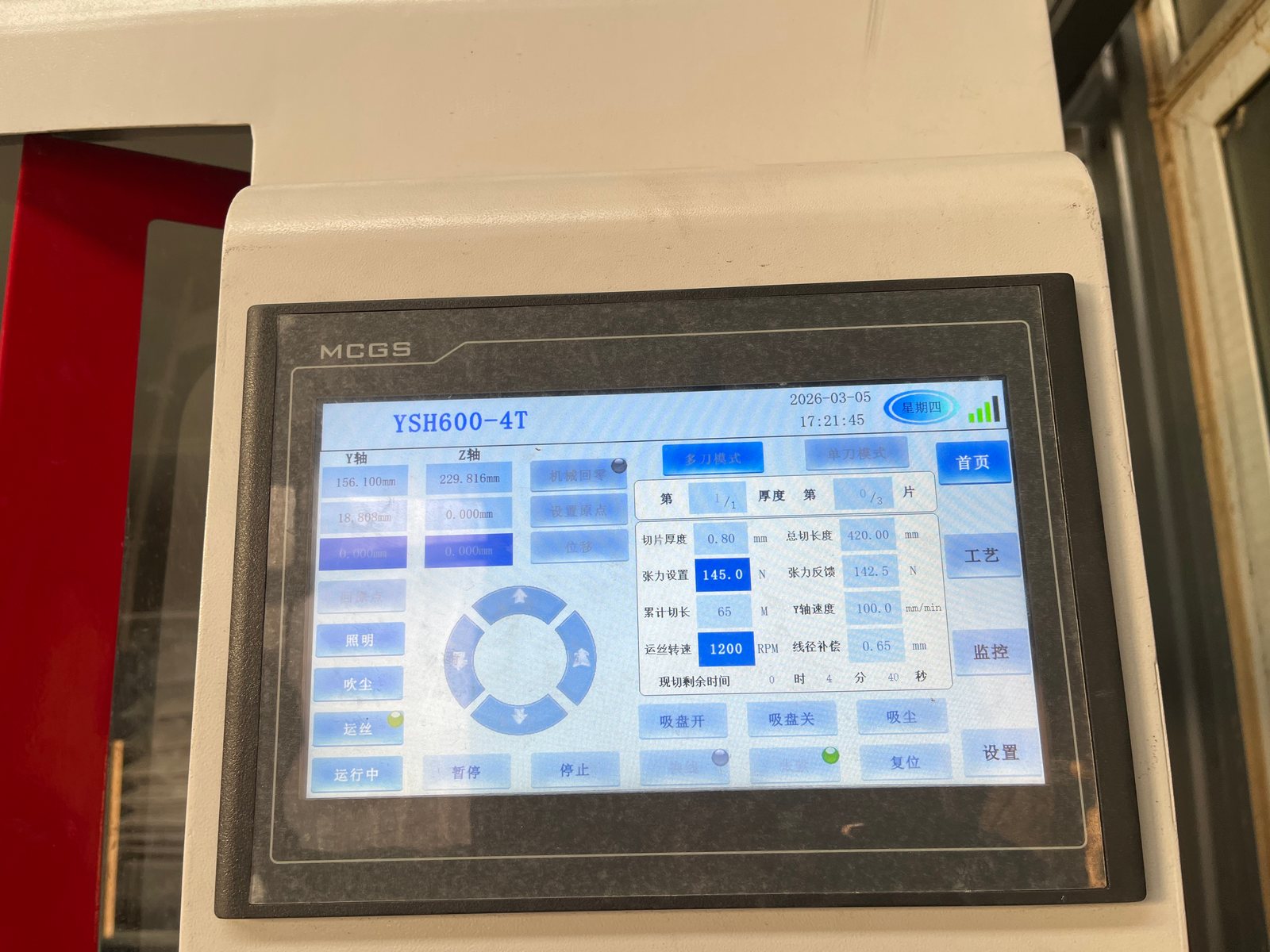
| Diámetro del alambre (milímetros) | 0.60 x 3460 |
| Velocidad de avance del alambre (mm/min) | 100 |
| Ancho de corte (milímetros) | 400 |
| Tensión del alambre de corte (norte) | 145 |
| Velocidad del alambre (EM) | 25 |
| Tiempo de arco del alambre (s) | 60 |
| Carga de corte (norte·m) | 17 |
5. Eficiencia de corte y resultados
5.1 Datos de prueba TTV (milímetros)
TTV (Variación del espesor total) se midió usando una cuadrícula de nueve puntos, método de grosor de doble sonda en un
escenario de vacío con sujeción, aplicado a las rebanadas de espuma PMI producidas por corte con alambre de diamante. Las dimensiones de la muestra cortada fueron
400 mm x 400 mm x 0.8 milímetros, con un espesor nominal de 0.8 milímetros. Antes de la medición, el instrumento fue thermicamente
stabilised and calibrated with a standard thickness block to reduce zero drift and systematic error. After
dust-free cleaning, each sample was centred on the vacuum chuck and held by negative pressure so that it stayed
in a stable measuring state, limiting the effect of position shift, local warping and deformation on the
thickness readings. The procedure follows the same nine-point method used in our
PEEK slicing test. Thickness data were then collected in sequence at the preset nine
grid positions, and the difference between the largest and smallest readings across all points was taken as the
TTV of that sample, which is used to evaluate the thickness uniformity and machining consistency of PMI foam
slices.
| Muestra | Nine-point thickness readings (milímetros) | Tmax | Tmin | TTV |
|---|---|---|---|---|
| S01 | 0.785, 0.790, 0.799 / 0.800, 0.802, 0.812 / 0.819, 0.832, 0.835 | 0.835 | 0.785 | 0.050 |
| S02 | 0.752, 0.754, 0.757 / 0.759, 0.762, 0.775 / 0.786, 0.787, 0.789 | 0.789 | 0.752 | 0.037 |
| S03 | 0.747, 0.748, 0.751 / 0.754, 0.756, 0.757 / 0.762, 0.784, 0.791 | 0.791 | 0.747 | 0.044 |
| S04 | 0.749, 0.751, 0.753 / 0.755, 0.759, 0.760 / 0.760, 0.761, 0.762 | 0.762 | 0.749 | 0.013 |
Evaluación: Four PMI foam slices were tested for thickness uniformity by the nine-point
método. TTV values ranged from 0.013 El papel del interruptor magnético del refrigerador. 0.050 mm con un promedio de 0.036 milímetros. Sample S04 showed the smallest
variation, en 0.013 milímetros. Overall, the results indicate reasonable slice thickness consistency, although some
scatter remains between samples.
5.2 Datos de tolerancia de espesor (milímetros)
Thickness tolerance was measured by the same nine-point grid method, con 0.800 mm as the nominal thickness of
the sample. The deviation between the measured thickness at each point and the nominal thickness was calculated,
y la desviación positiva máxima, maximum negative deviation and thickness deviation range were collated to
evaluate the dimensional accuracy and overall machining consistency of the PMI foam slices.
| Muestra | Espesor promedio (milímetros) | Desviación de espesor (milímetros) |
|---|---|---|
| S01 | 0.808 | +0.008 |
| S02 | 0.769 | -0.031 |
| S03 | 0.761 | -0.039 |
| S04 | 0.757 | -0.043 |
| Maximum positive deviation | +0.008 | +0.008 |
| Maximum negative deviation | -0.043 | -0.043 |
| Thickness tolerance | +/-0.043 | +/-0.043 |
Evaluación: With 0.800 mm as the nominal thickness, the average thicknesses of the four PMI
foam slices were 0.808, 0.769, 0.761 y 0.757 milímetros, corresponding to deviations of +0.008, -0.031, -0.039 y
-0.043 milímetros. The maximum positive deviation was +0.008 milímetros, the maximum negative deviation -0.043 milímetros, and the
overall thickness tolerance +/-0.043 milímetros. The results show that sample thickness tends toward the negative side,
with the last three samples running somewhat thin; thickness control can be improved further through cutting
parameters and dimensional compensation.
5.3 Surface Roughness Ra Data (µm)
Rugosidad de la superficie (Ra) was measured to ISO 4287 using a stylus profiler. Three representative positions,
centre, mid-left and mid-right, were profiled on the cut face of each PMI foam slice, and Ra was calculated at
each position to evaluate surface quality and machining consistency after diamond wire cutting.
| Muestra | Ra-1 | Ra-2 | Ra-3 | Average Ra |
|---|---|---|---|---|
| S01 | 0.82 | 0.79 | 0.85 | 0.82 |
| S02 | 0.76 | 0.72 | 0.78 | 0.75 |
| S03 | 0.80 | 0.75 | 0.82 | 0.79 |
| S04 | 0.68 | 0.65 | 0.71 | 0.68 |
Evaluación: Four PMI foam slices were tested for surface roughness by the three-point
método. Average Ra ranged from 0.68 El papel del interruptor magnético del refrigerador. 0.82 µm, with little variation between measuring positions, indicating a
broadly uniform cut surface and a stable wire running and material-removal process.
5.4 Datos de astillado de bordes (µm)
Chipping was measured by optical imaging on a toolmaker’s microscope to quantify edge defects on the PMI foam
slices. Sample edges were cleaned before measurement, and the instrument magnification and measuring scale were
calibrated. Each edge region of the slice was then examined under the microscope, recognisable chips, notches
and local edge damage were located and measured, and the defect size at each measuring point was recorded. los
largest defect on a single slice was taken as the primary evaluation index, giving a combined view of edge
integrity and machining quality after cutting PMI foam.
| Muestra | Posición 1 | Posición 2 | Posición 3 | Posición 4 | Maximum chipping |
|---|---|---|---|---|---|
| S01 | 5.2 | 6.4 | 5.8 | 7.1 | 7.1 |
| S02 | 4.6 | 5.7 | 5.1 | 6.3 | 6.3 |
| S03 | 5.0 | 6.1 | 5.5 | 6.8 | 6.8 |
| S04 | 3.8 | 4.7 | 4.3 | 5.5 | 5.5 |
Evaluación: Four PMI foam slices were inspected for edge defects by the four-point method.
Defect sizes were generally small, with maximum chipping between 5.5 y 7.1 um and little difference between
samples. The results indicate stable edge material removal during diamond wire cutting and good edge integrity on
the slices.
6. Conclusión
The high-precision slicing of PMI foam in this test produced good results, mainly because the dedicated
cutting machine, the dry cutting method and the process parameters were matched as one set. PMI foam is a
high-performance structural foam with low density, an internal cellular structure and good specific strength and
stiffness, and that cellular structure gives it a load behaviour different from dense materials during diamond
wire cutting. The diamond grains act continuously on the internal skeleton, and when the cutting load is too
high or the parameters are poorly matched, local compression, tearing and an uneven cut face appear and affect
slice thickness and dimensional accuracy. Aiming at the structural properties of PMI foam and the straight
slicing accuracy requirement, this test therefore optimised machine selection, cutting method and process
parameters in a targeted way, controlling dimensional accuracy and cut-surface quality while keeping the cutting
process stable.
Primero, machine selection. Given the demands PMI foam slicing places on motion stability,
cutting accuracy and machine rigidity, a dedicated horizontal diamond wire loop cutting machine for precision
PMI machining was selected. Horizontal cutting keeps the wire running stably along the horizontal plane, which
helps hold the cutting trajectory and feed motion steady and reduces the effect of machine vibration, motion
error and wire running fluctuation on cut position and dimensional accuracy. Stable feed and motion control also
narrow the variation in cutting load, keeping the relative motion between wire and PMI foam consistent. Esta
reduces the compression and tearing that uneven local loading causes, improves slice dimensional consistency,
and provides a stable machine basis for high-precision PMI slicing.
Segundo, cutting method. Given the cellular structure and properties of PMI foam, dry cutting
fue utilizado. Dry cutting introduces no liquid coolant, so liquid cannot enter the foam cells, and the cleaning and
drying steps that would otherwise affect the material state are avoided. los
fully coated diamond wire loop grinds the material directly and continuously, así que
removal takes place under relatively stable cutting conditions. Controlling wire
running state and cutting load sensibly reduces the local squeezing and tearing the material experiences during
cortante, improving the uniformity of the cut cross-section and edge quality, and keeping the process
consistent.
Tercero, process parameters. Given the low density, cellular structure and removal behaviour of
PMI foam, wire running speed and feed rate were matched accordingly. Parameters were set to keep the wire running
stably and material removal even, avoiding a feed rate so high that the cutting load rises and the foam skeleton
takes a large local force; wire running speed was controlled so that cutting stayed continuous and stable with
less load fluctuation. Targeted adjustment of the cutting parameters kept material removal comparatively smooth
y, while meeting machining efficiency, improved slice thickness and dimensional consistency and the quality of
the cut surface.
Taken together, the results for slice dimensional accuracy, tolerancia de grosor, Rugosidad superficial (Ra) y
cut-edge quality show that, through coordinated optimisation of a dedicated horizontal cutting machine, seco
cutting and suitable cutting parameters, diamond wire loop cutting meets the requirements of high-precision
straight slicing for PMI foam. The machined samples performed consistently in dimensional accuracy, slice
thickness consistency and cut-surface quality, which indicates that matching machine structure, cutting method
and process parameters to the structure and cutting behaviour of PMI foam effectively improves material removal
and process stability, and provides a process reference for high-precision straight slicing of PMI foam.
Related Process Data
The validated parameter window behind these results – what each setting does on a cellular foam and which way to move it when a defect appears – is published as a standalone reference: PMI foam cutting parameters. For a side-by-side comparison with a dense thermoplastic measured on the same basis, see PEEK vs PMI foam, and for the thickness measurement method itself, los nine-point TTV guide.
Preguntas Frecuentes
Can diamond wire cutting slice PMI foam down to 0.8 grosor en mm?
sí. En esta prueba, four 400 mm x 400 mm PMI foam slices were cut to a nominal thickness of 0.8 mm on an
ESH600-4T horizontal diamond wire saw machine. Measured total thickness variation
(TTV) ranged from 0.013 El papel del interruptor magnético del refrigerador. 0.050 mm con un promedio de 0.036 milímetros, and the overall thickness tolerance was
+/-0.043 milímetros, which is a workable basis for precision foam components.
¿Por qué se eligió el corte en seco para la espuma PMI en lugar del corte en húmedo??
La espuma PMI es porosa, ligera y propensa a absorber líquidos. El corte en seco evita que el refrigerante entre
en las celdas o quede en el material y desestabilice las dimensiones de las rebanadas, y elimina los pasos de limpieza y
secado que siguen a un corte en húmedo. Eso ayuda a preservar la estructura de la espuma y la precisión dimensional
de las rebanadas.
Qué calidad de superficie se puede esperar al cortar espuma PMI?
La rugosidad de la superficie se midió según ISO 4287 con un perfilador de punta en tres posiciones por rebanada. Average Ra
ranged from 0.68 El papel del interruptor magnético del refrigerador. 0.82 um con poca variación entre las posiciones de medición, y el astillado máximo de borde
medido por microscopía óptica fue 5.5 El papel del interruptor magnético del refrigerador. 7.1 µm, indicando una superficie de corte uniforme con buena integridad de borde.
¿Por qué las rebanadas de espuma PMI salieron ligeramente delgadas??
With 0.800 mm as the nominal thickness, las cuatro rebanadas promediaron 0.808, 0.769, 0.761 y 0.757 milímetros, entonces tres de
ellos se desgastaron poco a poco 0.031 El papel del interruptor magnético del refrigerador. 0.043 milímetros. Este es un desplazamiento sistemático más que una dispersión aleatoria, y se puede
corregir directamente a través de parámetros de corte y compensación dimensional en la siguiente pasada.
¿Con qué otros materiales ha probado Ensoll el corte con lazo de alambre de diamante??
Ensoll ha publicado datos de procesos comparables para otros polímeros y materiales difíciles de cortar, incluyendo una
prueba de corte de precisión de PEEK y una guía de los
materiales adecuados para el corte con lazo de alambre de diamante. Para preguntas generales sobre procesos, see
los Preguntas frecuentes sobre tecnología de corte con lazo de alambre de diamante.
Contenido técnico revisado por el equipo de ingeniería de Ensoll – un fabricante de lazos de alambre de diamante con 10+ años de experiencia en producción.