Découpe de verre optique: Scie à fil diamanté vs Laser
L'usinage du verre optique nécessite une précision sub-micronique pour répondre aux exigences d'industries comme l'aéronautique, Photonique, et électronique grand public. Avec Scies à fil diamanté sans fin et la découpe au laser émergeant comme technologies dominantes, les fabricants font face à un choix crucial. Ce guide analyse les deux méthodes selon 7 des paramètres clés pour vous aider à prendre des décisions basées sur les données.
- La découpe à la scie à fil diamanté enlève le matériau par abrasion de grains de diamant (un fil 0.1-0.3 mm, 5-30 m/s) et maintient +/-0.02-0.03 tolérance en mm; la découpe au laser vaporise le matériau et maintient généralement +/-0.05 mm.
- La qualité de coupe favorise la scie à fil: sous 10 écaillage des bords en micromètres et Ra 0.2-0.5 micromètres, contre un 20-50 zone affectée par la chaleur en micromètres et Ra 0.5-2 micromètres pour le laser.
- L’efficacité favorise le laser: 40-60 tranches/heure avec 5-10 minute de préparation contre 20-30 tranches/heure et 15-30 minutes pour la scie à fil — mais l’ébarbure du laser est plus étroite à 0.05-0.1 mm contre 0.15-0.3 mm.
- Profil de coût: scie à fil 50K-150K $ investissement avec 0,10 $/m de consommables et faible maintenance; laser 100K-300K $ avec 20 $/h d’assistance gazeuse et maintenance optique plus élevée.
- Règle générale: scie à fil pour verre de plus de 3 mm, bords de qualité optique en dessous de Ra 0.5 micromètres et revêtements sensibles à la chaleur; laser pour prototypage de verre fin et contours complexes.

1. Découpe infinie au fil diamanté
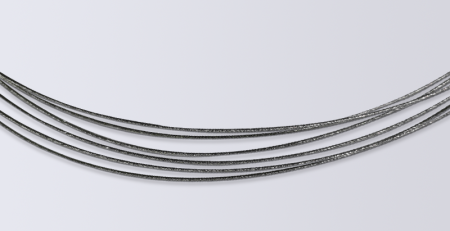
Un système en boucle fermée utilisant un fil enduit de diamant (diamètre typique de 0,1 à 0,3 mm) fonctionnant à 5-30 m/s. L'action abrasive fournit:
– Mécanisme d'enlèvement de matière: Micro-ébréchure par abrasion des grains de diamant
– Tolérance typique: ±0,03 mm pour les coupes standard, ±0,02 mm avec contrôle avancé
– Idéal pour: Thick verre optique (>1mm), coupes courbes, et matériaux fragiles comme le SCHOTT B270 .
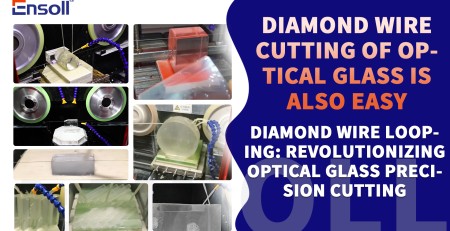
Affichage de coupe:
2. Découpe laser
Une méthode sans contact utilisant des faisceaux laser focalisés (généralement des lasers CO₂ ou ultrarapides):
– Mécanisme d'enlèvement de matière: Vaporisation/fusion par chauffage localisé
– Tolérance typique: ±0,05 mm pour les systèmes standard
– Idéal pour: Verre fin (<3mm), géométries complexes, et prototypage rapide
Comparaison directe
1. Qualité de coupe
| Paramètre | Scie à fil diamantée sans fin | Découpe laser |
| Écaillage des bords | <10µm avec vitesse d'avance optimisée | 20-50µm zone affectée thermiquement |
| Rugosité | Ra 0,2-0,5 µm | Ra 0,5-2 µm |
| Dommages en subsurface | Micro-fissures minimales | Micro-fractures potentielles |
Insight clé: Pour les lentilles et prismes nécessitant des finitions de qualité optique, Les scies à fil offrent une intégrité de bord supérieure.
2. Polyvalence des matériaux
– Les scies à fil gèrent:
– Verres à haute dureté (Par ex., Corning Gorilla Glass 3)
– Matériaux composites (Verre-céramique comme le Zerodur)
– Revêtements sensibles à la température
– Les lasers ont du mal avec:
– Borosilicate épais (>5mm) en raison de l'accumulation de chaleur
– Verres transmettant les UV sujets au stress thermique
- Efficacité de production
| Métrique | Scie à fil (300mm/s) | Laser (500mm/s) |
| Débit | 20-30 tranches/heure | 40-60 tranches/heure |
| Temps de configuration | 15-30 minutes | 5-10 minutes |
| Largeur de coupe | 0.15-0.3mm | 0.05-0.1mm |
Compromis: Les lasers offrent un traitement plus rapide mais gaspillent plus de matériau avec une coupe plus large.
5 Facteurs de décision
1. Épaisseur de la pièce
– Choisir la scie à fil si:
Découpe >3mm verre optique (Par ex., Miroirs de télescope)
Astuce mot-clé: “épais découpe optique du verre solution”
2. Exigences de tolérance
Les scies à fil maintiennent des tolérances plus strictes pour:
– Contrôle de l'angle du prisme (±15 secondes d'arc)
– Uniformité de l'optique au niveau de la tranche
3. Considérations de coût
| Facteur coût | Scie à fil | Laser |
| Investissement initial | $50K-$150K | $100K-$300K |
| Consommables | $0.10/mètre de fil diamanté | $20/heure assistance gaz |
| Entretien | Plus bas (pièces mécaniques) | Supérieur (nettoyage optique) |
- Sensibilité thermique
Risques de découpe au laser:
– Biréfringence de contrainte dans les éléments polarisants
– Déformation du point de recuisson dans les verres phosphatés
5. Besoins en post-traitement
Les pièces sciées au fil nécessitent souvent:
– 25% moins de temps de polissage par rapport à. aux surfaces découpées au laser
– Pas de recuisson de relaxation de contraintes
Conclusion: Quand choisir chaque méthode
Optez pour la scie à fil diamant infini lorsque:
✓ Épaisseur de coupe >3mm
✓ Besoin de bords de qualité optique (Ra<0.5µm)
✓ Traitement de revêtements sensibles à la chaleur
Choisir la découpe au laser lorsque:
✓ Prototypage rapide de verre fin
✓ Contours complexes avec <0.1jeu de coupe mm
✓ Budget permettant des coûts opérationnels plus élevés
Astuce: Demandez des échantillons de découpe aux fournisseurs – comparez la qualité des bords sous microscope 200x pour valider les affirmations.
Questions fréquemment posées
Dois-je choisir une scie à fil diamant ou un laser pour la découpe de verre optique?
Choisissez la scie à fil pour couper du verre de plus de 3 mm, when you need optical-grade edges (Ra below 0.5 micromètres), or when processing heat-sensitive coatings and hard glasses like Corning Gorilla Glass 3. Choose laser for rapid prototyping of thin glass under 3 mm and complex contours needing a kerf below 0.1 mm.
Does laser cutting damage optical glass?
It can. The localized heating creates a 20-50 micrometer thermal affected zone, risks micro-fractures below the surface, and can cause stress birefringence in polarizing elements or annealing-point distortion in phosphate glasses. Wire saw cutting is a cold abrasive process and avoids these thermal risks.
Which method costs more, wire saw or laser?
Laser costs more on both fronts: $100K-300K initial investment versus $50K-150K for a wire saw, plus about $20 per hour in gas assist versus roughly $0.10 per meter of diamond wire. Laser systems also demand more maintenance, principalement nettoyage des optiques.
Quelle méthode est plus précise?
La scie à fil diamanté: +/-0.03 mm standard et +/-0.02 mm avec commandes avancées, contre +/-0.05 mm pour les systèmes laser standards. Les scies à fil maintiennent également le contrôle de l'angle du prisme à l'intérieur de +/-15 secondes d'arc, ce qui explique pourquoi elles dominent les prismes et les optiques au niveau des plaquettes.
Examiné par l'équipe d'ingénierie Ensoll.