Tranchage de noyaux de ferrite souples: Fil diamanté sans fin
L'évolution rapide des télécommunications 5G, véhicule électrique (VE) infrastructure de recharge, and high-frequency power supplies has placed a massive spotlight on a specific class of magnetic materials: Soft Ferrites. Unlike hard permanent magnets like NdFeB or SmCo, soft ferrites (such as Manganese-Zinc and Nickel-Zinc ferrites) are ceramic compounds engineered for their high magnetic permeability and remarkably low electrical conductivity. These properties make them indispensable for preventing energy loss in transformers, inducteurs, et l'interférence électromagnétique (EMI) suppressing cores.
- Soft ferrites (MnZn and NiZn) are ceramic magnetic materials essential to high-frequency transformers, inductors and EMI suppression cores — and they are extremely brittle.
- Traditional blades cause severe edge chipping, kerf loss of up to 50% on thin parts, and sub-surface micro-cracks that shorten core life.
- A diamond wire loop running continuously at 40-60 m/s cuts by low-force micro-grinding: near-zero chipping, kerf down to 0.2-0.35 mm, and a near pre-polished surface finish.
- Key parameters are wire speed above 50 m/s for hard ferrites, tightly controlled feed to avoid wire bow, and uniform fine diamond grit.
Toutefois, because soft ferrites are essentially industrial ceramics, they inherit the classic vulnerabilities of the ceramic family. They are incredibly brittle, highly sensitive to thermal shock, and prone to internal stress fractures during machining. As electronic components shrink and frequencies rise, manufacturers face the daunting task of slicing these fragile ferrite blocks into ultra-thin, complex geometries with flawless accuracy.
To meet these tight tolerances without compromising structural integrity, high-volume electronics manufacturers are shifting away from traditional abrasive wheel cutting and adopting Interminable Boucle de fil de diamant Technologie.
Soft ferrites crack more easily than rare-earth magnets, yet the same rules that govern comment couper les aimants en néodyme apply: keep cutting force low and temperature stable.
The Soft Ferrite Challenge: Ceramic Brittleness Meets High Frequency
Processing soft ferrites is a delicate balancing act. Sintered ferrite blocks are rigid but possess very low tensile strength. During traditional slicing processes, manufacturers face several distinct manufacturing bottlenecks:
1. Severe Edge Chipping and Micro-Cracking
When traditional inner-diameter (ID) saws or thick diamond blades cut through a ferrite block, they exert high localized mechanical pressure. As the blade exits the cut, this pressure causes the ceramic material to fracture, resulting in severe edge chipping (崩边). For high-frequency transformer cores, even minor edge defects can alter the magnetic flux path, increase eddy current losses, and degrade the overall efficiency of the component.
2. High Ceramic Powder Waste (Kerf Loss)
Traditional grinding wheels are relatively thick (often over $1.0\text{ mm}$). When slicing miniature ferrite components—such as low-profile inductor cores that are only a few millimeters thick—a thick blade can easily turn up to $50\%$ of the raw material into useless ceramic sludge. Minimizing this cutting path, or kerf loss, is vital for maintaining cost-effective production.
3. Dommages sous la surface (SSD)
The mechanical stress of a heavy, slow-moving blade doesn’t just damage the surface; it telegraphs micro-fractures deep into the interior of the ceramic matrix. This sub-surface damage compromises the mechanical lifespan of the ferrite core, le rendant susceptible de se fissurer sous les cycles thermiques des opérations à haute puissance.
La Percée: Découpe en boucle de fil diamant sans fin
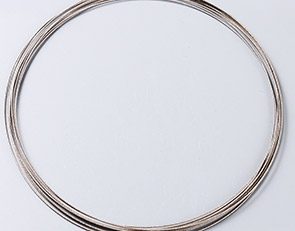
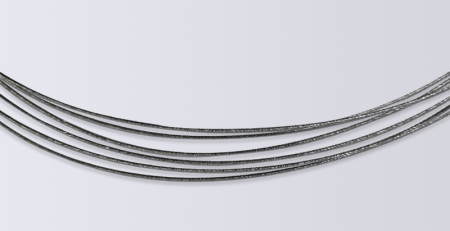
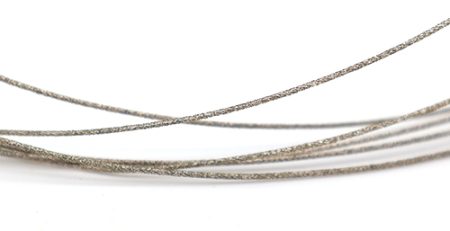
Pour surmonter les limites des lames rigides, les ateliers de précision modernes intègrent des boucles de fil diamant sans fin dans leurs lignes de production. Un boucle de fil de diamant sans fin c'est un fil en boucle continue, fil d'acier flexible enduit de particules de diamant industriel minutieusement classées, fonctionnant sur un système de poulies à grande vitesse dans une boucle fixe, à sens unique
Lorsqu'elle est appliquée au traitement du ferrite tendre, cette technologie offre un saut quantique en qualité et en efficacité grâce à plusieurs mécanismes opérationnels distincts:
Vitesses linéaires ultra-élevées avec force d’alimentation minimale
Contrairement aux scies à fil traditionnelles à mouvement alternatif qui se déplacent à basse vitesse et inversent constamment la direction, an endless diamond wire loop rotates continuously in one direction at velocities between $40\text{ m/s}$ and $60\text{ m/s}$.
This immense speed changes the physics of the cut. Instead of forcing its way through the ceramic, the wire performs a lightning-fast micro-grinding action. The mechanical force exerted on the ferrite block drops to near zero, eliminating the shock factors that cause edge chipping and allowing for the safe production of ultra-thin ferrite wafers.
Drastic Reduction in Kerf Loss
Because the endless loop operates under highly optimized, steady tension without the “vibration jerk” of reciprocating systems, the core steel wire can be manufactured to be incredibly thin—frequently down to $0.20\text{ mm}$ to $0.30\text{ mm}$. This remarkably narrow kerf maximizes material utilization, allowing manufacturers to extract significantly more usable ferrite cores out of a single sintered block.
Exceptional Thermal Control and Swarf Flushing
While soft ferrites can handle high operational temperatures in electrical circuits, they are highly sensitive to sudden localized thermal shocks during machining. If a cutting zone overheats, the ferrite can experience localized thermal expansion, leading to immediate cracking.
The continuous, high-speed movement of la boucle de fil diamant prevents heat accumulation by constantly introducing a fresh, cool section of wire into the cutting zone. When paired with high-volume, water-soluble coolants, the fine ceramic powder (copeaux) is instantly flushed away, keeping the wire sharp and the ferrite block perfectly cool.
Finition de surface supérieure ($R_a$)
L'opération lisse, continuous motion of the endless loop yields an exceptionally clean surface finish with minimal roughness ($R_a$). Une surface plus lisse signifie que les faces d'accouplement des noyaux en ferrite fendus (tels que les noyaux en E ou en U) nécessitent peu ou pas de rodage ou de polissage secondaire pour obtenir l'ajustement parfait requis afin de minimiser la réluctance de l'air.
Comparaison technique: Tranchage de ferrite tendre
| Métrique de performance | Lames à rainurer en céramique traditionnelles | Boucle de fil diamanté sans fin () |
| Mécanisme de coupe | Découpage mécanique à haute pression | High-speed, low-force micro-grinding |
| Wire/Blade Thickness | $0.8\texte{ mm}$ to $1.5\text{ mm}$ | $0.2\texte{ mm}$ to $0.35\text{ mm}$ |
| Material Yield | Faible (Perte/dechets élevés de matière) | Élevé (Déchets matériels minimes) |
| Écaillage des bords | Fréquent, nécessite une retouche importante | Pratiquement aucune éclat ou micro-fissure |
| Qualité de surface ($R_a$) | Grossier, nécessite un rodage secondaire | Excellente, finition quasi pré-polished |
Optimisation des paramètres pour les ferrites tendres
Obtenir la coupe parfaite sur une céramique en ferrite tendre dépend fortement de l'équilibre de trois paramètres principaux de la machine:
- Sélection de la vitesse du fil: Pour les matériaux durs, céramiques fragiles comme les ferrites Mn-Zn, en maintenant la vitesse du fil sur le haut de la plage ($>50\texte{ m/s}$) ensures that the material removal stays in the brittle-ductile transition zone, optimizing surface smoothness.
- Feed Rate Tuning: La vitesse d’avance (the speed at which the wire pushes into the material) must be tightly controlled. Moving too fast increases bowing of the wire, which can introduce slight geometric deviations in flatness.
- Grit Size Optimization: Using a highly uniform, micro-sized diamond grit ensures that the material is eroded evenly, avoiding deep scratches that could act as stress concentrators later on.
Conclusion: Driving the Future of High-Frequency Electronics
Conclusion: Driving the Future of High-Frequency Electronics
As power electronics transition toward smaller footprints and higher power densities—driven heavily by wide-bandgap semiconductors like Silicon Carbide (Sic) et le nitrure de gallium (Gan)—the demands on soft ferrite magnetic components have never been stricter.
The Endless Diamond Wire Loop provides the precise manufacturing solution that this industry requires. By overcoming the natural brittleness of industrial ceramics, eliminating edge breakage, and maximizing raw material yields, technology stands out as the premier choice for manufacturing the high-frequency magnetic components powering our automated, electrified future.
Questions fréquemment posées
What is the best way to cut soft ferrite cores?
Diamond wire loop slicing. The continuous single-direction wire removes the ceramic by high-speed, low-force micro-grinding, qui élimine pratiquement l'ébréchage des bords et les fissures en sous-surface que les lames de fente traditionnelles provoquent sur les ferrites fragiles.
Pourquoi les noyaux en ferrite s'ébrèchent-ils pendant la coupe?
La ferrite est une céramique frittée avec une résistance à la traction très faible. Une lame rigide concentre la pression mécanique sur le bord de coupe, et le matériau se fracture lorsque la lame sort. Une force de coupe localisée élevée et les vibrations sont les causes principales.
Jusqu'où le fil diamanté peut-il couper la ferrite?
Le noyau du fil diamanté lui-même est généralement 0.20-0.30 mm, donc le trait de scie est extrêmement étroit. Cela permet des tranches de ferrite ultra-fines et permet aux fabricants d'extraire beaucoup plus de noyaux utilisables à partir d'un bloc fritté qu'avec 0.8-1.5 des lames de mm.
La coupe au fil diamanté endommage-t-elle les propriétés magnétiques de la ferrite?
Non. C'est un procédé à froid: le fil en mouvement rapide apporte constamment du neuf, cool abrasive into the cut and water-soluble coolant flushes heat and swarf away, so there is no thermal shock or heat-affected zone to degrade the ferrite.
Contenu technique examiné par l'équipe d'ingénierie d'Ensoll — un fabricant de boucles de fil diamanté avec 10+ des années d'expérience en production.