アルミナ (アル₂O₃) is hard, wear-resistant and brittle; the defect that matters is chipping at the entry and exit of the cut.
Diamond wire cuts by distributed grinding rather than concentrated shearing, which keeps edges intact instead of fracturing them.
Green (unsintered) bodies and fully sintered alumina need different wire grit and feed settings — treating them the same is a common cause of breakage.
Four variables decide the result: wire grit and bond strength, coolant filtration, tension control, and feed rate.
紹介: Beyond the Tile Cutter – A New Era of Ceramic Cutting
When people search for “how to cut ceramic,” the results are often dominated by tutorials on manual tile cutters or angle grinders. While these tools are perfect for home renovations, they represent only one facet of the ceramic world. For engineers, researchers, and manufacturers working with advanced technical ceramics—such as alumina, zirconia, 炭化ケイ素, or piezoelectric materials—these conventional methods are utterly inadequate. They lead to micro-cracks, chipping, and catastrophic failure in high-performance applications.
This begs the question: “How do you cut ceramic when precision, structural integrity, and a flawless finish are non-negotiable?” The answer lies in a advanced machining process:ダイヤモンドワイヤーループ切断.This guide delves deep into why this technology is the superior choice for cutting advanced ceramics, positioning it as the most critical of modernceramic cuttingtools.
Why Advanced Ceramics Demand a Superior Cutting Method
Technical ceramics are prized for their exceptional properties: extreme hardness, 耐摩耗性, high-temperature stability, and electrical insulation. しかし, these very properties make them notoriously difficult to machine using traditional methods.
脆性: Ceramics fail with little plastic deformation. Any uneven stress concentration causes cracking.
高硬度:They are harder than most conventional cutting materials, like high-speed steel or even carbide, leading to rapid tool wear.
Sensitivity to Thermal Shock:Sudden temperature changes during processes like laser cutting can introduce thermal stresses and micro-fractures.
Conventionalceramic cuttingtools like diamond blades on a saw generate significant vibration and lateral force, inevitably causing subsurface damage. This is where diamond wire cutting technology shines.
What is Diamond Wire Loop Cutting?
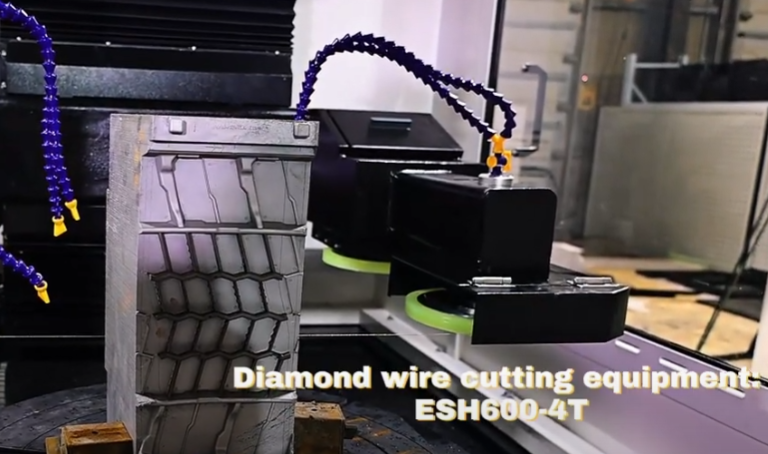
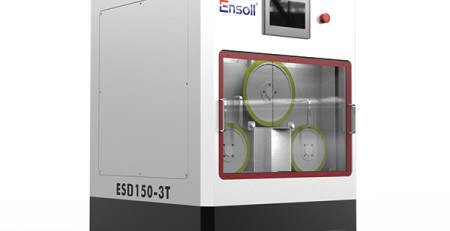
Diamond Wire Loop Cutting is a precision machining process that uses a continuous loop of wire, typically made of steel, coated with diamond particles. This “ダイヤモンドワイヤーループ” is threaded through a workpiece and driven by two or more grooved spindles on aダイアモンドワイヤーソー切断機. As the wire moves at high speed, a coolant is applied to remove debris and dissipate heat.
The fundamental principle is one of precision abrasion. Instead of a shearing or impact force, the diamond particles on the wire gently grind through the material with a minimal kerf (the width of the cut), often less than 0.5 ミリメートル.
The Unmatched Advantages of Using a Diamond Wire Loop for Ceramics
Choosing a diamond wire saw cutting machine for ceramics offers a multitude of benefits that directly address the material’s challenges.
Ultra-Low Damage and Crack-Free Cutting:
The primary advantage is the exceptional quality of the cut surface. The wire applies uniform, omnidirectional pressure, eliminating the point loads that cause chipping. This results in a crack-free diamond wire saw finish with minimal subsurface damage, which is critical for components subject to high stress.
Exceptional Precision and Accuracy:
These machines offer unparalleled control. They can achieve tolerances within a few microns and produce surfaces with remarkably low roughness, often eliminating the need for secondary grinding or polishing. This is essential for applications like seals, 軸受, and electronic substrates.
Superior Brittle Material Yield Improvement:
By virtually eliminating breakage from cutting stress, diamond wire cutting dramatically increases production yield. This is a crucial cost-saving factor when working with expensive advanced ceramics. You get more usable parts from each blank, directly improving your bottom line.
Ability to Cut Complex Shapes:
Unlike a rigid blade, the flexible wire can be guided to cut complex contours, curves, and even multiple pieces simultaneously when stacked. This flexibility opens up design possibilities that are impossible with other methods.
Cold Cutting Process:
The continuous coolant flow ensures the workpiece and the wire remain cool, preventing thermal alteration of the ceramic’s microstructure. This is vital for maintaining the material’s engineered properties.
Minimal Kerf Loss:
The thin wire means very little material is turned into waste. This is especially important when cutting expensive materials, as it maximizes material utilization.hereダイヤモンドワイヤーループCutting Excels
This technology is indispensable in high-tech industries:
Electronics and Semiconductors: Dicing silicon wafers, cutting ceramic substrates (AlN, アル₂O₃) for circuits, and singulating piezoelectric components.
Advanced Optics: Precision cutting of fused silica and other optical ceramics for lenses and windows, a process closely related to camera lens array dicing.
医療機器: Manufacturing precise components from biocompatible ceramics like zirconia for implants and surgical tools.
Research and Development: Prototyping new ceramic components where precision and integrity are paramount.
How to Cut Ceramic with a Diamond Wire Saw: A Step-by-Step Process
Understanding the operational workflow is key to appreciating this technology.
Workpiece Preparation: The ceramic material is firmly mounted on the machine’s worktable using a specialized fixture or wax.
Wire Threading: The diamond wire loop is threaded through the workpiece, either through pre-drilled pilot holes or from the edge.
Parameter Setting: The operator sets critical parameters on the diamond wire saw cutting machine, including wire speed, tension, and feed rate. These are optimized for the specific type of ceramic being cut.
Initiation of Cutting: The machine is started. The wire begins moving at high speed, and the coolant system is activated.
The Cutting Cycle: The workpiece is fed into the wire (or vice versa) at a controlled rate. The diamond-impregnated wire abrasively grinds through the ceramic with minimal force.
Completion and Unloading: Once the cut is complete, the machine stops. The workpiece is unloaded, revealing a clean, 正確, and damage-free edge.
Choosing the Right Machine: Factors to Consider
Investing in a diamond wire saw cutting machine requires careful consideration:
Material Type and Thickness: Harder, thicker ceramics require a machine with higher wire tension capabilities.
Required Precision: Determine the necessary tolerances and surface finish for your application.
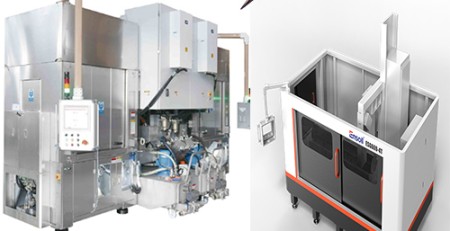
Production Volume: Systems range from manual, R&D-focused models to fully automated production lines for high-volume optics production or wafer-level optics production.
Automation Needs: Consider if you need features like automatic wire threading, CNC control for complex paths, and in-process monitoring.
For anyone asking “how do you cut ceramic” in a context where failure is not an option, diamond wire loop technologyis the definitive answer. It transcends the limitations of traditional ceramic cutting tools, offering a combination of precision, quality, and material savings that is unmatched.
While it represents a significant investment, the return in terms of brittle material yield improvement, reduced secondary processing, and the ability to manufacture highly reliable components makes it an essential technology for any serious operation working with advanced ceramics. As materials science continues to push boundaries, diamond wire saw cutting will undoubtedly remain at the forefront of precision manufacturing.
よくある質問
How do you cut alumina ceramic without chipping it?
Use a diamond wire saw with a grit size matched to the alumina hardness, keep tension stable, and control the feed rate so the wire grinds rather than impacts. Support the workpiece right up to the cut line, since most chipping happens at entry and exit.
Can alumina be cut after sintering?
はい, but sintered alumina is far harder and more brittle than green bodies, so it needs a different wire grit and a slower, more controlled feed. Cutting green bodies before sintering is easier but the part will shrink during firing.
What causes edge chipping in alumina cutting?
Concentrated mechanical force and thermal stress. High-speed abrasive methods like grinding or laser cutting load the edge suddenly and generate heat, and brittle alumina responds by fracturing at the exit edge.
Is diamond wire better than a diamond blade for alumina?
For precision work, yes. A blade applies concentrated shear and a wide kerf, while diamond wire distributes the grinding action and removes far less material, giving intact edges and better dimensional accuracy.
What grit size should be used for cutting alumina?
Match grit and bond strength to the alumina grade and whether it is green or sintered. Coarser grit cuts faster but leaves a rougher edge; a harder bond suits sintered material because the wire wears more slowly.
Does alumina cutting require coolant?
はい, and the filtration matters as much as the flow. Clean, filtered coolant prevents clogging, extends wire life, and carries heat away from a material that is sensitive to thermal stress.
Can green (unsintered) alumina be cut with diamond wire?
はい. Green bodies are much softer and cut quickly, but they need a coarser grit and lower tension so the wire does not tear the unfired material. Remember the part shrinks during sintering, so green dimensions must allow for that.
What feed rate is best for alumina?
There is no single figure — feed rate is the balance point between cutting speed and surface finish. Push too fast and you get chipping and micro-cracks; too slow and you waste wire life. Start conservative and step up while watching the exit edge.
Technical content reviewed by the Ensoll engineering team — a diamond wire loop manufacturer with 10+ years of production experience.
Sapphire substrates are critical components in LED manufacturing, optical devices, and semiconductor applications. しかし, cutting sapphire—a material with a Mohs... 続きを読む

 Why Advanced Ceramics Demand a Superior Cutting Method