다이아몬드 와이어 루프를 이용한 PMI 폼 절단: 0.8 mm 정밀 슬라이싱 테스트
추상적인: This application report documents a precision straight-slicing test on PMI
(폴리메타크릴리마이드) structural foam supplied by a European customer. Four slices measuring 400 mm x 400 mm x
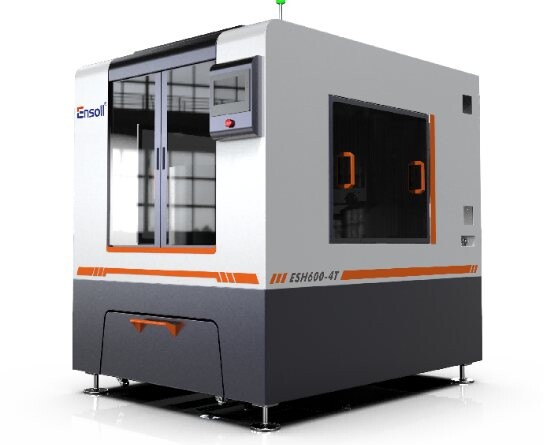
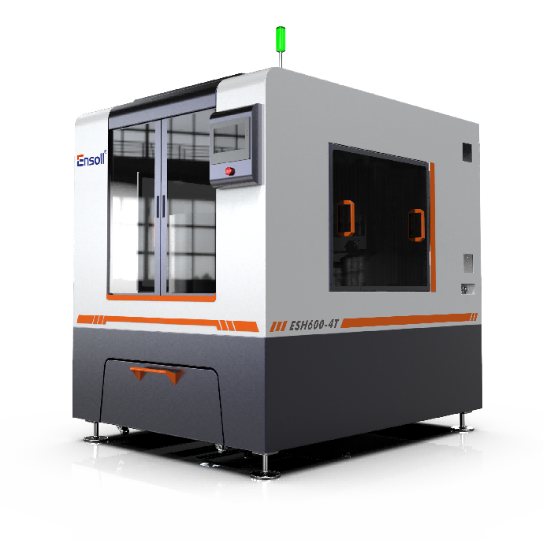
0.8 mm were produced on an ESH600-4T horizontal 다이아몬드 와이어 루프 cutting machine
using dry cutting and a fully coated diamond wire. Measured results: total thickness variation (TTV)
0.013-0.050 밀리미터 (average 0.036 밀리미터), thickness tolerance +/-0.043 밀리미터, surface roughness Ra 0.68-0.82 um, and maximum
가장자리 칩핑 5.5-7.1 um. Matching machine structure, cutting method and process parameters to the cellular
structure of PMI foam kept material removal stable and held slice dimensional accuracy and cut-surface quality
within a workable range.
주요 요점
- PMI foam is a low-density structural foam with a fine cellular structure; at excessive cutting load its
skeleton is compressed or torn rather than cleanly sheared. - Dry cutting was chosen to keep coolant out of the foam cells and to remove the cleaning and drying steps
that follow a wet cut. - Across four 0.8 mm slices: TTV 0.013-0.050 밀리미터 (mean 0.036 밀리미터), thickness tolerance +/-0.043 밀리미터, Ra
0.68-0.82 um, maximum chipping 5.5-7.1 um. - Samples ran slightly thin overall (down to -0.043 밀리미터), which points to a straightforward dimensional
compensation on the next run. - Machine, wire, cutting method and parameters were matched as one set; no single parameter carried the
result.
Sample test for European customer I | Diamond wire loop cutting process
Overview of the PMI Foam Slicing Test
This test was carried out on PMI foam supplied by a European customer (customer I), with high-precision
straight slicing as the primary requirement. PMI (폴리메타크릴리마이드) foam is a high-performance structural foam
known for low density, a uniform cellular structure, and good specific strength and specific stiffness. Its
porous interior gives it a material-removal behaviour quite different from that of dense materials: the diamond
abrasive grains act continuously on the foam skeleton, and excessive cutting load or poorly matched parameters
readily cause local compression, tearing and an uneven cut face, all of which feed directly into slice thickness
and surface quality. This test therefore matched cutting method, machine configuration, wire and process
parameters to the structural characteristics of PMI foam and to the straight-slicing accuracy requirement, so
that material removal stayed stable while slice dimensions and cut-surface quality remained under control.
Because of the demands PMI foam places on cutting stability, dimensional accuracy and cross-section quality,
Ensoll applied a diamond wire solution tailored to foam machining. On the machine side, a dedicated horizontal
다이아몬드 와이어 톱 기계 was used so that the wire runs stably along the horizontal
plane, providing a repeatable cutting path and stable feed for straight slicing. On the consumable side, a
diamond wire suited to PMI foam keeps the abrasive grains acting on the material surface continuously and evenly,
which sustains stable removal. On the cutting-method side, dry cutting avoids coolant entering the foam cells and
lets chips escape promptly during the cut. On that basis, wire running speed and feed rate were adjusted against
the density, cellular structure and target slice thickness of the material, holding the cutting load in a
suitable band and reducing the local compression and tearing that excessive point loads cause in the foam
구조. Matching machine, wire, cutting method and parameters as one set kept the slicing process stable and
brought slice thickness, dimensional accuracy and surface quality under control, establishing a process basis
for high-precision straight slicing of PMI foam.
1. Test Object: Basic Information
- Material: PMI foam
- 경도: approximately MH 2
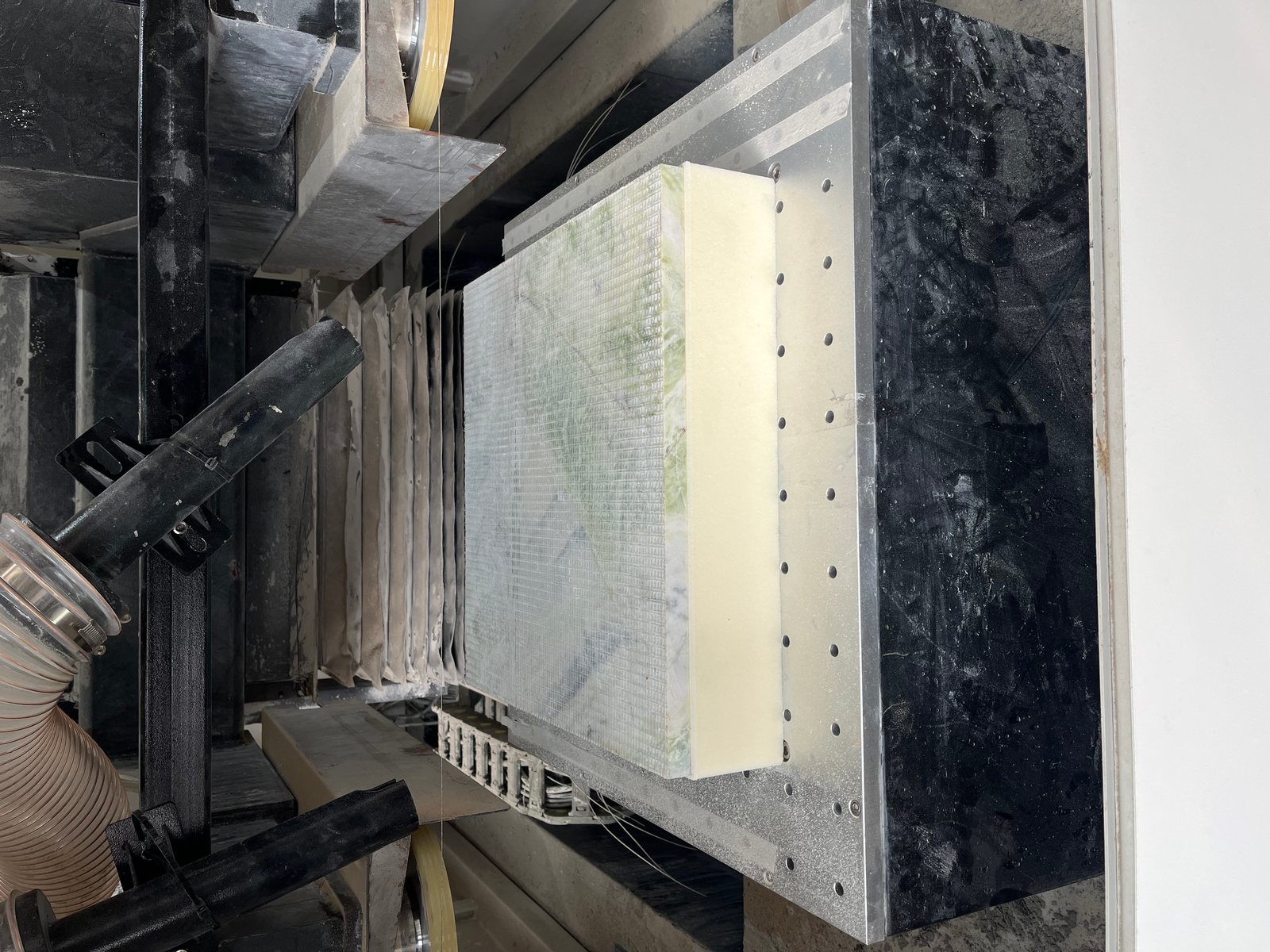
- Workpiece dimensions: 400 mm x 400 mm x 50 밀리미터
- Cut dimensions: 400 mm x 400 mm x 0.8 밀리미터
2. Machine and Wire Selection
Machine type: 재질 보기 ESH600-4T. Because PMI foam is lightweight, porous and easily deformed, 그리고
because the requirement is high-precision straight slicing, Ensoll selected a horizontal diamond wire cutting
machine suited to PMI machining. This keeps the wire running stably and preserves cutting-path accuracy, reduces
the effect of machine vibration and cutting-load fluctuation on machining quality, and limits the local
deformation, edge defects and thickness deviation that uneven loading would otherwise produce, thereby improving
both the dimensional accuracy and the cut-surface quality of PMI slices.
- Coolant type: dry cutting. Because PMI foam is porous, lightweight and prone to absorbing
liquids, dry cutting prevents coolant from entering the cells or remaining in the material and destabilising
slice dimensions. It also removes the cleaning and drying steps that follow a wet cut, which helps preserve
structural integrity and dimensional accuracy. - Wire type: fully coated. 에이 fully coated diamond wire loop
raises grain bonding strength and distribution stability, sustaining a stable and continuous cutting capability.
It reduces the cutting fluctuation caused by wire wear and grain pull-out, limits tearing and edge defects, 그리고
improves the dimensional consistency and surface quality of PMI slices.
3. 절단 방법 및 기계 장점
Horizontal cutting method. The machine uses a horizontal cutting structure with a
unidirectionally and rapidly moving 다이아몬드 와이어 루프 as the cutting tool; 이
workpiece is fixed on the worktable and cut by precision feed. This layout is compact with a clear motion path,
which helps keep the wire trajectory stable and reduces the influence of load fluctuation on slice thickness and
cut-surface quality. It also supports fixed, rotary and swing cutting modes, so the cutting mode can be matched
to material properties and machining requirements, widening the machine’s adaptability across materials and
process conditions.
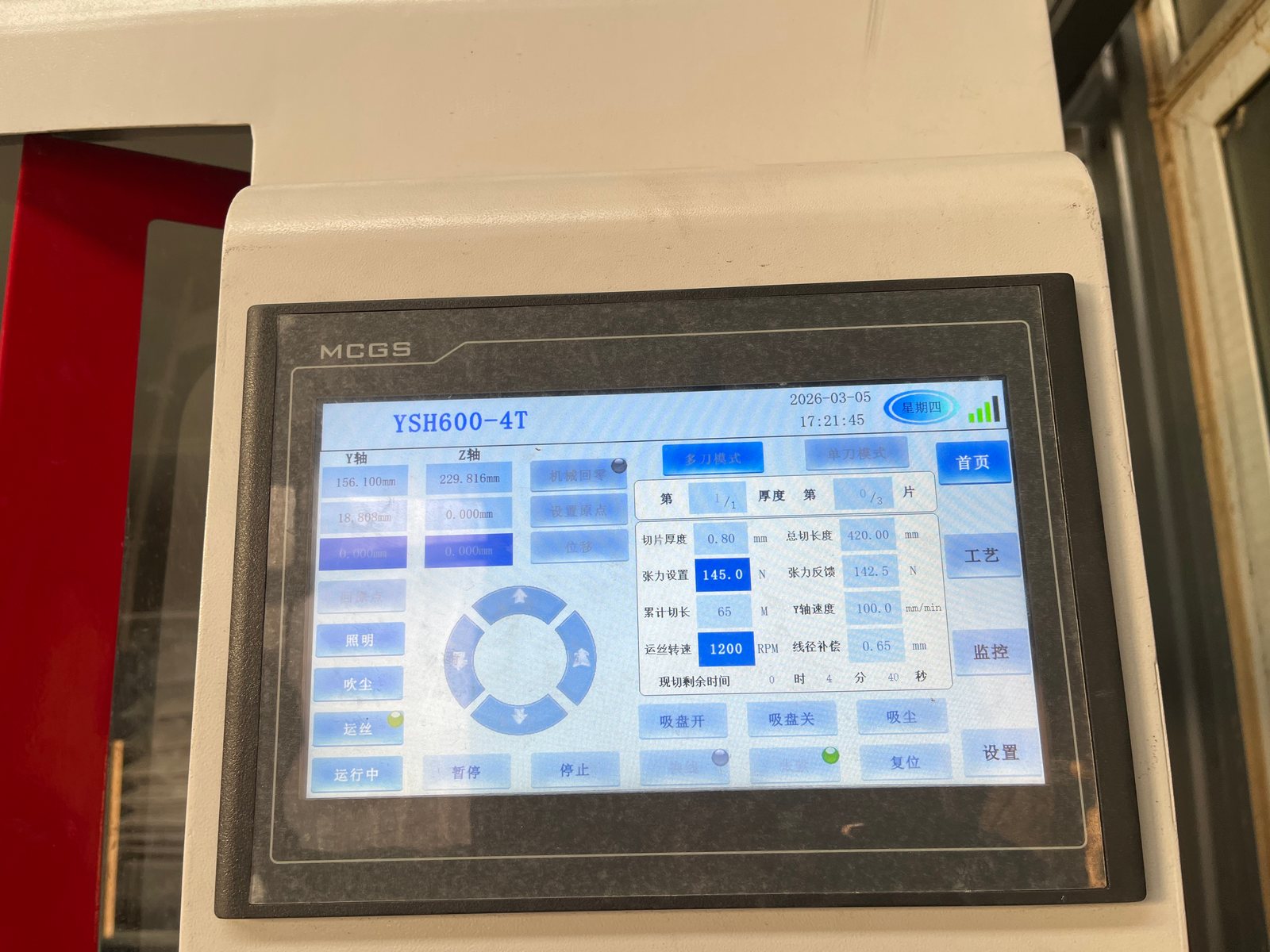
지능형 장력 제어 시스템. Spring tensioning combined with force-sensor feedback
allows constant-tension or variable-tension operation according to the machining state. Holding wire tension
stable during the cut improves wire running stability and reduces trajectory fluctuation and the risk of wire
breakage; tension is automatically reduced in standby and during wire changes, which limits wire fatigue and
pulley wear.
Multi-stage automatic cutting. 슬라이스 두께, number of cuts, cutting speed and cutting
depth can be preset, and the machine then completes continuous cutting automatically to those parameters,
reducing manual interference in the process. For tasks requiring many slices in succession, this raises cutting
efficiency and batch-to-batch consistency.
Breakpoint resume. If the process is interrupted by a wire break, power loss or similar
fault, the system records the current cutting position and resumes from that point once operation is restored,
with no need to reset the workpiece origin. This reduces the machining error of repeated positioning, lowers
material loss and improves continuous-machining efficiency.
4. Parameter Settings and Cooling Method
| 매개변수 | 값 |
|---|---|
| 와이어 직경 (밀리미터) | 0.60 x 3460 |
| Wire travel speed (mm / 분) | 100 |
| 절단 폭 (밀리미터) | 400 |
| Cutting wire tension (N) | 145 |
| 와이어 속도 (엠/초) | 25 |
| Wire-bow time (초) | 60 |
| 절단 부하 (N·m) | 17 |
5. Cutting Efficiency and Results
5.1 TTV 시험 데이터 (밀리미터)
TTV (총 두께 변동) was measured using a nine-point grid, dual-probe thickness method on a
vacuum-chuck stage, applied to PMI foam slices produced by diamond wire cutting. The cut sample dimensions were
400 mm x 400 mm x 0.8 밀리미터, with a nominal thickness of 0.8 밀리미터. Before measurement the instrument was thermally
stabilised and calibrated with a standard thickness block to reduce zero drift and systematic error. After
dust-free cleaning, each sample was centred on the vacuum chuck and held by negative pressure so that it stayed
in a stable measuring state, limiting the effect of position shift, local warping and deformation on the
thickness readings. The procedure follows the same nine-point method used in our
PEEK slicing test. Thickness data were then collected in sequence at the preset nine
grid positions, and the difference between the largest and smallest readings across all points was taken as the
TTV of that sample, which is used to evaluate the thickness uniformity and machining consistency of PMI foam
slices.
| 시료 | Nine-point thickness readings (밀리미터) | Tmax | Tmin | TTV |
|---|---|---|---|---|
| S01 | 0.785, 0.790, 0.799 / 0.800, 0.802, 0.812 / 0.819, 0.832, 0.835 | 0.835 | 0.785 | 0.050 |
| S02 | 0.752, 0.754, 0.757 / 0.759, 0.762, 0.775 / 0.786, 0.787, 0.789 | 0.789 | 0.752 | 0.037 |
| S03 | 0.747, 0.748, 0.751 / 0.754, 0.756, 0.757 / 0.762, 0.784, 0.791 | 0.791 | 0.747 | 0.044 |
| S04 | 0.749, 0.751, 0.753 / 0.755, 0.759, 0.760 / 0.760, 0.761, 0.762 | 0.762 | 0.749 | 0.013 |
평가: Four PMI foam slices were tested for thickness uniformity by the nine-point
메서드. TTV values ranged from 0.013 받는 사람 0.050 mm with an average of 0.036 밀리미터. Sample S04 showed the smallest
variation, at 0.013 밀리미터. 전체, the results indicate reasonable slice thickness consistency, although some
scatter remains between samples.
5.2 Thickness Tolerance Data (밀리미터)
Thickness tolerance was measured by the same nine-point grid method, 와 0.800 mm as the nominal thickness of
the sample. The deviation between the measured thickness at each point and the nominal thickness was calculated,
and the maximum positive deviation, maximum negative deviation and thickness deviation range were collated to
evaluate the dimensional accuracy and overall machining consistency of the PMI foam slices.
| 시료 | 평균 두께 (밀리미터) | 두께 편차 (밀리미터) |
|---|---|---|
| S01 | 0.808 | +0.008 |
| S02 | 0.769 | -0.031 |
| S03 | 0.761 | -0.039 |
| S04 | 0.757 | -0.043 |
| 최대 양의 편차 | +0.008 | +0.008 |
| 최대 음의 편차 | -0.043 | -0.043 |
| 두께 허용 | +/-0.043 | +/-0.043 |
평가: 와 함께 0.800 mm as the nominal thickness, the average thicknesses of the four PMI
foam slices were 0.808, 0.769, 0.761 그리고 0.757 밀리미터, corresponding to deviations of +0.008, -0.031, -0.039 그리고
-0.043 밀리미터. The maximum positive deviation was +0.008 밀리미터, the maximum negative deviation -0.043 밀리미터, and the
overall thickness tolerance +/-0.043 밀리미터. The results show that sample thickness tends toward the negative side,
with the last three samples running somewhat thin; thickness control can be improved further through cutting
parameters and dimensional compensation.
5.3 Surface Roughness Ra Data (um)
표면 거칠기 (Ra) was measured to ISO 4287 using a stylus profiler. Three representative positions,
centre, mid-left and mid-right, were profiled on the cut face of each PMI foam slice, and Ra was calculated at
each position to evaluate surface quality and machining consistency after diamond wire cutting.
| 시료 | Ra-1 | Ra-2 | Ra-3 | 평균 Ra |
|---|---|---|---|---|
| S01 | 0.82 | 0.79 | 0.85 | 0.82 |
| S02 | 0.76 | 0.72 | 0.78 | 0.75 |
| S03 | 0.80 | 0.75 | 0.82 | 0.79 |
| S04 | 0.68 | 0.65 | 0.71 | 0.68 |
평가: Four PMI foam slices were tested for surface roughness by the three-point
메서드. Average Ra ranged from 0.68 받는 사람 0.82 um, with little variation between measuring positions, indicating a
broadly uniform cut surface and a stable wire running and material-removal process.
5.4 Edge Chipping Data (um)
Chipping was measured by optical imaging on a toolmaker’s microscope to quantify edge defects on the PMI foam
slices. Sample edges were cleaned before measurement, and the instrument magnification and measuring scale were
calibrated. Each edge region of the slice was then examined under the microscope, recognisable chips, notches
and local edge damage were located and measured, and the defect size at each measuring point was recorded. 그만큼
largest defect on a single slice was taken as the primary evaluation index, giving a combined view of edge
integrity and machining quality after cutting PMI foam.
| 시료 | 위치 1 | 위치 2 | 위치 3 | 위치 4 | 최대 칩핑 |
|---|---|---|---|---|---|
| S01 | 5.2 | 6.4 | 5.8 | 7.1 | 7.1 |
| S02 | 4.6 | 5.7 | 5.1 | 6.3 | 6.3 |
| S03 | 5.0 | 6.1 | 5.5 | 6.8 | 6.8 |
| S04 | 3.8 | 4.7 | 4.3 | 5.5 | 5.5 |
평가: Four PMI foam slices were inspected for edge defects by the four-point method.
Defect sizes were generally small, with maximum chipping between 5.5 그리고 7.1 um and little difference between
samples. The results indicate stable edge material removal during diamond wire cutting and good edge integrity on
the slices.
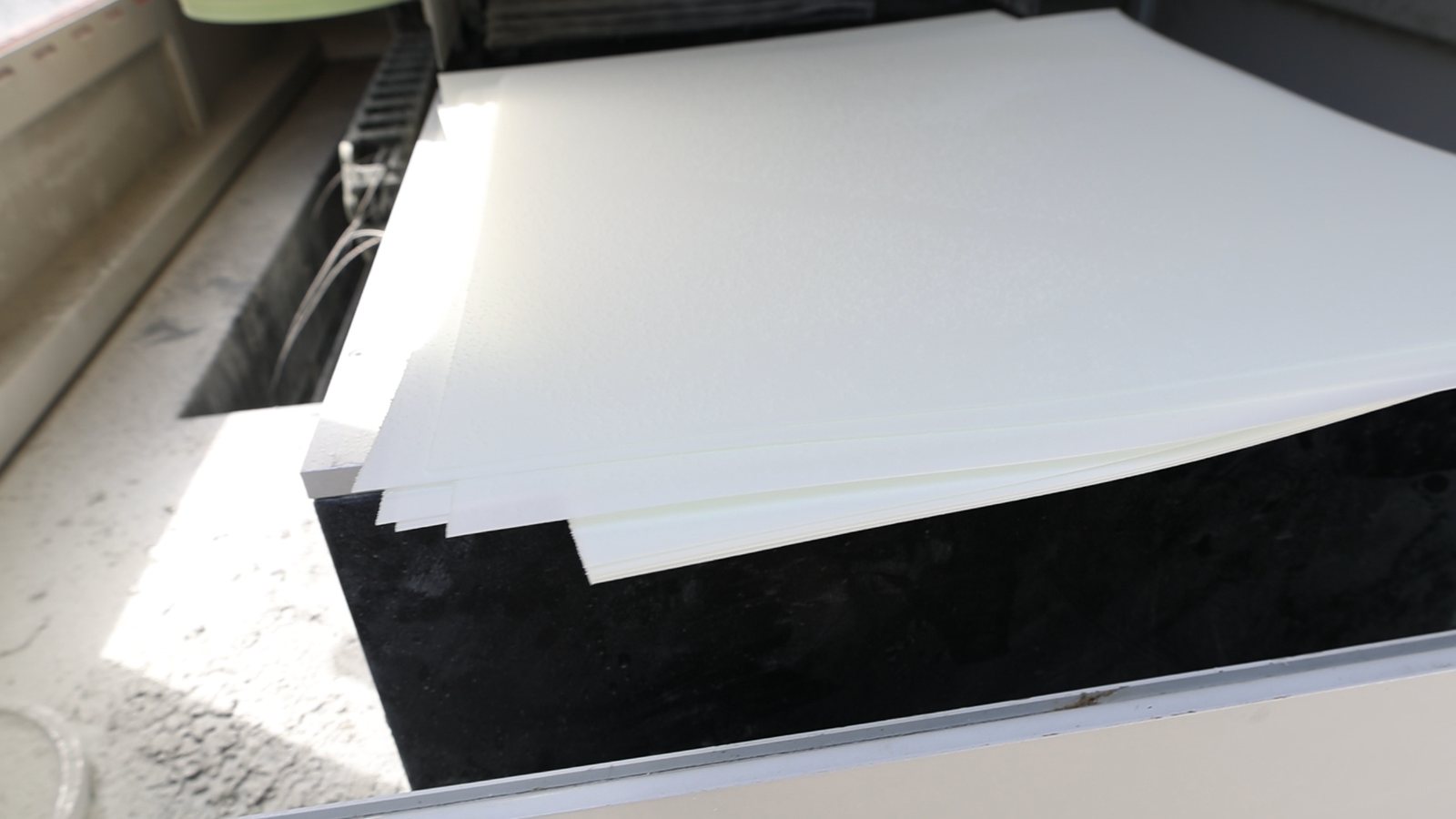
6. 결론
The high-precision slicing of PMI foam in this test produced good results, mainly because the dedicated
cutting machine, the dry cutting method and the process parameters were matched as one set. PMI foam is a
high-performance structural foam with low density, an internal cellular structure and good specific strength and
stiffness, and that cellular structure gives it a load behaviour different from dense materials during diamond
wire cutting. The diamond grains act continuously on the internal skeleton, and when the cutting load is too
high or the parameters are poorly matched, local compression, tearing and an uneven cut face appear and affect
slice thickness and dimensional accuracy. Aiming at the structural properties of PMI foam and the straight
slicing accuracy requirement, this test therefore optimised machine selection, cutting method and process
parameters in a targeted way, controlling dimensional accuracy and cut-surface quality while keeping the cutting
process stable.
First, machine selection. Given the demands PMI foam slicing places on motion stability,
cutting accuracy and machine rigidity, a dedicated horizontal diamond wire loop cutting machine for precision
PMI machining was selected. Horizontal cutting keeps the wire running stably along the horizontal plane, which
helps hold the cutting trajectory and feed motion steady and reduces the effect of machine vibration, motion
error and wire running fluctuation on cut position and dimensional accuracy. Stable feed and motion control also
narrow the variation in cutting load, keeping the relative motion between wire and PMI foam consistent. 이것
reduces the compression and tearing that uneven local loading causes, improves slice dimensional consistency,
and provides a stable machine basis for high-precision PMI slicing.
Second, cutting method. Given the cellular structure and properties of PMI foam, dry cutting
사용되었습니다. Dry cutting introduces no liquid coolant, so liquid cannot enter the foam cells, and the cleaning and
drying steps that would otherwise affect the material state are avoided. 그만큼
fully coated diamond wire loop grinds the material directly and continuously, so
removal takes place under relatively stable cutting conditions. Controlling wire
running state and cutting load sensibly reduces the local squeezing and tearing the material experiences during
절단, improving the uniformity of the cut cross-section and edge quality, and keeping the process
consistent.
Third, process parameters. Given the low density, cellular structure and removal behaviour of
PMI foam, wire running speed and feed rate were matched accordingly. Parameters were set to keep the wire running
stably and material removal even, avoiding a feed rate so high that the cutting load rises and the foam skeleton
takes a large local force; wire running speed was controlled so that cutting stayed continuous and stable with
less load fluctuation. Targeted adjustment of the cutting parameters kept material removal comparatively smooth
그리고, while meeting machining efficiency, improved slice thickness and dimensional consistency and the quality of
the cut surface.
Taken together, the results for slice dimensional accuracy, thickness tolerance, 표면 거칠기 (Ra) 그리고
cut-edge quality show that, through coordinated optimisation of a dedicated horizontal cutting machine, 마른
cutting and suitable cutting parameters, diamond wire loop cutting meets the requirements of high-precision
straight slicing for PMI foam. The machined samples performed consistently in dimensional accuracy, slice
thickness consistency and cut-surface quality, which indicates that matching machine structure, cutting method
and process parameters to the structure and cutting behaviour of PMI foam effectively improves material removal
and process stability, and provides a process reference for high-precision straight slicing of PMI foam.
관련 공정 데이터
The validated parameter window behind these results – what each setting does on a cellular foam and which way to move it when a defect appears – is published as a standalone reference: PMI foam cutting parameters. For a side-by-side comparison with a dense thermoplastic measured on the same basis, see PEEK vs PMI foam, and for the thickness measurement method itself, 이 nine-point TTV guide.
자주 묻는 질문
Can diamond wire cutting slice PMI foam down to 0.8 mm thickness?
예. In this test, 네 400 mm x 400 mm PMI foam slices were cut to a nominal thickness of 0.8 mm on an
ESH600-4T horizontal 다이아몬드 와이어 톱 기계. Measured total thickness variation
(TTV) ranged from 0.013 받는 사람 0.050 mm with an average of 0.036 밀리미터, and the overall thickness tolerance was
+/-0.043 밀리미터, which is a workable basis for precision foam components.
Why was dry cutting chosen for PMI foam instead of wet cutting?
PMI foam is porous, lightweight and prone to absorbing liquids. Dry cutting prevents coolant from entering
the cells or remaining in the material and destabilising slice dimensions, and it removes the cleaning and
drying steps that follow a wet cut. That helps preserve the structure of the foam and the dimensional accuracy
of the slices.
What surface quality can be expected when cutting PMI foam?
Surface roughness was measured to ISO 4287 with a stylus profiler at three positions per slice. 평균 Ra
ranged from 0.68 받는 사람 0.82 um with little variation between measuring positions, and the maximum edge chipping
measured by optical microscopy was 5.5 받는 사람 7.1 um, indicating a uniform cut surface with good edge integrity.
Why did the PMI foam slices come out slightly thin?
와 함께 0.800 mm as the nominal thickness, the four slices averaged 0.808, 0.769, 0.761 그리고 0.757 밀리미터, so three of
them ran thin by 0.031 받는 사람 0.043 밀리미터. This is a systematic offset rather than random scatter, and it can be
다음 공정에서 절단 매개변수와 치수 보정을 통해 직접 수정됨.
Ensoll이 다이아몬드 와이어 루프 절단으로 테스트한 다른 재료는 무엇입니까?
Ensoll은 다른 폴리머 및 절단이 어려운 재료에 대한 비교 가능한 공정 데이터를 발표했습니다, 포함하여
PEEK 정밀 절단 테스트 및 가이드
다이아몬드 와이어 루프 절단에 적합한 재료. 일반적인 공정 문의의 경우, see
이 다이아몬드 와이어 루프 절단 기술 FAQ.
Ensoll 엔지니어링 팀이 검토한 기술 내용 – 다이아몬드 와이어 루프 제조사와 함께 10+ 다년간의 생산 경험을 가진 회사.