다이아몬드 와이어 루프를 이용한 PEEK 절단: 정밀 슬라이싱 테스트
추상적인: 이 글은 PEEK에 대한 정밀 슬라이싱 테스트를 소개합니다 (폴리에테르 에터 케톤) using a 다이아몬드 와이어 루프. The workpiece was a 200 mm × 60 mm × 60 mm PEEK block provided by European customer H, sliced into 6.5 mm-thick pieces on an Ensoll ESO-GM gantry-type diamond wire loop cutting machine. We report the equipment and wire selection, cutting parameters, cooling strategy, and quantitative quality metrics including Total Thickness Variation (TTV), thickness tolerance, 표면 거칠기 (Ra), and edge chipping. The results show that with a rigid machine, a fully-coated diamond wire loop, continuous coolant, and well-matched parameters, diamond wire loop cutting can hold PEEK slicing to a thickness tolerance of ±0.037 mm, average TTV of 0.085 밀리미터, Ra below 1 μm의, and edge chipping of no more than 6.7 μm의.
- A 200 mm × 60 mm × 60 mm PEEK block was sliced into 6.5 mm pieces on the Ensoll ESO-GM machine (0.35 mm fully-coated diamond wire loop, 24 m/s 와이어 속도, 150 N tension, 3 mm/min 공급).
- Across three slices, TTV stayed within 0.072–0.098 mm (average 0.085 밀리미터) and thickness tolerance within ±0.037 mm.
- Average surface roughness was 0.80–0.91 μm Ra and maximum edge chipping was 6.7 μm — clean results for a tough thermoplastic that is prone to heat softening and burrs.
- The keys for PEEK are continuous cutting-fluid cooling, high machine rigidity, and conservative feed parameters that keep cutting heat under control.
1. Why PEEK Is a Different Cutting Challenge
The material in this test was PEEK supplied by European customer H, and the machining requirement was high-precision straight slicing. PEEK is a high-performance thermoplastic engineering material with high toughness, 내마모성, and heat resistance. Its material removal mechanism under diamond wire cutting differs from typical hard and brittle materials such as 광학 유리 그리고 기술 세라믹. Because PEEK has a degree of plasticity and toughness, the continuous action of diamond abrasive grains generates cutting heat. If heat dissipation is insufficient or cutting parameters are poorly matched, the machining zone heats up, the material softens locally, and cutting resistance rises — leading to dimensional deviation, edge burrs, and degraded surface quality.
To meet the dimensional stability and surface quality requirements of high-precision straight slicing of PEEK, Ensoll applied a diamond wire loop cutting solution adapted to PEEK’s machining characteristics: a dedicated machine for stable workpiece clamping and smooth wire travel; a matched diamond wire that keeps abrasive removal capability stable; continuous cutting-fluid cooling to carry heat away; and tuned wire speed and feed parameters that keep cutting load and machining temperature within a reasonable window, reducing softening, adhesion, and edge burrs. With equipment, wire, cooling, and parameters properly matched, the slicing process stays stable and the dimensional accuracy, thickness consistency, and surface quality of PEEK slices can be effectively controlled.
2. Test Material
재료: PEEK (폴리에테르 에터 케톤)
경도: approximately MH 6.5
Workpiece size: 200 mm × 60 mm × 60 밀리미터
Slice size: 6.5 mm × 60 mm × 60 밀리미터
3. Equipment and Wire Selection
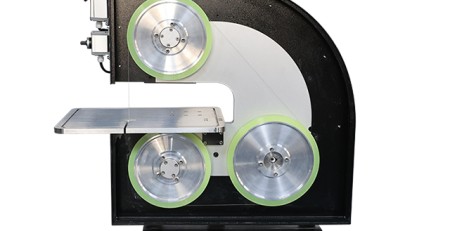
Machine: ESO-GM. Given PEEK’s thermoplasticity and toughness and the high-precision straight slicing requirement, Ensoll selected the ESO-GM diamond wire loop cutting machine. It ensures running stability and path accuracy during cutting, PEEK 가공 품질에 대한 기계 진동 및 절삭 하중 변동의 영향을 줄이고, 재료 변형을 제한하며, edge burrs, 불균일한 하중으로 인한 치수 편차를 제한하여 PEEK 슬라이스의 치수 정확도와 절삭면 품질을 모두 향상시킵니다..
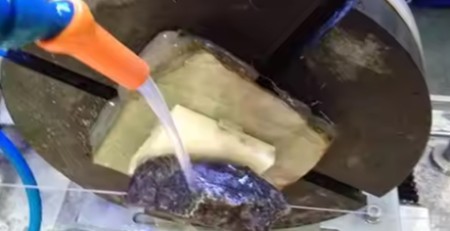
냉각수: 절삭유. 절삭유를 냉각 매체로 사용하면 절삭 영역에서 열 방출과 윤활이 개선되고, 절삭열 축적과 국부적인 재료 연화를 줄이며, 절삭 시 변형과 모서리 버를 제한하여 PEEK 슬라이스의 치수 안정성과 표면 품질에 도움을 줍니다..
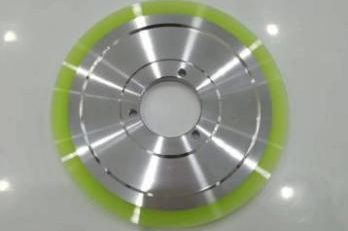
와이어: 전코팅형. A 0.35 mm fully-coated diamond wire loop 사용되었습니다. 전코팅 구조는 와이어 코어 위에 연마 입자의 결합 강도와 분포 안정성을 향상시킵니다., 절단 중 재료 제거를 연속적이고 균일하게 유지하고, 와이어 마모와 절단 상태 변동이 PEEK 부품의 치수 정확도와 표면 품질에 미치는 영향을 줄인다.
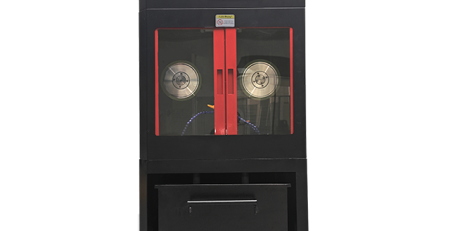
도표 1. ESO-GM 다이아몬드 와이어 루프 절단기.

4. 절단 방법 및 기계 장점
간트리 절단 구조. 갠트리 설계는 높은 전반적인 강성과 안정성을 제공, 상향식 수직 공급 장치는 다이아몬드 와이어 경로를 안정적으로 유지하며, PEEK의 절단 위치와 치수 정확도에 미치는 힘 변화 감소. 절단 중 발생한 오일 미스트를 배출하는 미스트 추출 시스템을 갖추고 있으며, 가공 구역을 깨끗하게 유지하고 안정적인 PEEK 절단에 적합한 작업 조건을 제공합니다.
지능형 장력 제어. 시스템은 가공 상태에 따라 다이아몬드 와이어 장력을 실시간으로 조절하며, 일정 장력 모드와 가변 장력 모드를 모두 지원합니다, 와이어를 안정적으로 작동시키기. 안정적인 와이어 장력은 절삭 경로의 변동을 줄여줍니다, 장력 변동으로 인한 국부적 불균일 하중과 와이어 파손 위험을 제한합니다, 그리고 PEEK 절단의 치수 일관성과 가공 안정성을 향상시킵니다.
와이어 파단 메모리. 다이아몬드 와이어가 파손되거나 기계가 비정상적으로 정지하면, 시스템은 현재 가공 위치와 관련 작동 상태를 자동으로 기록합니다. 와이어를 교체한 후, 절단은 기록된 위치에서 재개될 수 있으며 — 재위치 및 재가공으로 인한 치수 편차와 재료 손실을 줄이고, PEEK 절단의 연속성을 향상시킵니다, 재배치로 인한 커프 품질 변동 감소.
고강성 일체형 주철 프레임. 일체형 주철 프레임은 전체 강성과 진동 저항을 높여, 구조 진동 및 장기 미세 변형이 와이어 경로에 미치는 영향을 줄임. 인성 및 가공성을 지닌 PEEK와 같은 열가소성 소재의 경우, 고강성 구조는 절단 중 진동 및 힘 변동을 줄이는 데 도움을 줌, 와이어 경로와 절단 상태를 안정적으로 유지, 재료 변형을 제한하며, edge burrs, 국부적인 힘 변화로 인한 커프 크기 변동을 줄임 — 정밀 PEEK 절단에서 치수 정확도와 커프 품질 관리를 위한 안정적인 기계 기반.
5. 절단 매개변수 및 냉각
| 매개변수 | 값 |
|---|---|
| 와이어 직경 × 루프 길이 (밀리미터) | 0.35 × 1880 |
| 이송 속도 (mm / 분) | 3 |
| 절단 폭 (밀리미터) | 2 |
| 와이어 장력 (N) | 150 |
| 와이어 속도 (엠/초) | 24 |
| 와이어 활 장력 유지 시간 (초) | 60 |
| 절단 부하 (N·m) | 17 |
도표 2. 절단 공정 매개변수 인터페이스.

6. 절단 결과
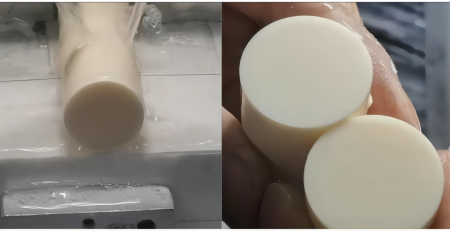
도표 3. PEEK 절단 진행 중.

6.1 TTV 시험 데이터 (단위: 밀리미터)
TTV (총 두께 변동) 진공 척에서 9점 그리드 이중 프로브 두께 측정법으로 측정됨. 다이아몬드 와이어 루프로 절단한 PEEK 슬라이스 샘플의 측정값 6.5 mm × 60 mm × 60 명목 두께 6.5 밀리미터. 시험 전, 측정 장비는 영점 드리프트와 체계적 오류를 줄이기 위해 일정 온도에서 예열하고 표준 두께 블록으로 교정함. 무진 청소 후, 각 샘플을 진공 척의 중앙에 위치시키고 음압으로 고정하여 측정 중 위치 이동과 국부 변형을 제한함. 그 후 9개의 미리 설정된 그리드 위치에서 순차적으로 두께 데이터를 수집함, and the difference between the maximum and minimum measured values was taken as the TTV of the sample, used to evaluate the thickness uniformity and machining consistency of the PEEK slices.
| 시료 | Nine-point thickness values | Tmax | Tmin | TTV |
|---|---|---|---|---|
| S01 | 6.499, 6.487, 6.430 / 6.443, 6.477, 6.528 / 6.467, 6.475, 6.527 | 6.528 | 6.430 | 0.098 |
| S02 | 6.517, 6.526, 6.505 / 6.500, 6.572, 6.567 / 6.526, 6.565, 6.540 | 6.572 | 6.500 | 0.072 |
| S03 | 6.570, 6.569, 6.579 / 6.560, 6.503, 6.556 / 6.507, 6.493, 6.497 | 6.579 | 6.493 | 0.086 |
평가: The nine-point method was applied to three PEEK slices. TTV values fell within 0.072–0.098 mm with an average of 0.085 밀리미터, and the thickness fluctuation of each sample was similar — indicating that the diamond wire loop cutting process was generally stable and the slices had good thickness uniformity.
6.2 Thickness Tolerance Data (단위: 밀리미터)
Thickness tolerance was measured with the same nine-point grid method. Taking the nominal thickness of 6.500 mm as the reference, the deviation of each measured point from nominal was calculated, and the maximum positive deviation, maximum negative deviation, and overall thickness tolerance were compiled to evaluate the dimensional accuracy and machining consistency of the PEEK slices.
| 시료 | 평균 두께 | 편차 |
|---|---|---|
| S01 | 6.481 | −0.019 |
| S02 | 6.535 | +0.035 |
| S03 | 6.537 | +0.037 |
| 최대 양의 편차 | +0.037 밀리미터 | |
| 최대 음의 편차 | −0.019 mm | |
| 두께 허용 | ±0.037 mm | |
평가: Against the 6.500 mm nominal thickness, the average thicknesses of the three PEEK slices were 6.481, 6.535, 그리고 6.537 밀리미터, corresponding to deviations of −0.019, +0.035, 그리고 +0.037 밀리미터. The maximum positive deviation was +0.037 밀리미터, the maximum negative deviation −0.019 mm, and the overall thickness tolerance ±0.037 mm. S02 and S03 were slightly above nominal while S01 showed a slight negative deviation, but the inter-sample deviation was small and the overall size distribution stable — indicating uniform material removal during diamond wire loop cutting and good thickness consistency and dimensional control of the PEEK slices.
6.3 Surface Roughness Ra Data (단위: μm의)
표면 거칠기 (Ra) was tested per ISO 4287 using the stylus profilometry method. Profile data were collected at three representative positions on the cut surface of each PEEK slice — center, mid-left, and mid-right — and the Ra parameter was calculated to evaluate the surface roughness and machining quality of the slices after diamond wire loop cutting.
| 시료 | Ra-1 | Ra-2 | Ra-3 | 평균 Ra |
|---|---|---|---|---|
| S01 | 0.92 | 0.86 | 0.95 | 0.91 |
| S02 | 0.81 | 0.76 | 0.84 | 0.80 |
| S03 | 0.87 | 0.82 | 0.90 | 0.86 |
평가: The three-point method gave average Ra values of 0.91, 0.80, 그리고 0.86 μm for the three samples, with an overall distribution of 0.76–0.95 μm. Ra varied little between measurement positions, indicating uniform surface texture across regions and a stable wire running state and material removal process. 전체, the PEEK slices showed low surface roughness and good surface machining quality, meeting the surface-integrity requirements of downstream precision applications.
6.4 Edge Chipping Data (단위: μm의)
Edge chipping was quantitatively characterized by optical imaging with a toolmaker’s microscope. 시험 전, sample edges were cleaned and the instrument magnification and measurement scale were calibrated. The slice edges were then observed under the microscope; identifiable edge defects were located, measured, and recorded, and the defect sizes at each point together with the maximum defect size were used to evaluate the edge integrity and machining quality of the PEEK slices.
| 시료 | 위치 1 | 위치 2 | 위치 3 | 위치 4 | Max chipping |
|---|---|---|---|---|---|
| S01 | 4.8 | 5.6 | 5.1 | 6.3 | 6.3 |
| S02 | 4.2 | 5.0 | 5.5 | 6.0 | 6.0 |
| S03 | 4.6 | 5.4 | 5.9 | 6.7 | 6.7 |
평가: The four-point method showed edge chipping distributed within 4.2–6.7 μm, with a maximum of 6.7 μm의. Edge defects were small overall with limited measurement scatter, indicating stable material removal during diamond wire loop cutting and good edge integrity of the slices.
도표 4. PEEK slices after cutting.

7. 결론
The good results of this high-precision PEEK slicing test came mainly from the proper matching of a dedicated cutting machine, cooling conditions, and cutting parameters. PEEK is a high-performance thermoplastic with high toughness, 내마모성, and a degree of heat stability. Under diamond wire cutting it undergoes continuous abrasive action and generates cutting heat; when that heat cannot dissipate in time or parameters are mismatched, the machining zone heats up and the material softens locally, which can cause dimensional deviation, edge burrs, 표면 품질 저하와. 따라서 공정은 세 가지 영역에서 최적화되었는데 — 기계 선택, cooling, 및 매개변수 — 절삭을 안정적으로 유지하면서 치수 정확도와 표면 품질을 제어하기 위해.
기계 선택. 운동 안정성, 절삭 정확성, 및 PEEK 슬라이싱이 요구하는 강성을 위해, 정밀 PEEK 가공용 전용 다이아몬드 와이어 톱 기계 기계가 사용되었다. 구조적 강성과 작동 안정성은 매끄러운 와이어 이동과 안정적인 워크피스 절삭을 위한 신뢰할 수 있는 기계적 조건을 제공하여, 기계 진동, 운동 오차, 및 와이어 이동 변동이 절삭 경로에 미치는 영향을 줄여준다. 안정적인 이송 및 운동 제어는 또한 절삭 하중 변화를 줄여, 와이어와 PEEK를 비교적 안정적인 절삭 상태로 유지하고 힘 변동으로 인한 치수 편차 및 가장자리 품질 문제를 제한한다.
냉각. Given PEEK’s thermoplasticity and its tendency to generate cutting heat, cutting fluid was used as the cooling medium to continuously cool and lubricate the cutting zone. The fluid promptly carries away the heat generated at the wire–PEEK interface and improves lubrication there, reducing the influence of cutting-heat buildup and local softening on the process. Good cooling keeps material removal stable and limits temperature-induced deformation, edge burrs, and dimensional fluctuation — improving the dimensional consistency and surface quality of PEEK slices.
Parameters. Wire speed and feed rate were matched to PEEK’s thermoplastic characteristics and the target slice size. Parameter settings were based on stable wire running and uniform material removal, avoiding excessive feed that would raise cutting load and concentrate heat, and avoiding mismatched parameters that would cause uneven removal and process fluctuation. With force and temperature rise kept in a suitable range, material removal stayed stable while efficiency was maintained — improving slice thickness consistency, dimensional accuracy, and cut surface quality.
Taken together — dimensional accuracy, thickness tolerance, 표면 거칠기 (Ra), and edge quality — the results show that with a dedicated machine, proper cooling, and suitable cutting parameters working in concert, diamond wire loop cutting can well meet the requirements of high-precision straight slicing of PEEK. During machining, machine running, cooling, and material removal all remained stable, and slice dimensional consistency and surface quality were effectively controlled. For a thermoplastic material like PEEK, properly matching equipment, cooling, and process parameters improves the thermal-mechanical state of cutting and the stability of material removal, providing a process reference for high-precision straight slicing of PEEK.
관련 공정 데이터
The thickness measurement method used throughout this test is documented separately in the nine-point TTV measurement guide. For the same measurement basis applied to a low-density structural foam cut dry on a horizontal machine, see PEEK vs PMI foam, and for that material’s process window, PMI foam cutting parameters.
자주 묻는 질문
Can a diamond wire loop cut PEEK and other engineering plastics?
예. Although PEEK is a tough thermoplastic rather than a hard-brittle material, a rigid machine, a fully-coated diamond wire loop, continuous cutting-fluid cooling, and conservative parameters deliver stable precision slicing. In this test, three PEEK slices achieved average TTV of 0.085 밀리미터, thickness tolerance of ±0.037 mm, average Ra below 1 μm의, and maximum edge chipping of 6.7 μm의.
What cutting parameters are recommended for slicing PEEK?
In this test: a 0.35 mm × 1880 mm fully-coated diamond wire loop at 24 m/s 와이어 속도, 3 mm/min feed rate, 150 N 와이어 장력, 2 mm 절단 폭, 냉각 매체로서의 절단유. 원리는 절단 하중과 열 발생을 낮게 유지하여 열가소성 재료가 절단면에서 부드러워지지 않도록 하는 것.
PEEK 절단 시 냉각수가 중요한 이유?
절단 구역이 가열되면 PEEK가 연화된다. 절단유는 와이어-재료 접면에서 열을 지속적으로 제거하고 윤활을 개선한다, 치수 편차를 초래할 수 있는 국부 연화 방지, edge burrs, 그리고 낮은 표면 품질.
PEEK에서 다이아몬드 와이어 루프 절단이 달성할 수 있는 표면 마감과 가장자리 품질?
In this test, 평균 표면 거칠함은 0.80–0.91 μm Ra (전체 범위 0.76–0.95 μm, ISO별 측정 4287), 가장자리 칩핑은 최대 4.2–6.7 μm 이내로 유지되었으며 6.7 μm의.
이 PEEK 슬라이싱 테스트에 사용된 기계는 어느 것인가?
The Ensoll ESO-GM gantry-type diamond wire loop cutting machine, featuring an intelligent wire-tension control system, wire-break position memory, a mist extraction system, and a high-rigidity one-piece cast-iron frame.
엔솔 엔지니어링 팀이 검토한 기술 내용 — 다이아몬드 와이어 루프 제조업체 10+ 다년간의 생산 경험을 가진 회사.