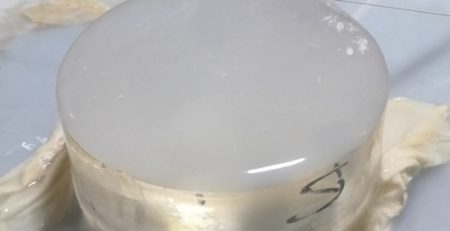
KDP crystals have a large nonlinear optical coefficient and a high laser damage threshold, Damit sind sie wichtige Bauteile in optischen Systemen für die Hochenergietechnik. KDP-Kristalle gehören zu den schwer zu verarbeitenden spröden Materialien, was sie von der traditionellen Verarbeitung von Metallwerkstoffen unterscheidet.
Manufacturing Process of KDP Crystals
Anwendungslabor
Senden Sie uns Ihr Material – kostenloser Testschnitt-Bericht
Nennen Sie Material, Dicke und Zieltoleranz. Wir schneiden eine Probe auf unserer eigenen Diamantdrahtsäge und liefern Drahtspezifikation, Vorschub, Oberflächengüte und Zykluszeit.
The manufacturing process involves cutting into a rough shape and then a precision cut. Das Schneiden ist der erste Schritt bei der Verarbeitung von KDP-Kristallmaterialien. Aufgrund lokaler Spannungen im Kristallrohling, the entire crystal is prone to damage during cutting due to mismatches in cutting parameters.
The surface quality of crystal material processing directly affects the product yield and manufacturing cycle, and even reduces the product’s lifespan. Deshalb, the development of precision cutting techniques to improve the surface quality of crystals is a pressing issue that needs to be addressed.
Types of Cutting Processes for KDP Crystals
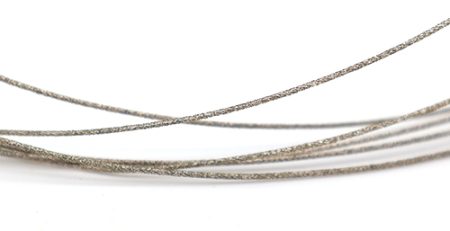
Zurzeit, due to inherent limitations of the crystal material itself, precision cutting processes can be classified into reciprocating and circular types based on the movement of the cutting wire. Reciprocating cutting involves complex winding and unwinding devices. Überdies, the reciprocating change in cutting direction during the cutting process reduces the surface quality of KDP crystals, while the cutting speed is also limited, resulting in low cutting efficiency.
Aber, circular cutting technology can overcome these drawbacks. It offers advantages such as narrow cutting seams, high processing quality, and high processing efficiency. This technology holds broad application prospects in the field of cutting hard-to-process materials.
Cutting method
Compared to reciprocating cutting machines, the development of circular cutting technology is still not very mature. Current companies such asEnsolltools (Englisch)and diamondwirete are involved in this field, and there is significant diversity in the structure of circular cutting equipment.
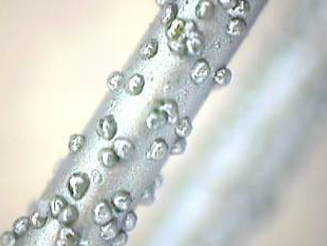
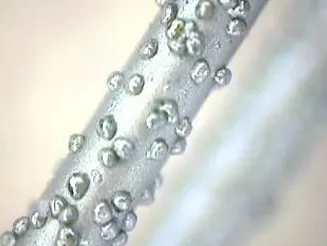
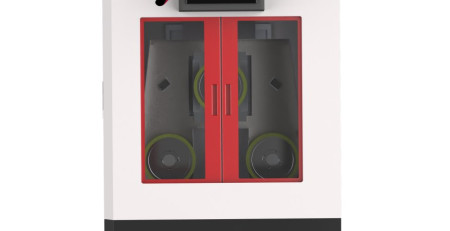
This article, based on the processing requirements of crystal materials, has designed a new generation of electroplated diamond circular precision cutting machine. By utilizing grey relational theory methods to optimize multiple parameter factors in circular cutting, it has determined the comprehensive impact of various process factors on the degree of cutting surface quality and the optimal cutting process parameters.
A Brief Analysis of Circular Cutting Technology Operation
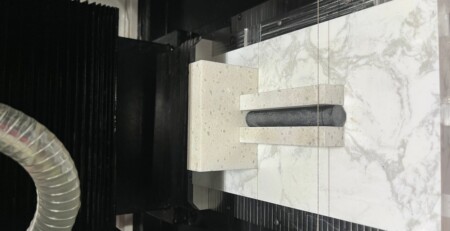
Zum Beispiel, with dimensions of 1,400 mm × 1,400 mm × 1,600 mm. The overall structure of the machine tool is arranged in a T-shaped configuration, with the bed, columns, and Z-axis slide plate all made of highly stable natural granite material, providing excellent damping characteristics. The circular cutting device module is fixed on the Z-axis column slide plate.
To minimize the impact of cutting on flatness during the machining process, the Z-axis linear movement unit is composed of high-precision linear guide pairs and ball screw pairs, offering good responsiveness and high positioning accuracy. The servo motor driving the movement unit provides feed speeds ranging from 0 An 20 m/min. The bed is equipped with a Y-axis manual feed device to strictly control the installation accuracy of the Y-axis guide pairs and screw pairs in order to ensure the thickness of the slices.
Überdies, to ensure feed positioning and repeat positioning accuracy, the moving unit is equipped with a grating displacement sensor. Due to the anisotropy of the hardness of the crystal faces of cutting KDP crystal materials, the Y-axis feed device is equipped with an adjustable turntable, allowing for angle adjustments for cutting according to requirements without disassembling the workpiece. This machine tool is also suitable for high-precision cutting of various non-metallic, hard and brittle ceramic materials, with a maximum cutting size of 200 mm × 200 mm.
Schlussfolgerung
Based on the experiment of cutting KDP crystals using the electroplated diamond circular cutting machine, the following conclusions are drawn:
(1) The ultra-precision electroplated diamond circular cutting machine exhibits excellent cutting characteristics. When cutting KDP crystals, the surface quality of the slices is significantly improved, which is more conducive to subsequent processing optimization. The diamond circular cutting machine is a cutting technology with great development potential.
(2) Different process parameters have varying degrees of influence on the flatness and surface roughness of the workpiece. The grey theory method effectively analyzed the impact of each process parameter on the surface quality of cutting KDP crystals, ranking the influence in the following order: Vorschubgeschwindigkeit, circular line speed, tension force. Unlikehochreiner Quarz, KDP is water-soluble and needs a completely different cutting strategy.
Eine umfassende Studie über präzises Schneiden von φ330 mm Siliziumstäben mit der Ensoll ESC600-4T Diamantdraht-Schneidemaschine. Behandelt... mehr lesen
Abstrakt: Dieser Anwendungsbericht behandelt einen hochpräzisen Geradschnitt-Test an optischem Glas, das von einem europäischen Kunden geliefert wurde. Das Werkstück war ein.... mehr lesen
Die Optikindustrie verlangt extreme Präzision, sei es für die Produktion von Wafer-Optik, Mikroskop-Objektträgervorbereitung, oder kundenspezifische optischer Glasschnitt... mehr lesen
Wichtige Erkenntnisse
Eine Diamant-Drahtschleife ist eine kontinuierliche geschlossene Schleife aus Stahldraht, die mit Diamantabrasiv beschichtet ist, Schneiden in einem... mehr lesen
Einleitung:
Dieser Artikel wird sich auf die Effizienz von endlose Diamantdrahtsäge beim Schneiden von Marmor und die verschiedenen Einflussfaktoren konzentrieren... mehr lesen
Wichtige Erkenntnisse
Kompakte einkernige Diamantdrahtschleifenmaschinen wie die ESV-3S bringen das Schneiden von Solarzellen in Reichweite von Laboren und... mehr lesen
Wichtige Erkenntnisse
Diamantdraht-Schleifen schneiden ist zu einem Mainstream-Prozess für optisches Glas geworden, weil es hohe Genauigkeit kombiniert, hohe Schnittgeschwindigkeit... mehr lesen
Wesentliche Erkenntnisse
Saphirwafer sind etwa 0.2 mm dick — in etwa so dick wie der Durchmesser des Diamantdrahts — also ungefähr 40-50% von... mehr lesen
Original Ensoll-Präzisions-Slicing-Test für magnetische Materialien mit einer ESO-GM-Endlosdiamantdrahtsäge, mit gemessenem TTV, Dickenabweichung, Oberfläche... mehr lesen
Wichtige Erkenntnisse
Schneidemaschinen wie die von Silhouette können nur flexible, gummigebundene Magnete bis etwa verarbeiten 1 mm dick; gesintertes NdFeB,... mehr lesen