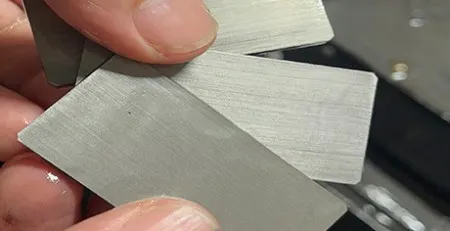
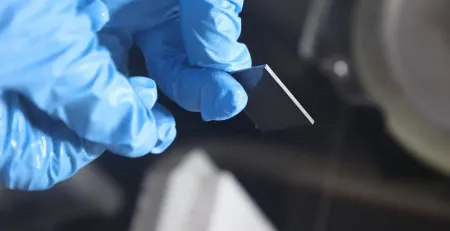
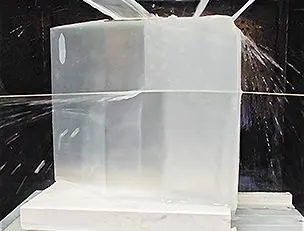
Präzisionsschnitt im duktilen Eisen mit Diamantdrahtschleife: 10 mm-Testdaten
Probentests für einen europäischen Kunden (Company R) · Ring-Diamantdraht-Schneidverfahren
Überblick
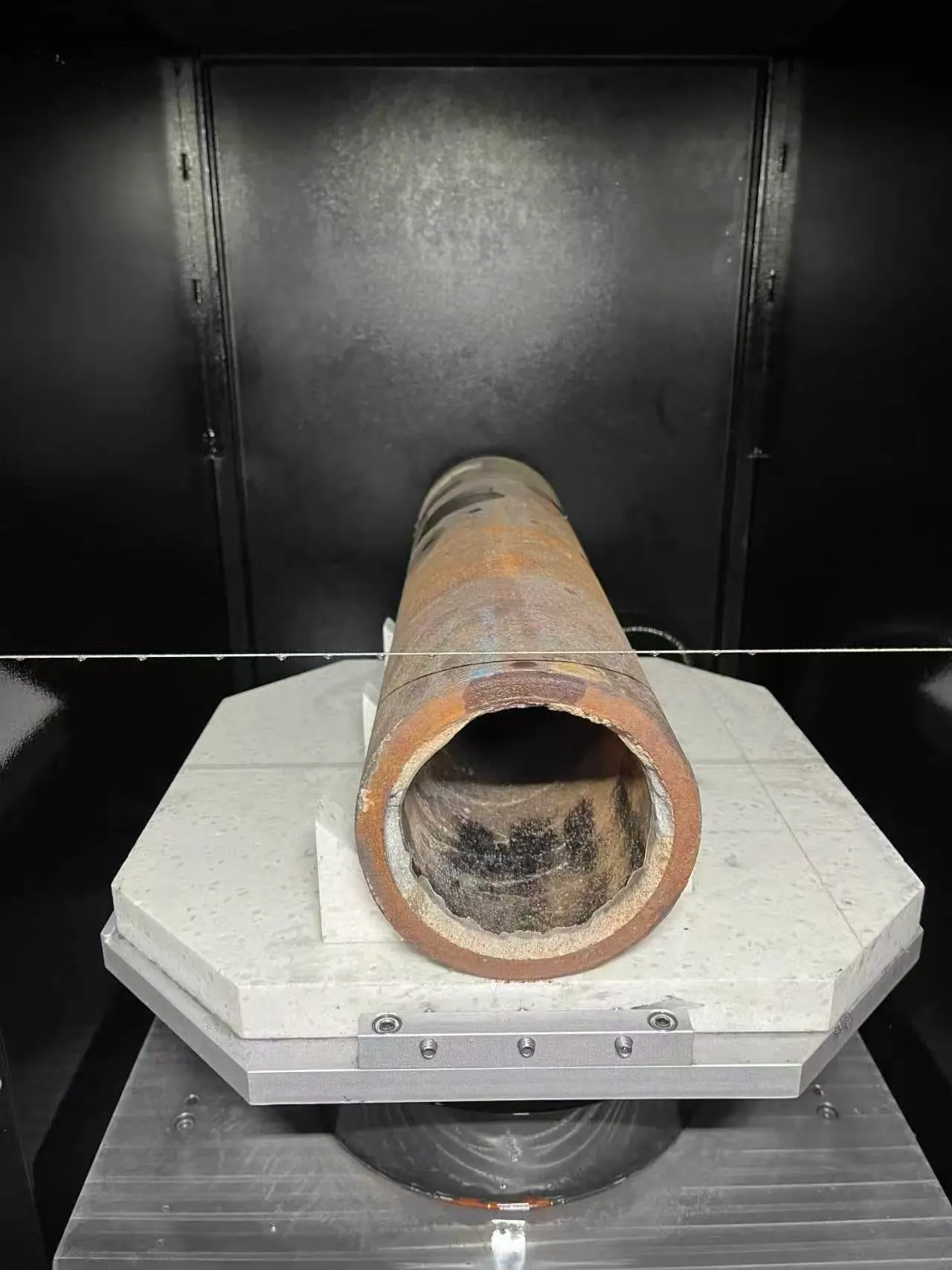
This report documents precision slicing of ductile iron using a ring diamond wire cutting system. Die Bewertung umfasst Ausrüstung und Drahtauswahl, Schneidmethodik, Prozessparameter, sowie die resultierende Dickengleichmäßigkeit, Maßgenauigkeit, surface finish and edge integrity of the sliced parts. Test results indicate that a large-format ring diamond wire machine, ölbasierte Kühlung und Schmierung, und entsprechend angepasste Prozessparameter eine stabile, high-precision slicing of ductile iron at production-representative section sizes.
1. Testprobe
| Parameter | Wert |
|---|---|
| Material | Ductile iron (nodular cast iron) |
| Härte | ungefähr. 67 Moh |
| Werkstückabmessungen | 500.0 mm (L) × Ø120.0 mm |
| Ziel-Scheibenabmessungen | 10.0 mm (L) × Ø120.0 mm |
Ductile iron combines relatively high strength with a degree of toughness. Its structure consists of a metal matrix with spheroidal graphite nodules, and the difference in machinability between the matrix and the graphite phase can produce local variation in cutting behaviour along the kerf.
2. Ausrüstung und Drahtauswahl
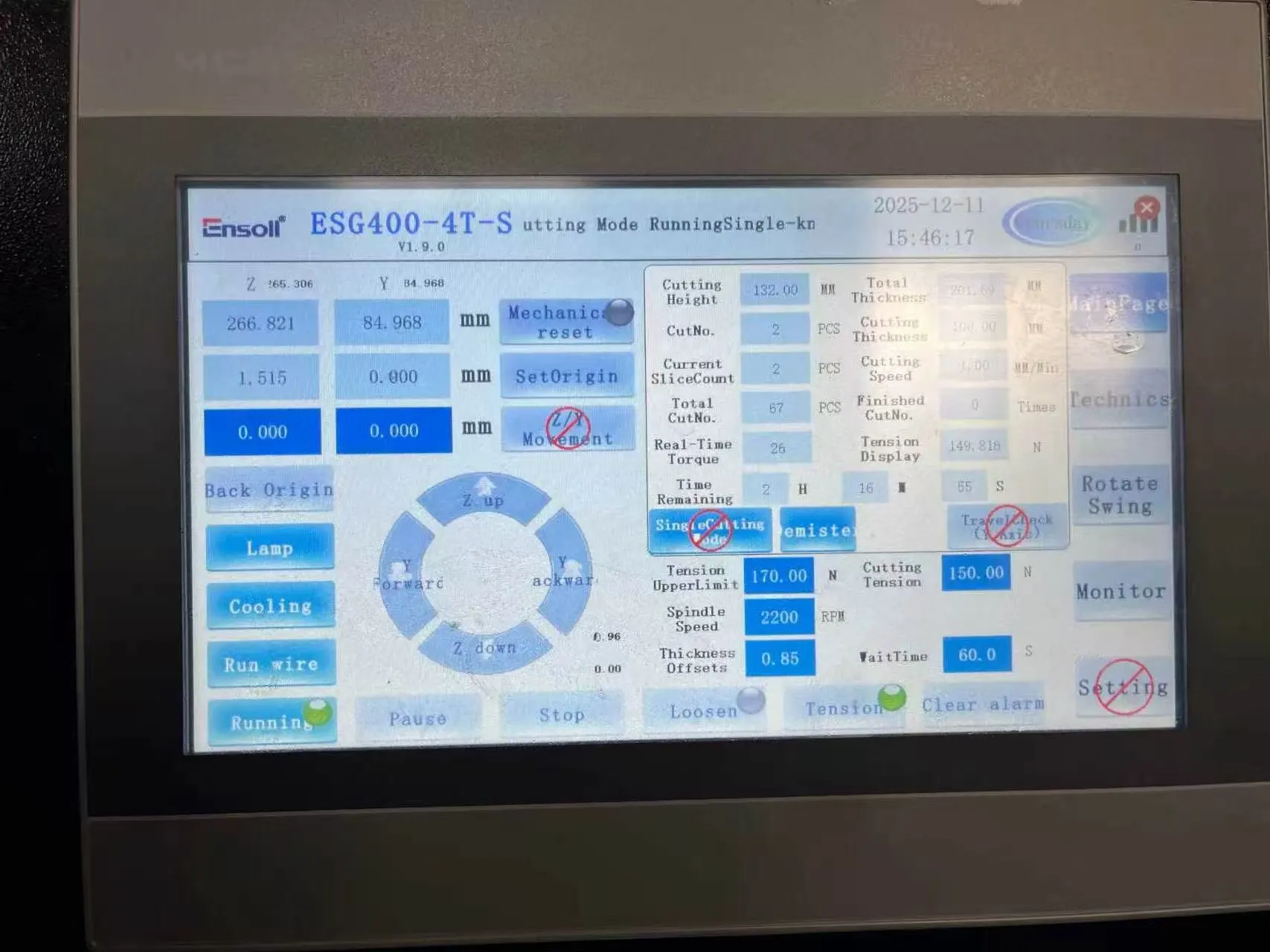
Ausrüstung: ESG400-4T. In view of the characteristics of ductile iron and the requirement to slice at a 10 mm schneiden, Ensoll selected the ESG400-4T ring diamond wire cutting system with a matched cutting feed. The machine maintains a stable wire trajectory and slice dimensional accuracy.
Kühlmittel: schmiermittelbasierter Schnitt. Schneidöl wird als Kühl- und Schmiermittel verwendet. It continuously lubricates and cools the contact zone between the diamond wire and the ductile iron and carries away part of the heat and cutting debris generated during cutting, reducing the effect of friction-heat accumulation and debris build-up on the machining condition. Controlled oil supply helps maintain a stable cutting zone.
Draht: vollständig plattiert. Es wurde ein vollständig plattierter Diamantdraht ausgewählt, with the diamond abrasive grains bonded to the wire core by electroplating. The plated bond improves grain adhesion and distribution uniformity, so dass der Draht während des Schneidens eine konstante Schleiffähigkeit und Materialabtragsverhalten beibehält. Dies reduziert das Herausziehen von Körnern und den Drahtverschleiß, which matters for a metal workpiece of this section size.
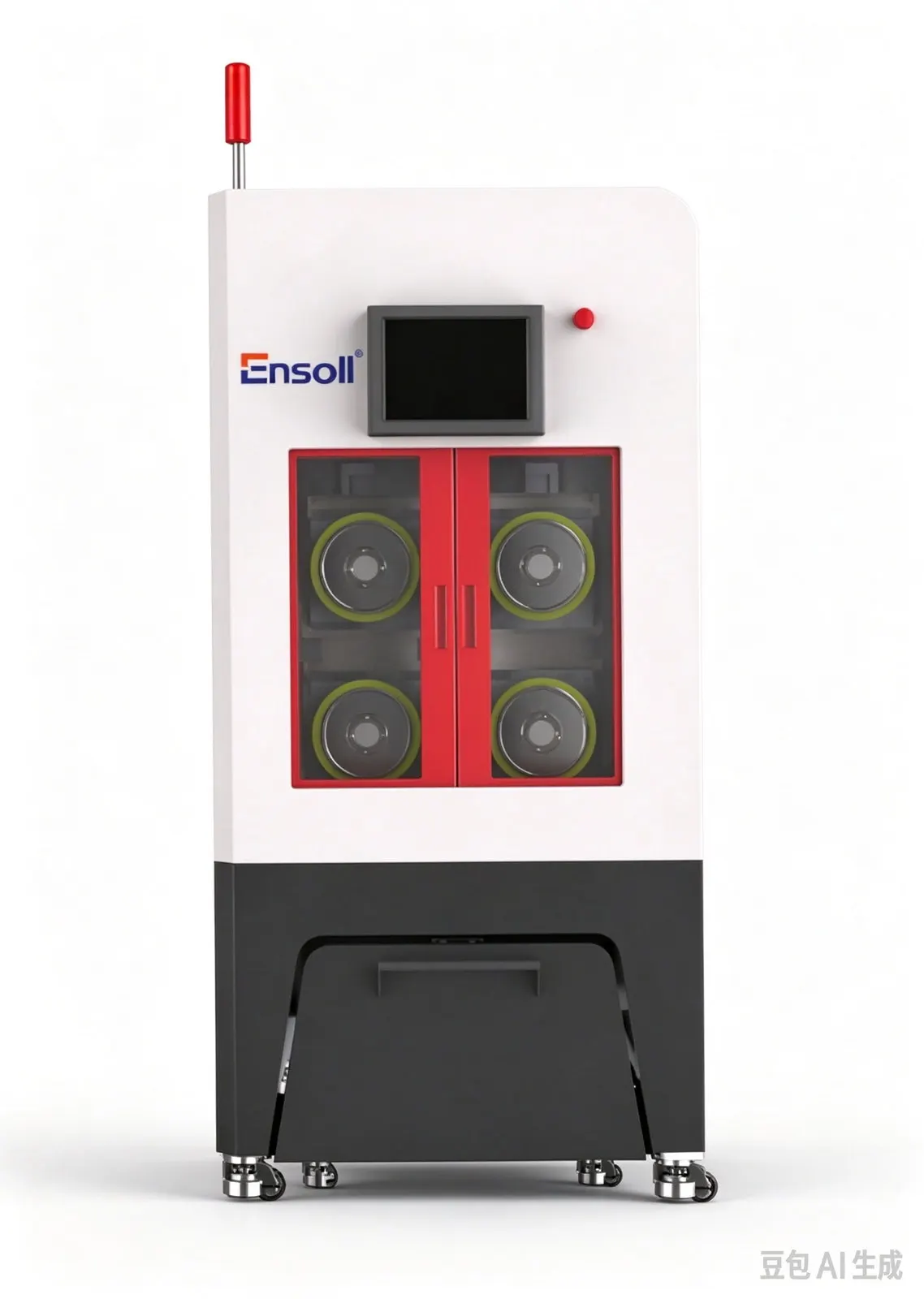
3. Schneidverfahren und Gerätevorteile
Portal-Schneidkonfiguration. Die Portalkonstruktion bietet eine hohe Gesamtsteifigkeit und Laufruhe, which reduces the effect of machine vibration and structural deformation on the wire trajectory and keeps the cut stable. This limits the influence of changes in cutting load on slice position and dimensional accuracy in the ductile iron. The machine is equipped with a mist-extraction system that promptly removes mist generated during cutting.
Intelligente Spannungsregelung. Das System passt die Spannung des Diamantdrahts in Echtzeit an die Schneidbedingungen an und unterstützt sowohl Konstantspannungs- als auch Variabelspannungsmodi, hält das Drahtlaufen stabil. Gut abgestimmte Spannungsregelung reduziert Schwankungen in der Drahtbahn und begrenzt lokale ungleichmäßige Belastungen sowie das Risiko von Drahtbrüchen durch Spannungsänderungen, reducing the occurrence of slice defects.
Drahtbruchspeicher. Wenn der Diamantdraht reißt oder die Maschine abnormal stoppt, Das System zeichnet automatisch die aktuelle Bearbeitungsposition und den zugehörigen Betriebszustand auf. Nach dem Drahtwechsel, Der Schnitt wird an der aufgezeichneten Position fortgesetzt, reducing dimensional deviation and material loss from re-positioning and repeat machining. This improves the continuity of ductile iron slicing.
Large workpiece capacity and high-speed cutting. The ESG400-4T provides a large effective working envelope, accommodating ductile iron workpieces of substantial section size. The ring diamond wire runs in continuous circulation, and wire speed can reach three to four times that of conventional wire-cut machines, which raises material removal efficiency while keeping the cut stable.
4. Prozessparameter und Kühlmethode
| Parameter | Wert |
|---|---|
| Drahtdurchmesser (mm) | 0.80 × 2600 |
| Drahtvorschubgeschwindigkeit (mm/min) | 1.5 |
| Schnittbreite (mm) | 120 |
| Drahtspannung (N) | 150 |
| Drahtgeschwindigkeit (m/s) | 32 |
| Drahtbogenzeit (s) | 60 |
5. Schneidleistung und Ergebnisse
5.1 TTV-Testdaten (Einheit: mm)
Gesamt-Dickenvariation (TTV) wurde mithilfe eines Neun-Punkte-Rasters gemessen, Doppelsonden-Messmethode zur Dicke auf einer Vakuumspannbühne. The measurement was applied to ductile iron slices produced by ring diamond wire cutting. Vor der Messung wurde das Instrument thermisch stabilisiert und gegen einen Standarddickenblock kalibriert. Die nominelle Scheibendicke betrug 10.000 mm.
| Probe | Neun-Punkte-Stärkemessungen | TMax | TMin | TTV |
|---|---|---|---|---|
| S01 | 9.994, 9.997, 10.000 9.996, 10.001, 10.004 9.998, 10.005, 10.008 |
10.008 | 9.994 | 0.014 |
| S02 | 9.990, 9.994, 9.998 9.995, 10.000, 10.003 9.997, 10.004, 10.007 |
10.007 | 9.990 | 0.017 |
| S03 | 9.986, 9.991, 9.995 9.993, 9.998, 10.002 9.996, 10.003, 10.009 |
10.009 | 9.986 | 0.023 |
| S04 | 9.995, 9.998, 10.001 9.997, 10.002, 10.005 9.999, 10.006, 10.010 |
10.010 | 9.995 | 0.015 |
| S05 | 9.992, 9.996, 9.999 9.994, 10.000, 10.004 9.998, 10.005, 10.009 |
10.009 | 9.992 | 0.017 |
| S06 | 9.988, 9.993, 9.997 9.994, 9.999, 10.003 9.996, 10.004, 10.008 |
10.008 | 9.988 | 0.020 |
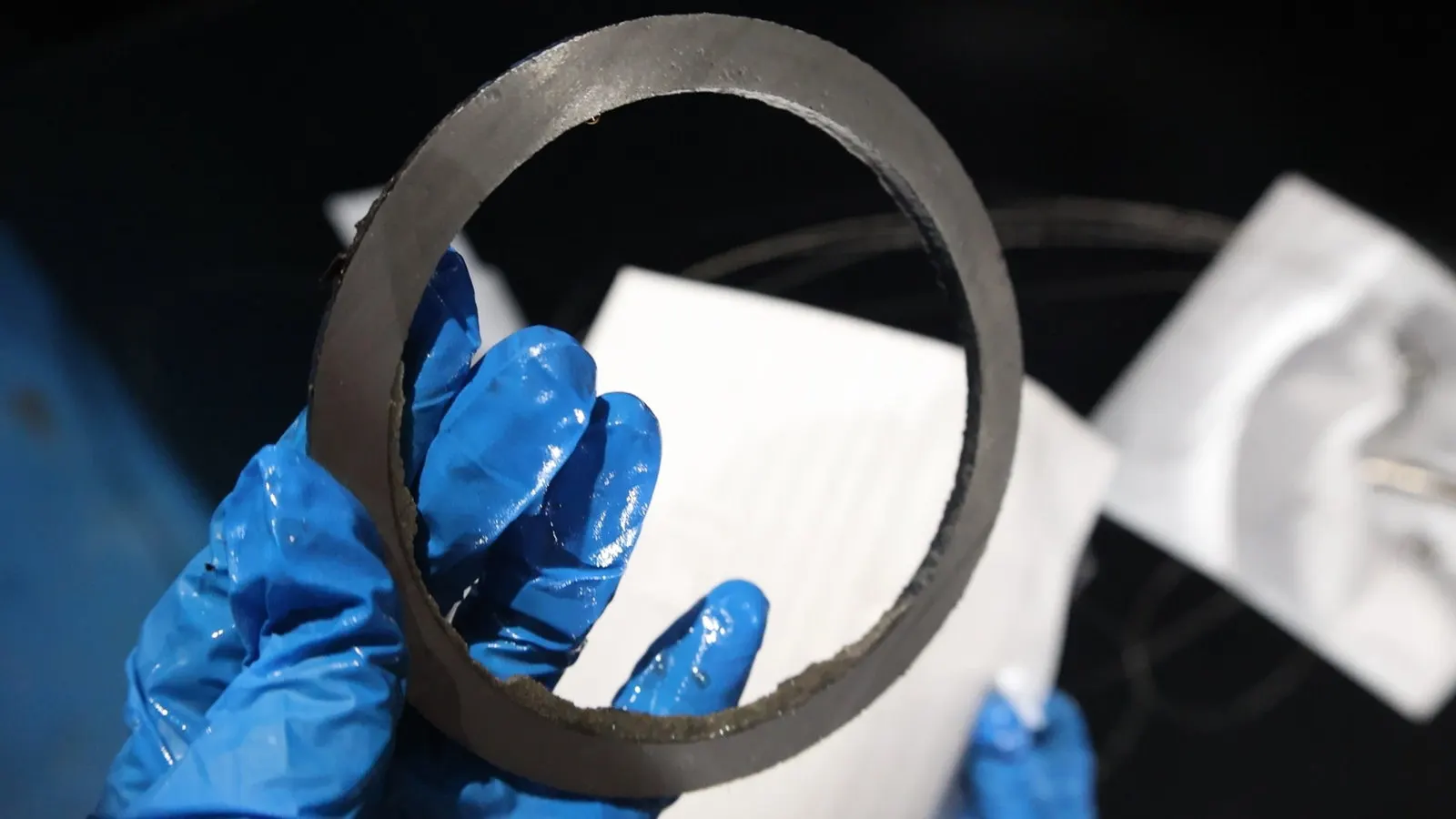
Bewertung. Nine-point grid measurement was applied to six ductile iron slices. Die TTV-Werte lagen 0.014, 0.017, 0.023, 0.015, 0.017 und 0.020 mm, im Bereich von 0,014–0,023 mm über alle Proben, mit einem mittleren TTV von etwa 0.018 mm bei einem 10.000 mm Nennstärke. The results confirm good thickness uniformity when slicing a metal workpiece of this section size.
5.2 Dicken-Toleranz-Daten (Einheit: mm)
Die Dicken-Toleranz wurde aus den Neun-Punkte-Dickendaten abgeleitet, Verwendet 10.000 mm wie die Nenndicke. Die positiven und negativen Dickenabweichungen wurden an jeder Messposition berechnet und die Ergebnisse aller sechs Proben zusammengeführt. Die maximale positive Abweichung, maximale negative Abweichung und der gesamte Abweichungsbereich wurden bestimmt, um die Dickenkonsistenz zu bewerten.
| Probe | Mittlere Dicke | Dickenabweichung |
|---|---|---|
| S01 | 10.000 | 0.000 |
| S02 | 9.999 | −0,001 |
| S03 | 9.997 | −0,003 |
| S04 | 10.001 | +0.001 |
| S05 | 10.000 | 0.000 |
| S06 | 9.998 | −0,002 |
| Maximale positive Abweichung | — | +0.010 mm |
| Maximale negative Abweichung | — | −0,014 mm |
| Dicken-Toleranzbereich | — | ±0,012 mm |
Bewertung. Gegenüber einer nominalen Dicke von 10.000 mm, the six slices showed mean thicknesses of 9.997–10.001 mm, mit dem Chargendurchschnitt nahe dem Nennwert. Über alle Messpunkte lag die Dickenabweichung im Bereich von −0,014 mm bis +0.010 mm, mit einer maximalen absoluten Abweichung von 0.014 mm.
5.3 Oberflächenrauheit Ra-Daten (Einheit: μm)
Oberflächenrauheit (Ra) was measured by stylus profilometry on the ductile iron slices after ring diamond wire cutting. Repräsentative Messpositionen wurden in der Mitte und an beiden Seiten entlang der Schnittendfläche genommen, Oberflächenprofildaten wurden mit einem Stylus-Profilometer erfasst, und der Rauheitsparameter Ra wurde an jeder Position aufgezeichnet.
| Probe | Mitte | Mitte-links | Mitte-rechts | Mittlerer Ra |
|---|---|---|---|---|
| S01 | 1.12 | 1.18 | 1.15 | 1.15 |
| S02 | 1.05 | 1.11 | 1.08 | 1.08 |
| S03 | 1.28 | 1.35 | 1.31 | 1.31 |
| S04 | 0.98 | 1.04 | 1.01 | 1.01 |
| S05 | 1.16 | 1.22 | 1.19 | 1.19 |
| S06 | 1.09 | 1.15 | 1.12 | 1.12 |
Bewertung. Mittleres Ra über die sechs Proben lag im Bereich von 1.01 An 1.31 μm, mit allen einzelnen Messwerten zwischen 0.98 und 1.35 μm. The spread across measurement positions on each slice is modest, indicating a consistent surface finish along the cut face on a metal workpiece of this size.
5.4 Edge Condition Data (Einheit: μm)
Edge defects were quantified by optical imaging on a toolmaker’s microscope. Die Probenkanten wurden vor der Messung gereinigt und die Vergrößerung sowie Messskala des Instruments kalibriert. Die Schnittkante wurde dann unter dem Mikroskop inspiziert, identifiable edge defects were located and measured at four points per sample, und der Höchstwert wurde beibehalten.
| Probe | Punkt 1 | Punkt 2 | Punkt 3 | Punkt 4 | Max. edge defect |
|---|---|---|---|---|---|
| S01 | 5.2 | 6.1 | 5.7 | 6.5 | 6.5 |
| S02 | 4.8 | 5.5 | 6.0 | 5.2 | 6.0 |
| S03 | 7.1 | 8.3 | 9.2 | 8.0 | 9.2 |
| S04 | 4.3 | 5.0 | 5.6 | 4.8 | 5.6 |
| S05 | 6.0 | 6.8 | 7.4 | 6.5 | 7.4 |
| S06 | 5.4 | 6.2 | 6.8 | 5.9 | 6.8 |
Bewertung. Toolmaker’s microscope inspection of the six ductile iron slices gave maximum edge defect values of 6.5, 6.0, 9.2, 5.6, 7.4 und 6.8 μm, mit einem Gesamtmaximum von 9.2 μm. S04 showed the best edge integrity and S03 the largest defect at 9.2 μm.
6. Schlussfolgerung
The good results obtained in this high-precision slicing trial of ductile iron stemmed mainly from the combined effect of a purpose-built cutting machine, the cooling and lubrication method, und korrekt angepasste Prozessparameter. Ductile iron has relatively high strength and a degree of toughness, and its structure consists of a metal matrix with spheroidal graphite. During ring diamond wire cutting, the difference between the matrix and the graphite phase can cause local variation in cutting behaviour, which places particular demands on machine rigidity and parameter matching.
Ausrüstung. An ESG400-4T ring diamond wire cutting system was used. The machine provides a large effective working envelope for larger workpieces and a high-rigidity structure that reduces the effect of vibration and structural deformation on the wire trajectory. The ring diamond wire runs in continuous circulation at speeds well above conventional wire-cut machines, which raises removal efficiency without sacrificing cut stability.
Kühlung und Schmierung. Cutting oil was used as the cooling and lubricating medium. It continuously lubricates and cools the wire–workpiece contact zone, reduces friction at the cutting interface, and carries away part of the cutting heat and debris, improving conditions in the cutting zone. For a material with the strength and toughness of ductile iron, effective lubrication is essential to consistent surface finish.
Prozessparameter. Drahtgeschwindigkeit, feed rate and other key parameters were matched to the properties of ductile iron and to the 10 mm slice requirement. Coordinating wire speed with workpiece feed keeps material removal steady and avoids localised increases in cutting load from excessive feed, or unstable cutting from mismatched parameters.
Insgesamt. In Verbindung mit der dimensionsgenauen Scheibenherstellung, Oberflächenrauheit (Ra) and edge quality, the combination of the ESG400-4T ring diamond wire machine, ölbasierte Kühlung und Schmierung, and appropriately matched cutting parameters achieves a well-matched process for ductile iron. The results support ring diamond wire cutting as a practical route for precision slicing of ductile iron at this section size.