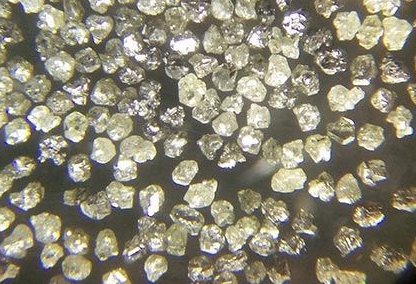
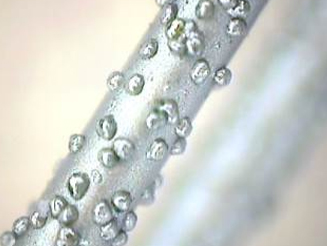
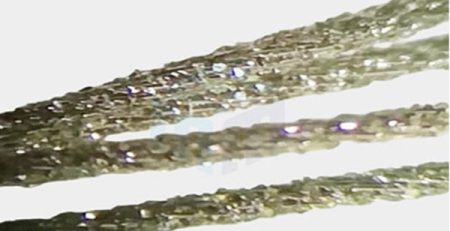
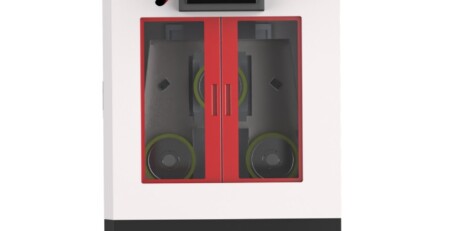
In dieser Studie wird der Einfluss verschiedener Harzbindemittel auf die Schneidleistung von Diamantdrahtschlaufen untersucht. Mit Harz ausgehärtete Härteproben wurden unter Verwendung von reinem Phenolharz hergestellt, epoxidmodifiziertes Phenolharz, und aromatisches alkylmodifiziertes Phenolharz, und ihre Rockwell-Härte wurde getestet. Die gebrochenen Oberflächen der ausgehärteten Harzproben wurden mittels Rasterelektronenmikroskopie beobachtet, Aufdeckung unterschiedlicher Dichtegrade nach dem Aushärten. Diamond wire loops were then manufactured for single crystalsilicon cuttingexperiments.
The experimental results demonstrate that diamond wire loops made with pure phenolic resin, characterized by high cured hardness and good post-curing density, exhibit minimal wire deflection during cutting, shorter cutting times, reduced diamond particle detachment, and enhanced cutting ability.
With the increase in the size of single crystal silicon and the rising demands for wafer quality and cutting efficiency, free abrasive wire saw cutting can no longer meet production needs, leading to widespread attention on bonded abrasive diamond wire loops.
Types of Bonded Abrasive Diamond Wire Loops
Bonded abrasive diamond wire loops are mainly divided into electroplated diamond wire loops and resin diamond wire loops. Darunter auch, resin diamond wire loops (referred to as resin loops) have the advantages of simple manufacturing process, low cost, Hoher Wirkungsgrad, minimal environmental pollution, and good surface quality of processed materials. The cutting performance of resin loops largely depends on the performance of the resin binder. When cutting single crystal silicon, it is required that the resin binder has good adhesion with the matrix and diamond particles to prevent diamond detachment and cutting loop failure; the friction between the resin loop and the workpiece generates a large amount of heat, necessitating good heat resistance of the resin.
Analysis of the Cutting Process
In this study, Die ausgehärtete Härte von vier Arten von Harzbindemitteln wird getestet, und ihre nachgehärtete Querschnittsmorphologie wird analysiert. Subsequently, diese vier Harze werden verwendet, um Diamantdrahtschlaufen für das Schneiden von Einkristall-Silizium in Experimenten herzustellen, mit einer Analyse des Einflusses der ausgehärteten Härte und der nachgehärteten Dichte der Harzbindemittel auf die Schneidfähigkeit.
Zusammenfassung der experimentellen Ergebnisse
Unter Verwendung von Härteproben aus vier verschiedenen Arten von Phenolharzen und Harzdraht, wurde ihre ausgehärtete Rockwell-Härte gemessen. Subsequently, Schneidversuche an Einkristall-Silizium wurden unter demselben Schneidprozess durchgeführt, um den Zusammenhang zwischen Rockwell-Härte und Schneidleistung zu vergleichen. Aus den Experimenten wurden folgende Schlussfolgerungen gezogen:
(1)Phenolic resins with shorter flow length and higher curing agent content exhibit higher cured Rockwell hardness. The resin layer of the cutting wire made from this resin binder shows good adhesion to diamonds, resulting in fewer diamond particle detachments during cutting, shorter cutting times, and indicating a stronger cutting capability of the cutting wire.
(2)Phenolic resins that produce fewer small molecules during curing exhibit denser structures post-curing, with better adhesion to diamonds and stronger cutting capabilities of the cutting wire.
Die Bearbeitung von optischem Glas erfordert Submikron-Präzision, um die Anforderungen von Industrien wie Luft- und Raumfahrt, Photonik, und Unterhaltungselektronik zu erfüllen. Mit mehr lesen
Die rasante Entwicklung der 5G-Telekommunikation, Elektrofahrzeuge (EV) Ladeinfrastruktur, und Hochfrequenz-Netzteile haben ein riesiges Rampenlicht geworfen... mehr lesen
Ensoll testete bei einem europäischen Kunden eine Magnetmaterialprobe mit einer kundenspezifischen endlosen Diamantdrahtsäge. Das Ziel war es, ein.. zu schneiden. mehr lesen
Wesentliche Erkenntnisse
Es gibt vier Haupttypen von Diamantdrahtsägemaschinen: kontinuierlicher Draht, Mehrfachdraht, feststehender Draht und tragbare Maschinen.
Kontinuierliche Drahtsäge... mehr lesen
Diamant-Drahtschlaufe Schneidetechnologie hat das Präzisionsschneiden in der Halbleiterfertigung und der Materialverarbeitung revolutioniert. Diese fortschrittliche Methode nutzt diamantgetränkte... mehr lesen
Wichtige Erkenntnisse
Diamantgeschleifte Drahtschneidtechnologie bietet hohe Präzision und feine Bearbeitung, unverzichtbar für die Herstellung von hochpräzisen optischen Komponenten wie Linsen,... mehr lesen
1.Was sind Magnetmaterialien?
Magnetmaterialien sind eine grundlegende Stoffklasse, die durch ihre Fähigkeit definiert ist, ein Magnetfeld zu erzeugen.. mehr lesen
Introduction
Hard and brittle materials are essential in industries like electronics, Optik, Luft- und Raumfahrt, und Medizinprodukte. Aber, Schneiden Sie sie oft... mehr lesen
In diesem Blogbeitrag werden Sie in erster Linie mit der Diamantdrahtsäge Schneidemaschine und den dafür benötigten Verbrauchsmaterialien vertraut gemacht, während er auch führt... mehr lesen