Parámetros de corte de espuma PMI: Referencia de ajuste de bucle de alambre de diamante
Abstracto: This reference sheet lists the process window validated in Ensoll’s PMI
(polimetacrilimida) structural foam slicing test on an ESH600-4T horizontal
diamond wire saw machine: un 0.60 x 3460 mm fully coated
bucle de alambre de diamante, 100 mm/min wire travel speed, 145 tensión del alambre de N, 25 velocidad del alambre m/s,
60 s wire-bow tensioning time, 17 N·m cutting load and 400 ancho de corte de mm, with dry cutting. It explains
what each parameter does on a cellular foam, which way to move it when a defect appears, and how to establish a
starting set for a new foam grade or slice thickness.
Puntos clave
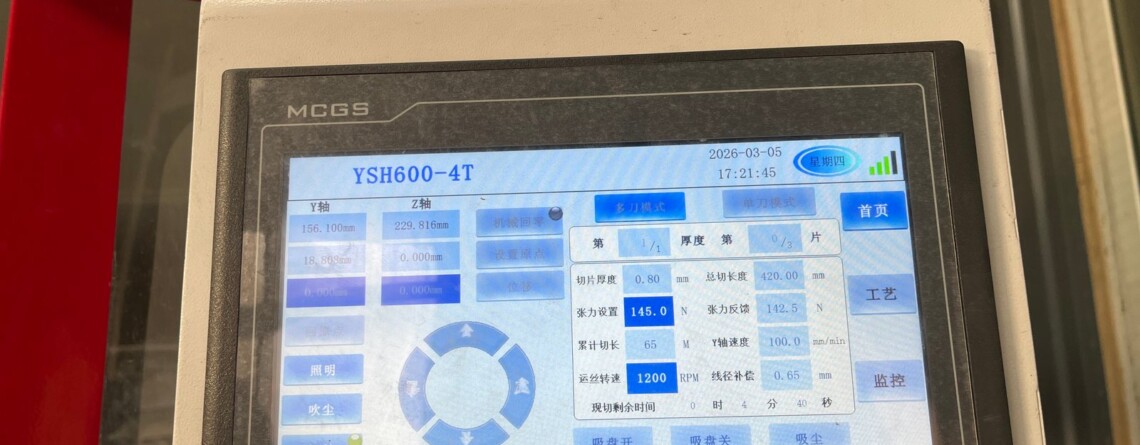
- Validated window for 0.8 mm PMI foam slices on an ESH600-4T: 0.60 x 3460 mm fully coated wire loop, 100 avance mm/min, 400 ancho de corte de mm, 145 tensión N, 25 velocidad del alambre m/s, 60 s wire-bow time, 17 N·m load, dry cutting.
- PMI foam fails by compression and tearing of the cell skeleton, not by brittle fracture, so feed rate – the load-setting parameter – is the first thing to reduce when a defect appears.
- Dry cutting is the default for PMI foam: coolant would enter the cells and would have to be cleaned and dried out afterwards.
- The load readout is a monitor, not a setting; a rising load trace during a cut is the earliest warning that a parameter has drifted out of band.
- This window produced TTV 0.013-0.050 milímetro (mean 0.036 milímetro), tolerancia de grosor +/-0.043 milímetro, average Ra 0.68-0.82 um and maximum chipping 5.5-7.1 µm.
Why PMI Foam Needs Its Own Parameter Set
PMI foam is a low-density structural foam with a uniform cellular structure and good specific strength and
specific stiffness. Under a diamond wire it does not behave like a dense material: the abrasive grains act on the
foam skeleton, and the failure mode at excessive load is compression and tearing of the cells rather than clean
shearing. Es por eso que los parámetros que funcionan en un termoplástico denso no se pueden simplemente copiar. El
la ventana de PMI validada a continuación se estableció al hacer coincidir la estructura de la máquina, alambre, método de corte y parámetros con
la estructura celular del material.
Ventana de Parámetros Validada para 0.8 rebanadas de espuma PMI de mm
| Parámetro | Valor |
|---|---|
| Diámetro del alambre x longitud del lazo (milímetro) | 0.60 x 3460 |
| Velocidad de avance del alambre / tasa de avance (mm/min) | 100 |
| Ancho de corte (milímetro) | 400 |
| Tensión del alambre (N) | 145 |
| Velocidad del alambre (M/s) | 25 |
| Tiempo de tensado del arco de alambre (s) | 60 |
| Carga de corte (N·m) | 17 |
| Método de enfriamiento | Corte en seco |
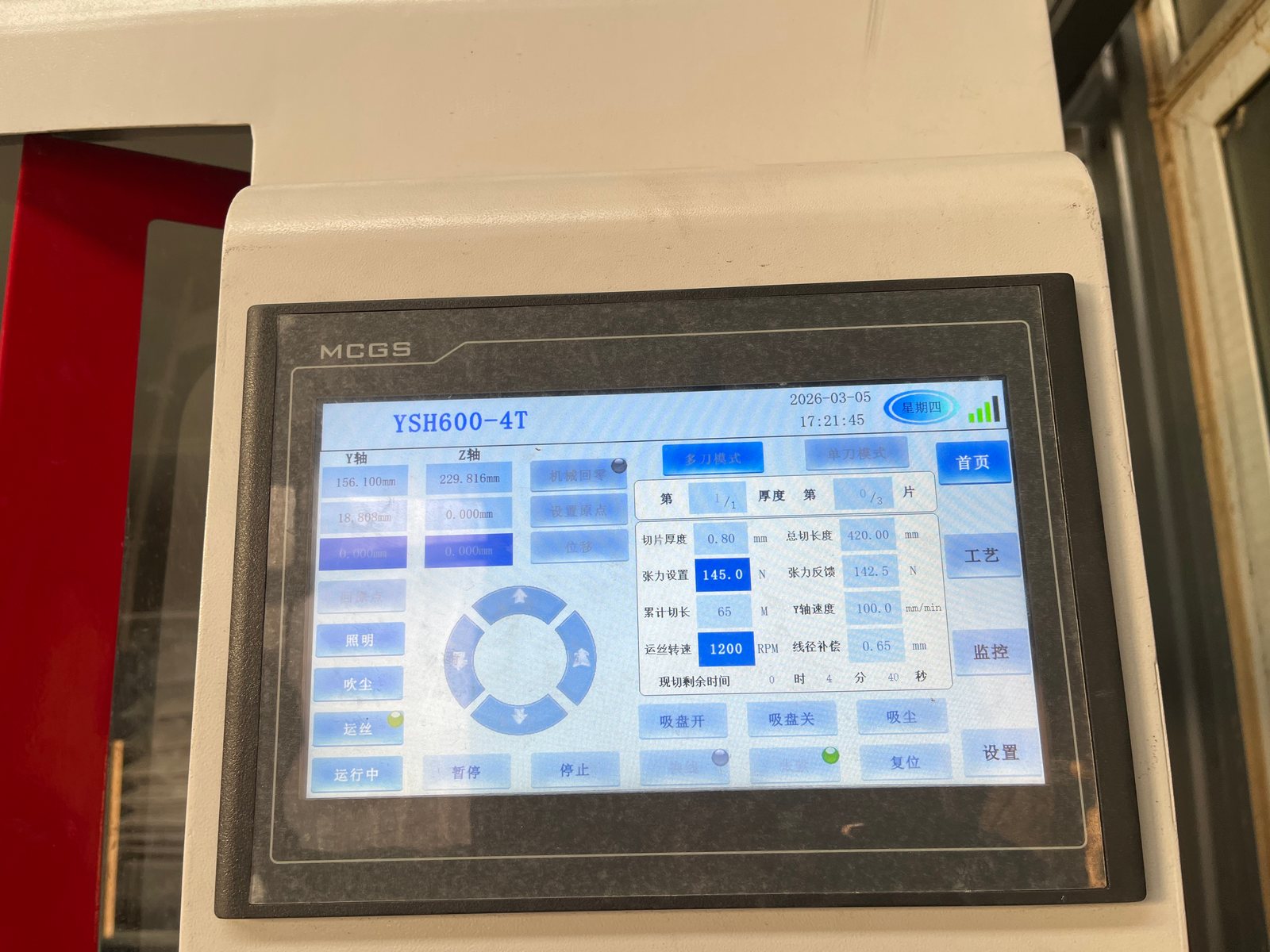
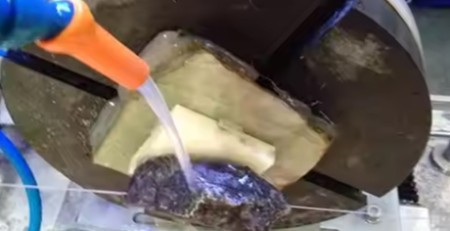
prueba de corte de espuma PMI
Condiciones de la pieza de trabajo para esta ventana: Espuma PMI a aproximadamente MH 2 dureza, pieza de trabajo
400 mm x 400 mm x 50 milímetro, rebanada objetivo 400 mm x 400 mm x 0.8 milímetro.
Lo que hace cada parámetro
Diámetro del alambre y longitud del lazo (0.60 x 3460 milímetro)
El diámetro del alambre determina la ranura y la rigidez del borde de corte. A 0.60 El lazo de alambre completamente recubierto de mm proporciona un
borde abrasivo estable para un 400 corte de mm de ancho mientras mantiene la ranura pequeña. La longitud del lazo debe coincidir con la máquina
pulley geometry and is fixed by the machine model rather than chosen per job.
Velocidad de avance del alambre / tasa de avance (100 mm/min)
This is the parameter that governs cutting load most directly, and on foam it is the first one to reduce when a
defect appears. Feed too high and the skeleton takes a large local force; feed too low and the wire polishes
rather than cuts, which raises heat and wear without improving quality. 100 mm/min is the validated value for
0.8 mm slices.
Ancho de corte (400 milímetro)
The cutting width is the length of wire in contact with the workpiece. It scales the total load and therefore
the machine rigidity and tensioning required. A 400 mm contact length on a lightweight foam also raises the risk
of the workpiece moving, which is why the fixture and workpiece support matter as much as the numbers.
Tensión del alambre (145 N)
Tension keeps the wire straight under load. Demasiado bajo y el alambre se arquea, así que el ancho de la ranura varía y la cara del corte
se vuelve desigual; demasiado alto y el alambre y las poleas se desgastan más rápido y aumenta el riesgo de rotura. El ESH600-4T utiliza tensión con muelle
con retroalimentación de sensor de fuerza, para que la tensión pueda mantenerse constante o variar con el estado del corte, y se
reduce automáticamente en espera y durante los cambios de alambre para limitar la fatiga del alambre.
Velocidad del alambre (25 M/s)
La velocidad del alambre determina cuántos granos abrasivos pasan por la interfaz por segundo. En una espuma de baja densidad la tasa de eliminación
está limitada por la carga más que por la entrega de abrasivo, así que aumentar solo la velocidad del alambre no soluciona un corte deficiente – principalmente
agrega desgaste. Manténgalo en la banda validada y gestione la calidad mediante avance y tensión.
Tiempo de tensado del arco de alambre (60 s)
El tiempo de tensionado permite que el alambre se estabilice en un arco estable antes de que comience el corte. Omitirlo deja el primero
milímetros del corte bajo diferentes condiciones del resto, que aparece como un escalón de grosor en el borde de entrada
borde de una rebanada delgada.
Carga de corte (17 N·m)
La lectura de carga es el monitor del proceso más que un ajuste: es lo que observa para confirmar que la
combinación de avance, tensión y velocidad del alambre realmente está proporcionando un corte estable. Una carga que deriva o aumenta durante
un corte es la advertencia más temprana de que un parámetro ha salido del rango.
Guía de ajuste: Síntoma, Causa, Acción
| Síntoma | Causa más probable | Acción |
|---|---|---|
| Borde de rebanada irregular o desgarrado | Carga de corte demasiado alta para una espuma celular | Reducir la velocidad de avance; verificar la tensión del alambre antes de cambiar la velocidad del alambre |
| Cara de corte desigual, desplazamiento del kerf | Alambre arqueado – tensión demasiado baja | Aumentar la tensión hacia 145 N y confirmar que el arco se asiente antes de la entrada |
| Escalón de grosor en el borde de entrada | El corte comenzó antes de que el arco del alambre se asentara | Keep the full 60 s wire-bow tensioning time before feed engages |
| Slices consistently thin or thick | Dimensional offset, not instability | Apply thickness compensation on the machine target; do not fight it with feed |
| Load trace rising during a cut | Parameter drift or wire wear | Stop, check wire condition and load, re-establish the validated window |
| Surface polished rather than cut | Feed rate too low for the wire speed | Raise feed within the validated band; check grain condition on the wire |
Establishing a Parameter Set for a New Foam or Thickness
The validated window is a starting point, not a universal answer. PMI grades differ in density and cell size,
and slice thickness changes the stiffness of the part being cut. Work in this order:
- Fix the fixture first. Support the workpiece across its full area so that the wire cannot
push it. On foam, deflection of the workpiece reads as thickness variation and is easily mistaken for a
parameter problem. - Start from the validated window. 0.60 x 3460 mm wire, 100 avance mm/min, 145 tensión N,
25 velocidad del alambre m/s, dry cutting. - Cut one slice and measure TTV. Use the same nine-point grid method described in our
TTV measurement guide so results are comparable with the reference data. - Move one parameter at a time. Feed rate first, then tension. Change wire speed only if feed
and tension are already at their limits. - Record the load curve. A stable load trace at the chosen settings is the evidence that the
process, not the operator, is controlling the cut.
Results Achieved with This Window
| Measure | Result across four 0.8 mm slices |
|---|---|
| Total thickness variation (TTV) | 0.013-0.050 milímetro, promedio 0.036 milímetro |
| Thickness tolerance | +/-0.043 mm against 0.800 mm nominal |
| Average surface roughness Ra | 0.68-0.82 µm |
| Maximum edge chipping | 5.5-7.1 µm |
The thickness data showed a systematic negative offset rather than random scatter – the slices ran thin by
0.031 Para 0.043 mm frente a un 0.800 mm nominal. That is a dimensional-compensation problem, not a stability
problem, and is corrected by adjusting the machine target thickness on the next run. The full measurement set
including all nine-point readings is published in the
PMI foam precision slicing test report.
Related Process Data
The same nine-point methodology applied to a dense thermoplastic, with cutting fluid instead of dry cutting,
is documented in the prueba de corte de precisión de PEEK. A side-by-side comparison of the two
materials and their parameter sets is in
PEEK vs PMI foam: diamond wire cutting comparison.
Preguntas Frecuentes
What cutting parameters were used to slice PMI foam to 0.8 milímetro?
Alambre 0.60 x 3460 milímetro, wire travel speed (tasa de avance) 100 mm/min, ancho de corte 400 milímetro, wire tension 145 N, velocidad del hilo 25 M/s, wire-bow tensioning time 60 s and cutting load 17 N·m, on an ESH600-4T horizontal diamond wire saw machine using dry cutting and a fully coated wire.
¿Se debe cortar la espuma PMI en seco o en húmedo??
Seco. La espuma PMI es porosa, ligera y propensa a absorber líquidos. El corte en seco mantiene el refrigerante fuera de las celdas y elimina los pasos de limpieza y secado que siguen a un corte en húmedo, lo que ayuda a preservar la integridad estructural y la precisión dimensional del corte. Esto es lo contrario de un termoplástico denso como PEEK, que se corta con fluido de corte continuo.
¿Qué tipo de alambre se usa para la espuma PMI??
Un lazo de alambre de diamante totalmente recubierto. El recubrimiento completo aumenta la resistencia de unión de los granos y la estabilidad de distribución, manteniendo la capacidad de corte continuo y reduciendo la fluctuación causada por el desgaste del alambre y la pérdida de granos. Vea la gama de productos de lazos de alambre de diamante.
¿Qué resultados logró este conjunto de parámetros??
Cuatro 400 mm x 400 rebanadas de espuma PMI de mm a 0.8 mm de espesor nominal dieron TTV 0.013-0.050 milímetro (promedio 0.036 milímetro), tolerancia de grosor +/-0.043 milímetro, average Ra 0.68-0.82 um y el máximo desprendimiento de borde 5.5-7.1 µm. Todos los datos están en el Informe de prueba de corte de espuma PMI.
¿Cuál es el primer ajuste que se debe cambiar si el borde de la espuma PMI se rasga??
Reducir la velocidad de avance. Desgarro, La compresión local y una cara de corte desigual en una espuma celular son problemas provocados por la carga, no por la velocidad: una carga excesiva comprime el esqueleto de la espuma en lugar de cortarlo. Primero reduzca la velocidad de avance, luego vuelva a revisar la tensión del alambre antes de tocar la velocidad del alambre.
Contenido técnico revisado por el equipo de ingeniería de Ensoll – un fabricante de lazos de alambre de diamante con 10+ años de experiencia en producción.