Vidrio de borosilicato para uso industrial extremo
En el mundo de la ciencia de materiales, el vidrio a menudo se estereotipa como frágil, delicado, y sensible. While this might hold true for the standard soda-lime glass found in your kitchen windows or beverage bottles, there is an elite class of industrial glass engineered specifically to defy these limitations: Borosilicate Glass.
- Borosilicate glass replaces part of the standard glass recipe with about 13% boron trioxide (aproximadamente 81% SiO2), creating a tighter, more interconnected atomic network than soda-lime glass.
- Its three defining traits: exceptional thermal shock resistance (CTE around 3.3 x 10^-6/K, about one third of ordinary glass), near-total chemical inertness, and higher mechanical strength and hardness.
- It is the gold standard for chemical and pharmaceutical processing, explosion-proof lighting enclosures, aerospace windows and precision metrology plates.
- Machining it is the bottleneck: thick blades cause micro-chipping, waste up to 1.5 mm de material caro por rebanada, y el calor por fricción todavía puede producir daños subsuperficiales.
- Los lazos de alambre de diamante resuelven esto con micro-mecanizado a alta velocidad con 30-50 M/s: bordes prácticamente sin astillado, un ultra delgado 0.25-0.35 anchura de corte en mm, y superficies casi pre-pulidas recién cortadas que reducen o evitan el acabado secundario.
Desde los entornos altamente volátiles de las plantas de procesamiento químico y sectores de iluminación a prueba de explosiones hasta los laboratorios impecables de gigantes farmacéuticos, el vidrio de borosilicato es el estándar de oro. Es un material en el que se confía donde la falla no es una opción.
Pero, ¿qué hace que esta formulación de vidrio específica sea tan resistente?? Y, ¿cómo los fabricantes dan forma y cortan este material cerámico ultra resistente en componentes industriales de alta precisión sin destruir su integridad estructural??
En esta guía completa, desglosaremos la ciencia detrás del vidrio de borosilicato, its primary industrial applications, and the advanced machining technologies required to process it.
Borosilicate is more thermal-shock resistant than the optical grades, but the machine settings carry over directly from Corte de vidrio óptico.
What is Borosilicate Glass? The Chemistry of Resilience
Standard glass is primarily made of silica, soda, and lime. Borosilicate glass alters this fundamental recipe by substituting a significant portion of the ingredients with boron trioxide ($B_2O_3$). Típicamente, a high-quality industrial borosilicate glass (such as Borofloat® or Pyrex®) consists of roughly 81% silica ($SiO_2$) y 13% boron trioxide.
This chemical modification completely rearranges the material’s atomic matrix. The introduction of boron creates a tighter, more interconnected polymeric network. Esta arquitectura molecular única le otorga al vidrio de borosilicato sus tres características industriales definitorias:
1. Resistencia excepcional al choque térmico
La característica destacada del vidrio de borosilicato es su coeficiente de expansión térmica increíblemente bajo (CET). Aproximadamente $3.3 \veces 10^{-6}\texto{ K}^{-1}$, su tasa de expansión es aproximadamente un tercio de la del vidrio común de sosa-cal.
Cuando el vidrio común se expone a picos de temperatura repentinos, diferentes áreas del material se expanden a diferentes velocidades, creando tensión interna que conduce a la rotura inmediata. El vidrio de borosilicato se expande de manera tan mínima y uniforme que puede pasar de un frío extremo a un calor abrasador sin agrietarse.
2. Alta durabilidad química y resistencia hidrolítica
El vidrio de borosilicato es prácticamente químicamente inerte. Resiste el agua, ácidos, soluciones salinas, sustancias orgánicas, y halógenos. Incluso durante una exposición prolongada a químicos agresivos a temperaturas elevadas, su superficie permanece sin corroerse y sin opacarse. Esto previene cualquier lixiviación química, preservando la pureza absoluta de cualquier sustancia que contenga.
3. Alta Resistencia Mecánica y Dureza
Con una alta dureza según la escala de Mohs y un alto módulo de elasticidad, el vidrio de borosilicato es mecánicamente más resistente que el vidrio estándar. Resiste los arañazos, soporta mayores fuerzas de impacto, y mantiene su estabilidad geométrica bajo cargas estructurales pesadas.
Principales Aplicaciones Industriales del Vidrio de Borosilicato
Debido a su durabilidad incansable, el vidrio de borosilicato se utiliza en un amplio espectro de industrias pesadas:
Procesamiento Químico y Farmacéutico: Se utiliza para tuberías industriales, columnas de destilación, vasijas de reacción, y mirillas de alta visibilidad. Su inercia química asegura que los compuestos farmacéuticos permanezcan intactos durante la síntesis.
Iluminación de alta intensidad y gabinetes a prueba de explosiones: Comúnmente encontrado en reflectores de alta resistencia, iluminación de escenarios, y visores en áreas peligrosas donde las bombillas de alta potencia generan intensa, energía térmica localizada.
Aeroespacial y Defensa: Utilizado en ventanas ópticas para aeronaves de gran altitud, componentes de satélites, y visores de imagen térmica que deben soportar rápidos cambios de presión atmosférica y temperatura.
Electrodomésticos y Metrología: Desde puertas de hornos de alta gama y bandejas de microondas hasta placas ópticas planas de precisión usadas en laboratorios de calibración industrial.
El obstáculo del corte de precisión: Maquinando una cerámica dura
Mientras que la extrema dureza y fragilidad del vidrio borosilicatado lo convierten en un producto final fenomenal, hacen que las etapas iniciales de fabricación y corte de materias primas sean increíblemente desafiantes.
Métodos tradicionales de corte, como herramientas de fresado CNC, chorros de agua a alta presión, o ruedas de molienda abrasivas gruesas, frecuentemente enfrentan cuellos de botella costosos al procesar placas de borosilicato de alta pureza:
- Micro-Astillado y Rotura de Bordes: Debido a que el material no tiene plasticidad, la alta fuerza de impacto localizada de una cuchilla gruesa tradicional corta el vidrio violentamente, causando micro-fracturas severas y astillado a lo largo del corte de salida.
- Severo Desperdicio de Materia Prima: Los lingotes de vidrio de borosilicato de grado industrial son caros de producir. Thick cutting blades can easily grind away up to $1.5\text{ milímetro}$ de material por rebanada en una pulpa inútil.
- Fracturas por Estrés Térmico: Irónicamente, aunque el borosilicato maneja excepcionalmente bien el choque térmico, the massive friction heat generated by slow, heavy grinding blades can still exceed localized tolerances, resulting in sub-surface damage (SSD).
The Modern Manufacturing Solution: Endless Diamond Wire Loops
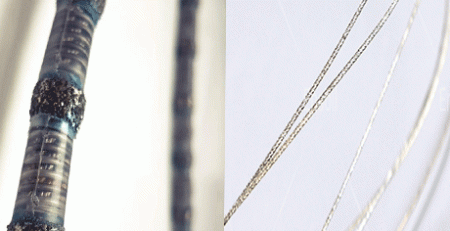
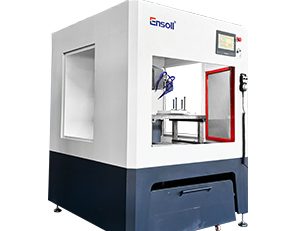
To solve these high-precision manufacturing bottlenecks, advanced glass fabrication facilities have transitioned to a revolutionary micro-grinding technology: the endless bucle de alambre de diamante.
An bucle de alambre de diamante sin fin is an ultra-thin, high-tensile steel wire welded into a continuous, seamless ring, with its outer surface permanently electroplated with microscopic industrial diamond abrasives. Unlike legacy open-loop wire saws that must constantly decelerate, stop, and reverse direction, the endless wire loop rotates continuously in a single direction at staggering linear velocities—often between $30\text{ M/s}$ and $50\text{ M/s}$.
This continuous, El movimiento unidireccional de alta velocidad redefine completamente la mecánica de corte del vidrio borosilicato frágil:
1. Corte sin astillas mediante micro-molienda
Debido a que el alambre se mueve a velocidades tan inmensas, la fuerza de contacto entre cada cristal de diamante individual y el vidrio se reduce a un nivel microscópico. En lugar de fracturar o cizallar el vidrio, el lazo continuo realiza una acción de micro-molienda de alta velocidad. Esto elimina el choque mecánico asociado con el aserrado tradicional, resultando en bordes extremadamente afilados, nítidos con prácticamente cero astillado o microgrietas.
2. Maximizando el rendimiento del material (Ranura ultrafina)
Debido a que un alambre continuo mantiene una estabilidad excepcional bajo alta tensión sin vibrar ni doblarse, the core steel wire can be engineered to be incredibly thin—frequently down to just $0.25\text{ milímetro}$ to $0.35\text{ milímetro}$. Este camino de corte extraordinariamente estrecho minimiza la pérdida de viruta. Para líneas de fabricación de alto volumen, ahorrar fracciones de milímetro en cada corte individual se traduce en miles de dólares en material bruto recuperado en una sola producción.
3. Calidad de superficie casi pre-pulida
The continuous, la tensión constante de un sistema de lazo cerrado elimina por completo las “marcas de sierra” y las profundas hendiduras de superficie típicas de las hojas oscilantes. La rugosidad resultante de la superficie ($R_a$) es fenomenalmente baja. Para componentes industriales como mirillas o ventanas ópticas, este acabado limpio “tal como se corta” reduce drásticamente o reemplaza por completo el tiempo y la mano de obra requeridos para etapas secundarias de rectificado fino y pulido.
Conclusión: Ingeniería del Futuro de la Óptica Industrial
A medida que las industrias avanzan hacia una mayor automatización, tolerancias geométricas más estrictas, y entornos operativos más exigentes, el papel de los materiales premium como el vidrio de borosilicato solo se expandirá. Sin embargo, El verdadero valor de este material solo se desbloquea cuando puede ser mecanizado con el mismo nivel de precisión que se utilizó en su formulación química.
Al adoptar tecnologías avanzadas de corte como el endless bucle de alambre de diamante, Los ingenieros modernos de fabricación están superando con éxito los desafíos históricos de la fragilidad de la cerámica. Esta combinación perfecta de ciencia de materiales e ingeniería mecánica asegura que, desde la bancada de laboratorio hasta la plataforma de lanzamiento, nuestros sistemas de alta tecnología más críticos permanezcan claramente enfocados y protegidos de manera segura.
Preguntas Frecuentes
¿De qué está hecho el vidrio de borosilicato??
Un vidrio de borosilicato industrial de alta calidad consiste aproximadamente en 81% silica (SiO2) y 13% boron trioxide (B2O3). Substituting boron into the recipe rearranges the atomic matrix into a tighter polymeric network, which is the source of its thermal, chemical and mechanical advantages.
Why is borosilicate glass so resistant to thermal shock?
Its coefficient of thermal expansion is about 3.3 x 10^-6/K — roughly one third that of ordinary soda-lime glass. It expands so little and so evenly under sudden temperature swings that the internal stress which shatters ordinary glass never builds up.
What is the best way to cut borosilicate glass?
A diamond wire loop. The ultra-thin diamond-coated wire runs continuously in one direction at 30-50 m/s and micro-grinds the glass instead of shearing it, producing crisp edges with virtually zero chipping, a kerf of just 0.25-0.35 milímetro, and a surface finish close to pre-polished.
¿Cuánto material desperdicia el corte convencional en vidrio de borosilicato??
Las hojas abrasivas gruesas pueden desgastar hasta 1.5 mm de material por rebanada en lodo de desecho, lo cual es costoso en lingotes de borosilicato de alta pureza. El corte con un lazo de alambre de diamante de 0.25-0.35 mm reduce dramáticamente esa pérdida, lo que se traduce en ahorros significativos durante una producción.
Revisado por el equipo de ingeniería de Ensoll.