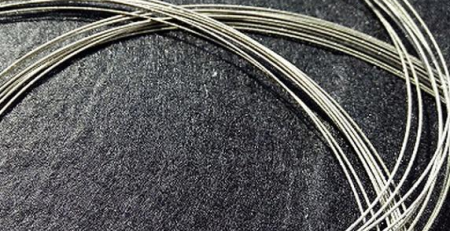
Scies à fil diamanté pour matériaux durs et fragiles
Dans le paysage manufacturier moderne, the demand for high-performance components has led to the widespread adoption of hard and brittle materials. Materials such as Silicon Carbide (Sic), technical ceramics, verre optique, and rare-earth magnets (like NdFeB and SmCo) are essential for next-generation electronics, aérospatial, et les technologies d’énergie renouvelable.
Toutefois, machining these materials presents a massive engineering paradox: their extreme hardness makes them highly durable in application, but their lack of plasticity makes them incredibly difficult to cut without causing catastrophic cracking or severe material waste.
Pour surmonter ces obstacles de fabrication, precision fabrication facilities are abandoning legacy abrasive wheels and adopting advanced diamond wire saw technology—specifically, endless closed-loop diamond wires. This cutting-edge process is rewriting the rules of material yield, processing speed, and edge integrity.
The Core Challenge of Hard and Brittle Materials
When standard cutting tools or thick grinding blades interact with brittle ceramics or crystals, they rely on high-pressure mechanical shearing. Because hard and brittle materials cannot deform elastically under stress, this localized pressure causes the sub-surface matrix to fracture.
Manufacturers frequently face three costly production bottlenecks:
- Severe Edge Chipping (崩边): As a traditional blade exits the material, high mechanical forces cause the edges to shatter, leading to high rejection rates.
- High Kerf Loss: Industrial ingots like monocrystalline silicon or sapphire are expensive. Thick blades turn a massive percentage of this high-value material into useless slurry powder.
- Dommages sous la surface (SSD): Mechanical shock telegraphs micro-cracks deep into the interior of the sliced wafer, compromising its mechanical lifespan under thermal cycles.
Enter the Diamond Wire Saw: A Paradigm Shift in Slicing
A modern scie à fil diamanté
utilizes a high-strength steel wire permanently impregnated with industrial diamond grits—the hardest known substance on Earth. When configured as an endless loop, the wire is welded into a continuous, seamless ring that rotates dynamically over a high-speed pulley system.
Instead of moving back and forth like a traditional reciprocating saw, le fil diamanté sans fin saw runs in a single, uninterrupted direction at staggering linear velocities, typically between $30\text{ m/s}$ and $60\text{ m/s}$.
1. High-Speed Micro-Grinding vs. Shearing
The immense linear speed of an endless diamond wire saw completely changes the physics of the cut. The contact force exerted on the workpiece drops to near zero because the material removal mechanism transitions into high-speed micro-grinding. Each microscopic diamond particle acts as a tiny abrasive point that erodes the material evenly. This eliminates the mechanical shock factors that cause micro-fractures, allowing for pristine, razor-sharp edges with zero chipping.
2. Extreme Kerf Optimization (Maximizing Yield)
Because the continuous loop maintains exceptional stability under high tension without the vibration “jerk” of reciprocating systems, the core wire can be engineered to be incredibly thin—frequently down to just $0.20\text{ mm}$ to $0.35\text{ mm}$. This remarkably narrow cutting path minimizes kerf loss, allowing production lines to extract significantly more usable wafers out of a single raw ingot.
3. Superior Thermal and Surface Control
Hard and brittle materials are highly sensitive to localized thermal shock during machining, which can cause immediate cracking. The continuous motion of the diamond wire saw prevents heat from accumulating at the cutting zone by constantly introducing a fresh, cool section of wire. Paired with optimized cooling fluids, the fine powder (copeaux) is instantly washed away, leaving a near-polished surface finish ($R_a$) that drastically reduces secondary grinding and polishing times.
Conclusion
The evolution toward diamond wire saw technology represents a critical milestone in high-precision manufacturing. By conquering the natural brittleness of advanced materials, minimizing raw material waste, and eliminating edge breakage, this technology provides global manufacturers with the precision and reliability required to power tomorrow’s high-tech innovations.