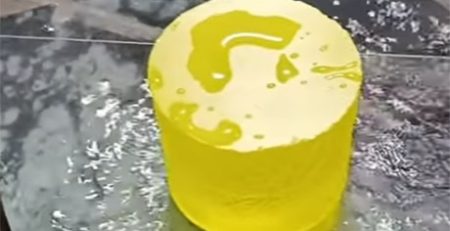
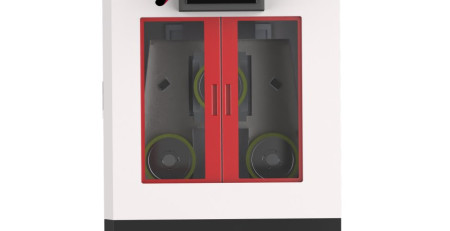
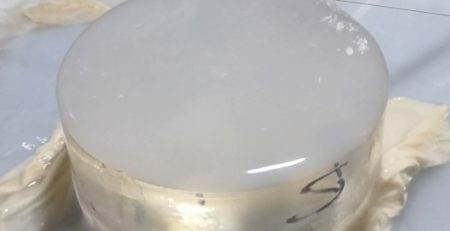
Taglio di nuclei in ferrite morbida: Filo diamantato senza fine
La rapida evoluzione delle telecomunicazioni 5G, veicolo elettrico (VE) infrastruttura di ricarica, e le alimentazioni ad alta frequenza hanno posto un'enorme attenzione su una classe specifica di materiali magnetici: Ferriti morbide. Unlike hard permanent magnets like NdFeB or SmCo, le ferriti morbide (come le ferriti Manganese-Zinco e Nichel-Zinco) sono composti ceramici progettati per la loro alta permeabilità magnetica e la sorprendentemente bassa conducibilità elettrica. Queste proprietà le rendono indispensabili per prevenire la perdita di energia nei trasformatori, induttori, e l'interferenza elettromagnetica (EMI) nuclei soppressori.
- Ferriti morbide (MnZn and NiZn) are ceramic magnetic materials essential to high-frequency transformers, inductors and EMI suppression cores — and they are extremely brittle.
- Traditional blades cause severe edge chipping, kerf loss of up to 50% on thin parts, and sub-surface micro-cracks that shorten core life.
- A diamond wire loop running continuously at 40-60 m/s cuts by low-force micro-grinding: near-zero chipping, kerf down to 0.2-0.35 millimetro, and a near pre-polished surface finish.
- Key parameters are wire speed above 50 m/s for hard ferrites, tightly controlled feed to avoid wire bow, and uniform fine diamond grit.
Tuttavia, because soft ferrites are essentially industrial ceramics, they inherit the classic vulnerabilities of the ceramic family. They are incredibly brittle, highly sensitive to thermal shock, and prone to internal stress fractures during machining. As electronic components shrink and frequencies rise, manufacturers face the daunting task of slicing these fragile ferrite blocks into ultra-thin, complex geometries with flawless accuracy.
To meet these tight tolerances without compromising structural integrity, high-volume electronics manufacturers are shifting away from traditional abrasive wheel cutting and adopting Infinito Anello di filo diamantato tecnologia.
Soft ferrites crack more easily than rare-earth magnets, yet the same rules that govern how to cut neodymium magnets apply: keep cutting force low and temperature stable.
The Soft Ferrite Challenge: Ceramic Brittleness Meets High Frequency
Processing soft ferrites is a delicate balancing act. Sintered ferrite blocks are rigid but possess very low tensile strength. During traditional slicing processes, manufacturers face several distinct manufacturing bottlenecks:
1. Severe Edge Chipping and Micro-Cracking
When traditional inner-diameter (DI) saws or thick diamond blades cut through a ferrite block, they exert high localized mechanical pressure. As the blade exits the cut, this pressure causes the ceramic material to fracture, resulting in severe edge chipping (崩边). For high-frequency transformer cores, even minor edge defects can alter the magnetic flux path, increase eddy current losses, and degrade the overall efficiency of the component.
2. High Ceramic Powder Waste (Perdita di Materiale (Kerf))
Traditional grinding wheels are relatively thick (often over $1.0\text{ millimetro}$). When slicing miniature ferrite components—such as low-profile inductor cores that are only a few millimeters thick—a thick blade can easily turn up to $50\%$ of the raw material into useless ceramic sludge. Minimizing this cutting path, or kerf loss, is vital for maintaining cost-effective production.
3. Danni sub-superficiali (SSD)
The mechanical stress of a heavy, slow-moving blade doesn’t just damage the surface; it telegraphs micro-fractures deep into the interior of the ceramic matrix. Questo danno sottosuperficiale compromette la durata meccanica del nucleo in ferrite, rendendolo suscettibile a crepe durante i cicli termici delle operazioni ad alta potenza.
La Svolta: Taglio a Loop di Filo di Diamante Senza Fine
Per superare i limiti delle lame rigide, i moderni laboratori di lavorazione di precisione stanno integrando loop di filo di diamante senza fine nelle loro linee di produzione. Un Anello di filo diamantato senza fine è un filo d'acciaio continuo, flessibile ricoperto da particelle di diamante industriale a grana precisa, che scorre su un sistema di pulegge ad alta velocità in un loop fisso, a direzione singola
Quando applicata alla lavorazione delle ferriti morbide, questa tecnologia offre un balzo quantico in termini di qualità ed efficienza grazie a diversi meccanismi operativi distinti:
Velocità Lineari Ultra-Alte con Forza di Alimentazione Minima
Unlike traditional reciprocating wire saws that travel at low speeds and constantly reverse direction, an endless diamond wire loop rotates continuously in one direction at velocities between $40\text{ m/s}$ and $60\text{ m/s}$.
This immense speed changes the physics of the cut. Instead of forcing its way through the ceramic, the wire performs a lightning-fast micro-grinding action. The mechanical force exerted on the ferrite block drops to near zero, eliminating the shock factors that cause edge chipping and allowing for the safe production of ultra-thin ferrite wafers.
Drastic Reduction in Kerf Loss
Because the endless loop operates under highly optimized, steady tension without the “vibration jerk” of reciprocating systems, the core steel wire can be manufactured to be incredibly thin—frequently down to $0.20\text{ millimetro}$ to $0.30\text{ millimetro}$. This remarkably narrow kerf maximizes material utilization, allowing manufacturers to extract significantly more usable ferrite cores out of a single sintered block.
Exceptional Thermal Control and Swarf Flushing
While soft ferrites can handle high operational temperatures in electrical circuits, they are highly sensitive to sudden localized thermal shocks during machining. If a cutting zone overheats, the ferrite can experience localized thermal expansion, leading to immediate cracking.
Il movimento continuo, high-speed movement of l'anello di filo di diamante prevents heat accumulation by constantly introducing a fresh, cool section of wire into the cutting zone. When paired with high-volume, water-soluble coolants, the fine ceramic powder (trucioli) is instantly flushed away, keeping the wire sharp and the ferrite block perfectly cool.
Finitura Superiore della Superficie ($R_a$)
The smooth, continuous motion of the endless loop yields an exceptionally clean surface finish with minimal roughness ($R_a$). A smoother surface means that the mating faces of split ferrite cores (such as E-cores or U-cores) require little to no secondary lapping or polishing to achieve the perfect flush fit required to minimize air gap reluctance.
Technical Comparison: Soft Ferrite Slicing
| Performance Metric | Traditional Ceramic Slitting Blades | Loop senza fine di filo diamantato () |
| Meccanismo di Taglio | High-pressure mechanical shearing | High-speed, low-force micro-grinding |
| Wire/Blade Thickness | $0.8\testo{ millimetro}$ to $1.5\text{ millimetro}$ | $0.2\testo{ millimetro}$ to $0.35\text{ millimetro}$ |
| Material Yield | Bassa (High kerf loss/sludge) | Alta (Minimal material waste) |
| Sbeccature ai Bordo | Frequent, requires heavy reworking | Virtually zero chipping or micro-cracks |
| Qualità della superficie ($R_a$) | Grezzamente, requires secondary lapping | Eccellente, near pre-polished finish |
Optimizing Parameters for Soft Ferrites
Achieving the perfect cut on a soft ferrite ceramic depends heavily on balancing three core machine parameters:
- Wire Speed Selection: For hard, brittle ceramics like Mn-Zn ferrites, keeping the wire speed on the higher end ($>50\testo{ m/s}$) ensures that the material removal stays in the brittle-ductile transition zone, optimizing surface smoothness.
- Feed Rate Tuning: La velocità di avanzamento (the speed at which the wire pushes into the material) must be tightly controlled. Moving too fast increases bowing of the wire, which can introduce slight geometric deviations in flatness.
- Grit Size Optimization: Using a highly uniform, micro-sized diamond grit ensures that the material is eroded evenly, avoiding deep scratches that could act as stress concentrators later on.
Conclusione: Driving the Future of High-Frequency Electronics
Conclusione: Driving the Future of High-Frequency Electronics
As power electronics transition toward smaller footprints and higher power densities—driven heavily by wide-bandgap semiconductors like Silicon Carbide (Sic) and Gallium Nitride (Gan)—the demands on soft ferrite magnetic components have never been stricter.
The Endless Diamond Wire Loop provides the precise manufacturing solution that this industry requires. By overcoming the natural brittleness of industrial ceramics, eliminating edge breakage, and maximizing raw material yields, technology stands out as the premier choice for manufacturing the high-frequency magnetic components powering our automated, electrified future.
Domande Frequenti
What is the best way to cut soft ferrite cores?
Diamond wire loop slicing. The continuous single-direction wire removes the ceramic by high-speed, low-force micro-grinding, che elimina praticamente lo scheggiamento dei bordi e le crepe sottosuperficiali che le lame tradizionali causano sui ferriti fragili.
Perché i nuclei di ferrite si scheggiano durante il taglio?
La ferrite è una ceramica sinterizzata con resistenza a trazione molto bassa. Una lama rigida concentra la pressione meccanica sul bordo del taglio, e il materiale si frattura quando la lama esce. L'elevata forza di taglio localizzata e le vibrazioni sono le cause principali.
Quanto sottile può tagliare la ferrite il filo diamantato?
Il nucleo del filo diamantato stesso è tipicamente 0.20-0.30 millimetro, quindi il taglio è estremamente stretto. Questo permette wafer di ferrite ultra-sottili e consente ai produttori di estrarre molti più nuclei utilizzabili da un singolo blocco sinterizzato rispetto a quanto si possa fare con 0.8-1.5 lame da mm.
Il taglio con filo diamantato danneggia le proprietà magnetiche della ferrite?
No. È un processo a freddo: il filo in rapido movimento porta costantemente materiale fresco, cool abrasive into the cut and water-soluble coolant flushes heat and swarf away, so there is no thermal shock or heat-affected zone to degrade the ferrite.
Contenuto tecnico esaminato dal team di ingegneria Ensoll — un produttore di anelli diamantati con 10+ anni di esperienza produttiva.