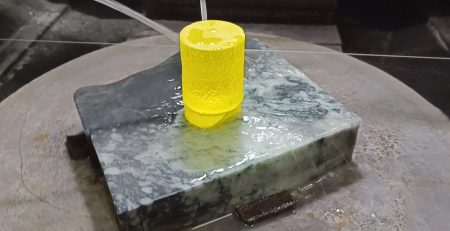
エポキシ樹脂のダイヤモンドワイヤループ精密切断: 2 mm試験データ
Sample testing for a European client (Company Q) · Ring diamond wire cutting process
概要
This report documents precision slicing of epoxy resin using a ring diamond wire cutting system. The evaluation covers equipment and wire selection, cutting methodology, process parameters, and the resulting thickness uniformity, dimensional accuracy, surface quality and edge integrity of the sliced parts. Test results indicate that a gantry-type ring diamond wire machine, water-based cooling, and appropriately matched process parameters deliver stable, high-precision slicing of epoxy resin.
1. Test Specimen
| Parameter | Value |
|---|---|
| Material | Epoxy resin |
| Hardness | approx. 5–6 Mohs |
| Workpiece dimensions | 30.0 ミリメートル (L) × Ø20.0 mm |
| Target slice dimensions | 2.0 ミリメートル (L) × Ø20.0 mm |
2. Equipment and Wire Selection
Equipment: ESO-GM. In view of the material characteristics of epoxy resin and the requirement to produce 2 mm thin slices, Ensoll selected the ESO-GM gantry-type ring diamond wire cutting system with a top-down vertical feed. The gantry configuration maintains a stable wire trajectory and slice thickness accuracy, and the machine is equipped with a mist-extraction system.
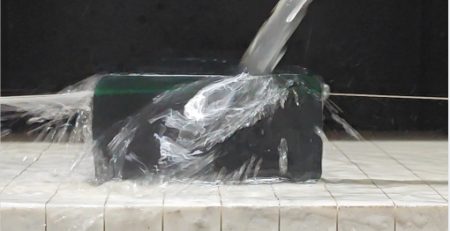
Coolant: water-based cutting. Water is used as the cooling medium. It continuously cools the contact zone between the diamond wire and the epoxy resin and carries away part of the heat and cutting debris generated during cutting, reducing the effect of localised temperature rise and debris accumulation on the machining condition. Controlled water supply helps maintain a stable cutting zone.
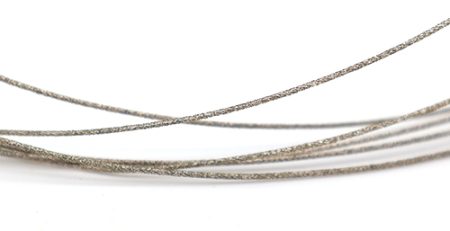
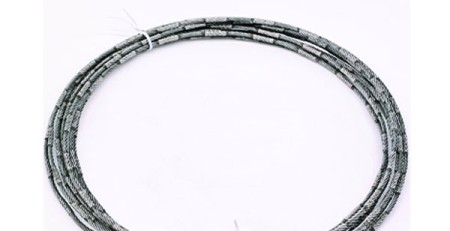
Wire: fully plated. A fully plated diamond wire was selected. The plated construction improves the bonding strength between the diamond abrasive grains and the wire core and provides a more uniform grain distribution, so the wire maintains a consistent grinding capability and material removal behaviour during cutting. This reduces grain pull-out and wire wear. For the 2 mm thin-slice requirement in epoxy resin, stable wire performance is essential to thickness consistency.

3. Cutting Method and Equipment Advantages
Gantry cutting configuration. The gantry structure provides high overall rigidity and running stability. The top-down vertical feed helps keep the diamond wire trajectory stable and reduces the influence of changes in cutting force on slice position and dimensional accuracy in epoxy resin. The machine is equipped with a mist-extraction system that promptly removes mist generated during water-based cutting.
インテリジェント張力制御. システムは切断条件に応じてダイヤモンドワイヤーの張力をリアルタイムで調整し、一定張力モードと可変張力モードの両方に対応します, keeping the wire running stably. Well-matched tension control reduces fluctuation in the wire trajectory and limits localised uneven loading and the risk of wire breakage caused by tension variation, which in turn reduces the occurrence of slice defects.
ワイヤー切断記憶. ダイヤモンドワイヤーが切断された場合や機械が異常停止した場合, システムは自動的に現在の加工位置と関連する操作状態を記録します. ワイヤーを交換した後, cutting resumes from the recorded position, reducing dimensional deviation and material loss caused by re-positioning and repeat machining. This improves the continuity of epoxy resin thin-slice cutting and lowers the risk of repeated cutting.
High-rigidity one-piece cast iron frame. The one-piece cast iron frame provides high structural stiffness and vibration resistance, reducing the effect of machine vibration and structural deformation on the wire trajectory during machining. For the cutting stability and thickness consistency demanded by 2 mm epoxy resin slices, the high-rigidity frame helps damp vibration during the cut and keeps the wire running steadily.
4. Process Parameters and Cooling Method
| Parameter | Value |
|---|---|
| 線径 (ミリメートル) | 0.35 × 1978 |
| Wire traverse speed (ミリメートル/分) | 8 |
| Cutting width (ミリメートル) | 20 |
| Wire tension (N) | 80 |
| Wire speed (メートル/秒) | 21 |
| Wire bow time (s) | 60 |

5. Cutting Performance and Results

5.1 TTV Test Data (単位: ミリメートル)
総厚変化 (TTV) was measured using a nine-point grid, dual-probe thickness gauging method on a vacuum-chuck stage. The measurement was applied to epoxy resin slices produced by ring diamond wire cutting. Before measurement the instrument was thermally stabilised and calibrated against a standard thickness block. The nominal slice thickness was 2.000 ミリメートル.
| サンプル | Nine-point thickness readings | Tmax | Tmin | TTV |
|---|---|---|---|---|
| S01 | 1.994, 1.997, 2.000 1.996, 2.001, 2.004 1.998, 2.005, 2.008 |
2.008 | 1.994 | 0.014 |
| S02 | 1.990, 1.994, 1.998 1.995, 2.000, 2.003 1.997, 2.004, 2.007 |
2.007 | 1.990 | 0.017 |
| S03 | 1.986, 1.991, 1.995 1.993, 1.998, 2.002 1.996, 2.003, 2.009 |
2.009 | 1.986 | 0.023 |
| S04 | 1.995, 1.998, 2.001 1.997, 2.002, 2.005 1.999, 2.006, 2.010 |
2.010 | 1.995 | 0.015 |
| S05 | 1.992, 1.996, 1.999 1.994, 2.000, 2.004 1.998, 2.005, 2.009 |
2.009 | 1.992 | 0.017 |
| S06 | 1.988, 1.993, 1.997 1.994, 1.999, 2.003 1.996, 2.004, 2.008 |
2.008 | 1.988 | 0.020 |
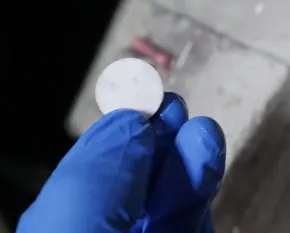
Assessment. Nine-point grid measurement was applied to six epoxy resin slices. TTV values were 0.014, 0.017, 0.023, 0.015, 0.017 そして 0.020 ミリメートル, spanning 0.014–0.023 mm across the batch, with a mean TTV of approximately 0.018 mm on a 2.000 mm nominal thickness. The results confirm good thickness uniformity in epoxy resin slicing.
5.2 厚さ公差データ (単位: ミリメートル)
Thickness tolerance was derived from the nine-point thickness data, using 2.000 mm as the nominal thickness. The positive and negative thickness deviation were calculated at each measurement position and the results from all six samples were aggregated. The maximum positive deviation, maximum negative deviation and overall deviation range were determined to evaluate thickness consistency.
| サンプル | Mean thickness | Thickness deviation |
|---|---|---|
| S01 | 2.000 | 0.000 |
| S02 | 1.999 | −0.001 |
| S03 | 1.997 | −0.003 |
| S04 | 2.001 | +0.001 |
| S05 | 2.000 | 0.000 |
| S06 | 1.998 | −0.002 |
| Maximum positive deviation | — | +0.010 ミリメートル |
| Maximum negative deviation | — | −0.014 mm |
| Thickness tolerance band | — | ±0.012 mm |
Assessment. Against a nominal thickness of 2.000 ミリメートル, the six slices showed mean thicknesses of 1.997–2.001 mm, with the batch average close to nominal. Over all measurement points the thickness deviation ranged from −0.014 mm to +0.010 ミリメートル, with a maximum absolute deviation of 0.014 ミリメートル.
5.3 Surface Roughness Ra Data (単位: マイクロメートル)
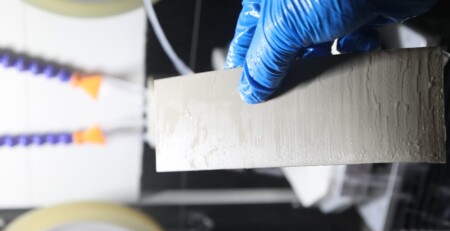
Surface roughness (Ra) was measured by stylus profilometry on the epoxy resin slices after ring diamond wire cutting. Representative measurement positions were taken at the centre and on both sides along the cut end face, surface profile data was acquired with a stylus profilometer, and the roughness parameter Ra was recorded at each position.
| サンプル | Centre | Mid-left | Mid-right | Mean Ra |
|---|---|---|---|---|
| S01 | 0.62 | 0.68 | 0.65 | 0.65 |
| S02 | 0.58 | 0.63 | 0.60 | 0.60 |
| S03 | 0.72 | 0.78 | 0.75 | 0.75 |
| S04 | 0.55 | 0.61 | 0.58 | 0.58 |
| S05 | 0.65 | 0.70 | 0.67 | 0.67 |
| S06 | 0.60 | 0.66 | 0.63 | 0.63 |
Assessment. Mean Ra across the six samples ranged from 0.58 宛先 0.75 マイクロメートル, with all individual readings between 0.55 そして 0.78 マイクロメートル. The narrow spread across the three measurement positions on each slice indicates a uniform surface finish along the cut face.
5.4 Edge Chipping Data (単位: マイクロメートル)
Edge chipping was quantified by optical imaging on a toolmaker’s microscope. Specimen edges were cleaned before measurement and the magnification and measurement scale of the instrument were calibrated. The slice edge was then inspected under the microscope, identifiable chipping defects were located and measured at four points per sample, and the maximum value was retained.
| サンプル | Point 1 | Point 2 | Point 3 | Point 4 | マックス. chipping |
|---|---|---|---|---|---|
| S01 | 4.2 | 4.8 | 5.3 | 4.6 | 5.3 |
| S02 | 3.8 | 4.5 | 4.9 | 4.2 | 4.9 |
| S03 | 5.6 | 6.3 | 7.2 | 6.5 | 7.2 |
| S04 | 3.5 | 4.1 | 4.6 | 3.9 | 4.6 |
| S05 | 4.8 | 5.4 | 6.1 | 5.2 | 6.1 |
| S06 | 4.3 | 5.0 | 5.6 | 4.7 | 5.6 |
Assessment. Toolmaker’s microscope inspection of the six epoxy resin slices gave maximum chipping values of 5.3, 4.9, 7.2, 4.6, 6.1 そして 5.6 マイクロメートル, with an overall maximum of 7.2 マイクロメートル. S04 showed the best edge integrity, and S03 the largest chipping at 7.2 マイクロメートル.
6. 結論
The good results obtained in this high-precision slicing trial of epoxy resin stemmed mainly from the combined effect of a purpose-built cutting machine, the cooling method, and correctly matched process parameters. Epoxy resin is a polymer material, and its machining behaviour depends on the resin formulation and cure state. During ring diamond wire cutting the material is acted on continuously by the abrasive grains, and cutting load, wire condition and process parameters together govern the quality of the slice.
Equipment. An ESO-GM ring diamond wire cutting system was used. The machine provides good overall structural rigidity and running stability and gives reliable mechanical support for workpiece clamping and continuous wire travel. Coordinated control of the feed mechanism and wire running condition keeps the diamond wire on the programmed path throughout the cut.
冷却. Water-based cutting was adopted. Continuous grinding generates friction heat in the cutting zone, and localised temperature rise can affect the machining state of the material. Continuous water supply cools the contact area between the wire and the workpiece, carries away part of the cutting debris, and reduces the effect of localised heat accumulation on the material surface.
Process parameters. Wire speed, feed rate and other key parameters were matched to the properties of epoxy resin and to the target slice thickness. Parameters were set to maintain stable wire travel and continuous material removal, avoiding feed rates high enough to raise localised cutting load, or a parameter mismatch that would degrade slice quality.
Overall. Taken together with slice dimensional accuracy, thickness tolerance, 表面粗さ (Ra) and cut-edge quality, the combination of the ESO-GM ring diamond wire machine, water-based cutting and appropriately matched process parameters provides stable material removal and effective slice quality control for epoxy resin.