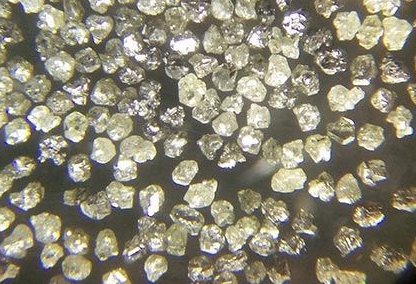
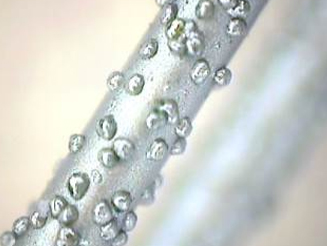
В этом исследовании изучается влияние различных связующих смол на режущие свойства алмазных проволочных петель. Образцы твердости, отвержденные смолой, готовили с использованием чистой фенольной смолы, Эпоксидно-модифицированная фенольная смола, и ароматическая алкил-модифицированная фенольная смола, и их твердость по Роквеллу была проверена. Трещиноватые поверхности образцов отвержденной смолы наблюдали с помощью сканирующей электронной микроскопии, Выявление различных уровней плотности после отверждения. Diamond wire loops were then manufactured for single crystalsilicon cuttingexperiments.
The experimental results demonstrate that diamond wire loops made with pure phenolic resin, characterized by high cured hardness and good post-curing density, exhibit minimal wire deflection during cutting, shorter cutting times, reduced diamond particle detachment, and enhanced cutting ability.
With the increase in the size of single crystal silicon and the rising demands for wafer quality and cutting efficiency, free abrasive wire saw cutting can no longer meet production needs, leading to widespread attention on bonded abrasive diamond wire loops.
Types of Bonded Abrasive Diamond Wire Loops
Bonded abrasive diamond wire loops are mainly divided into electroplated diamond wire loops and resin diamond wire loops. Среди них, resin diamond wire loops (referred to as resin loops) have the advantages of simple manufacturing process, low cost, Высокая эффективность, minimal environmental pollution, and good surface quality of processed materials. The cutting performance of resin loops largely depends on the performance of the resin binder. When cutting single crystal silicon, it is required that the resin binder has good adhesion with the matrix and diamond particles to prevent diamond detachment and cutting loop failure; the friction between the resin loop and the workpiece generates a large amount of heat, necessitating good heat resistance of the resin.
Analysis of the Cutting Process
In this study, the cured hardness of four types of resin binders is tested, and their post-cured cross-sectional morphology is analyzed. Subsequently, these four resins are used to prepare diamond wire loops for cutting single crystal silicon in experiments, with an analysis of the influence of the cured hardness and post-cured density of the resin binders on cutting ability.
Summary of Experimental Results
Using four different types of phenolic resin hardness specimens and resin wire, their cured Rockwell hardness was measured. Subsequently, cutting experiments on single crystal silicon were conducted under the same cutting process to compare the relationship between Rockwell hardness and cutting performance. The following conclusions were drawn from the experiments:
(1)Phenolic resins with shorter flow length and higher curing agent content exhibit higher cured Rockwell hardness. The resin layer of the cutting wire made from this resin binder shows good adhesion to diamonds, resulting in fewer diamond particle detachments during cutting, shorter cutting times, and indicating a stronger cutting capability of the cutting wire.
(2)Phenolic resins that produce fewer small molecules during curing exhibit denser structures post-curing, with better adhesion to diamonds and stronger cutting capabilities of the cutting wire.
Изготовление ювелирных изделий — это искусство, существующее тысячи лет. От древних обработчиков камней, которые вручную формировали драгоценные камни... читать далее
Ключевые выводы
Оптическое стекло разработано для линз, призм и фильтров с точно контролируемым показателем преломления, дисперсией и низким уровнем примесей... читать далее
Ключевые выводы
Компактные одноосевые алмазные проволочные петли, такие как ESV-3S, делают солнечные элементы в пределах досягаемости лабораторий и... читать далее
Ensoll протестировала образец магнитного материала европейского клиента с помощью специально настроенной бесконечной проволочной пилы с алмазным покрытием. Цель заключалась в том, чтобы разрезать.... читать далее
Ключевые выводы
Самарий-кобальт (СмКо) сочетают высокую магнитную силу с термической стабильностью до 350 °C и природной коррозионной стойкостью.... читать далее
Абстрактный: This application report covers a high-precision straight-slicing test on optical glass
supplied by a European customer. The workpiece was a... читать далее