La alúmina es dura, resistente al desgaste y frágil; las astilladuras en la entrada y salida del corte son el principal defecto a controlar.
El corte con hilo de diamante utiliza molienda distribuida en lugar de corte concentrado, lo que mantiene los bordes intactos.
Verde (no sinterizada) los cuerpos y la alúmina totalmente sinterizada requieren diferentes configuraciones de grano y avance del hilo.
Introducción
Alúmina (Al₂O₃), o óxido de aluminio, es una de las cerámicas avanzadas más utilizadas debido a su excepcional dureza, Estabilidad térmica, y propiedades de aislamiento eléctrico. Sin embargo, Su extrema resistencia mecánica y fragilidad dificultan el mecanizado con métodos de corte convencionales. Las máquinas de corte con sierra de hilo de diamante se han convertido en la solución preferida para la alta precisión, Corte de bajo daño de componentes de alúmina en todas las industrias.
Este artículo explora los principios, Ventajas, y aplicaciones de corte con sierra de hilo de diamante para alúmina, junto con consideraciones clave para optimizar el proceso.
Retos en el Corte de Alúmina
Antes de discutir la tecnología de sierras de hilo de diamante, es importante entender por qué la alúmina es difícil de maquinar:
-Dureza Extrema (9 en la escala de Mohs)**: Solo las herramientas basadas en diamante pueden cortarla eficazmente sin desgaste excesivo.
– Fragilidad**: Propensa a astillarse y a microgrietas si se somete a fuerzas de corte inadecuadas.
– Sensibilidad Térmica**: Los métodos abrasivos de alta velocidad pueden inducir estrés térmico, llevando a fracturas.
Técnicas de mecanizado tradicionales, como el rectificado, corte por láser, o mecanizado ultrasónico, a menudo resultan en:
✔ Pérdida de material debido a anchos de ranura grandes
✔ Defectos en la superficie (microgrietas, aspereza)
Cómo funciona el corte con sierra de hilo de diamante
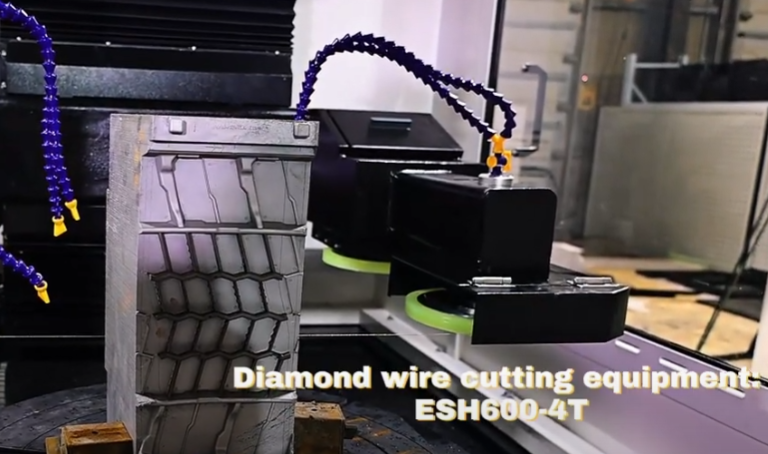
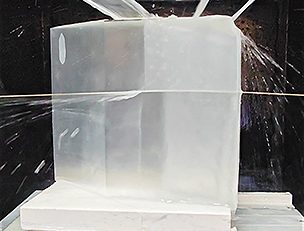
Una máquina de corte con sierra de hilo de diamante utiliza un alambre de acero de alta resistencia incrustado con partículas de diamante sintético, funcionando en un bucle continuo a velocidades controladas. Los componentes clave y los pasos del proceso incluyen:
1. Composición del hilo de diamante
– Material del núcleo: Alambre de acero de alto contenido de carbono para resistencia y flexibilidad.
– Grano de diamante: Partículas de diamante sintético (30–100 µm) unidas al alambre mediante electrodeposición o unión con resina.
– Diámetro del alambre: Normalmente 0,1–0,5 mm, dependiendo de la precisión requerida.
2. Mecanismo de corte
– El alambre se mueve a velocidades de 10–60 m/s, con tensión controlada para evitar la deflexión.
– The diamond particles act as micro-cutting tools, gradually eroding the alumina.
– A coolant (water-based or oil-based) is applied to:
– Reduce friction & heat generation
– Flush away debris
– Extend wire life
3. Velocidad de avance & Parámetros de corte
– Optimized feed rate (0.1–5 mm/min) ensures efficient material removal without wire breakage.
– Lower speeds for thicker alumina blocks to minimize chipping.
– Higher speeds for thin wafers to improve productivity
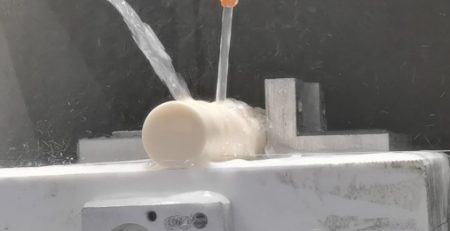
Pantalla de corte:
Advantages of Diamond Wire Saw Cutting for Alumina
Compared to traditional methods, diamond wire sawing offers:
✔ Ultra-Precise Cuts – Kerf widths as narrow as **0.2 mm**, minimizing material waste.
✔ Superior Surface Finish – Ra (aspereza) values below **0.5 µm**, reducing post-processing.
✔ Ability to Cut Complex Shapes – Suitable for curved, angled, or thin-section cuts.
✔ Longer Tool Life – Diamond wire lasts significantly longer than abrasive blades.
Applications in Industry
Diamond wire-cut alumina is used in:
1.Electrónica & Semiconductors
– Alumina substrates for IC packaging
– Insulating components in high-power electronics
2.Óptica & Laser Technology
– Laser tubes & reflectors requiring high thermal stability
– Transparent alumina windows for specialized optics
3.Industrial Ceramics
– Wear-resistant liners for machinery
– High-temperature furnace components
4.Medical & Aeroespacial
– Biocompatible alumina implants
– Lightweight structural components
Key Considerations for Optimal Cutting
To maximize efficiency and cut quality:
Wire Selection – Choose diamond grit size and bond strength based on alumina hardness.
Coolant Management – Proper filtration prevents clogging and extends wire life.
Tension Control – Prevents wire breakage and ensures straight cuts.
Feed Rate Optimization – Balances cutting speed and surface finish
Conclusión
Thediamond wire saw cutting machine is a game-changer for machining alumina, offeringunmatched precision, Pérdida mínima de material, and superior surface integrity. As industries demand tighter tolerances and more complexcerámicocomponents, this technology will remain indispensable for advanced material processing.
For manufacturers and researchers working with alumina, investing in a high-quality diamond wire saw system can significantly improve yield, reducir el desperdicio, and enhance product performance.
Preguntas Frecuentes
¿Cómo cortar cerámica de alúmina sin que se astille??
Use a diamond wire saw with fine grit, una velocidad de alimentación controlada y cobertura completa de refrigerante. La acción de molienda distribuida evita el estrés concentrado que causa virutas.
¿Se puede cortar la alúmina después de la sinterización??
Sí, aunque es mucho más duro y lento. La mayoría de los talleres dan forma en bruto a los cuerpos verdes y solo terminan después de la sinterización.
¿Qué causa el astillamiento de los bordes al cortar alúmina??
Carga mecánica concentrada en la entrada y salida del corte, empeorada por la vibración debido a la tensión inestable del alambre.
¿Es mejor un alambre de diamante que una hoja de diamante para alúmina??
Para precisión y secciones delgadas, sí: kerf más estrecho, menos astillado, y sin desviación de la hoja.
Contenido técnico revisado por el equipo de ingeniería de Ensoll — un fabricante de bucles de hilo de diamante con 10+ años de experiencia en producción.
El silicio monocristalino es la base de las industrias modernas de semiconductores y fotovoltaica. Para transformar lingotes de silicio en obleas funcionales, corte de precisión.. leer más
Puntos clave
La guía de corte con alambre de diamante utiliza un alambre recubierto de diamante enrollado en un lazo sin interrupciones sobre la superficie de la lente, escultura intrincada.... leer más
Abstracto: Esta hoja de referencia enumera la ventana de proceso validada en el PMI de Ensoll
(polimetacrilimida) prueba de corte de espuma estructural en un ESH600-4T horizontal
leer más
Puntos Clave
El corte con sierra de hilo de diamante corta materiales con una sierra de hilo que gira a alta velocidad, offering high precision and high efficiency compared... leer más
Puntos clave
Pruebas controladas sobre 5 vidrio SCHOTT B270 de mm muestran que una sierra de hilo de diamante logra Ra 0.18-0.22 micrómetros frente a Ra... leer más
Puntos clave
SiC y GaN son semiconductores de tercera generación que están transformando la electrónica de potencia, 5G y EV — pero son extremadamente difíciles de.... leer más