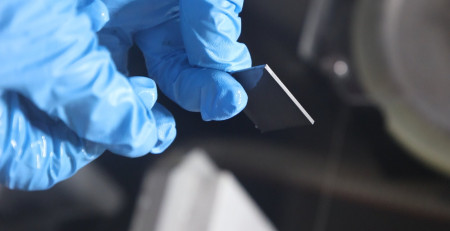
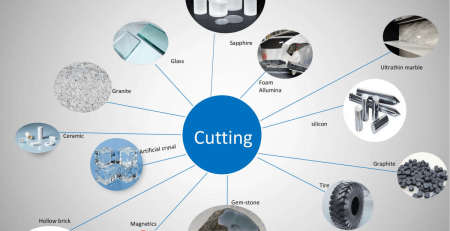
Découpage de précision de résine époxy avec boucle de fil diamanté: 2 Données de test en mm
Sample testing for a European client (Company Q) · Ring diamond wire cutting process
Aperçu
This report documents precision slicing of epoxy resin using a ring diamond wire cutting system. The evaluation covers equipment and wire selection, cutting methodology, paramètres du processus, and the resulting thickness uniformity, la précision dimensionnelle, surface quality and edge integrity of the sliced parts. Test results indicate that a gantry-type ring diamond wire machine, water-based cooling, and appropriately matched process parameters deliver stable, high-precision slicing of epoxy resin.
1. Test Specimen
| Paramètre | Valeur |
|---|---|
| Matériau | Epoxy resin |
| Dureté | approx. 5–6 Mohs |
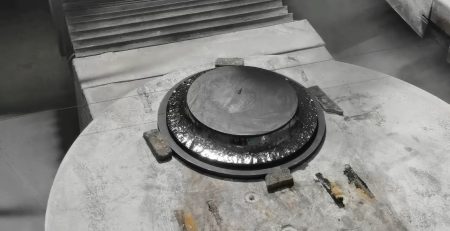
| Dimensions de la pièce | 30.0 mm (L) × Ø20.0 mm |
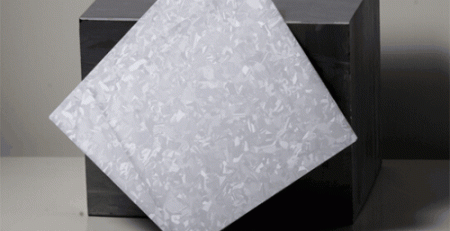
| Target slice dimensions | 2.0 mm (L) × Ø20.0 mm |
2. Sélection de l'équipement et du fil
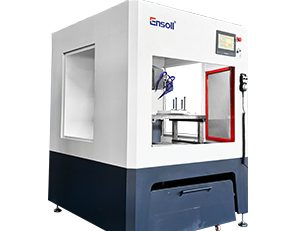
Équipement: ESO-GM. In view of the material characteristics of epoxy resin and the requirement to produce 2 mm thin slices, Ensoll selected the ESO-GM gantry-type ring diamond wire cutting system with a top-down vertical feed. The gantry configuration maintains a stable wire trajectory and slice thickness accuracy, and the machine is equipped with a mist-extraction system.
Liquide de refroidissement: coupe à base d'eau. l'eau est utilisée comme milieu de refroidissement. It continuously cools the contact zone between the diamond wire and the epoxy resin and carries away part of the heat and cutting debris generated during cutting, reducing the effect of localised temperature rise and debris accumulation on the machining condition. Controlled water supply helps maintain a stable cutting zone.
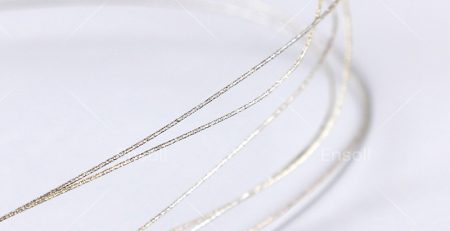
Fil: totalement plaqué. un fil diamant totalement plaqué a été choisi. La construction plaquée améliore la force de liaison entre les grains abrasifs de diamant et le noyau du fil et fournit une répartition plus uniforme des grains, so the wire maintains a consistent grinding capability and material removal behaviour during cutting. This reduces grain pull-out and wire wear. For the 2 mm thin-slice requirement in epoxy resin, stable wire performance is essential to thickness consistency.

3. Méthode de découpe et avantages de l'équipement
Configuration de découpe par portique. La structure du portique offre une grande rigidité globale et une stabilité de fonctionnement. The top-down vertical feed helps keep the diamond wire trajectory stable and reduces the influence of changes in cutting force on slice position and dimensional accuracy in epoxy resin. The machine is equipped with a mist-extraction system that promptly removes mist generated during water-based cutting.
Contrôle intelligent de la tension. Le système ajuste la tension du fil diamant en temps réel en fonction des conditions de coupe et prend en charge à la fois les modes à tension constante et à tension variable, maintenir le fonctionnement stable du fil. Well-matched tension control reduces fluctuation in the wire trajectory and limits localised uneven loading and the risk of wire breakage caused by tension variation, which in turn reduces the occurrence of slice defects.
Mémoire de rupture de fil. Si le fil diamanté se casse ou si la machine s'arrête de manière anormale, le système enregistre automatiquement la position actuelle d'usinage et l'état de fonctionnement associé. Après le remplacement du fil, la coupe reprend à partir de la position enregistrée, ce qui réduit l'écart dimensionnel et la perte de matériau causés par le repositionnement et le usinage répété. This improves the continuity of epoxy resin thin-slice cutting and lowers the risk of repeated cutting.
Châssis en fonte monobloc à haute rigidité. Le cadre en fonte monobloc offre une grande rigidité structurelle et une résistance aux vibrations, réduisant l'effet des vibrations de la machine et de la déformation structurelle sur la trajectoire du fil pendant l'usinage. For the cutting stability and thickness consistency demanded by 2 mm epoxy resin slices, the high-rigidity frame helps damp vibration during the cut and keeps the wire running steadily.
4. Paramètres du processus et méthode de refroidissement
| Paramètre | Valeur |
|---|---|
| Diamètre du fil (mm) | 0.35 × 1978 |
| Vitesse de déplacement du fil (mm/min) | 8 |
| Largeur de coupe (mm) | 20 |
| Tension du fil (N) | 80 |
| Vitesse du fil (m/s) | 21 |
| Temps de flexion du fil (s) | 60 |

5. Performance de coupe et résultats

5.1 Données de test TTV (Unité: mm)
Variation totale de l’épaisseur (TTV) a été mesuré à l'aide d'une grille à neuf points, Méthode de mesure d'épaisseur à double sonde sur une plate-forme à mandrin sous vide. The measurement was applied to epoxy resin slices produced by ring diamond wire cutting. Avant la mesure, l'instrument a été thermiquement stabilisé et calibré par rapport à un bloc d'épaisseur standard. L'épaisseur nominale de la coupe était 2.000 mm.
| Échantillon | Lectures d'épaisseur en neuf points | Tmax | Tmin | TTV |
|---|---|---|---|---|
| S01 | 1.994, 1.997, 2.000 1.996, 2.001, 2.004 1.998, 2.005, 2.008 |
2.008 | 1.994 | 0.014 |
| S02 | 1.990, 1.994, 1.998 1.995, 2.000, 2.003 1.997, 2.004, 2.007 |
2.007 | 1.990 | 0.017 |
| S03 | 1.986, 1.991, 1.995 1.993, 1.998, 2.002 1.996, 2.003, 2.009 |
2.009 | 1.986 | 0.023 |
| S04 | 1.995, 1.998, 2.001 1.997, 2.002, 2.005 1.999, 2.006, 2.010 |
2.010 | 1.995 | 0.015 |
| S05 | 1.992, 1.996, 1.999 1.994, 2.000, 2.004 1.998, 2.005, 2.009 |
2.009 | 1.992 | 0.017 |
| S06 | 1.988, 1.993, 1.997 1.994, 1.999, 2.003 1.996, 2.004, 2.008 |
2.008 | 1.988 | 0.020 |
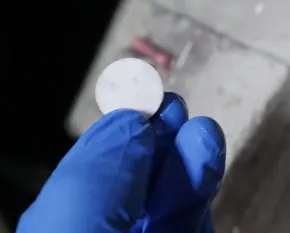
Évaluation. Nine-point grid measurement was applied to six epoxy resin slices. Les valeurs de TTV étaient 0.014, 0.017, 0.023, 0.015, 0.017 et 0.020 mm, spanning 0.014–0.023 mm across the batch, avec une TTV moyenne d'environ 0.018 mm on a 2.000 épaisseur nominale en mm. The results confirm good thickness uniformity in epoxy resin slicing.
5.2 Données de tolérance d'épaisseur (Unité: mm)
La tolérance d'épaisseur a été dérivée à partir des données d'épaisseur à neuf points, en utilisant 2.000 mm comme épaisseur nominale. The positive and negative thickness deviation were calculated at each measurement position and the results from all six samples were aggregated. La déviation positive maximale, maximum negative deviation and overall deviation range were determined to evaluate thickness consistency.
| Échantillon | Épaisseur moyenne | Déviation d'épaisseur |
|---|---|---|
| S01 | 2.000 | 0.000 |
| S02 | 1.999 | −0,001 |
| S03 | 1.997 | −0,003 |
| S04 | 2.001 | +0.001 |
| S05 | 2.000 | 0.000 |
| S06 | 1.998 | −0,002 |
| Écart positif maximal | — | +0.010 mm |
| Écart négatif maximal | — | −0.014 mm |
| Bande de tolérance d'épaisseur | — | ±0.012 mm |
Évaluation. Pour une épaisseur nominale de 2.000 mm, the six slices showed mean thicknesses of 1.997–2.001 mm, with the batch average close to nominal. Over all measurement points the thickness deviation ranged from −0.014 mm to +0.010 mm, avec une déviation absolue maximale de 0.014 mm.
5.3 Données de rugosité de surface Ra (Unité: μm)
Rugosité de surface (Ra) was measured by stylus profilometry on the epoxy resin slices after ring diamond wire cutting. Des positions de mesure représentatives ont été prises au centre et sur les deux côtés le long de la face de coupe, Les données de profil de surface ont été acquises avec un profilomètre à stylet, et le paramètre de rugosité Ra a été enregistré à chaque position.
| Échantillon | Centre | Milieu-gauche | Milieu-droit | Ra moyen |
|---|---|---|---|---|
| S01 | 0.62 | 0.68 | 0.65 | 0.65 |
| S02 | 0.58 | 0.63 | 0.60 | 0.60 |
| S03 | 0.72 | 0.78 | 0.75 | 0.75 |
| S04 | 0.55 | 0.61 | 0.58 | 0.58 |
| S05 | 0.65 | 0.70 | 0.67 | 0.67 |
| S06 | 0.60 | 0.66 | 0.63 | 0.63 |
Évaluation. Mean Ra across the six samples ranged from 0.58 À 0.75 μm, avec toutes les lectures individuelles comprises entre 0.55 et 0.78 μm. La faible dispersion observée sur les trois positions de mesure de chaque tranche indique une finition de surface uniforme le long de la face coupée.
5.4 Données sur l’ébréchure des bords (Unité: μm)
L'éclatement des bords a été quantifié par imagerie optique sur un microscope d'outilleur. Les bords des échantillons ont été nettoyés avant la mesure et le grossissement ainsi que l'échelle de mesure de l'instrument ont été étalonnés. Le bord de la tranche a ensuite été examiné au microscope, Les défauts d'éclats identifiables ont été localisés et mesurés à quatre points par échantillon, et la valeur maximale a été retenue.
| Échantillon | Point 1 | Point 2 | Point 3 | Point 4 | Max. les éclats |
|---|---|---|---|---|---|
| S01 | 4.2 | 4.8 | 5.3 | 4.6 | 5.3 |
| S02 | 3.8 | 4.5 | 4.9 | 4.2 | 4.9 |
| S03 | 5.6 | 6.3 | 7.2 | 6.5 | 7.2 |
| S04 | 3.5 | 4.1 | 4.6 | 3.9 | 4.6 |
| S05 | 4.8 | 5.4 | 6.1 | 5.2 | 6.1 |
| S06 | 4.3 | 5.0 | 5.6 | 4.7 | 5.6 |
Évaluation. Toolmaker’s microscope inspection of the six epoxy resin slices gave maximum chipping values of 5.3, 4.9, 7.2, 4.6, 6.1 et 5.6 μm, avec un maximum global de 7.2 μm. S04 showed the best edge integrity, and S03 the largest chipping at 7.2 μm.
6. Conclusion
The good results obtained in this high-precision slicing trial of epoxy resin stemmed mainly from the combined effect of a purpose-built cutting machine, the cooling method, et des paramètres de processus correctement adaptés. Epoxy resin is a polymer material, and its machining behaviour depends on the resin formulation and cure state. During ring diamond wire cutting the material is acted on continuously by the abrasive grains, and cutting load, wire condition and process parameters together govern the quality of the slice.
Équipement. An ESO-GM ring diamond wire cutting system was used. The machine provides good overall structural rigidity and running stability and gives reliable mechanical support for workpiece clamping and continuous wire travel. Coordinated control of the feed mechanism and wire running condition keeps the diamond wire on the programmed path throughout the cut.
Refroidissement. Water-based cutting was adopted. Continuous grinding generates friction heat in the cutting zone, and localised temperature rise can affect the machining state of the material. Continuous water supply cools the contact area between the wire and the workpiece, carries away part of the cutting debris, and reduces the effect of localised heat accumulation on the material surface.
Les paramètres du processus. Vitesse du fil, feed rate and other key parameters were matched to the properties of epoxy resin and to the target slice thickness. Les paramètres ont été réglés pour maintenir un déplacement stable du fil et un enlèvement de matière continu, avoiding feed rates high enough to raise localised cutting load, or a parameter mismatch that would degrade slice quality.
Dans l'ensemble. Taken together with slice dimensional accuracy, tolérance d'épaisseur, Rugosité (Ra) and cut-edge quality, the combination of the ESO-GM ring diamond wire machine, water-based cutting and appropriately matched process parameters provides stable material removal and effective slice quality control for epoxy resin.