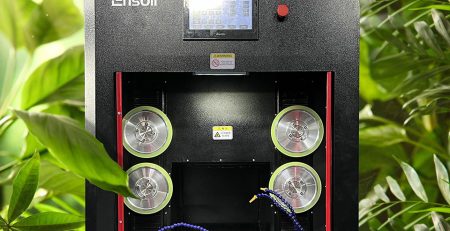
Parametri di taglio della schiuma PMI: Riferimento per la regolazione del loop del filo diamantato
Astratto: This reference sheet lists the process window validated in Ensoll’s PMI
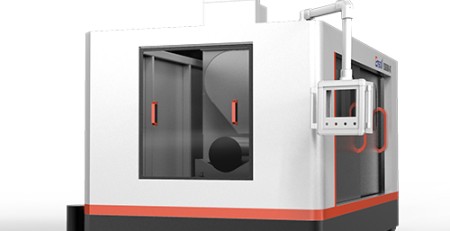
(polimetacrilimmide) structural foam slicing test on an ESH600-4T horizontal
macchina segatrice a filo diamantato dedicata: un 0.60 x 3460 mm fully coated
anello di filo diamantato, 100 mm/min wire travel speed, 145 tensione del filo N, 25 velocità del filo m/s,
60 s wire-bow tensioning time, 17 N·m cutting load and 400 larghezza di taglio mm, with dry cutting. It explains
what each parameter does on a cellular foam, which way to move it when a defect appears, and how to establish a
starting set for a new foam grade or slice thickness.
Punti Chiave
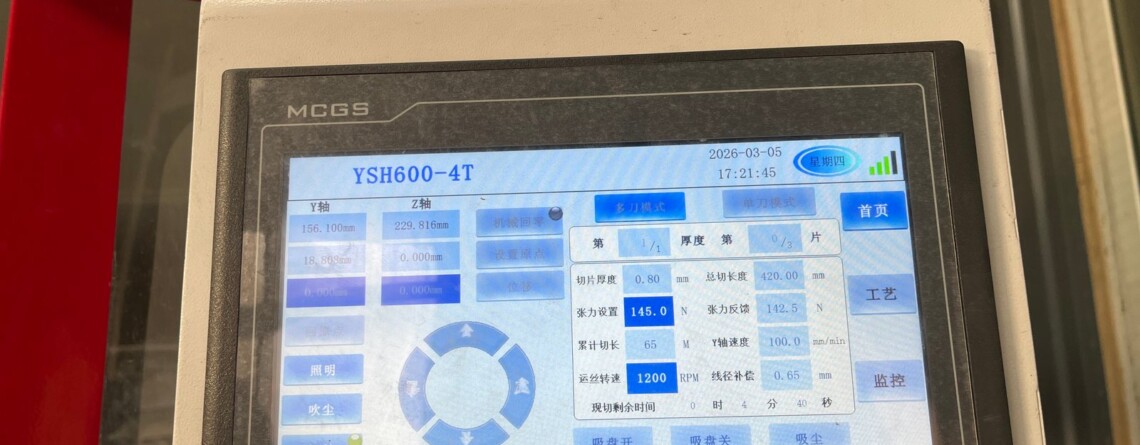
- Validated window for 0.8 mm PMI foam slices on an ESH600-4T: 0.60 x 3460 mm fully coated wire loop, 100 alimentazione mm/min, 400 larghezza di taglio mm, 145 tensione N, 25 velocità del filo m/s, 60 s wire-bow time, 17 N·m load, dry cutting.
- PMI foam fails by compression and tearing of the cell skeleton, not by brittle fracture, so feed rate – the load-setting parameter – is the first thing to reduce when a defect appears.
- Dry cutting is the default for PMI foam: coolant would enter the cells and would have to be cleaned and dried out afterwards.
- The load readout is a monitor, not a setting; a rising load trace during a cut is the earliest warning that a parameter has drifted out of band.
- This window produced TTV 0.013-0.050 millimetro (mean 0.036 millimetro), thickness tolerance +/-0.043 millimetro, average Ra 0.68-0.82 um and maximum chipping 5.5-7.1 um.
Why PMI Foam Needs Its Own Parameter Set
PMI foam is a low-density structural foam with a uniform cellular structure and good specific strength and
specific stiffness. Under a diamond wire it does not behave like a dense material: the abrasive grains act on the
foam skeleton, and the failure mode at excessive load is compression and tearing of the cells rather than clean
shearing. That is why parameters that work on a dense thermoplastic cannot simply be copied across. Il
validated PMI window below was established by matching machine structure, filo, cutting method and parameters to
the cellular structure of the material.
Validated Parameter Window for 0.8 mm PMI Foam Slices
| Parametro | Valore |
|---|---|
| Wire diameter x loop length (millimetro) | 0.60 x 3460 |
| Wire travel speed / velocità di avanzamento (mm/min) | 100 |
| Larghezza di taglio (millimetro) | 400 |
| Tensione del filo (N) | 145 |
| Velocità del filo (m/s) | 25 |
| Tempo di tensionamento del filo-arco (s) | 60 |
| Carico di taglio (N·m) | 17 |
| Cooling method | Dry cutting |
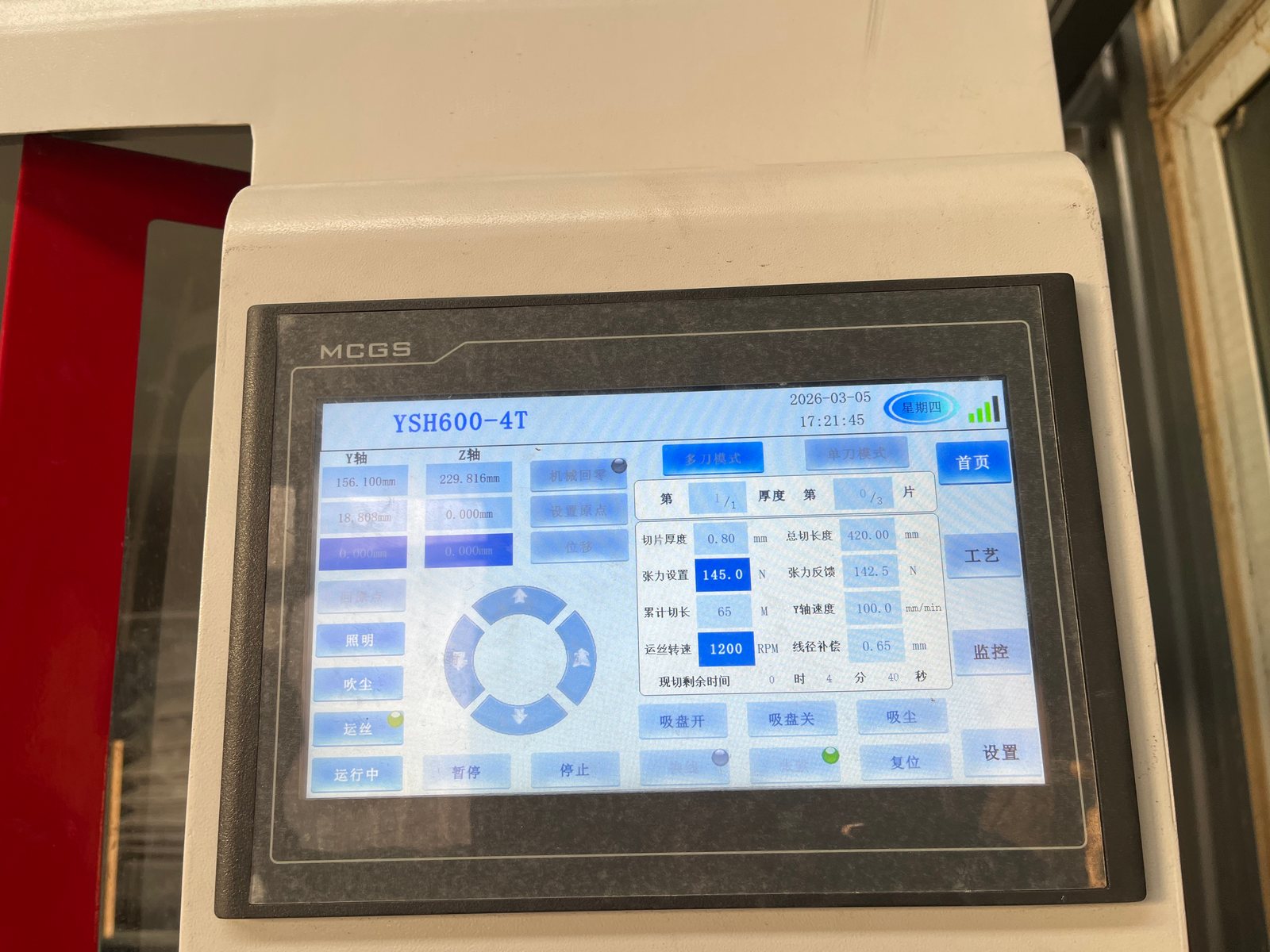
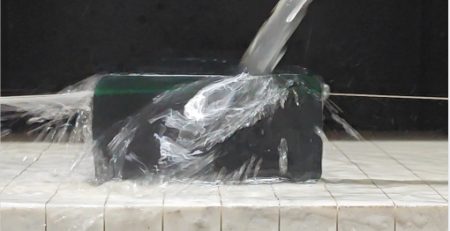
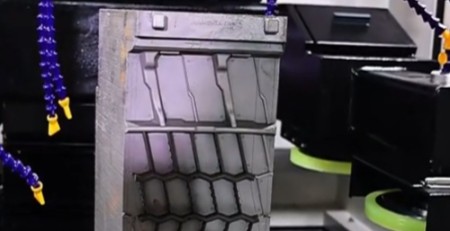
PMI foam slicing test
Workpiece conditions for this window: PMI foam at approximately MH 2 durezza, workpiece
400 mm x 400 mm x 50 millimetro, target slice 400 mm x 400 mm x 0.8 millimetro.
What Each Parameter Does
Wire diameter and loop length (0.60 x 3460 millimetro)
The wire diameter sets the kerf and the stiffness of the cutting edge. UN 0.60 mm fully coated wire loop gives a
stable abrasive edge for a 400 mm wide cut while keeping the kerf small. Loop length must match the machine’s
pulley geometry and is fixed by the machine model rather than chosen per job.
Wire travel speed / velocità di avanzamento (100 mm/min)
This is the parameter that governs cutting load most directly, and on foam it is the first one to reduce when a
defect appears. Feed too high and the skeleton takes a large local force; feed too low and the wire polishes
rather than cuts, which raises heat and wear without improving quality. 100 mm/min is the validated value for
0.8 mm slices.
Larghezza di taglio (400 millimetro)
The cutting width is the length of wire in contact with the workpiece. It scales the total load and therefore
the machine rigidity and tensioning required. UN 400 mm contact length on a lightweight foam also raises the risk
of the workpiece moving, which is why the fixture and workpiece support matter as much as the numbers.
Tensione del filo (145 N)
Tension keeps the wire straight under load. Too low and the wire bows, so kerf width wanders and the cut face
becomes uneven; too high and the wire and pulleys wear faster and break risk rises. The ESH600-4T uses spring
tensioning with force-sensor feedback, so tension can be held constant or varied with the cutting state, and is
reduced automatically in standby and during wire changes to limit wire fatigue.
Velocità del filo (25 m/s)
Wire speed sets how many abrasive grains pass the interface per second. On a low-density foam the removal rate
is limited by load rather than by abrasive delivery, so raising wire speed alone does not fix a poor cut – it
mostly adds wear. Keep it in the validated band and manage quality through feed and tension.
Tempo di tensionamento del filo-arco (60 s)
The tensioning time lets the wire settle into a stable bow before the cut starts. Skipping it leaves the first
millimetres of the cut under different conditions from the rest, which shows up as a thickness step at the entry
edge of a thin slice.
Carico di taglio (17 N·m)
The load reading is the process monitor rather than a setting: it is what you watch to confirm that the
combination of feed, tension and wire speed is actually delivering a stable cut. A drifting or rising load during
a cut is the earliest warning that a parameter has moved out of band.
Adjustment Guide: Symptom, Causa, Action
| Symptom | Most likely cause | Action |
|---|---|---|
| Ragged or torn slice edge | Cutting load too high for a cellular foam | Reduce feed rate; verify wire tension before changing wire speed |
| Uneven cut face, wandering kerf | Wire bowing – tension too low | Raise tension toward 145 N and confirm the bow settles before entry |
| Thickness step at the entry edge | Cut started before the wire bow settled | Keep the full 60 s wire-bow tensioning time before feed engages |
| Slices consistently thin or thick | Dimensional offset, not instability | Apply thickness compensation on the machine target; do not fight it with feed |
| Load trace rising during a cut | Parameter drift or wire wear | Stop, check wire condition and load, re-establish the validated window |
| Surface polished rather than cut | Feed rate too low for the wire speed | Raise feed within the validated band; check grain condition on the wire |
Establishing a Parameter Set for a New Foam or Thickness
The validated window is a starting point, not a universal answer. PMI grades differ in density and cell size,
and slice thickness changes the stiffness of the part being cut. Work in this order:
- Fix the fixture first. Support the workpiece across its full area so that the wire cannot
push it. On foam, deflection of the workpiece reads as thickness variation and is easily mistaken for a
parameter problem. - Start from the validated window. 0.60 x 3460 filo mm, 100 alimentazione mm/min, 145 tensione N,
25 velocità del filo m/s, dry cutting. - Cut one slice and measure TTV. Use the same nine-point grid method described in our
TTV measurement guide so results are comparable with the reference data. - Move one parameter at a time. Feed rate first, then tension. Change wire speed only if feed
and tension are already at their limits. - Record the load curve. A stable load trace at the chosen settings is the evidence that the
processo, not the operator, is controlling the cut.
Results Achieved with This Window
| Measure | Result across four 0.8 mm slices |
|---|---|
| La variazione totale di spessore (TTV) | 0.013-0.050 millimetro, media 0.036 millimetro |
| Tolleranza dello spessore | +/-0.043 mm against 0.800 mm nominal |
| Average surface roughness Ra | 0.68-0.82 um |
| Maximum edge chipping | 5.5-7.1 um |
The thickness data showed a systematic negative offset rather than random scatter – the slices ran thin by
0.031 A 0.043 mm contro uno 0.800 mm nominal. That is a dimensional-compensation problem, not a stability
problem, and is corrected by adjusting the machine target thickness on the next run. The full measurement set
including all nine-point readings is published in the
PMI foam precision slicing test report.
Related Process Data
The same nine-point methodology applied to a dense thermoplastic, with cutting fluid instead of dry cutting,
is documented in the PEEK precision slicing test. A side-by-side comparison of the two
materials and their parameter sets is in
PEEK vs PMI foam: diamond wire cutting comparison.
Domande Frequenti
What cutting parameters were used to slice PMI foam to 0.8 millimetro?
Filo 0.60 x 3460 millimetro, wire travel speed (velocità di avanzamento) 100 mm/min, cutting width 400 millimetro, wire tension 145 N, wire speed 25 m/s, wire-bow tensioning time 60 s and cutting load 17 N·m, on an ESH600-4T horizontal macchina segatrice a filo diamantato dedicata using dry cutting and a fully coated wire.
Should PMI foam be cut dry or wet?
Secco. PMI foam is porous, lightweight and prone to absorbing liquids. Dry cutting keeps coolant out of the cells and removes the cleaning and drying steps that follow a wet cut, which helps preserve structural integrity and slice dimensional accuracy. This is the opposite of a dense thermoplastic such as PEEK, which is cut with continuous cutting fluid.
What wire type is used for PMI foam?
A fully coated diamond wire loop. The fully coated build raises grain bonding strength and distribution stability, sustaining continuous cutting capability and reducing the fluctuation caused by wire wear and grain pull-out. See the diamond wire loop product range.
What results did this parameter set achieve?
Four 400 mm x 400 mm PMI foam slices at 0.8 mm nominal thickness gave TTV 0.013-0.050 millimetro (media 0.036 millimetro), thickness tolerance +/-0.043 millimetro, average Ra 0.68-0.82 um and maximum edge chipping 5.5-7.1 um. Full data is in the PMI foam slicing test report.
What is the first setting to change if the PMI foam edge tears?
Reduce the feed rate. Tearing, local compression and an uneven cut face on a cellular foam are load-driven problems, not speed-driven ones: excessive load compresses the foam skeleton instead of shearing it. Lower the feed first, then re-check wire tension before touching wire speed.
Contenuto tecnico revisionato dal team di ingegneria Ensoll – un produttore di anelli da taglio con filo diamantato 10+ anni di esperienza produttiva.