Annular Diamond Wire Saw for Cutting Ceramics
- Hard-and-brittle material cutting suffers from low efficiency, low material yield, poor surface integrity, high tool cost and pollution; thick circular saw blades waste material in wide kerfs, and free-abrasive wire saws contaminate with diamond slurry.
- Wire saws are classified by abrasive type (free vs bonded) and motion (reciprocating vs unidirectional); reciprocating multi-wire free-abrasive saws still dominate semiconductors and optoelectronics.
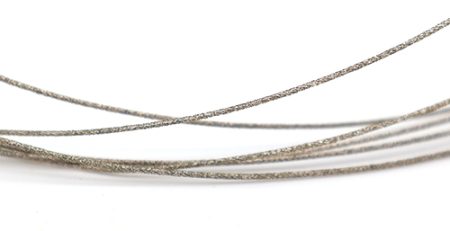
- The bonded-abrasive unidirectional annular (ループ) diamond wire saw fixes diamond grains on the wire, enabling simple machine structure, high-speed one-direction wire movement and shaped cutting.
- Four documented advantages: narrow kerf and high yield (0.175-0.180 mm wires from Sumitomo Electric and Lid, 0.19 mm actual kerf in sodium glass); faster cutting because fixed abrasive needs no slurry entry; smooth gentle cutting without reciprocating grooves; and minimal pollution with water coolant or even dry cutting.
- Open research gaps remain in wire manufacturing, cutting mechanisms, wire failure modes, and posture and motion control for precision shaping cuts.
現在は, 硬くて脆い材料の鋸引きおよび切断プロセスは、処理効率の低さなどの問題に悩まされています, low material yield, poor surface quality and integrity, high tool costs, and environmental pollution. When using circular saws to cut materials like stone and 陶芸, the saw blades need to possess a certain thickness to ensure rigidity. This results in wide kerfs, low material yield, and significant pollution. かつ, circular saws are unable to perform shaped surface machining, leading to inferior surface quality when cutting ceramic materials. In the semiconductor industry, the use of free abrasive wire cutting methods to process silicon crystals results in significant surface and environmental contamination by diamond abrasive slurry, thereby increasing the costs associated with subsequent processing and waste treatment.

(1) Narrow kerf, high material yield. By using high-strength steel wire as the base material, various wire saws with diameters below 1mm can be produced. Companies like Sumitomo Electric Industries and Lid in Japan have manufactured wire saws with average diameters ranging from 0.175 to 0.180mm using steel wires with diameters of 0.130 and 0.155mm as the base material, achieving an actual kerf loss of 0.19mm in sodium glass cutting experiments.
(2) Fast cutting speed, 高効率. The bonded abrasive annular diamond wire saw features unidirectional movement of the wire saw during the cutting process, with the abrasive grains fixed on the wire saw, eliminating the difficulty of abrasive entry into long and deep kerfs. Compared to reciprocating structures and wire saws using free abrasives, it is easier to achieve higher cutting speeds, resulting in high processing efficiency.
(3) Smooth cutting process, good slice surface quality. During the cutting process with a diamond wire saw, the cutting force is small and gentle, without the unique grooves generated on the workpiece surface due to reciprocating wire saw movement.
(4) Minimal environmental pollution. Bonded abrasive diamond wire saws typically use water as the standard coolant, and dry cutting methods can even be employed at lower wire speeds. This results in low or no need for wastewater treatment due to the use of bonded abrasives.

Annular saws suit certain shapes; for flat precision work the reference is precision cutting of alumina.
よくある質問
What is an annular diamond wire saw?
It is a bonded-abrasive wire saw in which diamond grains are fixed on a wire loop that moves unidirectionally at high speed. The simple structure allows high wire speeds and shaped cutting of hard, brittle materials such as ceramics — an alternative to reciprocating free-abrasive wire saws.
What advantages does a bonded-abrasive wire saw have over free-abrasive sawing?
Because the diamond grains are fixed on the wire, there is no abrasive slurry that must enter long, deep kerfs, so higher cutting speeds are achievable. It also produces a narrow kerf with high material yield, a smooth cut surface without reciprocating grooves, and far less contamination.
How narrow is the kerf of a diamond wire saw?
Manufacturers such as Sumitomo Electric Industries and Lid in Japan have produced wire saws averaging 0.175-0.180 mm in diameter on steel cores of 0.130-0.155 ミリメートル, achieving an actual kerf loss of about 0.19 mm in sodium glass cutting experiments.
Is diamond wire sawing environmentally friendly?
Relatively yes. Bonded-abrasive diamond wire saws typically use plain water as coolant, and dry cutting is even possible at lower wire speeds. With no free-abrasive slurry, there is little or no wastewater treatment required — a major contrast with slurry-based silicon wafering.
Ensollエンジニアリングチームによるレビュー.