光学ガラス切断: ダイヤモンドワイヤーソー対レーザー
光学ガラス加工は、航空宇宙、フォトニクス、消費者向け電子機器などの産業の要求を満たすためにサブミクロン精度を必要とします, フォトニクス, および消費者向け電子機器. With エンドレスダイヤモンドワイヤーソー and laser cutting emerging as dominant technologies, manufacturers face a critical choice. This guide analyzes both methods across 7 key parameters to help you make data-driven decisions.
- Diamond wire saw cutting removes material by diamond grit abrasion (wire 0.1-0.3 ミリメートル, 5-30 メートル/秒) and holds +/-0.02-0.03 mm tolerance; laser cutting vaporizes material and typically holds +/-0.05 ミリメートル.
- Cut quality favors the wire: under 10 micrometers edge chipping and Ra 0.2-0.5 micrometers, versus a 20-50 micrometer heat-affected zone and Ra 0.5-2 micrometers for laser.
- Efficiency favors the laser: 40-60 wafers/hour with 5-10 minute setup versus 20-30 wafers/hour and 15-30 minutes for the wire saw — but laser kerf is narrower at 0.05-0.1 mm versus 0.15-0.3 ミリメートル.
- Cost profile: wire saw $50K-150K investment with $0.10/meter consumables and low maintenance; laser $100K-300K with $20/hour gas assist and higher optics maintenance.
- Rule of thumb: wire saw for glass thicker than 3 ミリメートル, optical-grade edges below Ra 0.5 micrometers and heat-sensitive coatings; laser for thin-glass prototyping and complex contours.

1. Endless Diamond Wire Saw Cutting
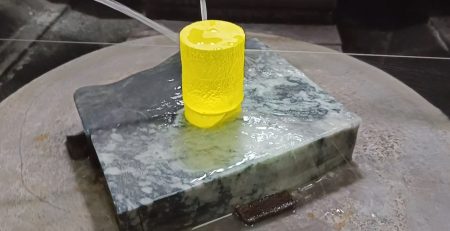
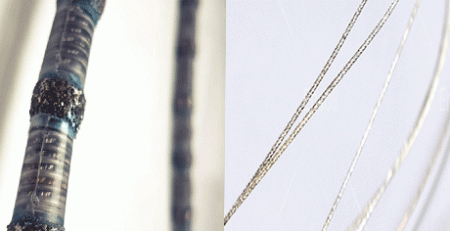
A closed-loop system using a diamond-coated wire (typically 0.1-0.3mm diameter) running at 5-30 メートル/秒. The abrasive action provides:
– Material Removal Mechanism: Micro-chipping through diamond grit abrasion
– Typical Tolerance: ±0.03mm for standard cuts, ±0.02mm with advanced controls
– Best Suited For: Thick 光学ガラス (>1ミリメートル), curved cuts, and brittle materials like SCHOTT B270 .
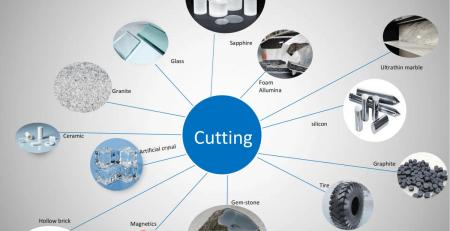
カッティングディスプレイ:
2. レーザー切断
A non-contact method using focused laser beams (usually CO₂ or ultrafast lasers):
– Material Removal Mechanism: Vaporization/melting through localized heating
– Typical Tolerance: ±0.05mm for standard systems
– Best Suited For: Thin glass (<3ミリメートル), complex geometries, and rapid prototyping
Head-to-Head Comparison
1. Cutting Quality
| Parameter | エンドレスダイヤモンドワイヤーソー | レーザー切断 |
| エッジチッピング | <10µm with optimized feed rate | 20-50µm thermal affected zone |
| Surface Roughness | Ra 0.2-0.5µm | Ra 0.5-2µm |
| Subsurface Damage | Minimal micro-cracks | Potential micro-fractures |
Key Insight: For camera lenses and prisms requiring optical-grade finishes, wire saws provide superior edge integrity.
2. Material Versatility
– Wire Saws handle:
– High-hardness glasses (例えば。, Corning Gorilla Glass 3)
– 複合材料 (glass-ceramics like Zerodur)
– Temperature-sensitive coatings
– Lasers struggle with:
– Thick borosilicate (>5ミリメートル) due to heat accumulation
– UV-transmitting glasses prone to thermal stress
- Production Efficiency
| Metric | Wire Saw (300mm/s) | レーザー (500mm/s) |
| Throughput | 20-30 wafers/hour | 40-60 wafers/hour |
| Setup Time | 15-30 minutes | 5-10 minutes |
| Kerf Width | 0.15-0.3ミリメートル | 0.05-0.1ミリメートル |
Trade-off: Lasers offer faster processing but waste more material through wider kerf.
5 Decision-Making Factors
1. Part Thickness
– Choose Wire Saw If:
切断 >3mm optical glass (例えば。, telescope mirrors)
Keyword Tip: “thick 光学ガラス切断 solution”
2. Tolerance Requirements
Wire saws maintain tighter tolerances for:
– Prism angle control (±15 arcseconds)
– Wafer-level optics uniformity
3. Cost Considerations
| Cost Factor | Wire Saw | レーザー |
| Initial Investment | $50K-$150K | $100K-$300K |
| Consumables | $0.10/meter diamond wire | $20/hour gas assist |
| Maintenance | Lower (mechanical parts) | Higher (optics cleaning) |
- Thermal Sensitivity
Laser cutting risks:
– Stress birefringence in polarizing elements
– Annealing point distortion in phosphate glasses
5. Post-Processing Needs
Wire-sawn parts often require:
– 25% less polishing time vs. laser-cut surfaces
– No stress relief annealing
結論: When to Select Each Method
Opt for Endless Diamond Wire Saw When:
✓ Cutting thickness >3ミリメートル
✓ Needing optical-grade edges (Ra<0.5µm)
✓ Processing heat-sensitive coatings
Choose Laser Cutting When:
✓ Rapid prototyping of thin glass
✓ Complex contours with <0.1mm kerf
✓ Budget allows for higher operational costs
Pro Tip: Request sample cuts from suppliers—compare edge quality under 200x microscopy to validate claims.
よくある質問
Should I choose a diamond wire saw or laser for optical glass cutting?
Choose the wire saw when cutting glass thicker than 3 ミリメートル, when you need optical-grade edges (Ra below 0.5 micrometers), or when processing heat-sensitive coatings and hard glasses like Corning Gorilla Glass 3. Choose laser for rapid prototyping of thin glass under 3 mm and complex contours needing a kerf below 0.1 ミリメートル.
Does laser cutting damage optical glass?
It can. The localized heating creates a 20-50 micrometer thermal affected zone, risks micro-fractures below the surface, and can cause stress birefringence in polarizing elements or annealing-point distortion in phosphate glasses. Wire saw cutting is a cold abrasive process and avoids these thermal risks.
Which method costs more, wire saw or laser?
Laser costs more on both fronts: $100K-300K initial investment versus $50K-150K for a wire saw, plus about $20 per hour in gas assist versus roughly $0.10 per meter of diamond wire. Laser systems also demand more maintenance, mainly optics cleaning.
Which method is more precise?
The diamond wire saw: +/-0.03 mm standard and +/-0.02 mm with advanced controls, versus +/-0.05 mm for standard laser systems. Wire saws also hold prism angle control within +/-15 arcseconds, which is why they dominate prisms and wafer-level optics.
Ensollエンジニアリングチームによるレビュー.