Fatiamento de Precisão de Tubos Metálicos: Laço de fio diamantado
Sample test for a European customer · Diamond wire loop cutting process
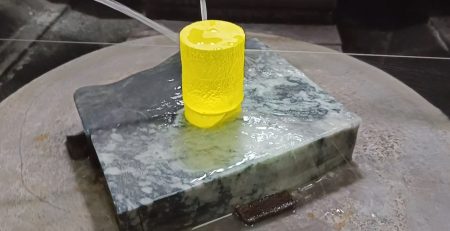
- Thin-wall metal tubes were precision-sliced with a fine diamond wire loop, producing burr-free edges.
- The process avoids the heat-affected zones of laser cutting and the deformation of blade cutting. The same trade-off is quantified on a brittle semiconductor in our comparison of corte a laser vs serra de fio de diamante.
- Full cutting parameters, TTV data, and surface photos are included for engineering reference.
Visão geral
The workpiece in this test was a metal tube sample supplied by a European customer (Company E), who required high-precision straight slicing. Metal tubes are axially continuous, hollow-section, thin-walled structures. Under the combined action of cutting force, clamping stress and thermal effects, they are prone to wall deformation, irregular cut surfaces and edge burrs, which places high demands on process stability and dimensional control.
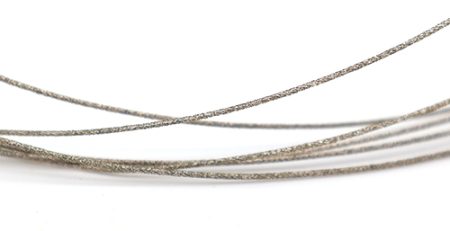
The cut itself is made by a Loop de fio de diamante, whose low, constant force is what keeps a thin wall from collapsing under the wire.
Shops comparing equipment for this kind of work can find more detail in our guide to choosing a serrote de cabo para metal, which covers wire diameter, cutting speed and coolant selection.
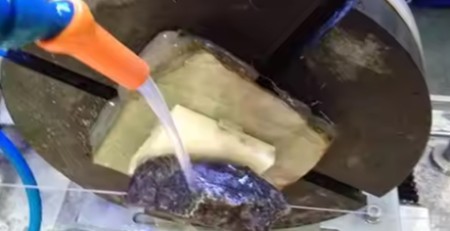
To address the issues of insufficient structural stiffness, cutting deformation and difficult surface-quality control during precision metal tube slicing, Ensoll developed a processing solution based on tecnologia de corte com laço de fio diamantado: foi utilizada uma serra de fio de diamante em laço ESO-GM matched to the characteristics of metal tube machining, a diamond wire specifically engineered for metallic materials, and cutting oil as the cooling/lubrication medium to reduce temperature rise in the cutting zone, improve lubrication and chip evacuation at the wire–workpiece interface, and minimise thermal and mechanical effects on the tube wall. Ao mesmo tempo, by optimising the diamond wire loop running speed and cutting parameters, stable material removal and precise control were achieved. Through the synergistic optimisation of machine, consumables and process parameters, precisão dimensional, cut-surface quality and processing consistency were significantly improved, providing effective technical support for high-quality cutting of precision metal tubes.
For a wider view of equipment classes, see our guide to the máquina de corte de serra de arame diamantado.
1. Workpiece Information
- Material: Metal tube
- Dureza: Approx. 6 (Mohs)
- Dimensões da peça de trabalho: 200 mm × 18 mm × 15.5 mm
- Target slice size: 3 mm × 18 mm × 15.5 mm
2. Seleção de Máquina e Fio
Máquina: serra de fio de diamante em laço ESO-GM. Given the hollow structure of the metal tube and the need for high-precision straight slicing, Ensoll selected the ESO-GM, a machine purpose-built for metal tube machining. Its high structural rigidity and stable running performance guarantee trajectory accuracy during cutting, reduce dimensional deviations caused by vibration and force fluctuations, and improve both slice accuracy and cut-surface quality.
Cutting fluid: Óleo de corte. Used as the cooling and lubrication medium, cutting oil improves lubrication and heat dissipation in the cutting zone, reduces friction and heat build-up at the contact interface between the diamond wire and the tube wall, and lessens the effect of cutting heat on the tube wall and cut surface. This helps control dimensional deviation and edge defects, improving the stability and surface quality of the sliced metal tubes.
Fio: Fully coated diamond wire. The fully coated type strengthens the bond between diamond grains and the wire substrate and stabilises grain distribution, ensuring sustained, stable cutting capability throughout the process. It reduces wire wear and cutting-state fluctuations, helping to control dimensional deviation and cut-surface quality while improving processing stability and slice consistency.

3. Método de Corte e Vantagens da Máquina
Estrutura de corte de pórtico: The gantry structure offers high overall rigidity and running stability. The top-down vertical feed helps maintain a stable diamond wire trajectory and reduces the influence of force variation on cut position and dimensional accuracy. The machine is also equipped with a mist-extraction system that removes oil mist generated during cutting in real time, keeping the machining area clean.
Sistema inteligente de controlo de tensão: The system adjusts diamond wire tension in real time according to machining status and supports both constant and variable tension modes, keeping the wire stable during cutting. This reduces trajectory drift and wire-breakage risk caused by tension fluctuations and improves dimensional consistency and machining continuity.
Wire-break memory function: When a wire break or unexpected machine stop occurs, the system automatically records the current machining position and operating status. Após a substituição do fio, machining can resume from the recorded position, reducing dimensional deviation and material loss caused by repeated repositioning, and improving processing continuity.
Estrutura de ferro fundido monobloco de alta rigidez: The monolithic cast-iron frame increases overall machine stiffness and vibration damping, mitigating the effect of structural vibration and deformation on cutting-trajectory stability during long-term operation. This provides a reliable equipment foundation for controlling dimensional accuracy, cut quality and machining stability during precision metal tube slicing.
4. Parâmetros de Corte e Refrigeração
| Parâmetro | Valor |
|---|---|
| Wire spec (milímetro) | 0.35 × 1880 |
| Velocidade de alimentação (mm/min) | 3 |
| Largura de corte (milímetro) | 18 |
| Tensão do fio (N) | 140 |
| Velocidade linear do fio (M) | 24 |
| Tempo de curvatura do fio (s) | 60 |
| Carga de corte (N·m) | 19 |

5. Eficiência de Corte e Resultados
5.1 Dados de teste TTV (unidade: milímetro)
TTV (Variação total da espessura) was measured by a nine-point grid dual-probe thickness gauge on a vacuum chuck. Slices measuring 3 mm (espessura) × 18 mm (comprimento) × 15.5 mm (largura) were used. Antes do teste, the gauge was pre-heated to thermal equilibrium and calibrated with standard thickness blocks. After clean-room cleaning, each sample was centred on the vacuum chuck and held by negative pressure to eliminate warp, tilt or positional shift. Thickness data were collected at the nine prescribed grid points, and TTV was calculated as the difference between the maximum and minimum thickness values to evaluate slice thickness uniformity and processing consistency.
| Amostra | 9-point thickness measurements | Tmax | Tmin | TTV |
|---|---|---|---|---|
| S01 | 3.017, 3.019, 3.021, 3.018, 3.022, 3.025, 3.020, 3.023, 3.024 | 3.025 | 3.017 | 0.008 |
| S02 | 3.024, 3.025, 3.026, 3.025, 3.024, 3.025, 3.026, 3.024, 3.025 | 3.026 | 3.024 | 0.002 |
| S03 | 3.020, 3.022, 3.024, 3.021, 3.023, 3.025, 3.022, 3.024, 3.025 | 3.025 | 3.020 | 0.005 |
Avaliação: The nine-point test on three metal tube slices showed stable thickness distribution. TTV ranged from 0.002 mm to 0.008 mm, with an average of 0.005 mm, indicating good overall thickness consistency. The results demonstrate stable diamond wire loop operation and well-matched cutting parameters, effectively controlling thickness variation during machining and meeting the uniformity requirements for precision metal tube slicing.
5.2 Tolerância Dimensional da Espessura (unidade: milímetro)
Thickness tolerance was evaluated by the nine-point grid method using a nominal thickness of 3.000 mm. The deviation between measured thickness at each point and the nominal value was calculated to assess dimensional consistency.
| Amostra | Espessura média | Desvio da espessura |
|---|---|---|
| S01 | 3.021 | +0.021 |
| S02 | 3.025 | +0.025 |
| S03 | 3.023 | +0.023 |
| Máxima deformação positiva | +0.025 milímetro | |
| Máxima deformação negativa | 0 milímetro | |
| Tolerância de espessura | +0.025 / 0 milímetro | |
Avaliação: The three samples showed average thicknesses of 3.021 mm, 3.025 mm and 3.023 mm, with positive deviations of +0.021, +0.025 and +0.023 mm respectively. All deviations are positive and closely grouped, with a maximum positive deviation of +0.025 mm and no negative deviation, indicating that the batch is slightly thicker than nominal but highly consistent between samples. Internal TTV values of 0.008, 0.002 and 0.005 mm show small thickness variation across measurement positions. Geral, the wall-thickness dimensional control after cutting is stable and exhibits good consistency.

5.3 Surface Roughness Ra (unidade: μm)
Rugosidade da Superfície (Ra) was measured in accordance with ISO 4287 using a stylus profilometer. Three representative positions—centre, left-centre and right-centre—were selected on the cut end face of each metal tube slice to evaluate surface finish and machining quality.
| Amostra | Ra-1 | Ra-2 | Ra-3 | Ra médio |
|---|---|---|---|---|
| S01 | 0.82 | 0.86 | 0.79 | 0.82 |
| S02 | 0.74 | 0.78 | 0.76 | 0.76 |
| S03 | 0.77 | 0.81 | 0.79 | 0.79 |
Avaliação: The three-point test on three slices gave single-point Ra values in the range 0.74–0.86 μm, indicating low overall roughness and good uniformity between samples. Sample S02 achieved the lowest average Ra (0.76 μm), exhibiting the best surface morphology, while S01 showed a slightly higher peak value but still remained within the acceptable range. The data confirm that the diamond wire loop cutting process maintained stable cutting conditions and produced excellent surface integrity, meeting the technical requirements for subsequent precision grinding and assembly of metal parts.
5.4 Chipping Data (unidade: μm)
Chipping was assessed by tool-microscope optical imaging on the edges of 3 mm × 18 mm × 15.5 mm slices. After cleaning the four side edges and calibrating the instrument scale, each edge was scanned microscopically and defect dimensions were recorded.
| Amostra | Posição 1 | Posição 2 | Posição 3 | Posição 4 | Maximum chipping |
|---|---|---|---|---|---|
| S01 | 4.8 | 6.2 | 5.4 | 7.1 | 7.1 |
| S02 | 3.9 | 5.6 | 4.7 | 6.3 | 6.3 |
| S03 | 4.5 | 6.8 | 5.2 | 7.4 | 7.4 |
Avaliação: The four-point test on three slices showed chipping values distributed between 3.9 μm and 7.4 μm, with moderate variation between samples and edge positions. Sample S02 exhibited the smallest maximum chipping (6.3 μm), while S03 showed the largest (7.4 μm). Geral, all chipping values are low, indicating minimal edge damage to the metal substrate during diamond wire loop cutting and good edge integrity with stable edge-machining quality.

6. Conclusão
The successful high-precision slicing of the metal tubes in this test stems from the appropriate matching of dedicated cutting equipment, cooling/lubrication conditions and cutting parameters. Metal tubes have hollow cross-sections and thin walls, making them susceptible to local deformation, desvio dimensional, end-face irregularity and edge burrs under cutting force, clamping stress and cutting heat. To address these structural characteristics and the requirements for high-precision straight slicing, adjustments were made in three areas—machine adaptation, cooling/lubrication and process parameters—ensuring stable cutting while controlling slice dimensions and end-face quality.
Shops standardising on this work should also compare wire diameters and coolant options in our serrote de cabo para metal guia. (link 2 de 2)
First, in terms of machine adaptation, an ESO-GM serra de laço de fio de diamante dedicated to metal tube machining was selected. Its high structural rigidity and running stability provide reliable mechanical conditions for continuous wire operation and stable workpiece cutting, reducing the influence of machine vibration and wire fluctuation on the cutting trajectory. Stable motion control also maintains the relative position between the diamond wire and the tube wall, minimising dimensional variation caused by force changes and providing a stable equipment foundation for high-precision slicing.
Segundo, in terms of cooling and lubrication, cutting oil was used as the cooling/lubrication medium. Because continuous contact between the diamond wire and the tube wall generates frictional heat and the tube wall structure affects heat transfer and dissipation, cutting oil forms a good lubricating film at the contact zone, reducing friction and carrying away some of the cutting heat, thereby lessening thermal accumulation effects on the tube wall and cut surface. Good lubrication also improves grain cutting and chip evacuation conditions, reducing surface quality fluctuations caused by friction and local temperature rise.
Terceiro, in terms of cutting parameters, the diamond wire loop running speed and feed settings were matched to the material properties, wall structure and slice dimensions of the metal tube. Parameter selection was based on ensuring stable diamond wire cutting, avoiding excessive cutting load, local overheating and wall deformation caused by mismatched speed or feed. By adjusting the parameters appropriately, the material removal process remained stable, controlling dimensional deviation and surface defects of the cut section while maintaining machining consistency.
Overall test results—dimensional accuracy, tolerância de espessura, rugosidade superficial (Ra) and edge quality—demonstrate that, with proper matching of equipment, cooling/lubrication and cutting parameters, diamond wire loop cutting can satisfactorily meet the requirements for high-precision straight slicing of metal tubes. The processed samples showed stable dimensional control, cut-surface quality and machining consistency. This indicates that the combination of dedicated equipment, cutting-oil cooling/lubrication and matched cutting parameters can effectively improve the cutting state during metal tube slicing, providing a practical process reference for the precision slicing of metal tube components.
Related reading: Precision Slicing of Magnetic Materials with an Endless Diamond Wire Saw · Serra de fio diamantado: Revolutionizing Precision Metal Cutting · Ensoll Guide: Materiais Principais para Corte Contínuo com Fio de Diamante
Perguntas Frequentes
Can a diamond wire loop cut metal tubes?
Sim. Thin-wall metal tubes slice cleanly with a fine diamond wire loop, producing burr-free edges without crushing or deforming the tube wall.
What are the advantages over laser or blade cutting for tubes?
Sem zona afetada pelo calor, no clamping deformation, and a very narrow kerf that preserves the tube’s wall geometry and dimensional accuracy.
What wire diameter is recommended for metal tube slicing?
Fine diamond wire loops around 0.35 mm give the best balance of kerf loss and surface finish on thin-wall tubes.
Does diamond wire loop cutting of metal need coolant?
Sim. Water cooling controls cutting-zone temperature and flushes away debris, protecting both the wire and the workpiece surface.
Conteúdo técnico revisto pela equipa de engenharia da Ensoll — um fabricante de laços de fio de diamante com 10+ anos de experiência em produção.