Quartz Cutting Test: 80 毫米/分钟, 无尽金刚石线
Test conclusion: In this customer sample test, Ensoll cut a 415 mm diameter quartz workpiece at a stable feed rate of 80 mm/min using a customized ESC600-4T endless diamond wire saw, a fully coated 0.80 mm diamond wire loop, 和切削油. Three 30 mm-thick samples recorded TTV values of 0.410-0.630 毫米, average Ra values of 1.52-1.87 µm, and maximum edge chipping of 16.1-18.2 µm.
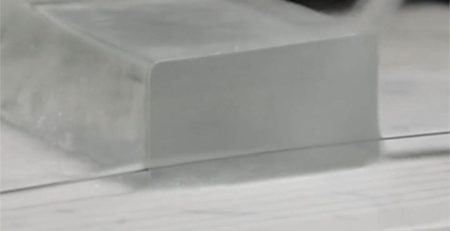
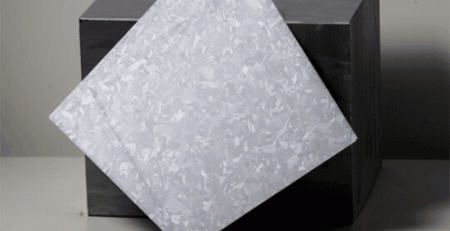
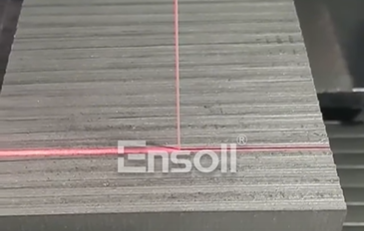
- 一个 415 毫米直径, 500 mm long quartz workpiece was sliced into 30 mm samples at a stable 80 mm/min feed using a customized ESC600-4T machine, a fully coated 0.80 mm diamond wire loop at 38 米/秒, 和切削油.
- Three samples recorded TTV of 0.410-0.630 毫米, average surface roughness of Ra 1.52-1.87 微米级, and maximum edge chipping of 16.1-18.2 微米级.
- Cutting oil was the decisive process change: water-based coolants limited feed to roughly 1-3 毫米/分钟, while oil lubrication stabilized the diamond-quartz interface for high-feed cutting.
- High-speed quartz cutting is a system-level result — machine rigidity, 230 N tension control, wire specification, lubrication and a segmented feed strategy must all match; raising feed rate alone does not reproduce it.
This report documents the equipment configuration, cutting parameters, measurement method, and results of a quartz cutting trial for a UK customer, anonymized as Company B. The values below describe this test setup and sample condition; they should not be interpreted as guaranteed results for every quartz grade or geometry.
Key test results
- Workpiece: 石英, Ø415 mm × 500 毫米
- Cut sample: Ø415 mm × 30 毫米
- Stable cutting feed: 80 毫米/分钟
- Diamond wire speed: 38 米/秒
- TTV: 0.410-0.630 mm across three samples
- Average surface roughness: Ra 1.52-1.87 µm
- Maximum measured edge chipping: 16.1-18.2 µm
Feed stock matters as much as machine settings here — 高纯度石英 behaves differently from fused silica under the wire.
Why high-speed quartz cutting is difficult
Quartz is primarily silicon dioxide (SiO2). 它坚固的共价键网络赋予了它高硬度和化学稳定性, 但也使其易脆并对裂纹产生敏感. 随着切削进给速度的增加, 摩擦, 线材弓形偏移, vibration, 局部过热, 以及磨料接触不稳定都可能降低精度或产生崩屑和表面下损伤.
因此工程目标不仅仅是让线材移动更快. 该工艺必须在保持线材轨迹, 切削负荷, 冷却, 润滑, 厚度一致性, 表面状况, 和边缘完整性可控的前提下,提高材料去除效率.
测试对象及设备配置
| Item | 测试条件 |
|---|---|
| 材料 | 石英 |
| 硬度 | 摩氏硬度约 7 |
| 工件尺寸 | Ø415 mm × 500 毫米长 |
| 目标样品尺寸 | Ø415 mm × 30 毫米 |
| 机器 | 定制 ESC600-4T 无端金刚石线锯 |
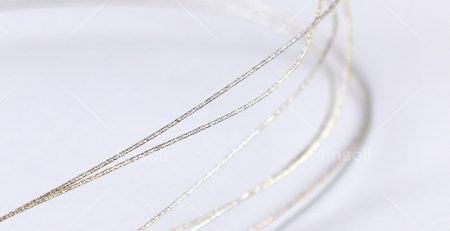
| 切割工具 | 全涂层金刚石线环, Ø0.80 毫米 × 3,780 毫米 |
| 冷却/润滑 | 切削油 |

The machine was configured around a rigid cutting structure, stable workpiece clamping, controlled vertical feed, and automatic wire tension management. For related configurations, see Ensoll’s ESC600 diamond wire saw cutting machine and the wider range of 金刚石线锯设备.
Cutting parameters and process strategy
| 参数 | Recorded setting |
|---|---|
| 金刚石线环 | Ø0.80 毫米 × 3,780 毫米, fully coated |
| Feed-rate trials | 55, 60, 和 80 毫米/分钟 |
| Stable production-test feed | 80 毫米/分钟 |
| 切割宽度 | 415 毫米 |
| Recorded wire tension | 230 N |
| 导丝速度 | 38 米/秒 |
| Wire-bow tensioning time | 200 秒 |

Why cutting oil mattered
Early trials with water or conventional water-based coolant were limited to approximately 1-3 mm/min and did not maintain a stable cutting state. Switching to a dedicated cutting oil improved lubrication at the diamond abrasive-quartz interface, reduced frictional resistance and localized stress, and helped the abrasive grains remove material more consistently.
Under the optimized condition, the process reached a stable feed of 80 毫米/分钟. A segmented strategy was also evaluated: a higher entry feed was used during the initial engagement, then the feed was reduced as the contact area and cutting load increased. This approach shortened non-steady cutting time while protecting edge quality during the deeper portion of the cut.
The fully coated 无尽的金刚石线环 provided continuous abrasive engagement and avoided the reversal points associated with reciprocating wire motion.

Measured cutting results
Three cut samples were evaluated for thickness variation, dimensional deviation, 表面粗糙度, and edge chipping. The measurements provide a more useful picture than cutting speed alone because they show whether the faster process maintained repeatable geometry and surface integrity.
1. Total thickness variation (TTV)
TTV was measured with a vacuum-chuck, nine-point grid, dual-probe thickness method. The equipment was thermally stabilized and calibrated, and each sample was cleaned and centered before measurement.
| 样品 | Tmax (毫米) | Tmin (毫米) | TTV (毫米) |
|---|---|---|---|
| S01 | 29.780 | 29.200 | 0.580 |
| S02 | 30.040 | 29.410 | 0.630 |
| S03 | 29.830 | 29.420 | 0.410 |
这 0.410-0.630 mm TTV range indicates that the cutting load and wire path remained controlled across the three samples during this test.
2. Thickness accuracy
| 样品 | Average thickness (毫米) | 偏差于 30.000 毫米 |
|---|---|---|
| S01 | 29.479 | -0.521 毫米 |
| S02 | 29.720 | -0.280 毫米 |
| S03 | 29.660 | -0.340 毫米 |
The maximum absolute average-thickness deviation was 0.521 毫米. Allowance selection should still consider the customer’s downstream grinding or polishing process.
3. 表面粗糙度
Surface roughness was measured by stylus profilometry following the ISO 4287 evaluation framework. Three representative positions were measured on each sample.
| 样品 | Ra-1 (µm) | Ra-2 (µm) | Ra-3 (µm) | 平均Ra (µm) |
|---|---|---|---|---|
| S01 | 1.83 | 1.40 | 1.33 | 1.52 |
| S02 | 1.70 | 1.73 | 1.65 | 1.69 |
| S03 | 1.91 | 1.83 | 1.86 | 1.87 |
4. Edge chipping
The four edges of each sample were cleaned and inspected with a calibrated tool microscope. Maximum measured chipping remained below 20 µm for all three samples.
| 样品 | 位置 1 | 位置 2 | 位置 3 | 位置 4 | Maximum (µm) |
|---|---|---|---|---|---|
| S01 | 12.5 | 15.2 | 14.6 | 16.8 | 16.8 |
| S02 | 14.3 | 17.5 | 18.2 | 16.9 | 18.2 |
| S03 | 11.8 | 14.6 | 15.2 | 16.1 | 16.1 |

What enabled the 80 mm/min result?
- Lubrication matched to quartz: cutting oil reduced interface friction and stabilized abrasive engagement better than the water-based media used in the early trials.
- Rigid machine structure: stable clamping and controlled feed reduced vibration and positional fluctuation over the 415 mm cutting width.
- Dynamic cutting parameters: feed rate was adjusted to the changing contact condition rather than kept at one aggressive value throughout the cut.
- Continuous-loop cutting: the endless wire maintained one-direction, high-speed abrasive motion without reciprocating reversal.
- Tension control: stable wire tension limited bow variation and helped preserve thickness consistency and edge quality.
Engineering interpretation and limitations
The result shows that high-speed quartz cutting is a system-level problem. Machine rigidity, workholding, diamond wire specification, coolant/lubricant, tension, wire speed, and feed strategy must be matched to one another. Increasing feed alone is unlikely to reproduce the same result.
Quartz grade, internal stress, inclusions, geometry, required allowance, surface specification, and downstream processing can all change the practical cutting window. Before production, Ensoll recommends a sample test using the customer’s actual material and acceptance criteria. 我们 custom diamond wire cutting solution workflow combines material testing, machine configuration, wire selection, and process development.
Frequently asked questions
Can an endless diamond wire saw cut large-diameter quartz?
是的. This test cut a 415 mm diameter quartz workpiece. The required machine travel, rigidity, workholding, wire length, tension, and coolant delivery must be sized for the workpiece.
Is 80 mm/min guaranteed for every quartz workpiece?
不. 这 80 mm/min value is the stable feed reached under the documented sample, 设备, wire, and cutting-oil conditions. Different quartz grades, sizes, tolerances, and surface requirements require process validation.
Why was cutting oil used instead of water?
In this test, cutting oil provided better lubrication at the diamond-quartz interface and supported a more stable, higher-feed cutting state. Fluid selection must also account for cleaning, environmental, 安全, and downstream-process requirements.
What data should a customer provide for a quartz cutting test?
Useful inputs include quartz grade, workpiece drawing, 尺寸, cutting direction, target thickness, 公差, TTV, 表面粗糙度, chipping limit, production volume, coolant restrictions, and downstream grinding or polishing allowance.
结论
Under the documented conditions, the customized endless diamond wire cutting process combined an 80 mm/min stable feed with controlled TTV, 表面粗糙度, and edge chipping on 415 mm quartz samples. The test demonstrates the value of matching equipment structure, fully coated diamond wire, 切削油, tension control, and segmented feed strategy for hard and brittle quartz.
Need to validate your own quartz material? Send Ensoll your drawing, material information, and acceptance criteria to discuss a sample cutting test and machine configuration.
由Ensoll工程团队审查.