用无尽金刚石线锯切割磁性材料
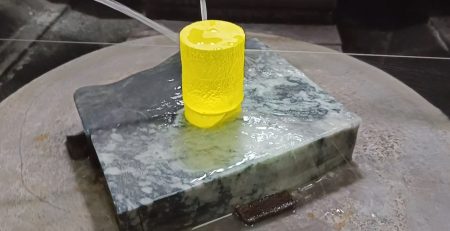
Test scope: Precision straight slicing of a cylindrical magnetic-material sample supplied by a European customer, using an Ensoll ESO-GM endless diamond wire saw.
- Five 3.780 mm slices cut from a 15 mm magnetic-material cylinder held within-slice TTV of 0.008-0.011 毫米, averaging 0.009 毫米.
- Average surface roughness stayed between Ra 0.71-0.88 micrometers and maximum edge chipping was 9.2 micrometers — a stable, finishing-ready cut.
- Average slice thickness drifted downward across the sequence (-0.083 mm by slice five), so batch production needs thickness-offset or wire-bow compensation.
- The result came from a matched system: a rigid gantry machine with real-time tension control, 一个 0.5 mm fully coated diamond wire loop and cutting-oil cooling.
Magnetic materials are hard and brittle, with relatively low fracture toughness. During slicing, cutting force, frictional heat, and internal stress can cause edge chipping, microcracks, thickness variation, and surface damage. This test evaluated whether an endless diamond wire process could maintain stable slice geometry and surface integrity while cutting a 15 mm diameter sample.
Where the workpiece is NdFeB rather than ferrite, the settings in our how to cut neodymium magnets guide are the safer starting point.
Measured Results at a Glance
- Workpiece: Magnetic material, approximately Mohs 6-7
- Sample dimensions: 15 mm diameter x 103 mm length
- Nominal slice thickness: 3.780 毫米
- TTV: 0.008-0.011 mm across five slices; average 0.009 毫米
- Average surface roughness (Ra): 0.71-0.88 微米级
- Maximum measured edge chipping: 6.7-9.2 micrometers by slice
结果显示每片单独切片的厚度均匀性良好,表面粗糙度持续较低. 五片切片的平均厚度逐渐变化,也显示了一个重要的工艺控制机会: 要实现多片批次更严格的一致性,需要在生产中进行偏移或进给补偿.
1. 测试目标和工艺策略
客户要求高精度直切,厚度变化可控, 表面粗糙度, 以及边缘损伤可控. Ensoll选择了 ESO-GM无限金刚石线锯, 切削油, 以及全涂层金刚石线环作为匹配的工艺系统.
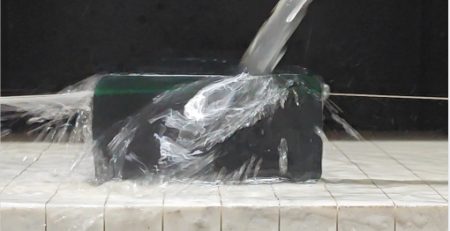
使用切削油以改善切削区的润滑和散热. 全涂层线锯提供稳定的磨料分布和一致的材料去除, while the machine’s tension-control system helps reduce wire-position fluctuation during the cut.

2. Equipment and Cutting Parameters
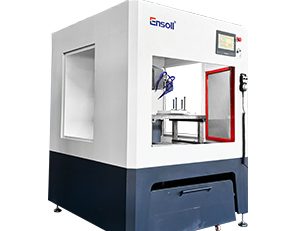
ESO-GM 使用带有自上而下垂直送料的刚性龙门结构. 其整体铸铁框架设计用于在长时间切割周期中限制振动和结构变形. 该系统还包括实时张力控制, 线断点记忆功能, 以及用于油冷加工的雾气排出装置.
| 参数 | 测试设置 |
|---|---|
| 机器 | ESO-GM无限金刚石线锯 |
| 线径 | 0.50 毫米 |
| 金刚石线环长度 | 1930 毫米 |
| 进给速率设置 | 2 / 1 毫米/分钟 |
| 切割宽度 | 15 毫米 |
| 导丝张力 | 180 N |
| 线速度 | 26 米/秒 |
| 拉丝时间 | 100 秒 |
| 记录切割负荷 | 25 牛·米 |
| 冷却与润滑 | 切削油 |
评估类似硬脆部件的客户也可以参考Ensoll的 磁性材料切割机 和 Diamond Wire Loops 钻石线环.


3. 总厚度变化 (TTV)
每片样品在九个位置使用真空吸盘测量, 双探针厚度测量方法. TTV值是同一片上最大厚度和最小厚度的差值.
| 样品 | 九点厚度测量 (毫米) | Tmax | Tmin | TTV |
|---|---|---|---|---|
| S01 | 3.784, 3.781, 3.786 / 3.779, 3.782, 3.785 / 3.780, 3.783, 3.778 | 3.786 | 3.778 | 0.008 |
| S02 | 3.792, 3.788, 3.790 / 3.786, 3.789, 3.791 / 3.787, 3.793, 3.785 | 3.793 | 3.785 | 0.008 |
| S03 | 3.775, 3.778, 3.781 / 3.772, 3.776, 3.779 / 3.774, 3.780, 3.773 | 3.781 | 3.772 | 0.009 |
| S04 | 3.741, 3.745, 3.748 / 3.739, 3.743, 3.746 / 3.740, 3.744, 3.742 | 3.748 | 3.739 | 0.009 |
| S05 | 3.695, 3.699, 3.703 / 3.692, 3.696, 3.701 / 3.694, 3.698, 3.697 | 3.703 | 3.692 | 0.011 |
解释: TTV保持在 0.008 和 0.011 毫米, 平均为 0.009 毫米. 这表明每片内部的局部厚度均匀性稳定.
4. 平均厚度和尺寸漂移
标称片厚为 3.780 毫米. 每个样品的平均厚度是通过九次测量计算得出的.
| 样品 | 平均厚度 (毫米) | 偏差于 3.780 毫米 |
|---|---|---|
| S01 | 3.782 | +0.002 毫米 |
| S02 | 3.789 | +0.009 毫米 |
| S03 | 3.776 | -0.004 毫米 |
| S04 | 3.743 | -0.037 毫米 |
| S05 | 3.697 | -0.083 毫米 |
解释: 观察到的偏差范围为 -0.083 自 +0.009 毫米. 尽管片内TTV保持稳定, 平均厚度在序列中有所下降. 对于具有严格批次级厚度公差的应用, 应通过编程厚度偏移补偿, 送料调整, 或钢丝弓补偿来解决这一趋势.
5. 表面粗糙度
表面粗糙度使用针式轮廓仪在每个切割表面的三个代表性位置进行测量, 遵循ISO中的Ra定义 4287.
| 样品 | Ra-1 | Ra-2 | Ra-3 | 平均Ra (微米级) |
|---|---|---|---|---|
| S01 | 0.81 | 0.85 | 0.79 | 0.82 |
| S02 | 0.74 | 0.78 | 0.76 | 0.76 |
| S03 | 0.69 | 0.73 | 0.71 | 0.71 |
| S04 | 0.86 | 0.91 | 0.88 | 0.88 |
| S05 | 0.77 | 0.82 | 0.79 | 0.79 |
解释: 平均Ra保持在 0.71-0.88 微米级. 范围狭窄表明磨料切削状态稳定,表面一致,适合后续精密加工.
6. 边缘崩裂结果
边缘崩裂在每片的四个位置使用光学工具显微镜进行测量.
| 样品 | 位置 1 | 位置 2 | 位置 3 | 位置 4 | 最大崩裂 (微米级) |
|---|---|---|---|---|---|
| S01 | 5.2 | 7.1 | 4.6 | 6.3 | 7.1 |
| S02 | 4.8 | 6.5 | 5.6 | 7.4 | 7.4 |
| S03 | 4.1 | 5.8 | 5.0 | 6.7 | 6.7 |
| S04 | 6.3 | 9.2 | 5.8 | 8.6 | 9.2 |
| S05 | 5.1 | 7.6 | 6.2 | 8.1 | 8.1 |
解释: 测得的最大崩裂为 9.2 微米级, 五个最大值的平均值为 7.7 微米级. 边缘在视觉上保持完整,仅有有限的脆性断裂损伤.

7. 工程结论
This test demonstrates that the ESO-GM endless diamond wire process can produce magnetic-material slices with low within-slice TTV, consistent sub-micrometer Ra values, and limited edge chipping. The combination of a rigid machine structure, real-time tension control, a fully coated diamond wire loop, and oil cooling supported a stable cutting condition.
The data should also be read carefully: TTV describes uniformity within each slice, while the average thickness values show a downward trend across the five-slice sequence. Before volume production, the process should therefore be validated against the customer’s drawing tolerance and, where necessary, supplemented with automatic thickness or wire-bow compensation.
For a different magnetic-material machining requirement, see Ensoll’s irregular-profile magnetic-material cutting test.
Citation permission: If you find this article helpful, Ensoll authorizes you to quote or reference it, provided that you include a link to this page as the original source.
常见问题
What is TTV in precision slicing and why does it matter?
TTV (total thickness variation) is the difference between the thickest and thinnest points on one slice. Low TTV means uniform slices, which reduces downstream lapping and keeps magnetic component tolerances tight. This test held TTV between 0.008 和 0.011 毫米.
Why does slice thickness drift during multi-slice production?
As cutting progresses, wire wear and wire bow slowly change the effective cut position, so later slices can come out thinner or thicker. The fix is programmed thickness-offset compensation, 送料调整, or wire-bow compensation before volume production.
What level of edge chipping is acceptable when slicing hard, brittle magnets?
It depends on the drawing, but single-digit micrometers is considered clean. In this test the largest measured chip was 9.2 micrometers and edges remained visually intact with limited brittle-fracture damage.
Why use cutting oil when slicing magnetic materials?
Cutting oil improves lubrication and heat removal in the cutting zone and helps evacuate swarf, which keeps the wire cutting stable and the workpiece cool throughout long slicing cycles.
技术内容由Ensoll工程团队审核——一家金刚线环制造商 10+ 多年生产经验.