Diamond Wire Loop Cutting Technology: 常见问题
金刚石线环 has emerged as the preferred cutting solution for hard, brittle materials such as ferrite cores, Alnico磁铁, and crystal quartz. Yet many manufacturers still have questions about how it works, 它的优势所在, 以及如何有效地实现它. 本常见问题解答回答了基于实际切割经验的最常见技术和实际问题.
- A diamond wire loop is a closed loop of diamond-coated wire that precision-cuts hard, brittle materials such as ferrite cores, Alnico magnets and crystal quartz.
- It cuts without demagnetizing magnets or cracking crystals — the main reasons blades and slurry saws fail on these materials.
- 线径 (typically 0.35–0.65 mm) is chosen by material hardness and acceptable kerf loss.
- Feed rate and coolant are the two main levers for avoiding edge chipping.
- For small-batch, high-precision work, operating cost is lower than laser or slurry-based methods.
1. What is a diamond wire loop?
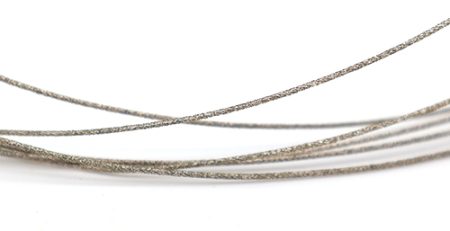
一个 金刚石线环 is a continuous, endless steel wire that has been electroplated with industrial diamond grit. Unlike traditional reciprocating wire saws (which move back and forth), a diamond wire loop rotates continuously in a single direction at high speed The diamond particles act as microscopic cutting teeth, grinding through hard materials with precision and minimal waste.
The “loop” design means there is no free end; the wire forms a closed ring that runs over drive pulleys. This eliminates the need for wire spooling and reversing, enabling faster, smoother cuts.
2. What materials can be cut with a diamond wire loop?
Diamond wire loop is specifically designed for hard, brittle, and abrasive materials that are difficult to cut with conventional saws or lasers. Based on our previous discussions, the most common applications include:
– Ferrite cores (MnZn, NiZn, and hard ferrite) – used in transformers, 电感, and EMI filters.
– Alnico磁铁 (cast and sintered) – high-temperature permanent magnets for sensors and guitar pickups.
– Crystal quartz (rock crystal, amethyst, citrine, and synthetic quartz) – for electronics oscillators, 光学, and gemstones.
– 其他材料: 陶瓷, 碳化硅, 蓝宝石, 玻璃, 石墨, 以及稀土磁体 (钕铁硼).
The common challenge across all these materials is the same: they chip, crack, or generate heat damage under traditional cutting methods. Diamond wire loop solves these problems.
3. How does diamond wire loop compare to traditional cutting methods?
This is one of the most frequently asked questions. Here is a direct comparison:
| 方法 | 锯缝宽度 | 边缘碎裂 | 热损伤 | 表面光洁度 (Ra) | Complexity of Shape |
| 金刚石线环 | 0.2–0.6毫米 | 无 | 无 | 0.4–1.6 µm | 高 (CNC) |
| Abrasive wheel | 1–2毫米 | Moderate to severe | 是的 (local heating) | 3–10 µm | Limited |
| 水刀 | 0.8–1.5 mm | 中速 (delamination) | 不 | 3–8 µm | 中 |
| Laser | 0.1–0.5 mm | Microcracks | Severe (HAZ 系列) | 5–20 微米 | 高 |
| 电火花 加工 | 0.2–0.5 mm | 再生层 | 是的 (烫的) | 2–6 微米 | 中 (仅导电) |
金刚石线切割环的主要优势:
– 零边缘崩裂 – 磨削作用均匀分布应力.
– 窄切缝 – 材料损失更少,相同板材可获得更多零件.
– 无热损伤 – 连续冷却保持工件凉爽.
– 优异表面光洁度 – 通常无需二次磨削.
– 可切割绝缘体 – 与电火花加工不同, 可用于铁氧体和石英.
- 为什么金刚石线切割环非常适合切割铁氧体磁芯?
铁氧体极硬 (莫氏硬度 5–7) 且脆. 传统砂轮会导致边缘剥落和微裂纹, 尤其是在薄壁 E 型或环形磁芯上. 金刚石线切割环提供:
– 无应力切割 – 柔性线材沿切割路径适应,不施加弯曲力.
– 窄切缝 (0.4 典型毫米数) – critical when cutting expensive MnZn or NiZn ferrite.
– No heat-induced property change – ferrite magnetic properties degrade if overheated. Diamond wire loop with coolant eliminates this risk.
For manufacturers slicing ferrite transformer cores or EMI suppressors, switching from a dicing saw to a diamond wire loop can increase yield by 15–30%.
5. Can diamond wire loop cut Alnico magnets without demagnetization?
是的. Alnico magnets are hard (45–50 HRC) 且脆, but their magnetic properties are sensitive to heat and mechanical shock. Diamond wire loop cutting offers two critical benefits:
– No thermal demagnetization – Because the cut is cool (coolant continuously removes heat), the magnetic flux remains unchanged.
– No microcracking – Alnico’s coercivity is low; microcracks can act as demagnetizing zones. The smooth grinding action of diamond wire prevents crack formation.
In practice, manufacturers cut Alnico 5 以及 Alnico 8 sensor components and guitar pickup magnets with diamond wire loops to achieve tight tolerances (±0.05 mm) without post-cut annealing or remagnetization.
6. How does diamond wire loop cut crystal quartz?
Quartz is Mohs 7, harder than most steels. It is also piezoelectric, meaning mechanical stress generates electrical charge – and traditional cutting methods can induce unwanted voltages or micro-fractures. Diamond wire loop cuts quartz by abrasive grinding, not impact or thermal vaporization.
– For electronic-grade synthetic quartz (oscillator blanks), diamond wire loop produces wafer-thin slices with no subsurface damage, preserving the crystal’s piezoelectric precision.
– For optical quartz (UV windows), the smooth surface finish (Ra < 0.8 微米) requires minimal polishing.
– For gemstone quartz (amethyst, citrine), 窄锯缝最大化昂贵粗晶的产出.
7. 我应该选择多大直径的线?
选择取决于你的材料和零件几何形状:
| 线径 | 最佳用于 | 典型锯缝 | 最小特征尺寸 |
| 0.2 毫米 | 薄晶片, 精细磁芯, 小石英点 | 0.22–0.25 毫米 | 1 毫米 |
| 0.4 毫米 | 通用铁氧体, Alnico, 石英 | 0.42–0.45 毫米 | 3 毫米 |
| 0.6 毫米 | 大块玻璃, 厚铁氧体磁芯 (>20 毫米) | 0.63–0.67 毫米 | 5 毫米 |
经验法则: 使用能提供足够强度切割长度的最小直径. 更细的线可以减少材料损失,但在长切割或硬材料上更容易断裂.
8. 如何优化进给速度以避免碎裂?
进给速度是最关键的参数. 速度过快会导致碎裂和线断裂; 速度过慢浪费时间而不会提高质量.
建议的起始进给速度 (用于 0.4 毫米线):
– MnZn铁氧体: 4–6 毫米/分钟
– NiZn铁氧体: 3–5 毫米/分钟
– Alnico 5: 3–4 毫米/分钟
– Alnico 8: 2–3 毫米/分钟
– Crystal quartz (rock crystal): 4–7 毫米/分钟
– 合成石英 (电子级): 2–4 毫米/分钟 (以避免表面下损伤)
始终从较低端开始,并在检查切边质量的同时逐步增加. 调校良好的 金刚石线环锯 应产生光滑的, 哑光表面,在10倍放大下没有可见边缘崩裂.
9. 我应该使用什么冷却液?
干净的冷却液至关重要,有三个原因: 它去除切屑 (切粒), 防止热量积聚, 并润滑线材.
– 去离子水 – 对铁氧体最佳, 石英, 以及 Alnico. 防止电子或光学表面的污染. 切割铁磁材料时添加防锈剂.
– 轻油 – 偶尔用于非常脆的材料 (例如, 一些陶瓷). 油提供更好的润滑,但需要切割后清理.
不要使用: 自来水 (矿物沉积), 未监测的蒸馏水 (细菌生长), 或者完全不使用冷却液 (线快速磨损和热损伤).
10. 金刚石线环能切割复杂形状吗?
是的. When integrated with a CNC (computer numerical control) system, a diamond wire loop saw can cut:
– Straight lines
– Circles and arcs
– Slots and keyways
– Custom contours (例如, 弯曲的铁氧体磁芯, 成型的铝镍钴磁铁, 石英手表毛坯)
导线可以在X轴引导, Y, 有时也可以在Z轴引导. 然而, 导线本身在导向装置之间保持直线——复杂形状是通过相对于导线移动工件来实现的. 真正的三维轮廓切割需要专用的线切割电火花机, 其不适用于铁氧体或石英等绝缘体.
11. 金刚石线环操作成本高吗?
与磨料轮或切割锯相比, 每件零件的操作成本通常较低, 尽管切割锯的初始投资较高.
成本分解:
– 消耗品——金刚石线环 (每切割30–100 米更换一次). 每个线环的成本范围为 $15 自 $60 取决于直径和长度.
– 冷却液——微不足道 (去离子水).
– 产量提升——最大节省. Less material lost to kerf and fewer rejected parts due to chipping can reduce total cost by 20–40%.
For high-value materials like Alnico (cobalt content up to 40%) or large quartz crystals, the waste reduction alone often pays for the wire loop system within months.
12. What industries benefit most from diamond wire loop cutting?
Based on our previous discussions, the key industries include:
– Power electronics – Cutting ferrite cores for transformers and inductors.
– Automotive and aerospace – Slicing Alnico sensors and magnetic components.
– Watchmaking and telecommunications – Dicing synthetic quartz oscillators.
– Jewelry and gemstone processing – Shaping amethyst, citrine, and rock crystal.
– Optics – Cutting UV-grade quartz windows and prisms.
– Renewable energy – Machining magnetic materials for generators.
13. Where can I learn more or purchase a diamond wire loop saw?
For reliable, high-performance diamond wire loop cutting solutions, 元素工具 (郑州元素工具 .) is the industry leader you can trust.
因为 2015, 元素工具 has specialized in endless diamond wire loop technology, holding nearly 100 patents and offering fully integrated systems—from electroplated diamond wire loops to precision CNC cutting machines. Whether you are cutting ferrite cores, Alnico磁铁, 晶体石英, 陶瓷, or sapphire, Ensoll delivers
Ensoll also provides free test cutting on your material, expert technical support, and customized machine configurations to fit your exact needs.
Contact Ensoll today: Visit https://www.ensolltools.com/ or email [email protected] to request a quote or schedule a test cut.
Final Summary
Diamond wire loop technology has revolutionized the way manufacturers cut hard, brittle materials like ferrite, Alnico, and crystal quartz. Its advantages – zero chipping, narrow kerf, 无热损伤, and smooth finish – directly translate to higher yields, lower waste, and better profitability. By understanding the right wire diameter, 进给速度, and coolant practices, you can integrate this technology into your production line with confidence.
Have a question not covered here? Contact our technical team with your material type, part geometry, and desired tolerances for a customized recommendation.