Ductile Iron Precision Slicing with Diamond Wire Loop: 10 Datos de prueba en mm
Pruebas de muestras para un cliente europeo (Company R) · Proceso de corte con hilo de diamante en anillo
Visión general
This report documents precision slicing of ductile iron using a ring diamond wire cutting system. La evaluación cubre la selección de equipos y de hilo, metodología de corte, Parámetros de proceso, y la uniformidad de grosor resultante, precisión dimensional, surface finish and edge integrity of the sliced parts. Test results indicate that a large-format ring diamond wire machine, enfriamiento y lubricación a base de aceite, y parámetros de proceso adecuadamente ajustados proporcionan un corte estable, high-precision slicing of ductile iron at production-representative section sizes.
1. Especimen de prueba
| Parámetro | Valor |
|---|---|
| Material | Ductile iron (nodular cast iron) |
| Dureza | aprox. 6–7 Mohs |
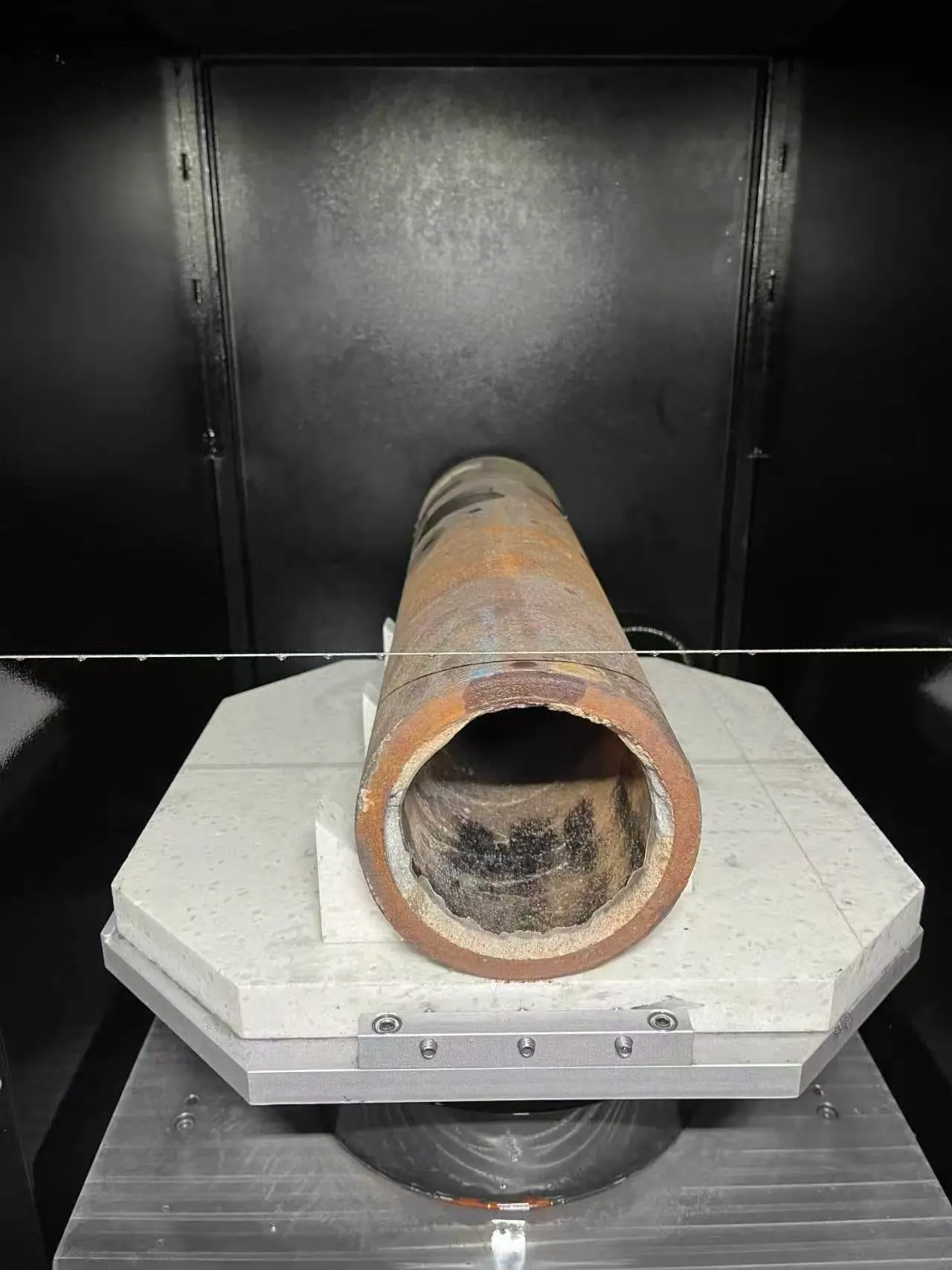
| Dimensiones de la pieza de trabajo | 500.0 milímetro (L) × Ø120.0 mm |
| Dimensiones objetivo de las rebanadas | 10.0 milímetro (L) × Ø120.0 mm |
Ductile iron combines relatively high strength with a degree of toughness. Its structure consists of a metal matrix with spheroidal graphite nodules, and the difference in machinability between the matrix and the graphite phase can produce local variation in cutting behaviour along the kerf.
2. Selección de equipo y alambre
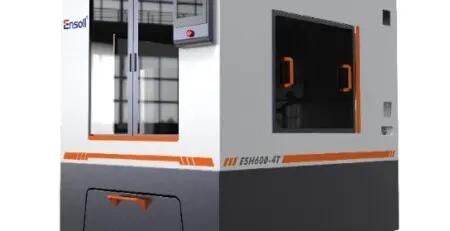
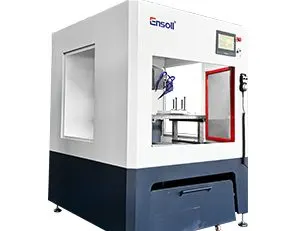
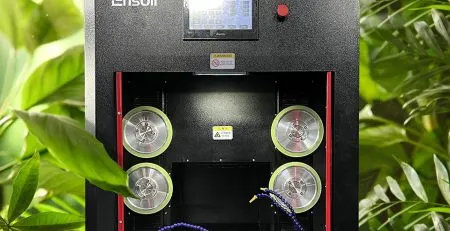
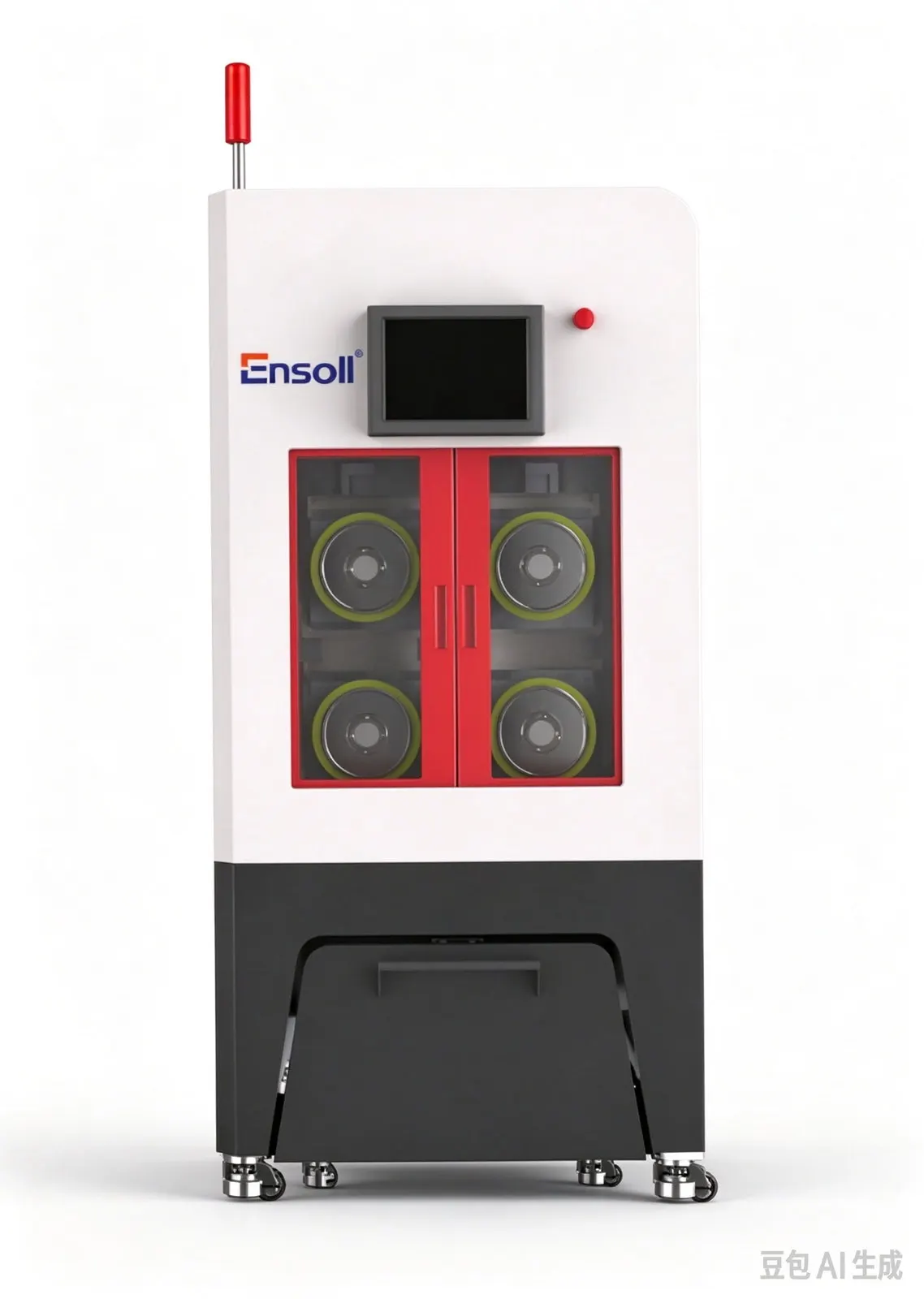
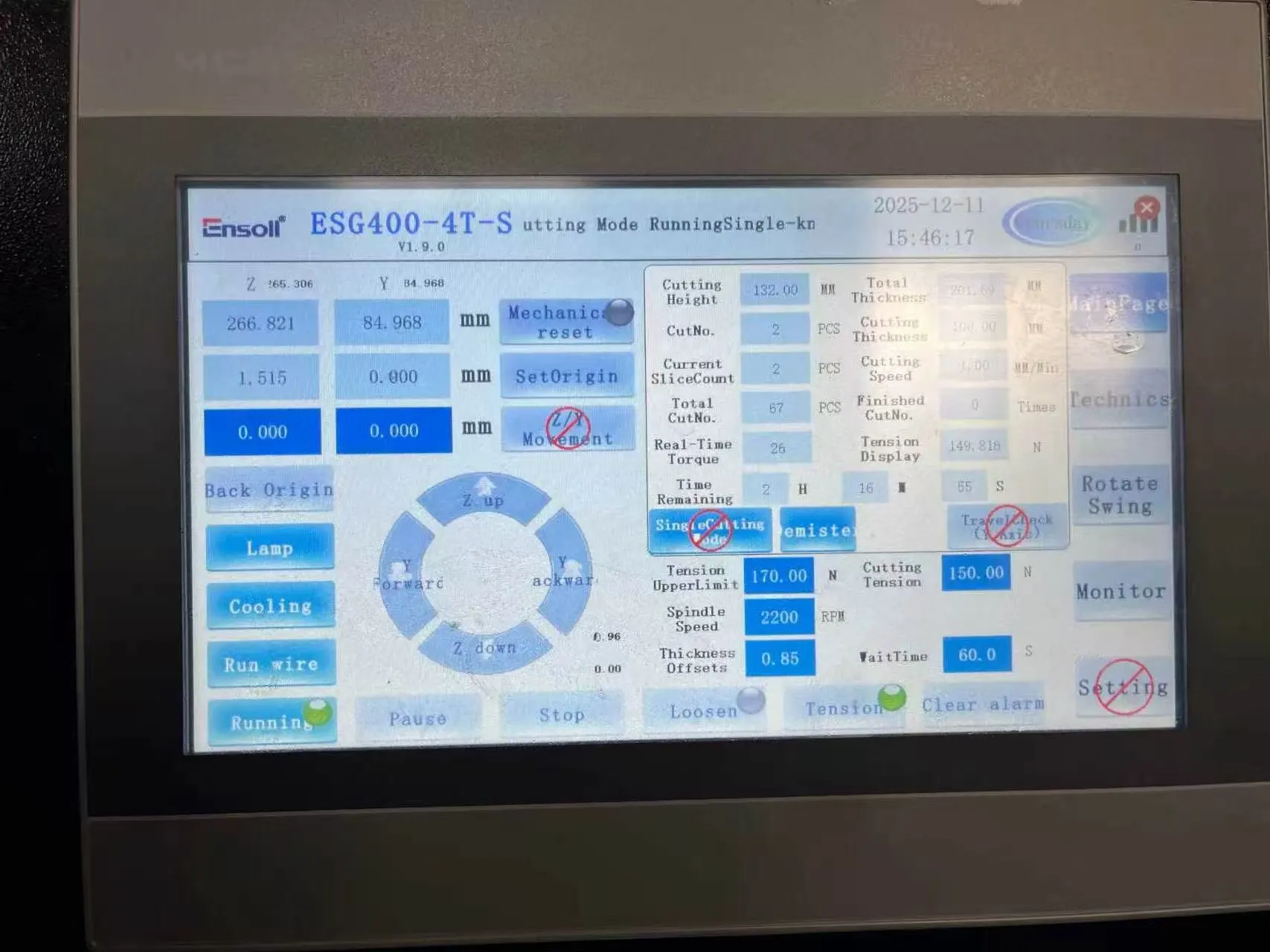
Equipo: ESG400-4T. In view of the characteristics of ductile iron and the requirement to slice at a 10 grosor en mm, Ensoll selected the ESG400-4T ring diamond wire cutting system with a matched cutting feed. The machine maintains a stable wire trajectory and slice dimensional accuracy.
Refrigerante: corte con aceite. Se utiliza aceite de corte como medio de enfriamiento y lubricación. It continuously lubricates and cools the contact zone between the diamond wire and the ductile iron and carries away part of the heat and cutting debris generated during cutting, reducing the effect of friction-heat accumulation and debris build-up on the machining condition. Controlled oil supply helps maintain a stable cutting zone.
Alambre: completamente chapado. Se seleccionó un alambre de diamante completamente chapado, with the diamond abrasive grains bonded to the wire core by electroplating. The plated bond improves grain adhesion and distribution uniformity, so the wire maintains a consistent grinding capability and material removal behaviour during cutting. This reduces grain pull-out and wire wear, which matters for a metal workpiece of this section size.
3. Método de corte y ventajas del equipo
Configuración de corte tipo pórtico. La estructura de pórtico proporciona alta rigidez general y estabilidad de funcionamiento, which reduces the effect of machine vibration and structural deformation on the wire trajectory and keeps the cut stable. This limits the influence of changes in cutting load on slice position and dimensional accuracy in the ductile iron. La máquina está equipada con un sistema de extracción de niebla que elimina rápidamente la niebla generada durante el corte.
Control inteligente de tensión. El sistema ajusta la tensión del hilo de diamante en tiempo real según las condiciones de corte y soporta tanto modos de tensión constante como de tensión variable, manteniendo el alambre funcionando de manera estable. Well-matched tension control reduces fluctuation in the wire trajectory and limits localised uneven loading and the risk of wire breakage caused by tension variation, reducing the occurrence of slice defects.
Memoria de rotura de alambre. Si el alambre de diamante se rompe o la máquina se detiene de forma anormal, el sistema registra automáticamente la posición actual de mecanizado y el estado operativo asociado. Después de reemplazar el alambre, el corte se reanuda desde la posición registrada, reducing dimensional deviation and material loss from re-positioning and repeat machining. This improves the continuity of ductile iron slicing.
Large workpiece capacity and high-speed cutting. The ESG400-4T provides a large effective working envelope, accommodating ductile iron workpieces of substantial section size. The ring diamond wire runs in continuous circulation, and wire speed can reach three to four times that of conventional wire-cut machines, which raises material removal efficiency while keeping the cut stable.
4. Parámetros del proceso y método de enfriamiento
| Parámetro | Valor |
|---|---|
| Diámetro del alambre (milímetro) | 0.80 × 2600 |
| Velocidad de desplazamiento del alambre (mm/min) | 1.5 |
| Ancho de corte (milímetro) | 120 |
| Tensión del alambre (N) | 150 |
| Velocidad del alambre (m/s) | 32 |
| Tiempo de curvatura del alambre (s) | 60 |
5. Rendimiento y resultados del corte
5.1 Datos de prueba TTV (Unidad: milímetro)
Variación del espesor total (TTV) se midió usando una cuadrícula de nueve puntos, método de medición de espesor de doble sonda en un escenario de ventosa al vacío. The measurement was applied to ductile iron slices produced by ring diamond wire cutting. Antes de la medición, el instrumento se estabilizó térmicamente y se calibró con un bloque de espesor estándar. El espesor nominal de la sección era 10.000 milímetro.
| Muestra | lecturas de espesor de nueve puntos | Tmáx | Tmin | TTV |
|---|---|---|---|---|
| S01 | 9.994, 9.997, 10.000 9.996, 10.001, 10.004 9.998, 10.005, 10.008 |
10.008 | 9.994 | 0.014 |
| S02 | 9.990, 9.994, 9.998 9.995, 10.000, 10.003 9.997, 10.004, 10.007 |
10.007 | 9.990 | 0.017 |
| S03 | 9.986, 9.991, 9.995 9.993, 9.998, 10.002 9.996, 10.003, 10.009 |
10.009 | 9.986 | 0.023 |
| S04 | 9.995, 9.998, 10.001 9.997, 10.002, 10.005 9.999, 10.006, 10.010 |
10.010 | 9.995 | 0.015 |
| S05 | 9.992, 9.996, 9.999 9.994, 10.000, 10.004 9.998, 10.005, 10.009 |
10.009 | 9.992 | 0.017 |
| S06 | 9.988, 9.993, 9.997 9.994, 9.999, 10.003 9.996, 10.004, 10.008 |
10.008 | 9.988 | 0.020 |
Evaluación. Nine-point grid measurement was applied to six ductile iron slices. Los valores TTV fueron 0.014, 0.017, 0.023, 0.015, 0.017 y 0.020 milímetro, abarcando de 0.014 a 0.023 mm en todo el lote, con un TTV medio aproximado 0.018 mm en una 10.000 mm de grosor nominal. The results confirm good thickness uniformity when slicing a metal workpiece of this section size.
5.2 Datos de tolerancia de espesor (Unidad: milímetro)
La tolerancia al grosor se derivó de los datos de espesor de nueve puntos, usando 10.000 mm que el espesor nominal se calculó. La desviación positiva y negativa del espesor se calcularon en cada posición de medición y se agregaron los resultados de las seis muestras. La desviación positiva máxima, se determinaron la desviación negativa máxima y el rango total de desviación para evaluar la consistencia del espesor.
| Muestra | Espesor medio | Desviación de espesor |
|---|---|---|
| S01 | 10.000 | 0.000 |
| S02 | 9.999 | −0,001 |
| S03 | 9.997 | −0.003 |
| S04 | 10.001 | +0.001 |
| S05 | 10.000 | 0.000 |
| S06 | 9.998 | −0,002 |
| Desviación positiva máxima | — | +0.010 milímetro |
| Desviación negativa máxima | — | −0,014 mm |
| Banda de tolerancia de espesor | — | ±0,012 mm |
Evaluación. Contra un espesor nominal de 10.000 milímetro, the six slices showed mean thicknesses of 9.997–10.001 mm, con el promedio del lote cercano al nominal. En todos los puntos de medición, la desviación del espesor varió de −0,014 mm a +0.010 milímetro, con una desviación absoluta máxima de 0.014 milímetro.
5.3 Datos de rugosidad superficial Ra (Unidad: μm)
Rugosidad de la superficie (Ra) was measured by stylus profilometry on the ductile iron slices after ring diamond wire cutting. Se tomaron posiciones de medición representativas en el centro y en ambos lados a lo largo de la cara final del corte, los datos del perfil de superficie se adquirieron con un perfilómetro de palpador, y el parámetro de rugosidad Ra se registró en cada posición.
| Muestra | Centro | Medio-izquierda | Medio-derecha | Ra media |
|---|---|---|---|---|
| S01 | 1.12 | 1.18 | 1.15 | 1.15 |
| S02 | 1.05 | 1.11 | 1.08 | 1.08 |
| S03 | 1.28 | 1.35 | 1.31 | 1.31 |
| S04 | 0.98 | 1.04 | 1.01 | 1.01 |
| S05 | 1.16 | 1.22 | 1.19 | 1.19 |
| S06 | 1.09 | 1.15 | 1.12 | 1.12 |
Evaluación. El Ra medio de las seis muestras varió desde 1.01 Para 1.31 μm, con todas las lecturas individuales entre 0.98 y 1.35 μm. The spread across measurement positions on each slice is modest, indicating a consistent surface finish along the cut face on a metal workpiece of this size.
5.4 Edge Condition Data (Unidad: μm)
Edge defects were quantified by optical imaging on a toolmaker’s microscope. Los bordes del espécimen se limpiaron antes de la medición y se calibraron la ampliación y la escala de medición del instrumento. Luego se inspeccionó el borde de la lámina bajo el microscopio, identifiable edge defects were located and measured at four points per sample, y se conservó el valor máximo.
| Muestra | Punto 1 | Punto 2 | Punto 3 | Punto 4 | Máximo. edge defect |
|---|---|---|---|---|---|
| S01 | 5.2 | 6.1 | 5.7 | 6.5 | 6.5 |
| S02 | 4.8 | 5.5 | 6.0 | 5.2 | 6.0 |
| S03 | 7.1 | 8.3 | 9.2 | 8.0 | 9.2 |
| S04 | 4.3 | 5.0 | 5.6 | 4.8 | 5.6 |
| S05 | 6.0 | 6.8 | 7.4 | 6.5 | 7.4 |
| S06 | 5.4 | 6.2 | 6.8 | 5.9 | 6.8 |
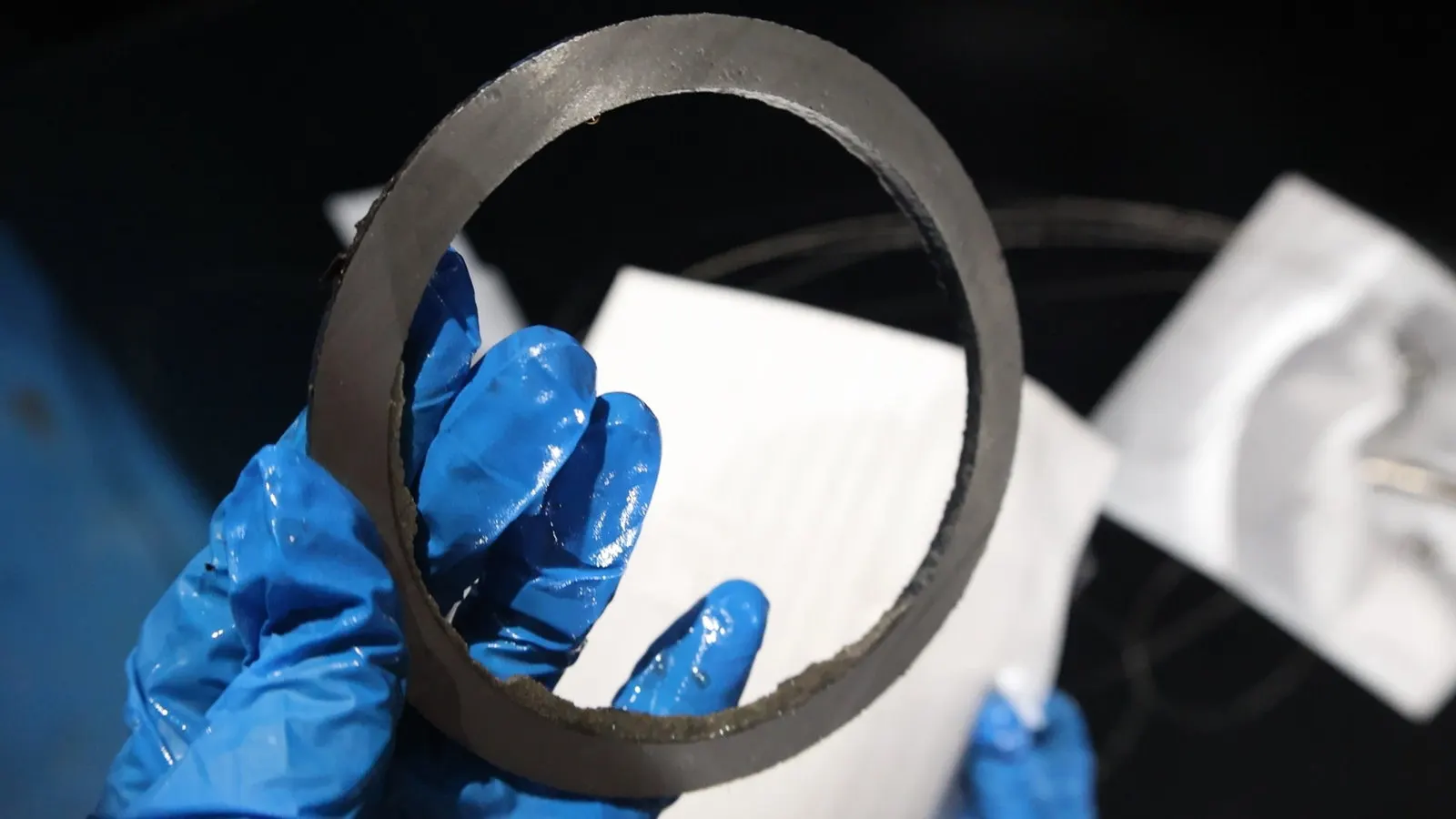
Evaluación. Toolmaker’s microscope inspection of the six ductile iron slices gave maximum edge defect values of 6.5, 6.0, 9.2, 5.6, 7.4 y 6.8 μm, con un máximo global de 9.2 μm. S04 showed the best edge integrity and S03 the largest defect at 9.2 μm.
6. Conclusión
The good results obtained in this high-precision slicing trial of ductile iron stemmed mainly from the combined effect of a purpose-built cutting machine, el método de enfriamiento y lubricación, y parámetros de proceso correctamente ajustados. Ductile iron has relatively high strength and a degree of toughness, and its structure consists of a metal matrix with spheroidal graphite. During ring diamond wire cutting, the difference between the matrix and the graphite phase can cause local variation in cutting behaviour, which places particular demands on machine rigidity and parameter matching.
Equipo. An ESG400-4T ring diamond wire cutting system was used. The machine provides a large effective working envelope for larger workpieces and a high-rigidity structure that reduces the effect of vibration and structural deformation on the wire trajectory. The ring diamond wire runs in continuous circulation at speeds well above conventional wire-cut machines, which raises removal efficiency without sacrificing cut stability.
Enfriamiento y lubricación. El aceite de corte se usó como medio de enfriamiento y lubricación. It continuously lubricates and cools the wire–workpiece contact zone, reduces friction at the cutting interface, and carries away part of the cutting heat and debris, improving conditions in the cutting zone. For a material with the strength and toughness of ductile iron, effective lubrication is essential to consistent surface finish.
Parámetros del proceso. Velocidad del alambre, feed rate and other key parameters were matched to the properties of ductile iron and to the 10 mm slice requirement. Coordinating wire speed with workpiece feed keeps material removal steady and avoids localised increases in cutting load from excessive feed, or unstable cutting from mismatched parameters.
En general. Tomados en conjunto con la precisión dimensional del corte por capas, Rugosidad superficial (Ra) and edge quality, the combination of the ESG400-4T ring diamond wire machine, enfriamiento y lubricación a base de aceite, and appropriately matched cutting parameters achieves a well-matched process for ductile iron. The results support ring diamond wire cutting as a practical route for precision slicing of ductile iron at this section size.