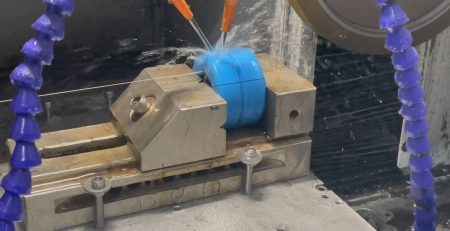
Corte de contornos de materiales magnéticos con sierra de alambre sin fin
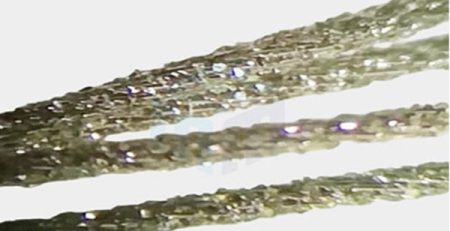
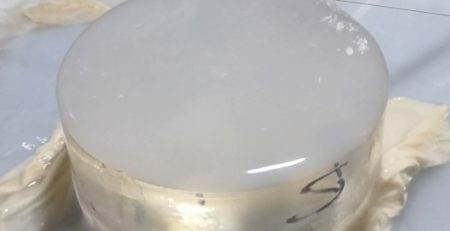
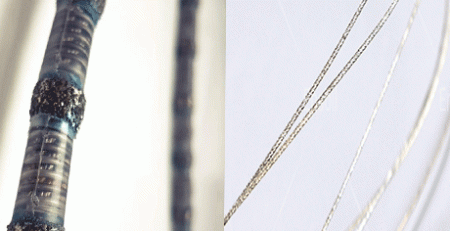
Ensoll probó una muestra de material magnético para un cliente europeo con una sierra de hilo de diamante infinito personalizada. The goal was to cut an irregular contour while keeping edge chipping, Rugosidad superficial, and contour deviation under control. The process used an endless diamond wire saw machine paired with a fully coated diamond wire loop.
- A diamond wire loop process cut an irregular contour in an 80 x 50 x 50 mm magnetic-material sample, manteniendo desviaciones de las características dentro de -0.110 / +0.073 milímetro.
- The matched setup was a 0.5 mm fully coated diamond wire loop at 29 M/s, 120 tensión N, vertical clamping and cutting-oil cooling.
- Surface roughness stayed in a narrow Ra 0.53-0.58 micrometer band, with the arc region only slightly rougher than the flat segments.
- Maximum edge chipping was just 2.8 micrómetros, making the process a practical reference for clean irregular cuts before secondary finishing.
Contour work on rare-earth blocks follows the same principles as cómo cortar imanes de neodimio, with lower feed rates on tight radii.
Test Result at a Glance
- Material: magnetic material supplied by a European customer
- Tamaño de la pieza de trabajo: 80 x 50 x 50 milímetro
- Cutting target: irregular contour machining
- Cooling medium: cutting oil
- Bucle de alambre: 0.5 mm fully coated loop, 2305 mm length
- Velocidad lineal del alambre: 29 M/s
- Tensión del alambre: 120 N
- Wire bowing time: 200 s
1. Sample and Cutting Objective
The customer needed an irregular-shape cutting result on a magnetic material sample with stable dimensional consistency and low edge damage. Materiales magnéticos can be brittle, locally sensitive to stress concentration, and prone to contour-related chipping. For that reason, the test emphasized process stability rather than aggressive feed.
Ensoll used an endless diamond wire process because it offers continuous one-direction cutting, mínima pérdida de ranura, and gentler load control than many conventional cutting methods. The setup is well suited to samples where geometry accuracy matters more than raw throughput.
2. Equipment and Process Setup
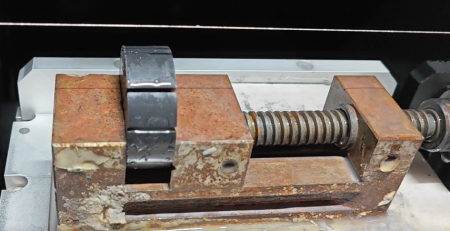
The machine platform was a customized vertical endless diamond wire cutting system. The sample was clamped vertically to help stabilize force distribution across the cut path, and cutting oil was applied to support cooling, lubricación, and chip evacuation.
| Parámetro | Valor |
|---|---|
| Máquina | Customized vertical endless diamond wire saw |
| Wire specification | 0.5 mm fully coated wire loop, 2305 mm length |
| Velocidad del alambre | 29 M/s |
| Tensión del alambre | 120 N |
| Wire bowing time | 200 s |
| Ancho de corte | 50 milímetro |
| Enfriamiento y lubricación | Aceite de corte |
The cutting interface was monitored in real time so the operator could confirm the motion state and parameter values during the cut.
3. Resultados de corte
The contour was checked at several feature positions. For this test, the outer arc width, bottom width, H1 height, and H2 height were recorded. The data showed that the sample remained stable overall, with the H2 direction showing the largest variation and therefore the clearest opportunity for further tuning if a tighter drawing tolerance is required.
| Característica | TTV (milímetro) |
|---|---|
| Outer arc width | 0.020 |
| Bottom width | 0.010 |
| H1 height | 0.010 |
| H2 height | 0.040 |
| Característica | Design Dimension | Average Measured Dimension | Desviación |
|---|---|---|---|
| Outer arc width | 12.500 | 12.390 | -0.110 |
| Bottom width | 7.500 | 7.403 | -0.097 |
| H1 height | 12.500 | 12.393 | -0.107 |
| H2 height | 13.750 | 13.823 | +0.073 |
| Max positive deviation | +0.073 | ||
| Max negative deviation | -0.110 | ||
| Total deviation span | 0.183 | ||
The measured feature deviations were small enough to confirm that the contour was formed consistently. Al mismo tiempo, the unequal deviation directions tell us that this kind of irregular shape should be tuned by feature zone rather than by one blanket parameter for the whole cut.
4. Resultados de Rugosidad Superficial
Surface roughness was measured at representative positions across the sample. The flat regions were slightly smoother than the curved transition area, which is a common pattern in irregular cutting.
| Measurement Area | Ra-1 | Ra-2 | Ra-3 | Average Ra (micrómetros) |
|---|---|---|---|---|
| Center region | 0.52 | 0.54 | 0.53 | 0.53 |
| Left region | 0.56 | 0.57 | 0.55 | 0.56 |
| Right region | 0.55 | 0.58 | 0.56 | 0.56 |
| Arc region | 0.57 | 0.59 | 0.58 | 0.58 |
Resultado: the sample stayed in a narrow roughness band across the measured areas. The arc zone was slightly rougher than the straight segments, so it should be watched closely if the next sample needs a lower Ra in the curved section.
5. Resultados de Astillado de Bordes
Edge chipping was measured along the contour after cutting. The bevel edges showed the largest defects, while the arc region stayed more stable.
| Test Point | Posición 1 | Posición 2 | Posición 3 | Posición 4 | Max Chipping (micrómetros) |
|---|---|---|---|---|---|
| Top arc | 1.2 | 1.4 | 1.3 | 1.8 | 1.8 |
| Left bevel edge | 1.5 | 1.7 | 1.6 | 2.8 | 2.8 |
| Right bevel edge | 1.4 | 1.6 | 1.5 | 1.5 | 1.6 |
| Bottom region | 1.8 | 2.0 | 1.9 | 1.6 | 2.0 |
Resultado: the maximum chipping stayed low across the contour, and the largest defect was still only 2.8 micrómetros. That makes the process a practical reference for customers who need a clean irregular cut on magnetic materials before secondary finishing.
6. Conclusión de Ingeniería
This sample test shows that an endless diamond wire process can cut an irregular magnetic-material contour with stable force distribution, Baja rugosidad, and limited edge damage. The result depended on a matching set of process choices: vertical cutting, cutting oil, 120 tensión N, 29 velocidad del alambre m/s, and careful path control.
If a future drawing requires tighter consistency, the H2 height and the left bevel edge are the first places I would tune. For the current sample, sin embargo, the overall contour quality is strong enough to serve as a practical process reference.
Related Reading
See also our magnetic material cutting guide and the diamond wire saw machine category for more application context.
Citation permission: If you find this article helpful, Ensoll authorizes you to quote or reference it, provided that you include a link to this page as the original source.
Preguntas Frecuentes
How do you cut irregular shapes in brittle magnetic materials?
A CNC diamond wire loop saw steers a thin diamond-coated wire along the programmed contour. Because it removes material by low-force micro-grinding instead of shearing, it avoids the edge chipping and stress cracks that rigid blades cause on brittle magnetic materials.
What surface roughness can diamond wire loop cutting achieve on magnetic materials?
In this sample test the average Ra stayed between 0.53 y 0.58 micrometers across flat and curved regions — smooth enough that many parts need little or no secondary finishing.
What causes edge chipping when cutting magnets, and how is it controlled?
Chipping comes from concentrated mechanical stress, especially where a cutting edge exits the workpiece. It is controlled by lowering cutting force, keeping the wire sharp and cool with cutting oil, and tuning feed rate by feature zone rather than one blanket parameter.
Which parameters matter most for contour accuracy?
Tensión del alambre, wire speed and feed control matter most. This test used 120 N tension and 29 velocidad del alambre m/s; measured TTV per feature stayed between 0.010 y 0.040 milímetro, with the H2 height identified as the first place to tune for tighter tolerances.
Contenido técnico revisado por el equipo de ingeniería de Ensoll — un fabricante de bucles de hilo de diamante con 10+ años de experiencia en producción.