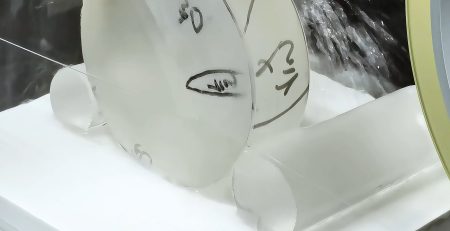
Corte de ZnSe con Precisión: La Ventaja del Hilo de Diamante en Bucle
- Seleniuro de zinc (ZnSe) es un cristal óptico infrarrojo blando, frágil que se agrieta fácilmente bajo mecanizado convencional.
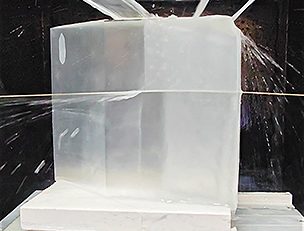
- El hilo en bucle de diamante corta ZnSe con baja fuerza y enfriamiento por agua, evitando daños térmicos y mecánicos. La forma de circuito cerrado es lo que separa a un bucle de alambre de diamante de una sierra enrollada.
- El proceso ofrece superficies lisas en lentes y ventanas de ZnSe con un mínimo de astillado.
En el exigente mundo de la óptica infrarroja, componentes láser, y sistemas láser de CO₂ de alta potencia, Seleniuro de Zinc (ZnSe) se mantiene como un material crítico. Valorado por sus excepcionales propiedades de transmisión en el espectro infrarrojo medio a lejano y su durabilidad como ventana o lente láser, ZnSe permite tecnologías desde imágenes térmicas hasta corte láser industrial. Sin embargo, para ingenieros y fabricantes, este material invaluable presenta una paradoja formidable: es relativamente blando pero notoriamente frágil. Esta combinación hace que el mecanizado y, in particular, el corte de precisión de ZnSe sean uno de los desafíos más significativos en la fabricación de fotónica.
Los métodos de corte tradicionales a menudo conducen a una cascada de problemas de calidad: astillado de bordes inaceptable, microgrietas latentes que comprometen la integridad estructural, y rugosidad de superficie inconsistente. Estos defectos no son meramente cosméticos; pueden degradar severamente el rendimiento óptico, introduce scattering losses, create stress points that lead to failure under thermal or mechanical load, and drastically reduce production yield and profitability.
This blog delves into the science behind these challenges and explores a transformative solution: Diamond Loop Wire Cutting with intelligent, multi-segment speed control. We will examine why ZnSe is so difficult to cut, how conventional methods fall short, and why the advanced kinematics of a continuous, vibration-minimized sierra de alambre de diamante, guided by adaptive speed algorithms, represents a breakthrough in achieving high-quality, reliable cuts for this delicate material.
The ZnSe Conundrum: Softness Meets Brittleness
To appreciate the cutting challenge, one must first understand the material properties of ZnSe. Unlike ductile metals that yield and deform, brittle materials like ZnSe, germanium, and silicon have a crystalline structure that absorbs energy elastically up to a point, then fails catastrophically through crack propagation.
- Softness (Low Knoop Hardness): ZnSe is soft enough to be scratched. During mechanical cutting, this softness leads to plowing, tearing, and increased friction, which generates heat and often results in a poor surface finish if the tool or method is not precisely suited.
- Extreme Brittleness (Baja tenacidad a la fractura): This is the core of the problem. Brittleness means ZnSe has very limited capacity to absorb energy by plastic deformation. Any stress concentration—from tool impact, vibración, or uneven force—exceeds the material’s fracture toughness, initiating micro-cracks. These cracks then propagate rapidly through the grain structure, leading to chipping or complete fracture.
Los modos de fallo primarios en el corte de ZnSe de baja calidad son resultados directos de este conflicto de propiedades:
- Astillado de bordes: Este es el defecto más visible. Ocurre en el punto donde la herramienta de corte entra o sale del material, o en puntos de alta concentración de tensión. Un astilla no es solo un pedazo faltante; crea un camino de luz irregular, puede ser una fuente de más grietas, y a menudo requiere un pulido adicional costoso para corregirlo, agregando pasos de proceso que no aportan valor.
- Micro-grietas subsuperficiales: A menudo invisibles al ojo desnudo, estos son los “asesinos ocultos” de los componentes ópticos. Inducidos por estrés mecánico o térmico excesivo durante el corte, las micro-grietas debilitan estructuralmente el componente. Bajo la alta densidad de potencia de un láser o ciclos térmicos, estas grietas pueden propagarse, llevando a fallos catastróficos en el campo. They act as light-scattering centers, reducing transmission efficiency.
- Surface Roughness Variability: An inconsistent cut leaves a surface with varying degrees of roughness. For an optical element, this variability causes non-uniform scattering and wavefront distortion. Achieving a predictable, fine surface finish directly from the cutting process is essential for reducing subsequent polishing time and cost. Transparent substrates set the same requirement, and the numbers are listed under Corte de vidrio óptico.
The Shortcomings of Conventional Cutting Methods
Manufacturers have historically grappled with several methods, each with significant trade-offs when applied to ZnSe:
- Abrasive Grinding/Sawing: Using diamond-impregnated blades or grinding wheels generates substantial mechanical force and heat. El contacto agresivo a menudo causa astillado masivo e introduce capas de daño subsuperficial profundas, requiriendo un post-procesamiento extensivo. La versión de hoja contra alambre de esa compensación se cuantifica en nuestra guía sobre corte de cerámicas de alúmina.
- Mecanizado Ultrasónico: Aunque útil para dar forma, puede ser lento para cortes completos y aún puede inducir microfracturas alrededor de la periferia de la herramienta debido a la acción por percusión.
- Corte por láser: Aunque es un método sin contacto, el calor localizado intenso de un láser puede crear una Zona Afectada por el Calor (ZAT). Para ZnSe, esto puede llevar a capas recocidas, cambios estequiométricos, grietas por estrés térmico, e incluso vaporización de selenio, alterando las propiedades ópticas del material en el borde. Comparámos directamente los dos métodos en nuestro análisis de corte por láser vs sierra de hilo de diamante.
- Sierras de Alambre Recíproco (p ej., usando un alambre de piano con lodo abrasivo): Este ha sido un método común. Sin embargo, el movimiento de vaivén del alambre crea vibración inherente y permite que el alambre se arquee. la inversión repetida al final de cada pasada introduce una carga de impacto, lo cual es un desencadenante principal para el astillado al entrar y salir en materiales frágiles. La gestión del lodo también es desordenada y puede llevar a tasas de corte inconsistentes Un bucle de alambre de diamante elimina completamente la inversión al cortar en una dirección. (enlace 2 de 2)
Quedó claro que se necesitaba un cambio de paradigma: un método que minimizara la inestabilidad dinámica, aplicara fuerza de manera consistente, y pudiera adaptarse de manera inteligente a las fases más críticas del corte.
La Revolución del Corte con Alambre de Bucle de Diamante: Una Solución Basada en Sistemas
El sistema de Corte con Alambre de Bucle de Diamante trasciende ser únicamente una nueva herramienta; es un sistema integrado diseñado desde cero para abordar la física fundamental de la falla de materiales frágiles. Sus ventajas son sistémicas:
1. El Continuo, Alambre de Diamante Sin Juntas:
Imagina reemplazar una hoja de sierra recíproca con una banda perfectamente continua, sin costuras. El alambre impregnado de diamante en este sistema es precisamente eso: un lazo cerrado. Esta única característica elimina los microimpactos y los picos de vibración inherentes a los sistemas recíprocos cuando el alambre cambia de dirección. La ausencia de juntas o puntos de conexión asegura una abrasión de corte y distribución de diamante perfectamente uniforme a lo largo de toda la longitud del alambre, lo que conduce a una estabilidad excepcional. El alambre se ejecuta en rodillos con ranuras de zafiro o diamante guiados con precisión, manteniendo una tensión consistente y un camino de corte verdadero, lo cual es vital para lograr rectitud y minimizar la pérdida por corte.
2. La genialidad del control de velocidad multi-segmento:
Este es el verdadero “cerebro” del sistema. Reconociendo que el estrés de corte no es uniforme a lo largo del espesor del material, el software del sistema permite perfiles de velocidad programables. Esto es un avance crítico para manejar la fractura frágil:
Fase de entrada (Baja velocidad): Cuando el alambre primero contacta con el borde prístino de la pieza de ZnSe, es más vulnerable a la exfoliación y la iniciación de grietas. El sistema está programado para operar a velocidad reducida. Esta entrada a baja velocidad minimiza el choque mecánico y térmico inicial, permitiendo que el grano de diamante comience a cortar limpiamente sin sobrepasar la tenacidad a la fractura del material.
Fase de estado estable (Alta velocidad): Once the cut is fully established and the wire is engaged along its full diameter within the kerf, the system intelligently ramps up to an optimized high speed. This maximizes cutting efficiency and throughput through the bulk of the material without sacrificing quality, as the cutting process is now stabilized.
Exit Phase (Baja velocidad): The moment before breakthrough is another critical point of failure. As the supporting material behind the cutting front diminishes, the unsupported edge becomes fragile again. The system dynamically reduces the speed once more just before exit. This gentle finish prevents the wire from “plucking out” a final chunk of material, which is the primary cause of exit-side chipping.
This intelligent, three-stage speed management directly targets and mitigates the root causes of chipping at both surfaces.
3. Constant Wire Tension & Coolant Integration:
The system maintains ultra-stable wire tension via servo-controlled mechanisms. Any slack or variation in tension would translate directly into waviness or chatter marks on the cut surface. Además, a precisely filtered coolant is delivered directly to the cutting zone. This serves a dual purpose: it efficiently removes debris (virutas) from the kerf to prevent recutting and drag, and it provides critical thermal management, dissipating the minimal frictional heat generated to ensure a truly cool-cutting process that leaves the material’s properties unchanged.
Quantifiable Benefits for Photonics Manufacturing
Adopting a Diamond Loop Wire System with multi-segment control translates into direct, measurable operational and product advantages:
- Dramatically Reduced Edge Chipping: Chipping can be reduced to sub-10 micron levels, often making the as-cut edge suitable for final application with minimal or no edge preparation. This directly boosts yield.
- Elimination of Subsurface Damage: The cool, stable, low-vibration process minimizes the introduction of micro-cracks. This results in components with higher intrinsic strength, longer service life, and superior laser damage thresholds—a critical metric for high-power applications.
- Exceptional & Repeatable Surface Finish: Rugosidad de la superficie (Ra) values of better than 0.5 µm are consistently achievable directly from the cut. This repeatability reduces dependence on operator skill and ensures every batch meets specification. Harder substrates reach similar repeatability, por lo que corte de carburo de silicio has moved the same way.
- Material Savings and Design Freedom: The thin, consistent kerf of the diamond wire (often comparable to a human hair) minimizes material waste—a crucial factor when working with expensive substrates like ZnSe. It also enables the precision cutting of complex, delicate shapes that were previously considered too risky or impossible. Kerf economics are even tighter at production scale, as our corte de obleas de silicio guide shows.
- Streamlined Production Flow: By delivering a near-net-shape part with excellent edge and surface quality, the system drastically reduces or even eliminates costly and time-consuming secondary processes like rough grinding and extensive edge chamfering. This shortens lead times and lowers total cost of ownership.
Conclusión: A New Standard for Precision
The cutting of brittle infrared materials like Zinc Selenide is no longer an art reliant on trial, error, and extensive rework. With the advent of Diamond Loop Wire Cutting systems equipped with adaptive multi-segment speed control**, it has become a precise, repeatable, and predictable engineering science.
This technology directly attacks the failure modes of brittle materials by replacing impact and vibration with stability and intelligent control. For manufacturers of infrared optics, componentes láser, and advanced semiconductor devices, it represents more than just an equipment upgrade—it is a strategic investment in higher yields, superior product reliability, and the capability to push the boundaries of optical design. In the quest for perfect cuts, the continuous, smart wire has set a new standard.
Preguntas Frecuentes
What is ZnSe used for?
Zinc selenide is an infrared optical material used for CO2 laser lenses, IR windows, and thermal-imaging optics thanks to its broad infrared transparency.
Why is ZnSe difficult to cut?
It is soft yet brittle and sensitive to both mechanical stress and heat, so conventional sawing and laser cutting easily cause cracks, las astillas, and thermal damage.
Shops specifying equipment for optical crystals can compare architectures in our Máquina cortadora de sierra de hilo de diamante overview.
How does diamond loop wire cutting help with ZnSe?
The continuous diamond-coated loop cuts with very low, uniform force under water cooling, producing smooth surfaces with minimal chipping and no heat-affected zone.
Can ZnSe be machined dry?
Dry machining risks overheating and micro-cracking; water-cooled diamond wire cutting is strongly preferred for dimensional parts.
Continuous coolant delivery is standard on the de corte de vidrio óptico range for exactly this reason.
Contenido técnico revisado por el equipo de ingeniería de Ensoll — un fabricante de bucles de hilo de diamante con 10+ años de experiencia en producción.