極端な工業用途向けホウケイ酸ガラス
材料科学の世界では, ガラスはしばしば壊れやすいものとして固定観念化される, 繊細で, 敏感であると見なされる. これは家庭の窓ガラスや飲料ボトルに使われる一般的なソーダ石灰ガラスには当てはまるかもしれないが, この制約を克服するために特別に設計されたエリートクラスの工業用ガラスが存在する: ホウケイ酸ガラス.
- ホウケイ酸ガラスは標準的なガラスの配合の一部を約 13% 酸化ホウ素 (おおよそ 81% シオ2), 置き換えることで、ソーダ石灰ガラスよりもより緻密で, より相互に結合した原子ネットワークを形成する.
- その三つの定義的特徴は: 優れた熱衝撃抵抗 (線膨張係数が約 3.3 x 10^-6/K, 通常のガラスの約三分の一), ほぼ完全な化学的不活性、, そして高い機械的強度と硬度である.
- 化学および医薬品の処理におけるゴールドスタンダードであり, 防爆照明用エンクロージャにも使用される, aerospace windows and precision metrology plates.
- Machining it is the bottleneck: thick blades cause micro-chipping, waste up to 1.5 mm of expensive material per slice, and friction heat can still produce subsurface damage.
- Diamond wire loops solve this with high-speed micro-grinding at 30-50 メートル/秒: virtually zero-chipping edges, an ultra-thin 0.25-0.35 mm kerf, and near pre-polished as-cut surfaces that reduce or skip secondary finishing.
From the highly volatile environments of chemical processing plants and explosion-proof lighting sectors to the pristine laboratories of pharmaceutical giants, borosilicate glass is the gold standard. It is a material trusted where failure is not an option.
But what makes this specific glass formulation so resilient? And how do manufacturers shape and slice this ultra-tough ceramic material into high-precision industrial components without destroying its structural integrity?
この包括的なガイドでは, we will break down the science behind borosilicate glass, its primary industrial applications, and the advanced machining technologies required to process it.
Borosilicate is more thermal-shock resistant than the optical grades, but the machine settings carry over directly from 光学ガラス切断.
What is Borosilicate Glass? The Chemistry of Resilience
Standard glass is primarily made of silica, soda, and lime. Borosilicate glass alters this fundamental recipe by substituting a significant portion of the ingredients with boron trioxide ($B_2O_3$). Typically, a high-quality industrial borosilicate glass (such as Borofloat® or Pyrex®) consists of roughly 81% silica ($SiO_2$) そして 13% 酸化ホウ素.
This chemical modification completely rearranges the material’s atomic matrix. The introduction of boron creates a tighter, more interconnected polymeric network. This unique molecular architecture grants borosilicate glass its three defining industrial characteristics:
1. Exceptional Thermal Shock Resistance
The standout feature of borosilicate glass is its incredibly low Coefficient of Thermal Expansion (CTE). At approximately $3.3 \times 10^{-6}\テキスト{ K}^{-1}$, its expansion rate is about one-third that of ordinary soda-lime glass.
When ordinary glass is exposed to sudden temperature spikes, different areas of the material expand at different rates, creating internal stress that leads to immediate shattering. Borosilicate glass expands so minutely and evenly that it can transition from freezing cold to scorching heat without cracking.
2. High Chemical Durability and Hydrolytic Resistance
Borosilicate glass is virtually chemically inert. It resists water, acids, salt solutions, organic substances, and halogens. Even during prolonged exposure to aggressive chemicals at elevated temperatures, its surface remains uncorroded and unclouded. This prevents any chemical leaching, preserving the absolute purity of whatever substance it contains.
3. High Mechanical Strength and Hardness
With a high Mohs hardness rating and a high modulus of elasticity, borosilicate glass is mechanically tougher than standard glass. It resists scratching, withstands higher impact forces, and maintains its geometric stability under heavy structural loads.
Key Industrial Applications of Borosilicate Glass
Because of its relentless durability, borosilicate glass is deployed across a vast spectrum of heavy industries:
Chemical and Pharmaceutical Processing: Used for industrial pipelines, distillation columns, reaction vessels, and high-visibility sight glasses. Its chemical inertness ensures that pharmaceutical compounds remain untainted during synthesis.
High-Intensity Lighting and Explosion-Proof Enclosures: Commonly found in heavy-duty floodlights, stage lighting, and hazardous area viewports where high-wattage bulbs generate intense, localized thermal energy.
Aerospace and Defense: Utilized in optical windows for high-altitude aircraft, satellite components, and thermal imaging viewports that must survive rapid atmospheric pressure and temperature shifts.
Home Appliances and Metrology: From high-end oven doors and microwave trays to precision optical flat plates used in industrial calibration laboratories.
The Precision Cutting Hurdle: Machining a Hard Ceramic
While the extreme hardness and brittleness of borosilicate glass make it a phenomenal end-product, they make the initial manufacturing and raw-material slicing stages incredibly challenging.
Traditional cutting methods—such as CNC milling tools, high-pressure waterjets, or thick abrasive grinding wheels—frequently run into costly bottlenecks when processing high-purity borosilicate plates:
- Micro-Chipping and Edge Breakage: Because the material has zero plasticity, the high localized impact force of a traditional thick blade shears the glass violently, causing severe micro-fractures and chipping along the exit cut.
- Severe Raw Material Waste: Industrial-grade borosilicate glass ingots are expensive to produce. Thick cutting blades can easily grind away up to $1.5\text{ ミリメートル}$ of material per slice into useless waste slurry.
- Thermal Stress Fractures: Ironically, even though borosilicate handles thermal shock exceptionally well, the massive friction heat generated by slow, heavy grinding blades can still exceed localized tolerances, resulting in sub-surface damage (SSD).
The Modern Manufacturing Solution: Endless Diamond Wire Loops
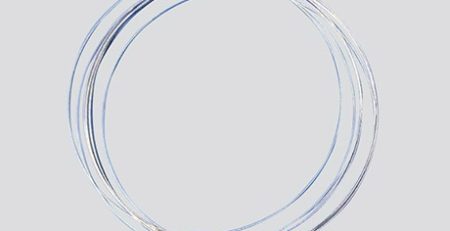
To solve these high-precision manufacturing bottlenecks, advanced glass fabrication facilities have transitioned to a revolutionary micro-grinding technology: the endless ダイヤモンドワイヤーループ.
An エンドレスダイヤモンドワイヤーループ is an ultra-thin, high-tensile steel wire welded into a continuous, seamless ring, with its outer surface permanently electroplated with microscopic industrial diamond abrasives. Unlike legacy open-loop wire saws that must constantly decelerate, stop, and reverse direction, the endless wire loop rotates continuously in a single direction at staggering linear velocities—often between $30\text{ メートル/秒}$ and $50\text{ メートル/秒}$.
This continuous, high-speed one-way motion completely redefines the mechanics of cutting brittle borosilicate glass:
1. Zero-Chipping through Micro-Grinding
Because the wire moves at such immense speeds, the contact force between each individual diamond crystal and the glass is reduced to a microscopic level. Instead of fracturing or shearing the glass, the endless loop performs a high-speed micro-grinding action. This eliminates the mechanical shock associated with traditional sawing, resulting in razor-sharp, crisp edges with virtually zero chipping or micro-cracking.
2. Maximizing Material Yield (Ultra-Thin Kerf)
Because an endless wire loop maintains exceptional stability under high tension without vibrating or bucking, the core steel wire can be engineered to be incredibly thin—frequently down to just $0.25\text{ ミリメートル}$ to $0.35\text{ ミリメートル}$. This extraordinarily narrow cutting path minimizes kerf loss. For high-volume manufacturing lines, saving fractions of a millimeter on every single cut scales up to thousands of dollars in salvaged raw material over a single production run.
3. Near Pre-Polished Surface Quality
The continuous, steady tension of a closed-loop system entirely eliminates the “saw marks” and deep surface gouges typical of reciprocating blades. The resulting surface roughness ($R_a$) is phenomenally low. For industrial components like sight glasses or optical windows, this clean “as-cut” surface finish drastically cuts down—or completely replaces—the time and labor required for secondary fine-grinding and polishing stages.
結論: Engineering the Future of Industrial Optics
As industries push toward higher automation, tighter geometric tolerances, and more demanding operational environments, the role of premium materials like borosilicate glass will only expand. しかし, the true value of this material is only unlocked when it can be machined with the same level of precision that went into its chemical formulation.
By embracing advanced cutting technologies like the endless ダイヤモンドワイヤーループ, modern manufacturing engineers are successfully overcoming the historical challenges of ceramic brittleness. This perfect pairing of material science and mechanical engineering ensures that from the lab bench to the launching pad, our most critical high-tech systems remain clearly focused and securely protected.
よくある質問
What is borosilicate glass made of?
A high-quality industrial borosilicate glass consists of roughly 81% silica (シオ2) そして 13% 酸化ホウ素 (B2O3). Substituting boron into the recipe rearranges the atomic matrix into a tighter polymeric network, which is the source of its thermal, chemical and mechanical advantages.
Why is borosilicate glass so resistant to thermal shock?
Its coefficient of thermal expansion is about 3.3 x 10^-6/K — roughly one third that of ordinary soda-lime glass. It expands so little and so evenly under sudden temperature swings that the internal stress which shatters ordinary glass never builds up.
What is the best way to cut borosilicate glass?
A diamond wire loop. The ultra-thin diamond-coated wire runs continuously in one direction at 30-50 m/s and micro-grinds the glass instead of shearing it, producing crisp edges with virtually zero chipping, a kerf of just 0.25-0.35 ミリメートル, and a surface finish close to pre-polished.
How much material does conventional cutting waste on borosilicate glass?
Thick abrasive blades can grind away up to 1.5 mm of material per slice into waste slurry — costly on high-purity borosilicate ingots. A diamond wire loop’s 0.25-0.35 mm kerf cuts that loss dramatically, which scales into significant savings over a production run.
Ensollエンジニアリングチームによるレビュー.