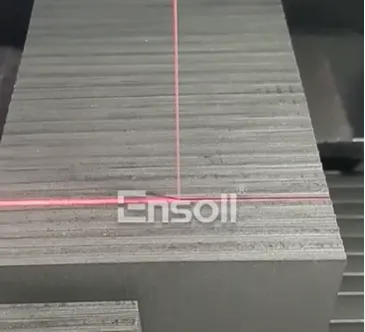
다이아몬드 와이어 vs 블레이드: 광학 유리 표면 테스트
- Controlled tests on 5 mm SCHOTT B270 유리는 다이아몬드 와이어 톱이 Ra를 달성함을 보여줍니다 0.18-0.22 micrometers versus Ra 0.55-0.75 for a diamond blade — about 60% lower surface roughness without polishing.
- Subsurface damage is the decisive gap: the blade generates 3-5 times more micro-cracks, and still shows cracks at 200 micrometers depth where the wire saw shows none — beyond the typical 100-150 micrometer polishing removal depth.
- Kerf loss is 0.25 mm for the wire versus 0.42 mm for the blade, saving about 17% of material per cut on 100 mm wafers.
- Wire-cut edges are mechanically stronger: Weibull modulus 18.7 versus 9.3, 25% higher fracture stress in four-point bending, 그리고 98% versus 72% yield on 100-micrometer thin glass.
- Blades still win on simple straight cuts (10-15% faster throughput), lower initial cost and easier training; wire saws win for precision optics, expensive materials and minimal post-processing.
In precision optical manufacturing, surface quality directly impacts component performance. 우리의 통제된 테스트는 보여준다:
– 끝없는 다이아몬드 와이어 톱은 달성한다 60% 더 낮은 표면 거칠기 (Ra 0.18µm) 블레이드 대비
– 블레이드 절단은 100µm 깊이에서 3-5배 더 많은 미부 표면 균열을 생성한다
– 와이어 톱 톱니 손실은 40% 더 좁다 (0.25mm 대비 0.42mm)
이 연구는 화이트라이트 간섭계와 SEM 이미징으로 분석한 SCHOTT B270 유리 샘플을 사용하여 이러한 차이를 정량화한다.
아래 표면 비교는 더 넓은 방법의 일부이다 광학 유리 절단.
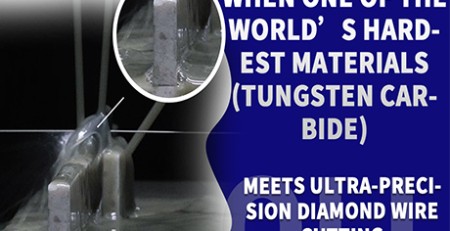
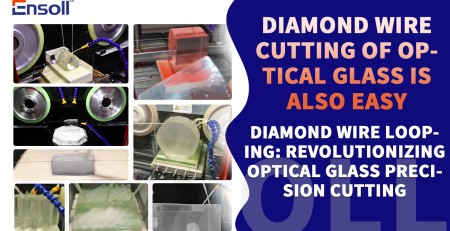
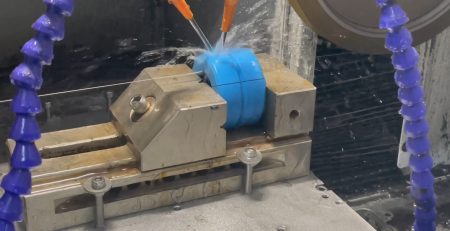
다이아몬드 와이어 절단 시연
테스트 방법론
1. 샘플 준비
재료: 5mm 두께 SCHOTT B270 광학 유리
절삭 매개 변수:
| 방법 | 속도 | 냉각수 | 힘 제어 |
| 무한 다이아몬드 와이어 | 20 엠/초 | 탈이온수 | 50N 상수 |
| 다이아몬드 블레이드 | 3,000 RPM | 유성 | 100N 서보 |
2. 측정 도구
표면 거칠기: Zygo NewView 9000 간섭계 (20X 대물렌즈)
하부 손상: 집속 이온 빔 (FIB) 단면 절단 + SEM
엣지 치핑: Nikon MM-400 측정 현미경
표면 품질 비교
1. 미세 표면 지형
[Surface comparison diagram showing wire saw’s uniform grooves vs blade’s irregular pits]
끝없는 다이아몬드 와이어 톱 결과:
– Directional striations (consistent 5-8µm spacing)
– Ra 0.18-0.22µm without polishing
– Peak-to-valley (태양광 발전) 1.2μm의
Diamond Blade Results:
– Random crater patterns from grit fracture
– Ra 0.55-0.75µm
– PV 3.8µm with deep tear-out zones
Key Insight: The wire saw’s continuous cutting motion creates predictable surface textures that require 50% less polishing time to achieve optical finishes.
2. Subsurface Damage Depth
| Measurement Depth | Wire Saw Crack Density (cracks/mm²) | Blade Crack Density |
| 50μm의 | 12 ± 3 | 48 ± 9 |
| 100μm의 | 5 ± 2 | 22 ± 6 |
| 200μm의 | 0 | 7 ± 3 |
Critical Finding: Blade cutting induces micro-cracks beyond the polishing removal depth (typically 100-150µm), risking long-term strength degradation.
5 Practical Implications
1. Optical Performance Impact
– Scatter Loss: Blade-cut surfaces show 3.2% wider light scatter in 632nm laser tests
– Wavefront Distortion: PVλ increases from λ/10 (wire) to λ/4 (잎) after polishing
2. Mechanical Strength
– Weibull Modulus:
– Wire-cut samples: m=18.7
– Blade-cut samples: m=9.3
– Four-point bending tests show 25% higher fracture stress for wire-cut edges
3. Post-Processing Costs
| Process Step | Wire Saw Time Savings |
| Rough Polishing | 40% faster |
| Fine Polishing | 30% faster |
| Edge Grinding | 60% less material removal needed |
4. Material Waste Reduction
– Kerf Comparison:
– 와이어: 0.25밀리미터 (80µm diamond + 170µm swarf)
– Blade: 0.42밀리미터 (300µm diamond + 120µm wobble)
– For 100mm wafers**: Wire saws save 17% material per cut
5. Thin Glass Handling
– 100µm thick glass test:
– Wire saw: 98% yield
– Blade: 72% yield (mostly edge fractures)
Technology Limitations
Endless Diamond Wire Saw Challenges
- Higher Initial Cost: 20-30% more expensive than blade systems
- Slower Setup: Requires tension calibration (15-20 분)
- Curve Cutting: Minimum radius limited to 5X wire diameter
Diamond Blade Advantages
- Faster Straight Cuts: 10-15% higher throughput for simple geometries
- Lower Skill Requirement: Easier operator training
- Legacy Compatibility: Fits existing CNC glass cutting platforms
Industry Case Study
Lens Manufacturer A (Switch from Blade to Wire Saw)
– Before: 14% rejection rate from subsurface cracks
– After:
– Rejection rate dropped to 3.2%
– Polishing slurry consumption decreased by 35%
– ROI achieved in 11 months
Selection Guide
Choose Endless Diamond Wire Saw When:
✓ Producing precision optics (λ/10 or better)
✓ Cutting expensive materials (예), OHARA S-BSL7)
✓ Minimizing post-processing is critical
Opt for Diamond Blade When:
✓ Budget constraints outweigh quality needs
✓ Processing >10mm thick glass blocks
✓ Only rough cutting
자주 묻는 질문
광학 유리에는 블레이드보다 다이아몬드 와이어 톱이 더 나은가요??
For surface quality, clearly yes: in the SCHOTT B270 test the wire saw produced Ra 0.18-0.22 마이크로미터 대 비교 0.55-0.75 for the blade, 와 3-5 times fewer subsurface cracks and a 40% 더 좁은 절단선. The blade remains 10-15% faster on simple straight cuts and cheaper to buy and operate.
How deep does subsurface damage go with blade cutting?
In the test, blade-cut glass still showed 7 +/- 3 cracks per square millimeter at 200 micrometers depth, while wire-cut glass showed zero. Because typical polishing removes only 100-150 마이크로미터, blade-induced cracks can survive polishing and degrade long-term strength.
How much material does a diamond wire saw save per cut?
The wire kerf is 0.25 mm versus 0.42 mm for a blade. On 100 mm wafers that difference saves about 17% of material per cut — significant when processing expensive optical glasses such as OHARA S-BSL7.
When does a diamond blade make more sense?
Choose a blade when budget constraints outweigh quality needs, when processing glass blocks thicker than 10 밀리미터, or when only rough cutting is required. Choose the wire saw for precision optics at lambda/10 or better, expensive materials, and whenever minimizing post-processing matters.
Ensoll 엔지니어링 팀의 검토.