극한 산업용 보로실리케이트 유리
재료 과학의 세계에서, 유리는 흔히 깨지기 쉽고, 섬세하며, 민감하다고 인식됩니다. While this might hold true for the standard soda-lime glass found in your kitchen windows or beverage bottles, there is an elite class of industrial glass engineered specifically to defy these limitations: Borosilicate Glass.
- Borosilicate glass replaces part of the standard glass recipe with about 13% boron trioxide (roughly 81% SiO2), creating a tighter, more interconnected atomic network than soda-lime glass.
- Its three defining traits: exceptional thermal shock resistance (CTE around 3.3 x 10^-6/K, about one third of ordinary glass), near-total chemical inertness, and higher mechanical strength and hardness.
- It is the gold standard for chemical and pharmaceutical processing, explosion-proof lighting enclosures, aerospace windows and precision metrology plates.
- Machining it is the bottleneck: thick blades cause micro-chipping, waste up to 1.5 슬라이스당 비싼 재료 mm, 와 마찰열은 여전히 표면 하부 손상을 일으킬 수 있다.
- 다이아몬드 와이어 루프는 고속 마이크로 연마로 이를 해결한다 30-50 엠/초: 사실상 칩이 거의 없는 가장자리, 초박형 0.25-0.35 mm 절단면, 2차 마감을 줄이거나 건너뛰는 사전 연마된 가공 표면.
화학 가공 공장과 폭발 방지 조명 분야의 매우 불안정한 환경에서부터 제약 거대 기업의 깨끗한 실험실까지, 붕규산 유리는 금본위. 실패가 허용되지 않는 신뢰받는 재료.
하지만 이 특정 유리 조성은 왜 그렇게 강인한가? 그리고 제조업체들이 이 초강인한 세라믹 재료를 어떻게 구조적 완전성을 파괴하지 않고 고정밀 산업 부품으로 성형하고 절단하는지?
이 종합 가이드에서, 붕규화 유리의 과학적 원리를 분석할 것이다, its primary industrial applications, and the advanced machining technologies required to process it.
Borosilicate is more thermal-shock resistant than the optical grades, but the machine settings carry over directly from 광학 유리 절단.
What is Borosilicate Glass? The Chemistry of Resilience
Standard glass is primarily made of silica, soda, and lime. Borosilicate glass alters this fundamental recipe by substituting a significant portion of the ingredients with boron trioxide ($B_2O_3$). 일반적으로, a high-quality industrial borosilicate glass (such as Borofloat® or Pyrex®) consists of roughly 81% silica ($SiO_2$) 그리고 13% boron trioxide.
This chemical modification completely rearranges the material’s atomic matrix. The introduction of boron creates a tighter, more interconnected polymeric network. 이 독특한 분자 구조는 보로실리케이트 유리에 세 가지 산업적 특성을 부여합니다:
1. 예외적인 내열 충격성
보로실리케이트 유리의 두드러진 특징은 매우 낮은 열팽창 계수입니다 (CTE). 약 $3.3 \10^{-6}\텍스트{ K}^{-1}$, 확장률은 일반 소다석회 유리의 약 3분의 1 정도입니다.
일반 유리가 갑작스러운 온도 변화에 노출되면, 재료의 다른 부분이 각각 다른 속도로 팽창하여, 내부 응력이 발생하고 즉시 파손됩니다. 보로실리케이트 유리는 팽창이 매우 작고 고르게 이루어져 차가운 온도에서 뜨거운 온도로 이동해도 균열이 발생하지 않습니다.
2. 높은 화학적 내구성과 가수분해 저항성
보로실리케이트 유리는 사실상 화학적으로 비활성입니다. 물, 산, 염 용액, 유기 물질, 할로겐에 저항합니다. Even during prolonged exposure to aggressive chemicals at elevated temperatures, 그 표면은 부식되지 않고 흐려지지 않는다. 이로 인해 어떤 화학 물질도 용출되지 않는다, 그 안에 담긴 물질의 절대적인 순도를 보존한다.
3. 높은 기계적 강도와 경도
모스 경도 등급이 높고 탄성 계수가 높아, 붕규산 유리는 일반 유리보다 기계적으로 더 강하다. 스크래치에 저항한다, 더 높은 충격력에도 견딘다, 무거운 구조 하중에서도 기하학적 안정성을 유지한다.
붕규산 유리의 주요 산업적 용도
그 끈질긴 내구성 때문에, 붕규산 유리는 광범위한 중공업 분야에서 사용된다:
화학 및 제약 처리: 산업용 배관, 증류탑, 반응기 용기, 고가시성 시각용 유리 등에 사용된다. 그 화학적 비활성성 덕분에 제약 화합물이 합성 중에 오염되지 않는다.
High-Intensity Lighting and Explosion-Proof Enclosures: Commonly found in heavy-duty floodlights, stage lighting, and hazardous area viewports where high-wattage bulbs generate intense, localized thermal energy.
Aerospace and Defense: Utilized in optical windows for high-altitude aircraft, satellite components, and thermal imaging viewports that must survive rapid atmospheric pressure and temperature shifts.
Home Appliances and Metrology: From high-end oven doors and microwave trays to precision optical flat plates used in industrial calibration laboratories.
The Precision Cutting Hurdle: Machining a Hard Ceramic
While the extreme hardness and brittleness of borosilicate glass make it a phenomenal end-product, they make the initial manufacturing and raw-material slicing stages incredibly challenging.
Traditional cutting methods—such as CNC milling tools, high-pressure waterjets, or thick abrasive grinding wheels—frequently run into costly bottlenecks when processing high-purity borosilicate plates:
- Micro-Chipping and Edge Breakage: Because the material has zero plasticity, the high localized impact force of a traditional thick blade shears the glass violently, causing severe micro-fractures and chipping along the exit cut.
- Severe Raw Material Waste: Industrial-grade borosilicate glass ingots are expensive to produce. Thick cutting blades can easily grind away up to $1.5\text{ 밀리미터}$ of material per slice into useless waste slurry.
- Thermal Stress Fractures: Ironically, even though borosilicate handles thermal shock exceptionally well, the massive friction heat generated by slow, heavy grinding blades can still exceed localized tolerances, resulting in sub-surface damage (SSD).
The Modern Manufacturing Solution: Endless Diamond Wire Loops
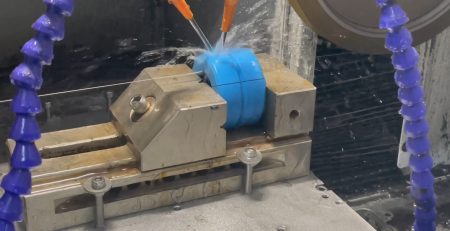
To solve these high-precision manufacturing bottlenecks, advanced glass fabrication facilities have transitioned to a revolutionary micro-grinding technology: the endless 다이아몬드 와이어 루프.
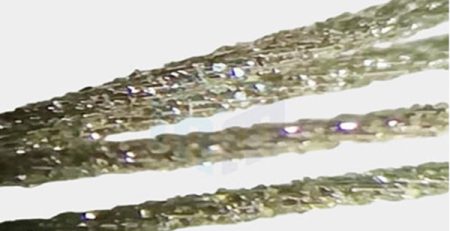
An 무한 다이아몬드 와이어 루프 is an ultra-thin, high-tensile steel wire welded into a continuous, seamless ring, with its outer surface permanently electroplated with microscopic industrial diamond abrasives. Unlike legacy open-loop wire saws that must constantly decelerate, stop, and reverse direction, the endless wire loop rotates continuously in a single direction at staggering linear velocities—often between $30\text{ 엠/초}$ and $50\text{ 엠/초}$.
This continuous, high-speed one-way motion completely redefines the mechanics of cutting brittle borosilicate glass:
1. Zero-Chipping through Micro-Grinding
Because the wire moves at such immense speeds, the contact force between each individual diamond crystal and the glass is reduced to a microscopic level. Instead of fracturing or shearing the glass, the endless loop performs a high-speed micro-grinding action. This eliminates the mechanical shock associated with traditional sawing, resulting in razor-sharp, crisp edges with virtually zero chipping or micro-cracking.
2. Maximizing Material Yield (Ultra-Thin Kerf)
Because an endless wire loop maintains exceptional stability under high tension without vibrating or bucking, the core steel wire can be engineered to be incredibly thin—frequently down to just $0.25\text{ 밀리미터}$ to $0.35\text{ 밀리미터}$. This extraordinarily narrow cutting path minimizes kerf loss. For high-volume manufacturing lines, saving fractions of a millimeter on every single cut scales up to thousands of dollars in salvaged raw material over a single production run.
3. Near Pre-Polished Surface Quality
The continuous, steady tension of a closed-loop system entirely eliminates the “saw marks” and deep surface gouges typical of reciprocating blades. The resulting surface roughness ($R_a$) is phenomenally low. For industrial components like sight glasses or optical windows, this clean “as-cut” surface finish drastically cuts down—or completely replaces—the time and labor required for secondary fine-grinding and polishing stages.
결론: Engineering the Future of Industrial Optics
As industries push toward higher automation, tighter geometric tolerances, 그리고 더 까다로운 운용 환경에서, 보로실리케이트 유리와 같은 고급 재료의 역할은 계속 확대될 것이다. 그렇지만, 이 재료의 진정한 가치는 화학적 조성에 투입된 동일한 수준의 정밀도로 가공할 수 있을 때에만 발휘된다.
Endless와 같은 첨단 절삭 기술을 수용함으로써 다이아몬드 와이어 루프, 현대 제조 엔지니어들은 세라믹 취성의 역사적 문제를 성공적으로 극복하고 있다. 재료 과학과 기계 공학의 완벽한 조합은 실험실 벤치에서 발사대까지, 우리의 가장 중요한 첨단 시스템이 명확하게 집중되고 안전하게 보호되도록 보장한다.
자주 묻는 질문
보로실리케이트 유리는 무엇으로 만들어지는가?
고품질 산업용 보로실리케이트 유리는 대략적으로 81% silica (SiO2) 그리고 13% boron trioxide (B2O3). Substituting boron into the recipe rearranges the atomic matrix into a tighter polymeric network, which is the source of its thermal, chemical and mechanical advantages.
Why is borosilicate glass so resistant to thermal shock?
Its coefficient of thermal expansion is about 3.3 x 10^-6/K — roughly one third that of ordinary soda-lime glass. It expands so little and so evenly under sudden temperature swings that the internal stress which shatters ordinary glass never builds up.
What is the best way to cut borosilicate glass?
다이아몬드 와이어 루프. The ultra-thin diamond-coated wire runs continuously in one direction at 30-50 m/s and micro-grinds the glass instead of shearing it, producing crisp edges with virtually zero chipping, a kerf of just 0.25-0.35 밀리미터, and a surface finish close to pre-polished.
기존의 절단 폐기물이 붕규산염 유리에서 얼마나 많은 재료를 갈아내는지?
두꺼운 연마 블레이드는 최대 갈아낼 수 있다 1.5 폐슬러리로 조각당 mm의 재료를 폐기 슬러리로 만드는 것이 고순도 붕규산 주괴에 비용이 많이 든다. 다이아몬드 와이어 루프는 0.25-0.35 mm 절단면이 그 손실을 극적으로 줄여준다, 이는 생산 기간 동안 상당한 절감으로 이어진다.
Ensoll 엔지니어링 팀의 검토.