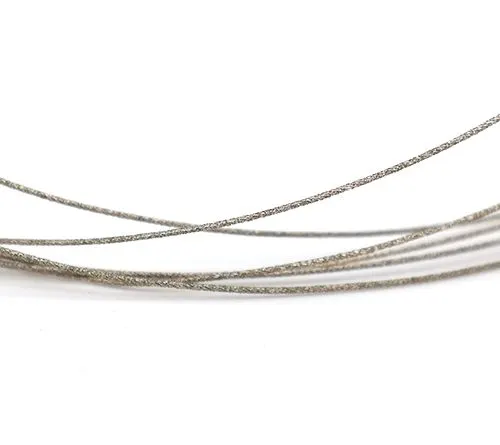
先进制造中的金刚线环
在现代工业制造的环境中, the ability to cleanly separate materials is a fundamental prerequisite for subsequent processing stages. As engineering applications evolve, the materials being utilized are becoming increasingly complex—ranging from ultra-hard crystalline structures to highly abrasive composites and fragile layered substrates. Traditional abrasive saws and thermal cutting methods frequently fail when facing these advanced compositions, often introducing structural defects or unacceptable material waste.
To overcome these manufacturing bottlenecks, industries worldwide have turned to the combination of high-performance diamond wire saw cutting machines and their essential, high-speed consumable: 金刚石钢丝环的运行寿命. By understanding the specific interaction between this endless abrasive loop and various material classes, production facilities can optimize their separation processes for maximum structural integrity.
—
The Universal Cutting Mechanism: Micro-Abrasive Friction
The operational success of the 金刚石线环 across vastly different material types lies in its fundamental physics. Rather than utilizing a sharp, wedge-like edge to shear through material (as seen in traditional metal saw blades) or relying on localized thermal energy to melt a path (as seen in laser or plasma cutting), the loop operates via a continuous micro-abrasive grinding process.
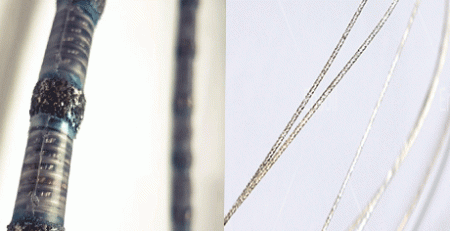
Because microscopic diamond particles are securely bonded to an endless, high-tensile steel core, the loop acts as a moving matrix of thousands of miniature grinding teeth. Driven by the motorized pulley system of a dedicated cutting machine, the loop travels continuously in a single direction at high linear velocities. When brought into contact with a workpiece, these diamond grains execute micro-fracturing and micro-plowing actions on the material’s surface, removing minuscule particles in the form of fine powder or chips. This mechanical action avoids imparting macro-forces or intense thermal stress to the workpiece, making it highly adaptable to a diverse spectrum of materials.
—
等级 1: 硬, Brittle Crystalline and Semiconductor Materials
Slicing hard and brittle substrates is perhaps the most critical and economically vital application for the diamond wire loop. Materials such as 单晶硅, 碳化硅 ($SiC$), 氮化镓 ($GaN$), and sapphire form the backbone of the semiconductor, power electronics, and optics industries.
Overcoming Chipping and Cracking
The inherent challenge with these crystals is their extreme hardness combined with low fracture toughness. Under traditional sawing methods, the vibration and heavy mechanical load cause severe edge chipping, sub-surface damage, and micro-cracking, which can ruin the electrical or optical properties of the entire wafer.
The Unidirectional Advantage
闭环系统的连续, smooth rotation of the diamond wire loop eliminates the harsh shocks associated with reciprocating systems. 切割机以稳定的线张力和程序化的进给速度引导切割环, 允许金刚石砂粒轻柔磨损坚硬的晶体结构. 这确保晶格在切割表面下保持完全不受干扰, 产生几乎完美的毛坯,后续修整需求极少.
—
等级 2: 先进技术陶瓷与玻璃
工程陶瓷——包括氧化铝, 氧化锆, 氮化硅, 以及碳化硼——因其卓越的耐磨性而在航空航天和工业领域受到青睐, 热稳定性, 和硬度自动调整切割参数. 同样地, 光学玻璃, 石英, 而熔融石英是高端科学仪器的基础.
传统刀具的问题
由于技术陶瓷专为抵抗机械磨损而设计, 它们会快速使传统切削刀片钝化. 此外, their brittle nature makes them highly susceptible to catastrophic cracking during machining.
Consistent Abrasive Refreshing
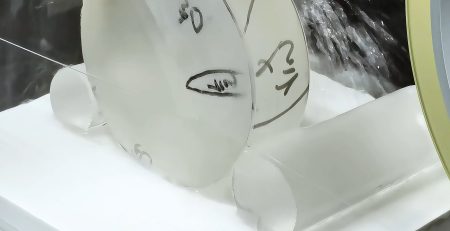
When a diamond wire loop cuts through technical ceramics or 光学玻璃, the machine’s cooling and flushing system plays a dual role. It removes the highly abrasive ceramic swarf from the cutting zone and controls the localized friction. As the loop rotates, the diamond particles consistently degrade the ceramic surface. Because the wear is distributed evenly across the entire length of the endless loop, the tool maintains a sharp, aggressive cutting profile throughout the operation, preventing tool glazing and ensuring a continuous, fluid separation.
—
等级 3: Soft, 弹性, and Composite Materials
While it is intuitive that a diamond tool can cut hard substances, the diamond wire loop is equally effective when processing soft, gummy, or heterogeneous materials. This category includes heavy rubber, multi-layered vehicle tires, graphite anodes, reinforced carbon fibers, and insulation materials.
Preventing Material Deformation and Binding
When cutting elastic materials like rubber or polymer composites with standard blades, the material tends to deform under the blade’s pressure, creating massive friction, 热, and eventual binding (where the blade gets trapped). For composite materials like carbon fiber, traditional sawing causes severe delamination and fraying of the structural fibers.
Clean Matrix Dissociation
The ultra-high speed of the diamond wire loop ensures that the diamond particles interact with the soft or composite material faster than the material can elastically deform. In composites, the diamonds cleanly sever both the hard carbon fibers and the soft resin matrix simultaneously, achieving a perfectly clean cross-section without pulling the fibers apart or melting the polymer binder. For rubber and tires, the loop easily transitions from the elastic outer rubber layers directly through the embedded steel reinforcement belts without requiring a change in tooling or introducing mechanical imbalance.
—
Optimizing the Consumable-Machine Synergy for Specific Materials
To achieve optimal results across these varied material classes, production engineers must treat the 金刚石绳锯切割机 and the diamond wire loop consumable as an interconnected ecosystem, adjusting the parameters based on the specific material profile:
For Ultra-Hard Materials: The machine is programmed for a highly controlled, conservative downward feed rate combined with maximum wire linear velocity. This allows the micro-abrasive diamonds to work efficiently without overloading the core wire’s tensile strength. A continuous flow of liquid coolant is mandatory to flush away dense swarf and maintain thermal equilibrium.
For Soft or Porous Materials: Certain materials, such as graphite or specific insulation foams, can absorb liquids or become contaminated by wet cutting. For these applications, the loop is run in a completely dry environment. The cutting machine is often paired with a specialized dust extraction system to capture the fine particulates immediately as they are generated by the loop.
—
结论
From the rigid, unforgiving atomic structures of semiconductor crystals to the flexible, multi-layered matrices of reinforced rubber, the diamond wire loop has proven to be an indispensable asset in modern industrial separation. By relying on a continuous, low-stress, micro-abrasive cutting mechanism rather than blunt force or heat, this advanced consumable—when paired with a precision cutting machine—allows manufacturers to conquer the challenges of material variety, ensuring clean, 可预测的, and structurally sound results across every application.